
It’s 7:15 on a Tuesday morning in Gallatin, and Sarah is walking her daughter to the corner where the school bus will arrive. They pass neighbors loading into SUVs, engines already running. A few blocks over, someone’s backing out of a driveway, coffee mug in the cupholder, headed toward the interstate. This is how most mornings unfold here—not with train schedules or bus transfers, but with car keys and departure times calibrated to beat the worst of the traffic. For families moving to Gallatin, understanding this rhythm matters more than any transit map ever could.
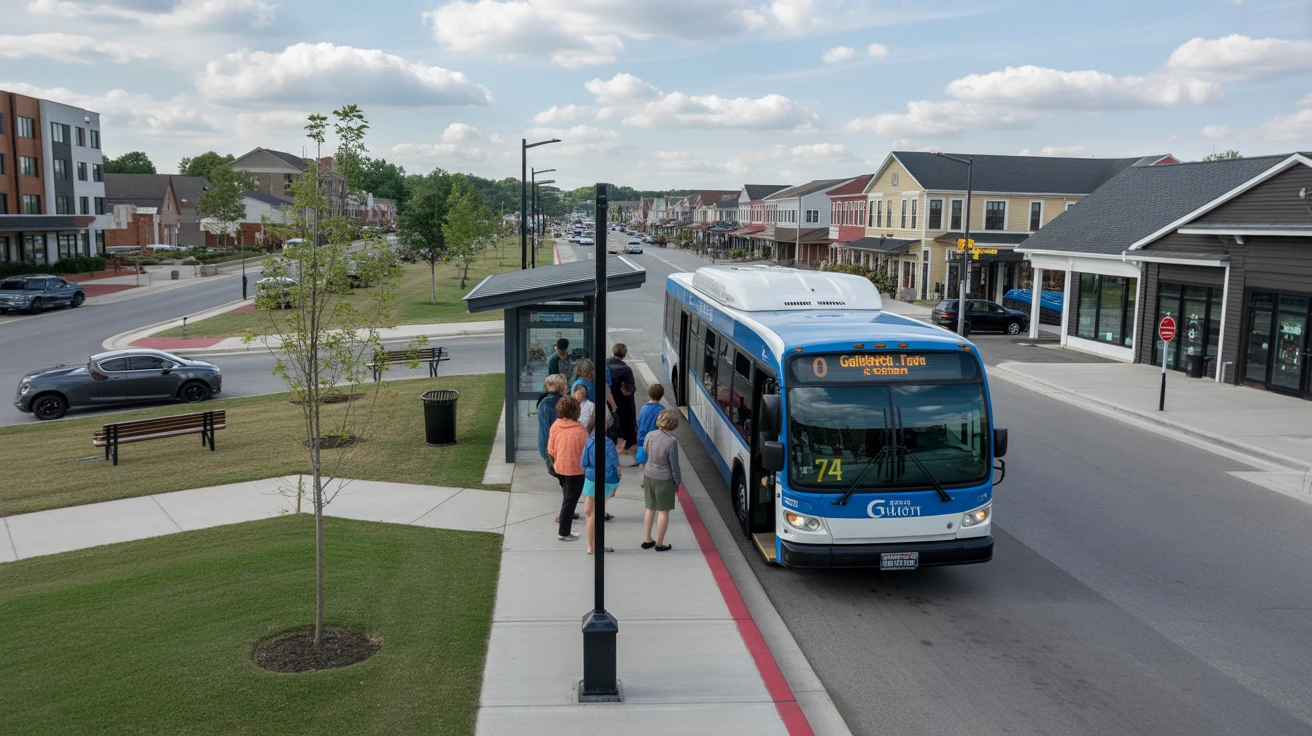
How People Get Around Gallatin
Transportation options in Gallatin are shaped by the city’s layout and infrastructure, which prioritize personal vehicles over other modes. The street network is built for driving, with limited pedestrian paths and minimal infrastructure for alternative transportation. Most residents depend on cars for daily errands, work commutes, and household logistics. This isn’t a matter of preference—it’s a structural reality rooted in how the city has developed over time.
Newcomers often assume that proximity to Nashville means access to regional transit options, but Gallatin functions as a car-first environment. The infrastructure that supports walking, biking, or public transit simply doesn’t exist at a scale that changes how most people move through their day. Grocery stores, schools, medical appointments, and workplaces are distributed in ways that make driving the default, and often the only practical, choice.
The average commute in Gallatin takes 26 minutes, and more than two out of five workers face longer trips. With only 9.4% working from home, the vast majority of residents are on the road daily. That pattern—combined with sparse food and grocery access—means that even routine errands require a car. There’s no fallback system that makes car-free living viable for most households.
Public Transit Availability in Gallatin
Public transit plays a minimal role in Gallatin’s transportation landscape. Infrastructure analysis reveals no detectable bus stops, rail stations, or transit service coverage within the city. For residents expecting even limited transit as a backup option, this absence is a defining constraint.
In cities where transit exists, it typically serves dense corridors, employment centers, or areas with mixed-use development. Gallatin’s development pattern—low-density residential zones separated from commercial areas—doesn’t support the kind of ridership or route efficiency that sustains public transportation. Even if service were introduced, the distances involved and the dispersed destinations would limit its usefulness for most daily trips.
This isn’t a gap that’s easily closed. Transit viability depends on density, land-use mix, and pedestrian infrastructure—all of which are currently below the thresholds needed to make service practical. Residents who rely on transit in their current city will find that Gallatin requires a fundamental shift in how they think about mobility.
Driving & Car Dependence Reality
In Gallatin, car ownership isn’t optional—it’s the foundation of daily life. The city’s infrastructure is designed around driving, and nearly every aspect of household logistics assumes access to a personal vehicle. Grocery shopping, school drop-offs, medical appointments, and commuting all require a car. There’s no workaround that doesn’t involve significant inconvenience or isolation.
Parking is generally abundant and free, which removes one of the friction points that makes driving costly in denser cities. But the tradeoff is distance. Errands that might be a ten-minute walk elsewhere become a ten-minute drive here, and those trips add up. The layout of Gallatin—residential neighborhoods separated from commercial zones—means that even nearby destinations require getting in the car.
For households with multiple workers or complex schedules, this creates logistical pressure. A single-car household faces coordination challenges that don’t exist in places with transit or walkable access. Two-car households avoid that friction, but they also absorb the fixed costs of insurance, maintenance, and depreciation on both vehicles. The flexibility that driving provides comes with a baseline cost structure that’s hard to reduce.
Commuting Patterns & Daily Mobility
Most workers in Gallatin commute alone by car, often to jobs in Nashville or surrounding areas. The 26-minute average commute masks significant variation—41.5% of workers experience longer trips, and those extended commutes shape daily routines in ways that go beyond time spent in the car. Departure windows narrow, childcare logistics tighten, and the margin for delays shrinks.
Commutes here are rarely single-purpose trips. Parents drop kids at school before heading to work. Workers stop for gas or groceries on the way home. The car becomes the hub of daily logistics, and the commute becomes a multi-stop sequence rather than a direct route. That pattern works when schedules align, but it creates vulnerability when they don’t.
Remote work offers an escape from this structure, but only 9.4% of Gallatin workers have that option. For the rest, the commute is a fixed daily obligation, and the lack of alternatives means there’s no flexibility when circumstances change—no bus to catch if the car breaks down, no carpool lane to rely on during repairs, no backup that doesn’t involve borrowing a vehicle or missing work.
Who Transit Works For — and Who It Doesn’t
Transit, in the traditional sense, doesn’t work for anyone in Gallatin because the infrastructure doesn’t exist. But it’s worth understanding who would benefit if it did—and who faces the most friction under the current car-dependent model.
Households with school-age children benefit from strong educational infrastructure and playground access, but they still need a car for nearly everything else. Families manage by coordinating schedules, sharing vehicles, and planning trips in advance. It’s a system that works when everyone’s healthy, employed, and on schedule—but it’s brittle when disruptions occur.
Single-car households face the most acute tradeoffs. If one partner works outside Gallatin and the other needs the car for errands or childcare, the logistics become a daily negotiation. There’s no transit to fill the gap, no walkable grocery store to reduce car dependency, and no easy workaround that doesn’t involve asking neighbors for rides or delaying tasks until the car is available.
Non-drivers—whether by choice, age, or circumstance—experience Gallatin as isolating. Without transit or pedestrian-friendly infrastructure, independence requires either access to a car or reliance on others. That’s a significant constraint for retirees, young adults, or anyone whose life circumstances make driving difficult or impossible.
Transportation Tradeoffs in Gallatin
The tradeoff in Gallatin isn’t between transit and driving—it’s between accepting car dependence or choosing a different place to live. Driving offers control, flexibility, and access to the full range of services and employment in the region. But it also locks households into fixed costs and logistical complexity that can’t be reduced without changing where you live or how you work.
There’s no middle ground here. You can’t rely on transit part-time or walk to the grocery store when the weather’s nice. The infrastructure doesn’t support partial car dependence. Either you have a car and can participate fully in daily life, or you don’t and face significant barriers to independence.
For households evaluating Gallatin, this clarity is useful. There’s no ambiguity about what’s required. The question isn’t whether you’ll need a car—it’s whether the housing affordability, school quality, and community character justify the transportation structure that comes with it. For many families, especially those prioritizing space and stability, the answer is yes. But it’s a package deal, and the car dependence is part of the package.
FAQs About Transportation in Gallatin (2026)
Is public transit usable for daily commuting in Gallatin?
No. Gallatin lacks detectable public transit infrastructure, including bus routes and rail service. Daily commuting requires a personal vehicle, and there’s no transit system to serve as a backup or alternative.
Do most people in Gallatin rely on a car?
Yes. The city’s infrastructure is built for driving, and nearly all daily activities—commuting, errands, school runs, medical appointments—require a car. Car ownership is effectively mandatory for independent living here.
Which areas of Gallatin are easiest to live in without a car?
None. Even areas with moderate grocery density still lack pedestrian infrastructure and transit access. No neighborhood in Gallatin supports car-free living in a practical sense.
How does commuting in Gallatin compare to nearby cities?
Gallatin’s 26-minute average commute is moderate, but the lack of transit options means all commuting happens by car. Nearby cities with transit infrastructure offer flexibility that Gallatin doesn’t, even if average commute times are similar.
What happens if my car breaks down in Gallatin?
Without transit or walkable access to services, losing access to a car creates immediate logistical challenges. Most households rely on borrowing a vehicle, ride-sharing, or delaying activities until repairs are complete. There’s no public infrastructure to fill the gap.
How Transportation Fits Into the Cost of Living in Gallatin
Transportation in Gallatin isn’t just a line item—it’s a structural factor that shapes housing decisions, time allocation, and household flexibility. The car dependence here means that transportation costs are largely fixed. You can’t reduce them by taking the bus more often or walking to the store. The baseline requirement is vehicle ownership, and the costs that come with it—insurance, maintenance, fuel, depreciation—are unavoidable.
That structure affects what a budget has to handle in Gallatin. Housing may be more affordable than in Nashville, but the savings are offset by the necessity of owning and maintaining at least one vehicle, often two. Families evaluating Gallatin need to account for that reality upfront, not as an optional expense but as a prerequisite for living here.
The tradeoff is clarity. There’s no ambiguity about what’s required, no complex transit fare structures to navigate, and no uncertainty about whether a neighborhood will support your transportation needs. Gallatin works for households that accept car dependence as part of the deal—and for those households, the city offers space, stability, and strong family infrastructure. But the transportation model is non-negotiable, and understanding that upfront is the first step toward making a confident decision about whether Gallatin fits your life.
How this article was built: In addition to public economic data, this article incorporates location-based experiential signals derived from anonymized geographic patterns—such as access density, walkability, and land-use mix—to reflect how day-to-day living actually feels in Gallatin, TN.