
Is Farmington the kind of place you grow roots—or just pass through? That depends less on what the town offers and more on what you need from daily life. Farmington presents as affluent, orderly, and green—a place where healthcare access is strong, income is high, and the landscape feels carefully maintained. But beneath that polished surface, the structure of everyday logistics tells a more nuanced story. Walkability exists in pockets, not as a system. Errands require planning and a car. Family infrastructure—schools, playgrounds, kid-centered density—registers as surprisingly thin for a town of this income level. The vibe here rewards people who value space, quiet, and financial stability over spontaneity, density, or car-free convenience.
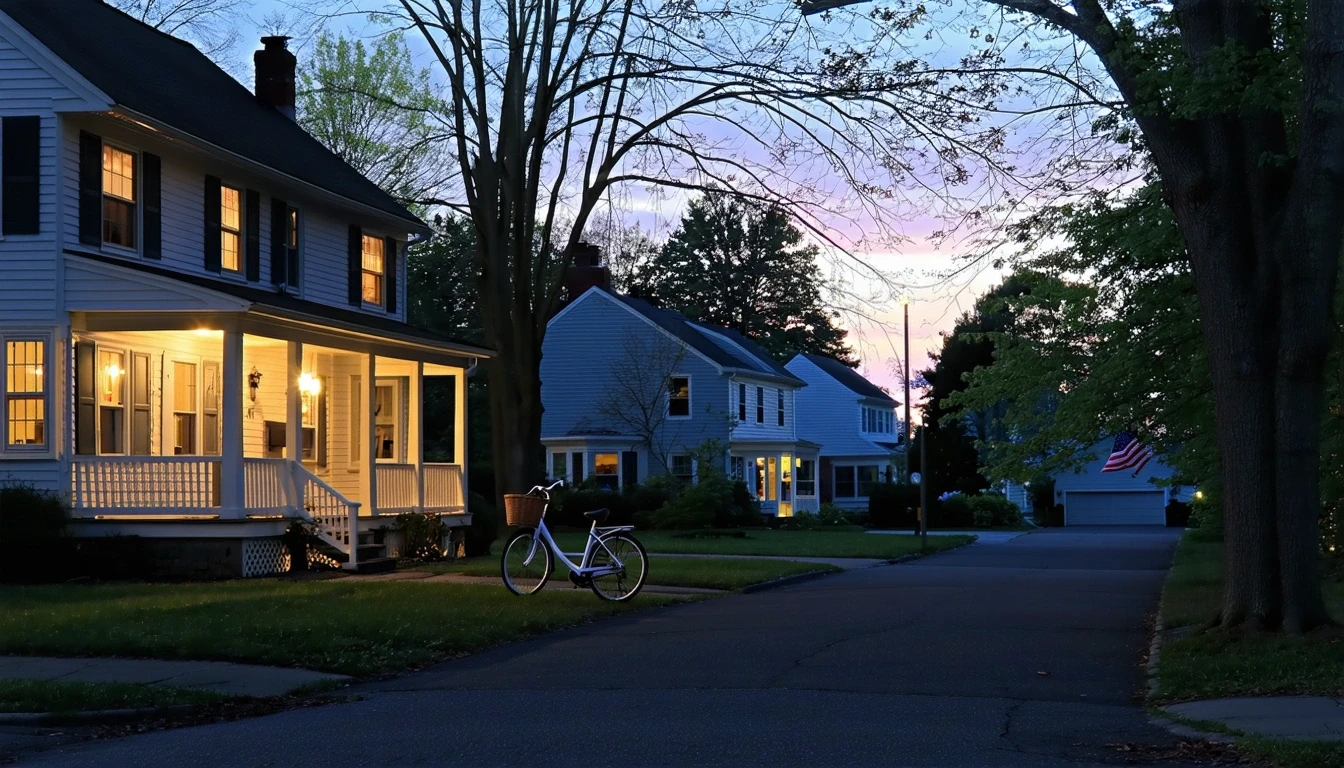
What It Feels Like to Live Here
Farmington’s emotional tone is one of restrained prosperity. The median household income sits at $118,329 per year, and the median home value is $375,700—numbers that signal an established, financially comfortable community. The unemployment rate of 3.8% reflects economic stability. But wealth alone doesn’t define the lived experience. What shapes daily life here is the interplay between affluence and infrastructure: you have resources, but you’ll spend them navigating a place built more for privacy than for proximity.
The town offers substantial pedestrian infrastructure in certain areas—enough that the ratio of walkable paths to roads exceeds typical suburban thresholds. Yet that walkability doesn’t translate into errand convenience. Food and grocery establishment density falls below baseline thresholds, meaning even in the more walkable zones, you’re often walking to your car, not to your destination. Bus service is present, but rail transit is not, and cycling infrastructure exists in limited pockets. The result is a place where you can enjoy a pleasant walk, but you can’t rely on walking to meet your needs.
Green space access feels present and integrated, with park density in the moderate range and water features woven into the landscape. A hospital is located within the town, offering a level of healthcare access that many suburban communities lack. But family-oriented amenities—schools and playgrounds—register as sparse relative to the town’s size and income. For households with young children, that gap can feel like a mismatch between expectation and reality.
Social Media Buzz in Farmington
Online, Farmington’s tone is protective and proud, but not without frustration. Conversations on local Facebook groups and regional subreddits often circle around preservation, change, and the tension between maintaining character and accommodating growth. Residents describe the town as “beautiful but not built for convenience,” a phrase that captures both affection and logistical fatigue.
“It’s a great place to live if you already have everything you need,” one recurring sentiment reads. “But if you’re used to grabbing groceries on foot or popping out for coffee, you’ll feel the friction fast.”
Another common thread: “Farmington feels like it’s for people who’ve already figured out their routines. It’s not a place that invites exploration—it rewards stability.”
There’s also a quiet defensiveness when comparisons to nearby towns arise. Residents acknowledge that West Hartford offers more walkable density and that Simsbury feels more family-saturated, but they frame Farmington as the choice for people who prefer calm over bustle. The trade-off is accepted, not lamented—but it’s clearly understood.
Local News Tone
Local coverage of Farmington tends to frame the town through the lens of stewardship and incremental change. Headlines don’t scream; they hum. The tone is one of careful management rather than disruption or controversy. Typical framing includes:
- “Town Weighs New Development Proposals with Eye on Character”
- “Residents Appreciate Green Space Access Amid Suburban Growth”
- “Healthcare and Wellness Remain Central to Community Identity”
- “Farmington Balances Quiet Living with Regional Connectivity”
- “Conversations Continue About Walkability and Daily Convenience”
The coverage reflects a community that values what it has and approaches change cautiously. There’s little appetite for dramatic transformation, but there’s awareness that quality of life factors like errand access and family density don’t align perfectly with the town’s self-image as a complete, high-functioning suburb.
Review-Based Public Perception
On platforms like Google Reviews, Yelp, and Nextdoor-style forums, Farmington earns praise for its aesthetics, safety, and healthcare access—but draws criticism for its logistical gaps. The pattern is consistent: people who wanted suburban tranquility feel rewarded; people who expected suburban convenience feel surprised.
Positive reviews emphasize the town’s “park-like feel,” “low-key sophistication,” and “access to quality medical care.” Long-time residents and empty nesters tend to express high satisfaction, particularly those who’ve built routines around driving and don’t need dense amenities.
Critical reviews, while rarely harsh, focus on the same few themes: limited dining variety, sparse grocery options within walking distance, and a sense that the town “looks more walkable than it functions.” Families with young children sometimes note the lack of playground density and kid-centered gathering spots, describing the town as “beautiful but a bit isolated for raising little ones.”
Newer planned areas are described as tidy and quiet, while older pockets are praised for character and tree cover. Neither is framed as definitively better—just different in texture and expectation.
Comparison to Nearby Cities
| Dimension | Farmington | West Hartford | Simsbury |
|---|---|---|---|
| Overall Vibe | Affluent, orderly, car-reliant calm | Walkable, bustling, amenity-dense | Family-saturated, pastoral, tight-knit |
| Walkability | Pockets of paths, low errand density | High walkability with retail access | Scenic walks, limited daily destinations |
| Family Feel | Limited school/playground density | Moderate family infrastructure | Strong family-oriented amenities |
| Daily Errands | Sparse, requires driving | Broadly accessible on foot | Car-dependent, rural-adjacent |
| Healthcare Access | Hospital present, strong access | Clinics and hospitals available | Routine care local, hospital nearby |
Farmington sits between West Hartford’s urban-suburban density and Simsbury’s pastoral family focus. If you want walkable errands and spontaneous dining, West Hartford will feel more functional. If you want a family-centric environment with strong school and playground density, Simsbury may align better. Farmington offers something different: financial stability, green space, and healthcare access in a setting that prioritizes privacy over proximity. It’s the choice for people who’ve already solved for convenience elsewhere—or who don’t prioritize it.
What Locals Are Saying
“I love the quiet here, and the fact that I can get to a hospital in minutes. But I do miss being able to walk to a coffee shop or grab groceries without getting in the car. It’s a trade-off I’ve accepted, but it’s real.”
“Farmington is perfect for us now that the kids are grown. We don’t need playgrounds or school density anymore. We want space, safety, and access to good healthcare. This town delivers all three.”
“I thought ‘walkable pockets’ meant I could live car-free. That’s not the case. You can take a nice walk, sure, but you’re still driving for everything that matters day-to-day.”
“It’s a beautiful town, but it doesn’t feel like it was designed for young families. The parks are lovely, but there aren’t a lot of kid-centered gathering spots or playgrounds. We ended up driving to other towns for that.”
“If you work remotely and value a calm, affluent environment over walkable amenities, Farmington is hard to beat. Just know that ‘calm’ also means ‘logistically car-dependent.’”
“I moved here from a denser suburb and was surprised by how much I had to plan around driving. The town looks more connected than it functions. But the green space and the hospital access make up for it, at least for me.”
“Farmington feels like it’s for people who’ve already figured out their lives. It’s not a place that invites spontaneity or exploration. It rewards routine and stability, which is exactly what I needed at this stage.”
Does Farmington Feel Like a Good Fit?
Farmington doesn’t ask you to compromise on income, safety, or green space. But it does ask you to accept a specific logistical reality: this is a place where affluence and infrastructure don’t always align. Walkability exists in fragments. Errands require a car. Family amenities are thinner than the income level might suggest. Healthcare access is strong, but convenience is not a given.
This tends to work for established professionals, empty nesters, and remote workers who value calm, space, and financial stability over spontaneous walkability or dense family infrastructure. It tends to frustrate young families expecting playground density, car-free households relying on transit and walkable errands, and urbanites seeking texture and variety within walking distance.
If you’re deciding whether Farmington fits, the question isn’t whether it’s a “happy” place—it’s whether its tradeoffs match your priorities. If you’ve already built routines around driving, if you value green space and healthcare access over errand convenience, and if you’re past the stage of needing dense family amenities, Farmington’s structure will feel like a reward. If you’re still figuring out your routines, or if you need daily life to be walkable and spontaneous, the friction will show up fast.
For more on housing pressure, monthly expenses, and how these tradeoffs play out financially, explore the related guides.
How this article was built: In addition to public economic data, this article incorporates location-based experiential signals derived from anonymized geographic patterns—such as access density, walkability, and land-use mix—to reflect how day-to-day living actually feels in Farmington, CT.
The perspectives shown reflect commonly expressed local sentiment and recurring themes in public discussion, rather than individual accounts.