
“It’s not Seattle, and that’s exactly why we’re here — but sometimes you really feel the distance.”
That tension captures much of what living in Everett feels like: a city caught between affordability and aspiration, between industrial heritage and residential growth, between proximity to Seattle and the daily reality of getting there. For some, Everett offers exactly the right balance — space, access to nature, and a chance to own a home without Seattle’s price tag. For others, it’s a compromise that reveals its limits quickly: the commute stretches longer than expected, walkability exists only in pockets, and the cultural texture feels thin compared to what’s just 30 miles south.
Understanding whether Everett fits you means understanding what you’re willing to trade — and what you’re not.
What Everett Feels Like: The Emotional Landscape
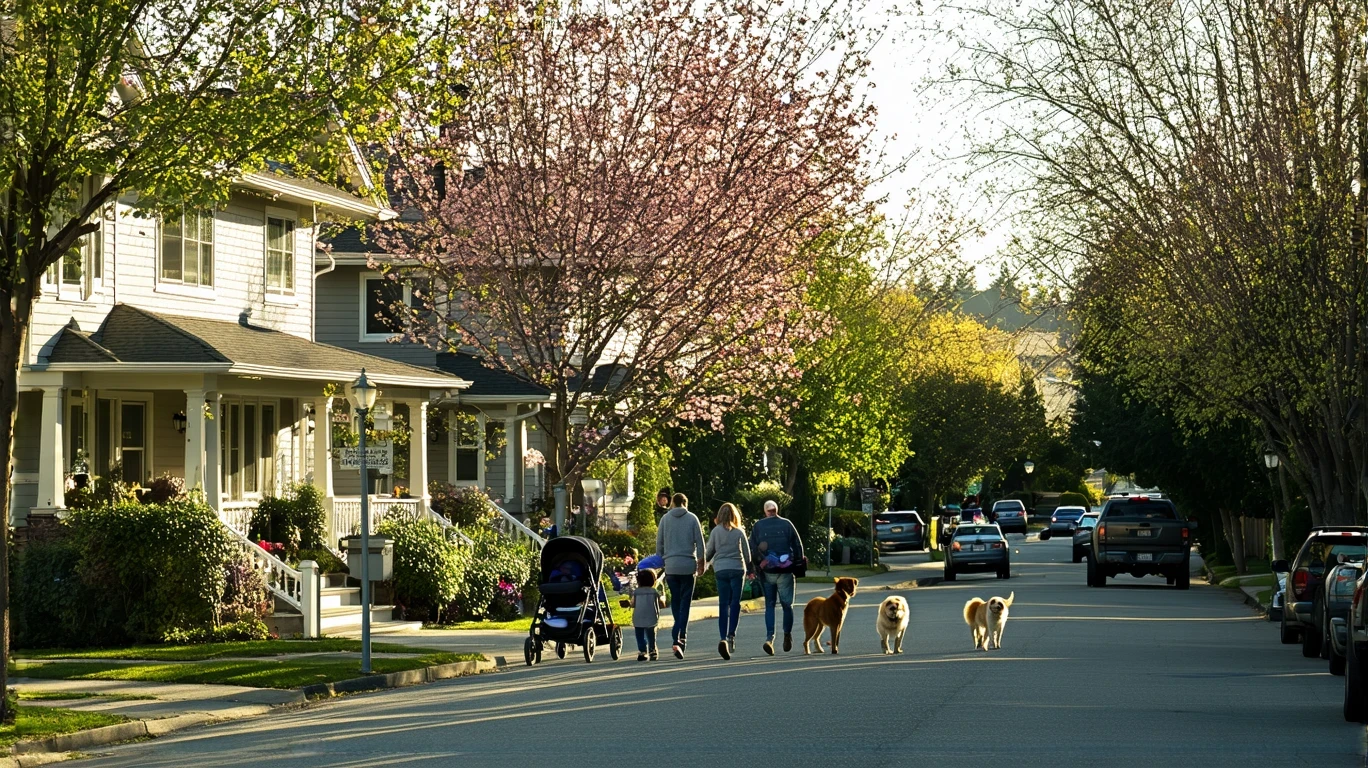
Everett sits at the northern edge of the Seattle metro, shaped by Boeing’s massive presence, a working waterfront, and a residential population that has grown steadily as housing costs elsewhere have climbed. The city has rail transit, a hospital, parks along the water, and neighborhoods that range from older single-family pockets to newer planned developments. It’s a place where you can still find a yard, where schools are present and accessible, and where the Puget Sound and the Cascades frame daily life.
But it’s also a place where getting around still means driving most of the time, where grocery stores and restaurants cluster along commercial corridors rather than integrating into neighborhoods, and where the sense of “city identity” feels unsettled — neither fully suburban nor urban, neither purely industrial nor residential.
People who feel at home here tend to value practicality over prestige. They’re often families who need space and can’t afford Seattle or Bellevue, commuters who work in the metro but want a house with a garage, or outdoor enthusiasts who prioritize proximity to water and trails over walkable nightlife. They accept that convenience sometimes requires planning, that errands mean driving, and that social life may require heading south.
People who feel friction here tend to be those who expected more walkability than actually exists, who underestimated how car-dependent daily life would be, or who find the commute to Seattle exhausting over time. They may feel isolated from the cultural energy of the metro core, frustrated by limited dining and entertainment options, or restless in a city that feels like it’s still figuring out what it wants to be.
Social Media Buzz: What Everett Residents Talk About Online
On platforms like Reddit and local Facebook groups, Everett discussions tend to circle around a few recurring themes: housing affordability (relative to Seattle), commute frustration, neighborhood safety perceptions, and debates about growth and development. There’s a protective tone among long-time residents who remember Everett’s industrial past, and a cautiously optimistic tone among newcomers who see potential in the city’s evolution.
Composite voices from these spaces capture the range:
“We moved here from Capitol Hill and yeah, we miss the walkability, but we have a yard now and our mortgage is half what rent was.”
“The commute to Seattle is brutal if you’re doing it five days a week. The train helps, but you still need to get to the station and then get where you’re going on the other end.”
“People talk about Everett like it’s sketchy, but honestly most neighborhoods are just quiet and normal. It’s not exciting, but it’s not dangerous either.”
The emotional tone is pragmatic, sometimes defensive, and often focused on tradeoffs rather than celebration. There’s less boosterism here than in some peer cities, and more acknowledgment that Everett works best for people who know what they’re getting.
Local News Tone: How Everett Gets Framed
Local coverage of Everett tends to focus on growth, infrastructure projects, economic development tied to Boeing and the port, and ongoing conversations about housing and homelessness. The tone is often one of transition: a city working to redefine itself as more than an industrial hub, but not yet fully settled into a new identity.
Recurring headline-style themes include:
- “Waterfront Redevelopment Aims to Draw New Residents and Visitors”
- “Commuters Weigh Transit Expansion Against Traffic Reality”
- “Neighborhoods Debate Density as Housing Demand Grows”
- “City Balances Industrial Legacy with Residential Appeal”
- “Families Find Affordability, But Ask What Comes Next”
The framing is neither celebratory nor critical — it’s observational, focused on change in progress rather than outcomes achieved. For readers trying to gauge the city’s direction, the takeaway is that Everett is still becoming something, and what that something is depends partly on who moves there and what they expect.
Review-Based Public Perception: What People Praise and Criticize
On platforms like Google Reviews, Yelp, and Nextdoor-style forums, Everett’s public perception splits along predictable lines. People who moved from more expensive areas tend to express relief and appreciation: they highlight the ability to buy a home, the presence of parks and waterfront access, and the relative ease of raising kids here. They describe neighborhoods as “quiet,” “safe enough,” and “good for families.”
People who moved expecting urban convenience or walkable amenities tend to express disappointment. They note that errands require driving, that dining and entertainment options feel limited, and that the city lacks the texture and spontaneity they were used to. Some describe feeling “stuck between suburbs and city,” where neither the rural peace nor the urban energy fully materializes.
Neighborhood variation matters here, though specifics are often vague. Newer planned areas tend to feel more suburban and car-oriented, with HOAs and limited street life. Older pockets closer to downtown or the waterfront have more pedestrian infrastructure and mixed-use character, but also more visible economic struggle and aging housing stock.
Healthcare access gets consistent praise — the presence of a hospital and clinics means routine and urgent care are locally available. Schools are described as “fine” or “decent,” meeting basic expectations without standing out. Parks and outdoor spaces earn genuine appreciation, especially among families and outdoor enthusiasts who value proximity to water and trails.
Comparison to Nearby Cities
| Dimension | Everett | Seattle | Tacoma |
|---|---|---|---|
| Overall Vibe | Practical, transitional, car-dependent | Urban, dense, culturally vibrant | Gritty, artistic, more affordable than Seattle |
| Housing Sentiment | Relief at affordability, space available | Stressful, competitive, expensive | More accessible, but still challenging |
| Commute Mood | Frustrating if Seattle-bound, manageable locally | Internal congestion, but walkable core | Long if Seattle-bound, easier locally |
| Walkability Feel | Pockets exist, but car still essential | Strong in core, varies by neighborhood | Improving downtown, suburban elsewhere |
| Cultural Texture | Limited, industrial heritage visible | Rich, diverse, constantly active | Emerging arts scene, blue-collar roots |
| Family Sentiment | Practical, schools adequate, space valued | Competitive, expensive, but resource-rich | Affordable, family-friendly pockets present |
Everett occupies a distinct emotional position relative to its neighbors. It offers more affordability and space than Seattle, but less walkability, transit utility, and cultural density. Compared to Tacoma, Everett feels more tied to Boeing and industry, less defined by an emerging arts or food scene, and more suburban in character despite similar population size.
If you need to be near Seattle for work but can’t afford Seattle housing, Everett makes sense — as long as you’re prepared for the commute and the car dependency. If you want affordability and a sense of place that feels culturally distinct, Tacoma may offer more of that texture. If you want urban living with walkability and nightlife, neither Everett nor Tacoma will satisfy the way Seattle does, but both offer more financial breathing room.
What Locals Are Saying: Composite Voices from Everett
Young professional, remote worker: “I moved here during the pandemic when I could work from anywhere. The rent was way better than Seattle, and I thought I’d just drive down when I wanted to do stuff. But honestly, I don’t go as often as I thought I would. It feels like more of a commitment than I expected, and Everett itself doesn’t have much going on at night.”
Family with two kids: “We love it here. We have a yard, the kids’ school is walkable, and we’re ten minutes from the waterfront. Yeah, my husband’s commute to Bellevue is rough, but we couldn’t have bought a house anywhere closer. For us, it’s worth it.”
Long-time local, retired: “Everett’s changed a lot. It used to be all about Boeing and the port. Now it’s all these new people moving in, and the city’s trying to be something different. I’m not sure it knows what yet. It’s not bad, just… different.”
Newcomer from California: “People warned me about Everett, but I think it’s fine. It’s not fancy, but it’s not falling apart either. The weather’s gray, but you get used to it. If you’re looking for affordability in the Seattle area, this is one of the few places left where that’s even possible.”
Commuter to Seattle: “The train is great when it works with your schedule, but if you need flexibility, you’re driving. And that drive during rush hour is soul-crushing. I keep telling myself it’s temporary, but two years in, I’m starting to wonder.”
Parent of teens: “There’s not a ton for teenagers to do here unless they’re into sports or outdoor stuff. My kids are always asking to go to Seattle, and I get it — Everett doesn’t have that energy. But it’s safe, and we can actually afford to live here, so we make it work.”
Single, early 30s: “I thought I’d meet people more easily here than in Seattle, but honestly it’s harder. Everyone’s either married with kids or just passing through. The social scene is pretty limited unless you’re willing to drive south all the time.”
Does Everett Feel Like a Good Fit?
Everett doesn’t ask you to love it — it asks you to decide whether its tradeoffs align with your priorities. It’s a city that works best for people who value affordability and space over walkability and cultural density, who are comfortable with car dependency, and who either work locally or are willing to absorb a significant commute. It rewards families who need room to grow, outdoor enthusiasts who prioritize access to water and trails, and pragmatists who care more about housing tradeoffs than urban texture.
It tends to frustrate people who underestimate how much driving daily life requires, who miss the spontaneity and convenience of denser urban environments, or who find the commute to Seattle unsustainable over time. It’s not a city that offers much nightlife, cultural programming, or walkable errands outside specific pockets. If those things matter deeply to you, Everett will feel limiting.
The city’s identity is still in flux — shaped by Boeing’s presence, the growth of residential development, and the tension between industrial heritage and aspirational livability. That fluidity means Everett may feel unfinished to some, or full of potential to others. Your experience will depend largely on what you bring to it: realistic expectations, a willingness to drive, and clarity about what you’re trading space and affordability for.
If you’re trying to stay in the Seattle metro without paying Seattle prices, Everett is one of the few places where that’s still possible. Whether it feels like home or just a compromise depends on how much you value proximity over place, and whether the distance — both literal and emotional — from the metro core feels like relief or isolation.
For a clearer sense of how costs break down day-to-day, explore monthly spending patterns. To understand what income levels tend to feel stable here, see the lifestyle requirements guide.
How this article was built: In addition to public economic data, this article incorporates location-based experiential signals derived from anonymized geographic patterns—such as access density, walkability, and land-use mix—to reflect how day-to-day living actually feels in Everett, WA.
The perspectives shown reflect commonly expressed local sentiment and recurring themes in public discussion, rather than individual accounts.