
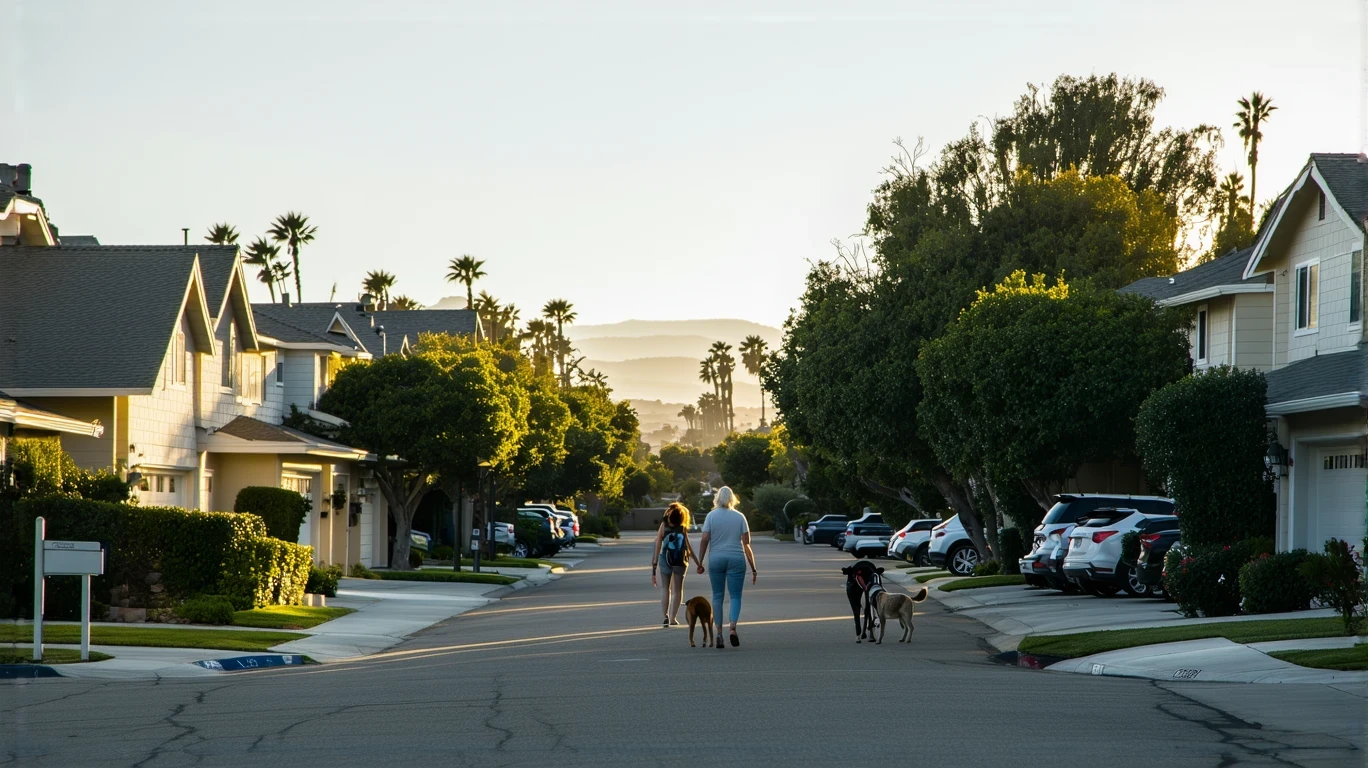
The common assumption is that Chula Vista is the more affordable option in San Diego County—lower home prices, lower rent, and a reputation as a practical bedroom community. But that framing misses how cost pressure actually works. Encinitas commands higher housing entry costs, yes, but its walkable infrastructure, dense grocery access, and reduced car dependence can reshape daily spending in ways that don’t show up in a rent comparison. Chula Vista offers more accessible homeownership and expansive park systems, but longer commutes and car-reliant errands introduce time costs and transportation exposure that affect household budgets differently depending on your priorities and routines.
Both cities sit within the San Diego metro, share similar utility rates and regional price levels, and offer rail transit access. The decision between them isn’t about which is cheaper overall—it’s about which cost structure aligns with how your household actually lives. Families prioritizing yard space and park access may find Chula Vista’s lower housing barrier worth the commute friction. Singles or couples who value walkable errands, cycling infrastructure, and reduced driving may find Encinitas’ higher rent offset by lower transportation dependence and daily convenience. In 2026, the better choice depends on which costs dominate your household’s day-to-day reality.
This comparison explains where cost pressure concentrates in each city, how different households experience those differences, and which tradeoffs matter most when deciding between coastal walkability and inland family space within the same metro region.
Housing Costs: Entry Barrier vs Ongoing Obligation
Housing is where the clearest numeric difference appears between Encinitas and Chula Vista, but the decision isn’t simply about price—it’s about what type of housing pressure you’re willing to manage. Encinitas’ median home value sits at $1,354,600, with median gross rent at $2,480 per month. Chula Vista’s median home value is $647,100, with median rent at $2,035 per month. These figures reflect fundamentally different housing markets: Encinitas is a coastal city with limited developable land, walkable neighborhoods, and high demand for proximity to the ocean and established infrastructure. Chula Vista is a larger, inland city with more recent suburban development, more single-family housing stock, and greater availability of entry-level ownership options.
For renters, the difference between $2,480 and $2,035 per month represents a meaningful gap in ongoing obligation, but it’s important to understand what that gap buys. Encinitas renters typically gain access to neighborhoods where daily errands—groceries, coffee, pharmacies—are within walking or biking distance, reducing the need for a second car or frequent driving. The city’s pedestrian infrastructure and mixed land use mean that many households can manage daily life with fewer transportation costs and less time spent in the car. Chula Vista renters, by contrast, often face a more car-dependent routine. Food and grocery options tend to cluster along commercial corridors rather than being broadly distributed, and the moderate pedestrian-to-road ratio means that even short errands often require driving. The rent savings in Chula Vista may be partially offset by higher transportation exposure, more frequent gas purchases, and the practical need for reliable vehicles for each working adult.
For prospective buyers, the difference in median home values is stark. Encinitas’ entry barrier is more than double that of Chula Vista, which effectively narrows the pool of households who can access ownership without significant down payment resources or dual high incomes. Chula Vista’s lower home values make ownership more accessible to first-time buyers, families seeking yard space, and households prioritizing square footage over walkability. However, ownership in Chula Vista often comes with trade-offs: longer commutes (the city’s average commute is 29 minutes, and 44.4% of workers face long commutes), higher reliance on cars for daily tasks, and the ongoing costs associated with maintaining single-family homes in a region with warm, dry summers that stress landscaping and cooling systems.
| Housing Type | Encinitas | Chula Vista |
|---|---|---|
| Median Home Value | $1,354,600 | $647,100 |
| Median Gross Rent | $2,480/month | $2,035/month |
| Typical Housing Form | Mixed: apartments, townhomes, older single-family | Predominantly single-family, newer suburban tracts |
| Walkability to Errands | High in established neighborhoods | Moderate, corridor-dependent |
Housing takeaway: Encinitas imposes a steep entry barrier but rewards it with walkable access and reduced car dependence, making it a better fit for households with higher incomes who prioritize convenience and lifestyle over space. Chula Vista offers more accessible ownership and family-sized homes but requires households to absorb commute time, transportation costs, and the logistics of car-reliant daily life. Renters sensitive to monthly obligations may find Chula Vista’s lower rent appealing, but those who value reducing transportation friction and time costs may find Encinitas’ structure more aligned with their priorities. First-time buyers and families seeking yard space will find Chula Vista far more accessible; high-earning couples or singles prioritizing walkability and coastal proximity will find Encinitas worth the premium if they can clear the entry threshold.
Utilities and Energy Costs: Predictability vs Exposure
Utility costs in Encinitas and Chula Vista are shaped by similar regional rates but behave differently depending on housing type, building age, and household routines. Encinitas’ electricity rate is 31.91¢/kWh, with natural gas priced at $21.89/MCF. Chula Vista’s electricity rate is slightly higher at 33.60¢/kWh, with natural gas at $21.94/MCF. These differences are minimal in isolation, but the way households experience utility costs depends more on housing stock, climate exposure, and daily patterns than on the rates themselves.
Encinitas benefits from coastal proximity, which moderates temperature swings and reduces the intensity of summer cooling demands. Many homes in Encinitas are older, smaller, and built before modern insulation standards, which can increase baseline heating and cooling costs in less efficient units. However, the city’s mixed housing stock—including apartments, townhomes, and smaller single-family homes—means that many households occupy spaces with lower total square footage, which naturally limits energy consumption. Renters in multi-unit buildings often see lower utility bills due to shared walls and reduced exposure to outdoor temperatures. Homeowners in older single-family homes may face higher variability, particularly if they rely on older HVAC systems or lack updated insulation.
Chula Vista sits farther inland, where summer heat is more intense and prolonged, increasing cooling season exposure. The city’s housing stock skews toward newer single-family homes with larger floor plans, which means higher baseline energy consumption even in well-insulated properties. Families with children, pets, or members working from home often run air conditioning for extended periods during summer months, and larger homes with multiple zones can see significant seasonal spikes in electricity usage. Natural gas usage in both cities is relatively low compared to colder climates, but households with gas water heaters, dryers, or older furnaces will see modest winter increases.
Utility cost exposure also varies by household size and daily routines. Single adults or couples in Encinitas apartments may see stable, predictable bills year-round, particularly if they can rely on natural ventilation during mild months. Families in Chula Vista single-family homes face more volatility, with summer cooling costs spiking and baseline usage higher due to more occupants, more appliances, and more square footage to condition. Older homes in either city—particularly those with single-pane windows, outdated insulation, or aging HVAC systems—will experience higher costs and less predictability, regardless of location.
Utility takeaway: Encinitas households, particularly renters in smaller units, tend to experience more predictable utility costs due to coastal moderation and lower square footage. Chula Vista households, especially those in larger single-family homes, face higher seasonal volatility driven by inland heat and greater cooling demands. Families with children or members working from home will feel utility pressure more acutely in Chula Vista, while singles or couples in Encinitas apartments may find utilities a minor, stable line item. Homeowners in either city should assess building age, insulation quality, and HVAC efficiency as key drivers of long-term utility exposure.
Groceries and Daily Expenses: Access Density vs Planning Burden
Grocery and daily spending pressure in Encinitas and Chula Vista is shaped less by price differences—both cities share the same regional price parity index—and more by how accessible, convenient, and flexible shopping options are in daily life. Encinitas offers broadly accessible food and grocery options, with high density of both food establishments and grocery stores distributed throughout residential neighborhoods. This means that many households can walk, bike, or make quick trips to multiple stores without extensive planning or driving. The city’s walkable infrastructure and mixed land use support spontaneous errands, smaller frequent trips, and the ability to compare prices or shop at different stores without significant time cost.
Chula Vista’s grocery and food access is more corridor-clustered, with options concentrated along major commercial streets rather than evenly distributed across neighborhoods. This structure works well for households who plan larger, less frequent shopping trips and don’t mind driving to access big-box stores, discount grocers, or specialty markets. However, it introduces more friction for spontaneous errands, quick trips for missing ingredients, or households trying to reduce car dependence. Families managing larger grocery volumes may benefit from Chula Vista’s access to warehouse clubs and big-box retailers, which offer bulk pricing and one-stop convenience. Singles or couples in Encinitas may prefer the flexibility of neighborhood markets, smaller format stores, and the ability to walk to groceries as part of daily routines.
Daily spending beyond groceries—coffee, takeout, household goods, personal care—follows similar patterns. Encinitas’ dense commercial fabric means more options within walking distance, which can reduce the temptation to drive and the associated costs of gas, parking, and time. However, the convenience of walkable access can also increase spending frequency, particularly for households prone to coffee runs, casual dining, or impulse purchases at boutique shops. Chula Vista’s car-oriented layout tends to bundle errands into planned trips, which can reduce spontaneous spending but increases reliance on driving and the time cost of managing logistics.
Grocery and daily expense takeaway: Encinitas households benefit from dense, walkable access to groceries and daily errands, which reduces transportation friction and supports flexible, spontaneous routines. This structure fits singles, couples, and small families who value convenience and are comfortable with slightly higher spending frequency in exchange for reduced driving. Chula Vista households face more planning burden and car dependence but gain access to big-box retailers and bulk pricing options that work well for families managing larger volumes. Households sensitive to time costs and convenience will prefer Encinitas’ structure; those prioritizing bulk savings and willing to plan trips will find Chula Vista’s corridor-clustered access sufficient.
Taxes and Fees: Structural Differences Without Numeric Certainty
Property taxes, sales taxes, and local fees in Encinitas and Chula Vista are governed by California’s statewide frameworks, but the way these costs show up for households depends on housing type, length of ownership, and local service structures. California’s Proposition 13 caps property tax increases for long-term homeowners, meaning that households who purchased years ago pay significantly less than recent buyers of comparable homes. In Encinitas, where median home values exceed $1.3 million, new homeowners face substantial annual property tax obligations based on purchase price. In Chula Vista, where median home values are lower, the baseline property tax burden is correspondingly smaller, though still meaningful for recent buyers.
Sales taxes in California are among the highest in the nation, and both cities are subject to similar county and district rates. Households that spend more on taxable goods—furniture, electronics, vehicles, home improvement materials—will feel this pressure regardless of location. However, the structure of daily spending can influence total sales tax exposure: households in Encinitas who walk to groceries and dine out frequently may spend more on prepared food (often taxed) and less on durable goods, while households in Chula Vista who drive to big-box retailers may make larger, less frequent purchases that concentrate sales tax payments into fewer transactions.
Local fees—trash collection, water, sewer, street maintenance—vary by provider and housing type. Homeowners in both cities typically pay these fees directly, either as part of property tax bills or through separate utility accounts. Renters may see these costs bundled into rent or charged separately, depending on lease terms. HOA fees are more common in Chula Vista’s newer suburban developments, where master-planned communities often include landscaping, recreation facilities, and shared infrastructure. Encinitas has fewer large HOA-governed communities, but older neighborhoods may have Mello-Roos or special assessment districts that fund infrastructure improvements. These fees are less predictable and harder to compare without property-specific research, but they represent ongoing obligations that affect long-term affordability for homeowners.
Taxes and fees takeaway: Encinitas homeowners face higher property tax obligations due to elevated home values, but long-term residents benefit from Proposition 13’s assessment caps. Chula Vista homeowners pay lower baseline property taxes but are more likely to encounter HOA fees in newer developments. Renters in both cities are partially insulated from property tax volatility but should verify whether local fees are bundled into rent or charged separately. Households planning to stay several years should research Mello-Roos, HOA structures, and special assessments as these can add meaningful ongoing costs that don’t appear in initial purchase or lease agreements.
Getting Around: Walkability vs Commute Reality
Transportation costs and commute patterns differ significantly between Encinitas and Chula Vista, not because of gas prices—Encinitas’ $4.59/gallon and Chula Vista’s $4.21/gallon are both elevated but regionally typical—but because of how much driving each city requires and how much time households spend managing transportation logistics. Encinitas’ walkable pockets, high pedestrian-to-road ratio, and notable cycling infrastructure mean that many daily errands, social activities, and short trips can happen without a car. Both cities have rail transit access, but Encinitas’ denser land use and mixed residential-commercial neighborhoods make it easier to rely on transit, biking, or walking as primary modes for at least some trips.
Chula Vista’s moderate pedestrian infrastructure and corridor-clustered errands mean that most households depend on cars for daily life. The city’s average commute time is 29 minutes, and 44.4% of workers face long commutes, often to job centers in downtown San Diego, Sorrento Valley, or other parts of the metro. Only 9.0% of Chula Vista workers work from home, which means the vast majority are driving regularly, often during peak hours. This introduces not just fuel costs but time costs—hours spent in traffic, wear and tear on vehicles, and the logistical complexity of coordinating schedules for multi-adult households.
For single adults or couples, Encinitas’ reduced car dependence can translate into meaningful savings: fewer miles driven, less frequent gas purchases, lower insurance premiums for reduced mileage, and the option to own one car instead of two. Families in Chula Vista, by contrast, often need multiple vehicles to manage work commutes, school drop-offs, and errands, which increases both fixed costs (insurance, registration, maintenance) and variable costs (fuel, repairs). The time cost of commuting also affects household logistics: longer commutes mean less time for errands, meal preparation, and family activities, which can push households toward convenience spending—takeout, delivery, paid services—that wouldn’t be necessary with shorter commutes or walkable access.
Transportation takeaway: Encinitas reduces transportation pressure through walkable infrastructure, cycling access, and shorter distances to daily destinations, making it a better fit for households willing to prioritize proximity over space. Chula Vista requires more driving, longer commutes, and greater reliance on personal vehicles, which increases both direct costs and time burden. Households with flexible schedules, remote work options, or a preference for walkable routines will find Encinitas’ structure more aligned with their priorities. Families with multiple working adults, school-age children, or jobs requiring long commutes will need to account for the time and money costs of car dependence in Chula Vista, even if housing costs are lower.
Where Cost Pressure Concentrates
Housing dominates the cost experience in Encinitas, where the steep entry barrier and elevated rent levels create the primary financial hurdle. Households who can clear that threshold gain access to a lifestyle structure that reduces transportation dependence, shortens errands, and supports walkable routines that lower ongoing costs in other categories. The city’s dense grocery access, notable cycling infrastructure, and walkable pockets mean that many households can manage daily life with one car, fewer miles driven, and less time spent on logistics. Utilities remain predictable due to coastal moderation and smaller housing units, and the city’s mixed land use reduces the friction costs associated with car-dependent errands.
Chula Vista’s cost structure is more distributed. Housing entry is far more accessible, with lower home values and rent levels that open ownership and family-sized spaces to a broader range of households. However, the city’s inland location, car-dependent layout, and longer commutes introduce ongoing costs that don’t appear in a simple rent comparison. Transportation becomes a larger, more persistent expense—not just fuel, but time, vehicle maintenance, and the logistical burden of managing multiple cars for multi-adult households. Utilities introduce more seasonal volatility due to inland heat and larger single-family homes, and the corridor-clustered grocery access means more planning burden and less spontaneous flexibility.
For households sensitive to housing entry costs, Chula Vista offers a clear advantage: lower home values, more accessible ownership, and more space for families. For households sensitive to time costs, convenience, and transportation friction, Encinitas offers a structure that reduces daily logistics and supports walkable, less car-dependent routines. The decision isn’t about which city is cheaper overall—it’s about which cost pressures your household is better equipped to manage and which tradeoffs align with your priorities.
How the Same Income Feels in Encinitas vs Chula Vista
Single Adult
In Encinitas, housing becomes the non-negotiable cost that defines affordability, but once that’s covered, a single adult gains significant flexibility through reduced transportation dependence. Walkable errands, cycling infrastructure, and dense grocery access mean fewer miles driven, less time spent on logistics, and the option to live with one car or none. In Chula Vista, housing costs are lower and more manageable, but transportation becomes a persistent, ongoing obligation—longer commutes, more frequent driving, and the practical need for a reliable vehicle. Flexibility exists in housing choice and space, but time costs and car dependence reduce the discretionary margin that lower rent initially suggests.
Dual-Income Couple
In Encinitas, a dual-income couple faces front-loaded housing pressure but benefits from walkable infrastructure that allows one car to suffice if both work locally or remotely. Errands become less time-intensive, and the ability to walk or bike to daily destinations reduces both transportation costs and schedule friction. In Chula Vista, lower housing costs free up income for other priorities, but the car-reliant layout and longer commutes often require two vehicles, which introduces fixed costs—insurance, registration, maintenance—that persist regardless of income. Flexibility exists in housing size and savings potential, but commute time and transportation logistics become ongoing constraints that affect household routines and discretionary time.
Family with Kids
In Encinitas, families face the steepest housing entry barrier, and the limited availability of single-family homes with yards makes space a premium. However, the city’s strong family infrastructure, walkable neighborhoods, and access to parks mean that daily logistics—school drop-offs, errands, activities—can happen with less driving and more predictable routines. In Chula Vista, families gain access to larger homes, more yard space, and integrated park systems that support outdoor play and recreation. However, the car-dependent layout, longer commutes, and corridor-clustered errands mean more time spent driving, coordinating schedules, and managing the logistics of multi-child households. Flexibility exists in housing form and outdoor access, but transportation and time costs become the dominant friction points that shape daily life.
Decision Matrix: Which City Fits Which Household?
| Decision Factor | If You’re Sensitive to This… | Encinitas Tends to Fit When… | Chula Vista Tends to Fit When… |
|---|---|---|---|
| Housing entry + space needs | You prioritize lower upfront costs and family-sized space over walkability | You can absorb higher housing costs in exchange for reduced car dependence and walkable access | You need accessible ownership, yard space, and lower entry barriers even if it requires longer commutes |
| Transportation dependence + commute friction | You value time over space and want to minimize driving and commute burden | You work locally or remotely and prioritize walkable errands and cycling infrastructure | You’re willing to manage longer commutes and car reliance in exchange for lower housing costs |
| Utility variability + home size exposure | You prefer predictable utility bills and want to avoid seasonal spikes | You live in a smaller unit or apartment where coastal moderation reduces cooling demands | You’re comfortable managing seasonal volatility in a larger single-family home with inland heat exposure |
| Grocery strategy + convenience spending creep | You want walkable access to groceries and daily errands without planning burden | You value spontaneous, frequent trips and dense neighborhood access over bulk shopping | You prefer planned, car-based trips to big-box stores and are comfortable with corridor-clustered access |
| Fees + friction costs (HOA, services, upkeep) | You want to avoid ongoing HOA fees and prefer older neighborhoods with fewer bundled services | You’re willing to research Mello-Roos and accept older housing stock without HOA structures | You’re comfortable with HOA fees in newer developments that bundle landscaping and amenities |
| Time budget (schedule flexibility, errands, logistics) | You prioritize reducing time spent on logistics and want shorter, walkable errands | You value proximity, walkability, and the ability to manage daily life without extensive driving | You’re willing to absorb commute time and car-dependent logistics in exchange for more space and lower housing entry |
Lifestyle Fit: Coastal Walkability vs Inland Family Space
Encinitas and Chula Vista offer distinct lifestyle experiences shaped by geography, infrastructure, and community character. Encinitas is a coastal city with a laid-back, beach-oriented culture, walkable downtown areas, and a strong emphasis on outdoor recreation—surfing, cycling, hiking, and beach access. The city’s mixed building heights, pedestrian-friendly streets, and integrated land use create neighborhoods where daily life can happen on foot or by bike. Parks are present and accessible, and the city’s strong family infrastructure—schools and playgrounds meeting density thresholds—supports households with children, though space is more limited and housing options skew toward smaller lots and attached units.
Chula Vista is a larger, more suburban city with expansive park systems, newer residential developments, and a family-oriented character. The city’s integrated green space access—park density exceeding high thresholds—means that families have abundant options for outdoor play, sports, and recreation. The city’s mixed building heights and residential-commercial land use provide some walkable pockets, but the overall layout is more car-dependent, with errands and activities requiring driving to reach. Chula Vista’s rail transit access connects residents to downtown San Diego and other job centers, but the city’s size and spread mean that most daily routines happen by car.
Lifestyle differences between the cities can indirectly affect costs. Encinitas’ walkable infrastructure and dense errands access reduce the need for a second car, which lowers insurance, maintenance, and fuel costs. The city’s coastal climate moderates temperature extremes, which can reduce utility costs for households in smaller, well-insulated units. Chula Vista’s newer housing stock often includes modern insulation and energy-efficient systems, but larger floor plans and inland heat increase baseline cooling costs. The city’s car-dependent layout increases transportation exposure, but the abundance of parks and outdoor space means families can access free recreation without paying for memberships or activities.
Encinitas is currently 54°F and feels like 53°F—mild coastal weather that supports year-round outdoor activity without extreme heating or cooling demands. Chula Vista is currently 60°F and feels like 60°F—comfortable conditions typical of inland San Diego County, though summer heat is more intense and prolonged than in coastal areas.
Frequently Asked Questions
Is Chula Vista cheaper than Encinitas for families in 2026?
Chula Vista offers lower housing entry costs—median home values and rent are significantly below Encinitas—which makes ownership and family-sized space more accessible. However, the cost structure includes longer commutes, higher transportation dependence, and more car-reliant errands, which introduce ongoing time and money costs that don’t appear in a simple rent comparison. Families prioritizing yard space, park access, and lower housing barriers will find Chula Vista more accessible. Families prioritizing walkability, shorter commutes, and reduced car dependence may find Encinitas’ higher housing costs offset by lower transportation friction and time savings.
How do commute times affect the cost comparison between Encinitas and Chula Vista in 2026?
Chula Vista’s average commute is 29 minutes, with 44.4% of workers facing long commutes, often to job centers across the metro. This introduces time costs—hours spent in traffic—and money costs—fuel, vehicle wear, insurance for higher mileage. Encinitas’ walkable infrastructure and denser land use reduce commute distances for many households, and the city’s rail access supports transit use for longer trips. Households with remote work options or jobs in North County will find Encinitas’ proximity advantageous. Households commuting to South Bay or East County job centers may find Chula Vista’s location more practical despite longer overall commute times.
Do utility costs differ meaningfully between Encinitas and Chula Vista in 2026?
Electricity and natural gas rates are nearly identical—Encinitas at 31.91¢/kWh and Chula Vista at 33.60¢/kWh—but utility cost behavior differs based on housing type and climate exposure. Encinitas’ coastal location moderates temperature swings, reducing cooling demands, and many households live in smaller units with lower baseline consumption. Chula Vista’s inland heat increases summer cooling costs, and the city’s larger single-family homes mean higher total energy usage. Families in Chula Vista should expect more seasonal volatility, while singles or couples in Encinitas apartments may see stable, predictable bills year-round.