
Can you live in El Cajon without a car? For most residents, the honest answer is no—but the full picture is more textured than that. El Cajon sits in a region where rail transit exists and grocery stores are plentiful, yet the street layout itself was built around driving. Understanding how people actually move through this city, and which transportation options work for whom, matters more than any single yes-or-no answer.
How People Get Around El Cajon
El Cajon operates as a car-first city with selective transit access. The infrastructure reflects decades of suburban development: wide arterial roads, low-rise buildings, and a street network where pedestrian pathways exist but remain sparse relative to the road system. Rail service runs through the city, providing a genuine alternative for specific commute patterns, but the pedestrian infrastructure around most neighborhoods doesn’t support the kind of spontaneous, car-free errands that define walkable cities.
What newcomers often misunderstand is that El Cajon isn’t a transit desert—it has real public transportation infrastructure—but it’s also not a place where you can easily substitute transit for driving in all parts of daily life. Food and grocery establishments are broadly accessible across the city, exceeding density thresholds that would suggest convenience. But accessing them without a car requires intentional route planning, not the kind of casual walk-around-the-corner ease you’d find in denser urban cores.
The result is a mobility pattern where most households own at least one vehicle, use it for the majority of errands and obligations, and may supplement with transit for specific, predictable trips—particularly commutes into San Diego or other rail-served destinations.
Public Transit Availability in El Cajon
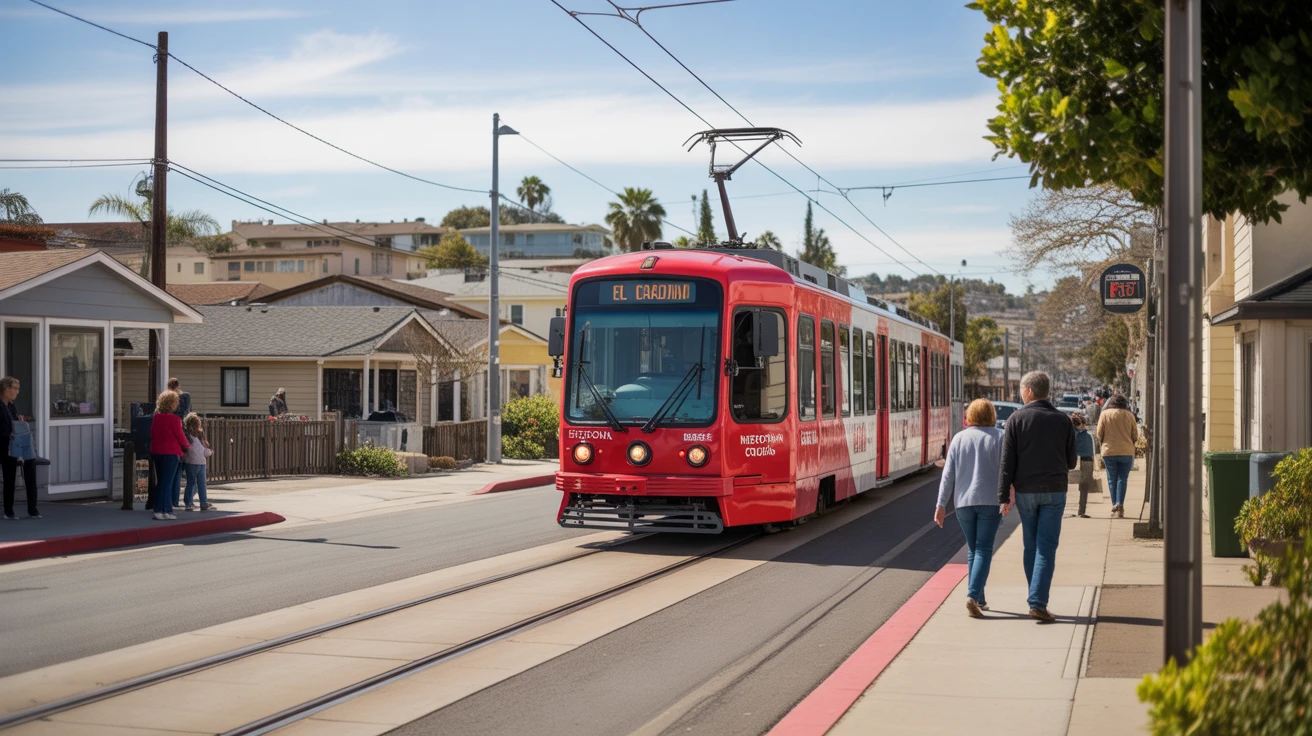
Public transit in El Cajon often centers around systems such as the San Diego Metropolitan Transit System (MTS), including the Trolley, which provides rail service through the city. This is not decorative infrastructure—it’s a functioning transit option that connects El Cajon to downtown San Diego, nearby employment centers, and other parts of the metro area.
Transit works best for residents living near rail stations with commutes that align with the rail corridor. If your job sits along the Trolley line and your daily routine is relatively fixed, rail becomes a practical, cost-predictable alternative to driving. The rail service offers the kind of schedule reliability and coverage that makes car-free commuting genuinely viable for a subset of residents.
Where transit falls short is in neighborhood-level coverage and late-hour service. The city’s layout—low-rise, spread out, with limited pedestrian density—means that even when rail stations are accessible, the last-mile problem persists. Getting from your front door to the station, or from the station to your final destination, often requires a car, a bike, or a willingness to walk along streets that weren’t designed with pedestrians as the primary user. Bus service exists to fill some of these gaps, though coverage varies by area and time of day.
For households whose daily obligations involve multiple stops, irregular schedules, or destinations outside the rail corridor, transit shifts from practical to cumbersome. It’s not that the system is broken—it’s that the city’s structure doesn’t support transit as a universal solution.
Driving & Car Dependence Reality
Driving isn’t just common in El Cajon—it’s structurally embedded in how the city functions. Parking is widely available, streets are built to prioritize vehicle flow, and the distance between residential areas and commercial corridors assumes car access. This isn’t about preference or lifestyle choice; it’s about infrastructure.
For families managing school drop-offs, grocery runs, medical appointments, and weekend errands, a car provides the flexibility that transit can’t match. Even for single adults, the time cost of piecing together multi-stop trips via bus or rail often exceeds the hassle of driving and parking. The city’s low-rise, spread-out form means that density-driven conveniences—like being able to walk to three different grocery stores, a pharmacy, and a park within ten minutes—don’t exist in most neighborhoods.
Gas prices in the region run higher than the national average, with current prices around $4.38 per gallon, but this doesn’t fundamentally alter car dependence. It shifts the cost burden, particularly for households with long commutes or multiple vehicles, but it doesn’t make transit a practical substitute for most daily mobility needs.
The tradeoff is straightforward: driving gives you control, predictability, and the ability to manage complex household logistics. It also locks you into fuel costs, maintenance, insurance, and the time spent behind the wheel. But in El Cajon, that tradeoff tilts heavily toward car ownership for the majority of residents.
Commuting Patterns & Daily Mobility
Commuting in El Cajon varies widely depending on where you work and how your day is structured. Residents commuting into downtown San Diego or other rail-accessible job centers can rely on the Trolley for predictable, traffic-independent travel. This works particularly well for single-job, fixed-schedule commuters who live within reasonable distance of a station.
For everyone else—those working in office parks, industrial zones, or suburban employment centers scattered across the metro area—driving becomes the default. The region’s job distribution doesn’t concentrate neatly along transit corridors, and many employment sites sit in areas where bus service is infrequent or nonexistent.
Households managing multi-stop days—picking up kids, running errands, attending appointments—face a different calculus entirely. Transit can handle a linear commute, but it struggles with the branching, time-sensitive logistics that define family life. Proximity to work matters, but so does proximity to schools, grocery stores, and medical facilities. In El Cajon, those elements rarely align in a way that eliminates the need for a car.
The city’s structure also means that even short trips often require driving. A mile-and-a-half errand that would be a quick walk in a denser city becomes a five-minute drive here, not because people are lazy, but because the pedestrian infrastructure and street design make walking less practical.
Who Transit Works For — and Who It Doesn’t
Transit in El Cajon works best for a specific profile: individuals or couples living near rail stations, commuting to destinations along the Trolley line, with relatively fixed schedules and minimal need for mid-day mobility. Renters in core corridors, particularly those without school-age children, can build a lifestyle around rail access and selective car use.
It doesn’t work well for families managing multiple daily obligations, residents in peripheral neighborhoods with low pedestrian infrastructure, or anyone whose job, school, or routine requires frequent stops across different parts of the metro area. The city’s layout and the limited reach of pedestrian-friendly infrastructure mean that car-free living requires either significant compromise or a very specific set of circumstances.
Bike infrastructure exists in pockets, with bike-to-road ratios in the medium band, but it’s not evenly distributed. Cyclists can navigate certain corridors, but the network isn’t comprehensive enough to serve as a primary transportation mode for most residents. Biking works as a supplement—getting to the station, running a quick errand—but not as a replacement for car ownership.
Older adults, people with mobility limitations, and households with young children face additional friction. Transit requires walking, waiting, and navigating transfers, all of which become more challenging when physical mobility is limited or when you’re managing strollers, car seats, and unpredictable schedules.
Transportation Tradeoffs in El Cajon
The choice between transit and driving in El Cajon isn’t about which is objectively better—it’s about which tradeoffs you’re willing to accept. Transit offers predictability for specific commutes, eliminates fuel and parking costs for those trips, and reduces the wear-and-tear exposure that comes with daily driving. But it sacrifices flexibility, adds time to multi-stop errands, and works only when your destinations align with the rail corridor.
Driving gives you control over timing, routing, and the ability to manage complex days without piecing together transfers and schedules. It also means absorbing fuel costs, maintenance, insurance, and the time spent in traffic. In a region where gas prices run above the national average and commutes can stretch long depending on where you work, those costs add up—but they don’t eliminate the practical necessity of car ownership for most households.
The real tradeoff isn’t transit versus driving in isolation—it’s how much of your daily life you can realistically structure around rail access. If your job, home, and routine align with the Trolley, you gain meaningful cost control and time predictability. If they don’t, you’re left managing the friction of a car-oriented city without the infrastructure to make transit a practical substitute.
FAQs About Transportation in El Cajon (2026)
Is public transit usable for daily commuting in El Cajon?
Yes, but only for specific commute patterns. If you live near a rail station and work along the Trolley line, transit is a practical, reliable option. For commutes to suburban office parks, industrial zones, or areas without rail access, driving remains the more functional choice.
Do most people in El Cajon rely on a car?
Yes. The city’s layout, limited pedestrian infrastructure, and the dispersed nature of jobs and services mean that car ownership is the norm. Even residents who use transit for commuting typically own a car for errands, family obligations, and off-peak travel.
Which areas of El Cajon are easiest to live in without a car?
Neighborhoods near rail stations with direct access to the Trolley offer the most viable car-free or car-light living. These areas work best for individuals or couples with fixed commutes and minimal need for mid-day mobility. Families and residents in peripheral areas face significantly more friction without a vehicle.
How does commuting in El Cajon compare to nearby cities?
El Cajon benefits from rail access that connects to downtown San Diego and other parts of the metro area, giving it an advantage over purely car-dependent suburbs. However, it lacks the pedestrian density and transit coverage of more urban cores, placing it in a middle zone—better than isolated suburbs, but not as transit-rich as denser cities.
Can you bike as your primary transportation in El Cajon?
Biking works in pockets, particularly for short trips or as a way to reach transit stations, but the bike infrastructure isn’t comprehensive enough to serve as a primary transportation mode for most residents. The city’s layout and traffic patterns favor cars, and cyclists face gaps in safe, connected routes.
How Transportation Fits Into the Cost of Living in El Cajon
Transportation in El Cajon isn’t just a line item—it’s a structural factor that shapes where you can live, how you spend your time, and what kind of household logistics you can manage. Monthly spending in El Cajon includes fuel, insurance, and maintenance for most households, but the bigger impact is how car dependence limits your ability to trade off housing location for transportation savings.
In denser cities, you might pay more for rent but eliminate car costs entirely. In El Cajon, that tradeoff rarely works. Even if you live near a rail station and commute via transit, you’ll likely still need a car for errands, family obligations, and off-peak travel. The city’s structure doesn’t support the kind of car-free living that would meaningfully reduce transportation exposure.
For households deciding whether El Cajon fits their budget and lifestyle, transportation isn’t a variable you can optimize away—it’s a fixed reality shaped by infrastructure. The question isn’t whether you’ll need a car, but how much of your daily life you can structure around the transit options that do exist, and whether that alignment is worth the tradeoffs in flexibility and convenience.
How this article was built: In addition to public economic data, this article incorporates location-based experiential signals derived from anonymized geographic patterns—such as access density, walkability, and land-use mix—to reflect how day-to-day living actually feels in El Cajon, CA.