
Carmel is considered expensive in 2026, with median home values at $425,900 and median rent at $1,499 per month. The value proposition depends on housing entry cost versus the city’s walkable pockets and integrated park access, rather than day-to-day price volatility.
When Maya transferred to Indianapolis for work, she chose Carmel for the schools and trails. The rent was manageable—until she realized her 40-minute commute and two-car household were quietly reshaping her monthly pressure points. It wasn’t the grocery bill or the gas rate that surprised her. It was how much of her budget had already been decided before she ever turned a key.
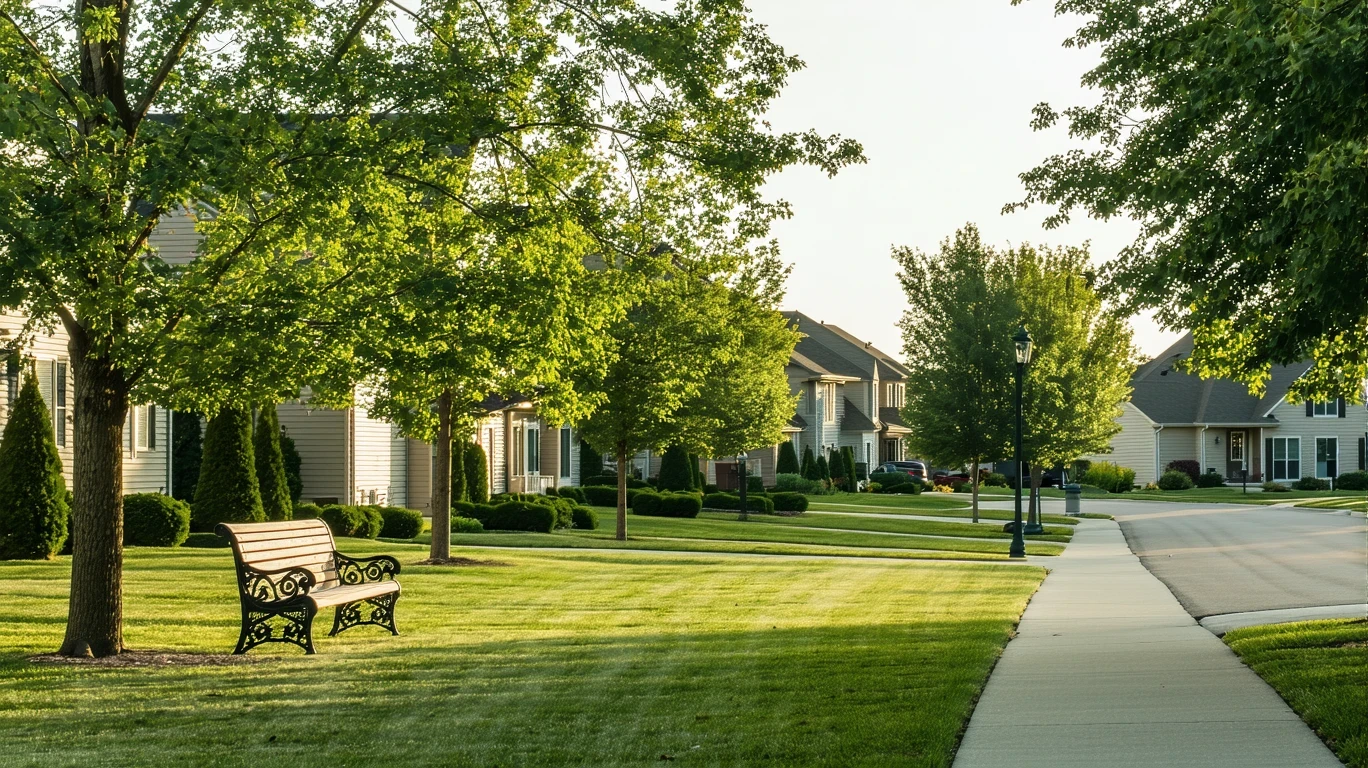
Overall Cost of Living Snapshot
Carmel’s cost structure is defined by a single dominant force: housing entry. Whether you’re buying at $425,900 or renting at $1,499 per month, shelter claims the largest share of household resources before any other expense enters the picture. The regional price parity index sits at 95, meaning goods and services here cost slightly less than the national baseline—but that modest advantage dissolves quickly against the weight of housing.
What surprises newcomers isn’t the price of milk or the electric rate. It’s the realization that transportation becomes a recurring, non-negotiable line item. Carmel’s structure includes notable cycling infrastructure and walkable pockets with high pedestrian-to-road ratios, but food and grocery options remain corridor-clustered rather than broadly accessible. That means most households still depend on a car for daily errands, and many depend on two. Commutes, fuel, insurance, and maintenance stack into a secondary cost pillar that rivals utilities and groceries combined.
The unemployment rate stands at 3.3%, reflecting a stable local economy with median household income at $132,859 per year. But income level doesn’t eliminate cost pressure—it shifts where that pressure concentrates. High earners face housing entry barriers. Renters face transportation exposure. Families with long commutes face fuel and time costs that compress discretionary spending.
Driver verdict: Housing dominates upfront. Transportation dominates ongoing exposure. Surprises come not from unit prices but from how suburban structure converts convenience into cost.
Housing Costs (Primary Driver)
At $425,900, the median home value in Carmel represents the single largest financial commitment most households will make. This isn’t a market where you can “ease in” with a starter property and trade up later—entry itself is the hurdle. For buyers, that means assembling a down payment in the mid-five figures, qualifying for a mortgage that assumes stable dual income, and accepting that property taxes, insurance, and maintenance will add thousands more annually.
Renting at $1,499 per month offers a lower entry threshold but no equity accumulation and limited control over annual increases. Rental stock in Carmel tends to cluster near corridors rather than spread evenly, meaning location choice often comes with tradeoffs: proximity to work versus access to parks, walkable retail versus highway convenience.
This is not a transitional city where people rent briefly and leave. It’s a place where households choose a lane—ownership with long-term equity exposure, or renting with flexibility and liquidity—and live with the structural consequences of that choice.
| Housing Type | Cost Anchor | What That Buys You |
|---|---|---|
| Median Home | $425,900 | Equity exposure, tax/insurance/maintenance responsibility, long-term price risk |
| Median Rent | $1,499/month | Flexibility, no maintenance burden, no equity, annual increase exposure |
Conclusion: Carmel is a buying city for households with capital and income stability. Renting works for those prioritizing flexibility or still building savings, but it doesn’t eliminate cost pressure—it redirects it.
Utilities & Energy Risk
Electricity in Carmel is billed at 17.34¢ per kWh, and natural gas costs $14.78 per MCF. For illustrative context, a household using around 1,000 kWh per month would see a baseline electric expense near $173 before fees and taxes. Natural gas usage fluctuates with season—heating months in Indiana’s cold winters drive consumption higher, while summer months see minimal gas draw.
The current temperature sits at 15°F, feeling like 6°F with wind chill. That’s the reality of Carmel’s winter exposure: extended heating seasons where gas becomes a primary cost driver for several months. Summers bring their own pressure, with cooling demand rising during stretches of heat and humidity. Utility bills here aren’t flat—they pulse with the calendar.
Households in older homes or those with poor insulation face amplified swings. Newer construction or homes with efficiency upgrades experience less volatility, but the seasonal rhythm remains. The key risk isn’t the per-unit rate—it’s the cumulative exposure over months of high usage.
Risk classification: Moderate. Seasonal swings are predictable and manageable with planning, but they’re not trivial. Utility costs won’t destabilize a budget, but they will fluctuate enough to require attention during peak heating and cooling months.
Groceries & Daily Costs
Grocery pricing in Carmel reflects the regional price parity index of 95, meaning food costs run slightly below the national baseline. Derived estimates suggest bread around $1.74 per pound, ground beef near $6.35 per pound, and eggs at $2.58 per dozen. These figures are modeled rather than observed, but they point to a consistent truth: day-to-day grocery expenses here don’t create acute pressure.
The bigger factor isn’t price—it’s access friction. Food and grocery establishments are corridor-clustered, with medium density rather than broad neighborhood distribution. That means most shopping trips require a car, and consolidating errands becomes a logistical task rather than a spontaneous walk. For households accustomed to urban density or walkable retail, that shift adds time and planning overhead, even if the prices themselves feel reasonable.
For larger households or those with specific dietary needs, the cumulative grocery spend still matters. But it’s rarely the category that tips a budget from comfortable to strained. That role belongs to housing and transportation.
Transportation Reality
Carmel’s structure creates transportation as a recurring cost exposure, not a one-time decision. The city includes notable cycling infrastructure and walkable pockets, but daily errands and commuting still depend heavily on cars for most households. Gas prices sit at $2.83 per gallon—a manageable per-unit cost that becomes significant when multiplied across two vehicles, long commutes, and frequent trips.
Many Carmel residents commute to Indianapolis or other metro employers, and those trips add up quickly. A 25-mile round-trip commute at 25 MPG burns roughly one gallon per day, or about $60 per month in fuel alone per vehicle. Add insurance, maintenance, registration, and depreciation, and the transportation line item rivals or exceeds utilities for many households.
The city’s infrastructure supports alternatives in specific areas—bike-to-road ratios exceed high thresholds, and pedestrian paths are well-developed in pockets—but these features serve recreational and local trips more than daily commuting. For most households, reducing transportation costs means reducing commute distance or vehicle count, not switching modes.
Transportation as exposure: This isn’t a city where you can avoid car ownership. The question is whether you need one vehicle or two, and how far you’re driving each week. Those variables determine whether transportation remains a manageable fixed cost or becomes a significant monthly drain.
Cost Exposure Profiles
Understanding cost pressure in Carmel requires looking at how different household structures interact with the city’s cost drivers. Exposure isn’t about income—it’s about which costs you face and how much control you have over them.
Low-exposure households typically own their home (locking in predictable housing costs), work locally or remotely (minimizing transportation), and occupy efficient or right-sized housing (reducing utility swings). These households face fewer variables and more control. Their largest cost—housing—is stable, and their secondary costs—utilities, transportation—are manageable through behavior and planning.
High-exposure households face the opposite structure: renting (with annual increase risk), commuting long distances (with fuel and time costs), operating multiple vehicles (with insurance and maintenance multipliers), and occupying older or larger homes (with higher utility volatility). These households face more variables and less control. Every cost category includes exposure to external forces—landlord decisions, gas prices, weather extremes, commute changes.
The difference isn’t about who can or cannot afford Carmel. It’s about which households face predictable, controllable costs versus which face compounding, variable exposures. A high-income household with a long commute and two car payments may feel more financial pressure than a moderate-income household with a paid-off home and a short commute.
Carmel rewards households that can absorb the upfront housing cost and minimize ongoing transportation exposure. It penalizes households that rent, commute far, and depend on multiple vehicles. The city’s walkable pockets and park access offer quality-of-life value, but they don’t eliminate the structural cost realities of suburban living.
How Day-to-Day Living Actually Works Here
Carmel’s infrastructure creates a specific rhythm for daily life. Food and grocery options are corridor-clustered rather than neighborhood-distributed, meaning most shopping trips require a car and some planning. You’re not walking to the corner store for a forgotten ingredient—you’re driving to a retail corridor and likely consolidating errands to make the trip worthwhile.
That said, the city’s notable cycling infrastructure and walkable pockets mean recreation and local errands can happen on foot or bike in certain areas. Parks are highly integrated, and the pedestrian-to-road ratio exceeds high thresholds in parts of the city, so weekend trails, evening walks, and neighborhood loops are accessible without a vehicle. But weekday logistics—getting to work, picking up groceries, running errands—still default to driving for most households.
For families, this structure adds a layer of coordination. School drop-offs, activity shuttles, and grocery runs require vehicle access and time. The city’s infrastructure supports active mobility for recreation, but it doesn’t eliminate car dependency for household logistics. That’s the tradeoff: high-quality parks and trails, but limited walkable access to daily necessities.
How this article was built: In addition to public economic data, this article incorporates location-based experiential signals derived from anonymized geographic patterns—such as access density, walkability, and land-use mix—to reflect how day-to-day living actually feels in Carmel, IN.
Frequently Asked Questions
Is Carmel more affordable than Indianapolis in 2026? No. Carmel’s median home value of $425,900 significantly exceeds Indianapolis’s more varied housing stock, and rent at $1,499 per month runs higher than many Indianapolis neighborhoods. Carmel trades lower day-to-day prices for higher housing entry costs.
What does a typical cost profile look like in Carmel? Housing dominates, followed by transportation (especially for commuters), then utilities with seasonal swings. Groceries and daily costs remain moderate. The profile favors homeowners with short commutes and penalizes renters with long commutes and multiple vehicles.
Do utilities cost more in Carmel than nearby areas? Not significantly. Electricity at 17.34¢/kWh and natural gas at $14.78/MCF are in line with regional averages. The bigger factor is seasonal usage—Indiana winters and summers create predictable but meaningful swings in heating and cooling costs.
What costs tend to surprise newcomers in Carmel? Transportation. Many newcomers underestimate how much two-car dependency and commuting to Indianapolis add to monthly expenses. The per-gallon gas price feels reasonable until you multiply it across long distances and multiple vehicles.
Are property taxes higher in Carmel than Fishers or Westfield? Property tax rates vary by jurisdiction and assessment, but Carmel’s higher home values mean absolute tax bills tend to run higher even if rates are comparable. It’s a function of the entry price, not necessarily the rate structure.
Is Carmel a good value for families? It depends on your priorities. Families who value schools, parks, and safety often find the housing cost justified. Families who need walkable errands or want to avoid car dependency may find the structure frustrating. The value proposition hinges on how much weight you place on housing quality versus transportation convenience.
Can you live in Carmel without a car? Technically possible in specific walkable pockets, but impractical for most households. Grocery access, commuting, and errands require a vehicle for the majority of residents. Cycling infrastructure supports recreation and short local trips, but not full car replacement.
How much does commuting to Indianapolis add to monthly costs? A 25-mile round-trip commute at $2.83/gallon and 25 MPG costs roughly $60 per month in fuel per vehicle, before insurance, maintenance, or time costs. For two-car households, that doubles. Commuting isn’t just a transportation cost—it’s a recurring exposure that compounds across vehicles and years.