
It’s 7:15 a.m., and Maria is walking three blocks from her apartment to the rail station, coffee in hand, passing a corner grocery she’ll stop at on the way home. By 7:45, she’s on the train heading toward her job in downtown Los Angeles. Her neighbor, Kevin, leaves at the same time—but he’s in his car, merging onto the freeway for a 29-minute drive to an office park in Anaheim. Both live in Buena Park, but their daily transportation realities couldn’t be more different.
That contrast captures the mobility landscape here: Buena Park offers genuine transportation options, but which one works depends entirely on where you live within the city, where you work, and how your household is structured. This isn’t a place where you can assume one mode fits all.
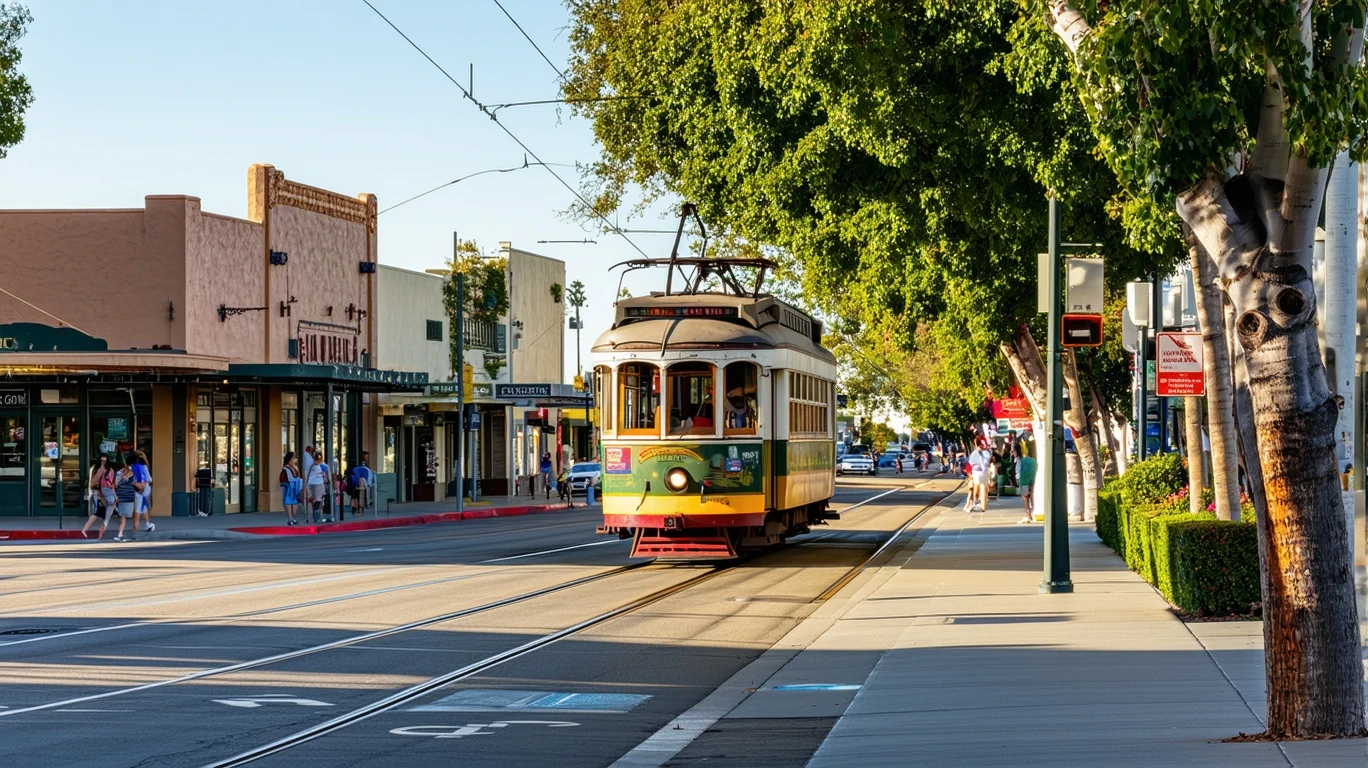
How People Get Around Buena Park
Buena Park sits within Orange County’s car-oriented infrastructure, but it’s not uniformly suburban. Parts of the city feature substantial pedestrian infrastructure relative to the road network, creating pockets where walking to errands or transit stops feels practical rather than punishing. Food and grocery establishments are broadly accessible—density exceeds high thresholds across both categories—which means daily needs don’t always require a car trip if you’re positioned near those concentrations.
Rail transit is present, offering a real alternative for commuters whose destinations align with the service area. But rail access doesn’t extend evenly across the city, and bus service, while available, plays a secondary role for most residents. The result is a mixed pattern: some households can structure their week around a combination of walking, transit, and occasional driving, while others depend on a car for nearly every trip.
Newcomers often misunderstand this. They see rail service and walkable commercial strips and assume the whole city operates that way. In practice, mobility experience varies sharply by neighborhood. If you’re near a station and within a walkable pocket, your transportation options expand. If you’re farther out or in areas with lower pedestrian infrastructure, driving becomes the default—not by preference, but by necessity.
Public Transit Availability in Buena Park
Public transit in Buena Park often centers around systems such as Metrolink or OCTA, though coverage and service patterns vary by area. Rail service provides access to regional job centers, particularly for commuters heading into Los Angeles or other parts of Orange County. For those whose work aligns with rail corridors, transit becomes a viable daily option—predictable, immune to freeway congestion, and less stressful than driving.
Bus service exists but tends to work best for specific corridors rather than citywide mobility. If your routine involves moving between neighborhoods within Buena Park or reaching destinations not served by rail, bus transit requires more planning and time. Late-hour service is limited, which narrows its usefulness for shift workers or evening activities.
Transit works best in areas where residential density, commercial activity, and station proximity overlap. In those pockets, you can walk to a stop, reach a grocery store on foot, and use rail for longer commutes. Outside those zones, transit becomes supplemental rather than primary—useful for occasional trips but not sufficient for daily household logistics.
Driving & Car Dependence Reality
For most Buena Park households, driving remains essential. Even in walkable pockets, a car provides flexibility that transit can’t match: reaching job sites outside rail corridors, handling multi-stop errands, accommodating irregular schedules, and managing household logistics that don’t fit neatly into fixed routes.
Parking is generally available and less constrained than in denser urban cores, which reduces one friction point of car ownership. But driving here means navigating Orange County freeway congestion, particularly during peak hours. Nearly half of workers—47.6%—face long commutes, a reflection of regional job dispersal and the mismatch between where people live and where employment concentrates.
Car dependence isn’t about preference; it’s structural. If your job, childcare, or regular errands fall outside transit-served areas, driving becomes non-negotiable. The city’s layout and the broader regional infrastructure assume car access, and households without it face significant friction in daily life.
Commuting Patterns & Daily Mobility
The average commute in Buena Park is 29 minutes, but that figure masks wide variation. Some residents work nearby and face short, predictable trips. Others commute into Los Angeles, Irvine, or other regional centers, where travel time depends heavily on traffic conditions and departure timing.
About 13.3% of workers operate from home, which removes commute exposure entirely and shifts transportation needs toward occasional errands rather than daily fixed trips. For everyone else, commute structure shapes daily life: single-destination commutes favor transit if alignment is good, while multi-stop routines (dropping kids, running errands, reaching dispersed job sites) favor driving.
Proximity to work matters more than proximity to transit for most households. If your job is within Buena Park or a neighboring city accessible by surface streets, commute friction stays low. If you’re heading across the county or into Los Angeles, you’re either absorbing freeway volatility or depending on rail service that may or may not align with your schedule.
Who Transit Works For — and Who It Doesn’t
Transit works best for single commuters whose jobs sit along rail corridors and who live near a station within one of Buena Park’s walkable pockets. If you can walk to the station, reach groceries on foot, and your work destination is rail-accessible, you can structure a low-car or car-free lifestyle. That’s a real option here, but it’s not universal.
Families with multiple job sites, school drop-offs, or activity schedules face more complexity. Transit can handle one leg of the day, but coordinating multiple stops across different household members usually tips the balance toward driving. Flexibility and time control matter more than cost savings in those situations.
Households in peripheral areas or outside walkable pockets face full car dependence. If your neighborhood lacks pedestrian infrastructure or sits far from transit stops, walking isn’t practical and bus service doesn’t fill the gap. Renters in those areas need to budget for car ownership as a fixed cost, not an optional convenience.
Older adults or individuals with mobility limitations may find transit access uneven. Where stations and stops are well-integrated with sidewalks and crossings, transit remains viable. In areas with gaps in pedestrian infrastructure, driving or ride assistance becomes necessary.
Transportation Tradeoffs in Buena Park
Choosing between transit and driving in Buena Park isn’t about optimizing cost—it’s about matching transportation mode to household structure and daily logistics.
Transit offers predictability and removes exposure to freeway congestion, but it requires alignment: your home, work, and errands need to fall within the service area, and your schedule needs to fit service hours. When alignment is good, transit reduces stress and eliminates parking hassles. When it’s not, transit adds time and friction.
Driving offers flexibility and control. You’re not constrained by routes or schedules, and you can handle complex trip chains (work, daycare, grocery, home) without transfers or waiting. But driving exposes you to traffic volatility, freeway congestion, and the ongoing costs of fuel, insurance, and maintenance. Gas prices in the area currently sit at $4.20 per gallon, a reminder that driving isn’t cost-neutral even when it’s necessary.
The tradeoff isn’t binary. Many households use both modes strategically: rail for predictable commutes, driving for errands and off-peak trips. That hybrid approach works best when you live near transit but still have access to a car for situations where transit falls short.
FAQs About Transportation in Buena Park (2026)
Is public transit usable for daily commuting in Buena Park?
Yes, if your job aligns with rail corridors and you live near a station. Rail service provides reliable access to regional employment centers, particularly in Los Angeles and parts of Orange County. Outside those corridors, transit becomes less practical for daily commuting.
Do most people in Buena Park rely on a car?
Yes. While rail transit and walkable pockets exist, most households depend on a car for daily logistics. Regional job dispersal, long commutes, and uneven transit coverage make driving the default mode for the majority of residents.
Which areas of Buena Park are easiest to live in without a car?
Areas near rail stations with high pedestrian infrastructure and access to grocery and food establishments offer the most car-free viability. These pockets allow walking for errands and rail use for commuting, though even in these areas, a car adds significant flexibility.
How does commuting in Buena Park compare to nearby cities?
Buena Park’s 29-minute average commute reflects regional patterns, but nearly half of workers face long commutes due to job dispersal across Orange County and into Los Angeles. Proximity to freeways and rail helps, but commute experience depends more on destination than on Buena Park’s location itself.
Can I rely on buses for getting around Buena Park?
Bus service exists but works best for specific corridors rather than comprehensive citywide mobility. If your routine involves moving within Buena Park or reaching non-rail destinations, buses require more time and planning than driving. They’re supplemental rather than primary for most households.
How Transportation Fits Into the Cost of Living in Buena Park
Transportation isn’t just a budget line—it’s a structural factor that shapes where you can live, how much time you control, and what tradeoffs you’re forced to make. In Buena Park, mobility costs show up in multiple ways: fuel and vehicle expenses if you drive, time and schedule constraints if you rely on transit, and housing location premiums if you prioritize walkability or station access.
Households that can position themselves near rail and within walkable pockets gain optionality. They’re not locked into car dependence, and they can shift modes based on trip type. Households in peripheral areas or outside transit-served zones lose that flexibility and absorb higher transportation exposure as a fixed cost.
Understanding your monthly budget in Buena Park means recognizing how transportation mode affects not just direct costs but also time, stress, and household logistics complexity. The question isn’t whether transit or driving is cheaper—it’s which mode aligns with your daily reality and what you’re willing to trade for control, predictability, or flexibility.
If you’re evaluating a move to Buena Park, map your job location, household routines, and errands against transit routes and walkable areas before assuming one mode will work. The city offers real transportation options, but they’re unevenly distributed, and your experience will depend entirely on where you land within that geography.
How this article was built: In addition to public economic data, this article incorporates location-based experiential signals derived from anonymized geographic patterns—such as access density, walkability, and land-use mix—to reflect how day-to-day living actually feels in Buena Park, CA.