
Can you live in Brooklyn Park without a car? For most people, the honest answer is no—but the full picture is more textured than that simple verdict suggests. Brooklyn Park sits in a mobility middle ground: bus service exists, pockets of the city support walking and biking for nearby errands, and some residents do manage daily life with minimal driving. But the city’s layout, the way housing and commercial corridors are arranged, and the realities of schedule flexibility mean that for the majority of households, a car remains the primary tool for getting around. Understanding transportation options in Brooklyn Park means understanding not just what exists on paper, but how mobility actually works in practice—and for whom.
Brooklyn Park’s transportation landscape reflects its suburban structure. Residential neighborhoods spread across a wide area, while grocery stores, medical offices, and workplaces cluster along a few key corridors. That geography shapes how people move: driving offers control and reach, while transit and biking serve narrower, more localized roles. Newcomers often assume that because bus service is present, it functions like urban transit—frequent, flexible, and comprehensive. In reality, Brooklyn Park’s transit works best for people whose routines align with bus schedules and who live near stops along serviced routes. For everyone else, the car is the default, and the city’s infrastructure assumes as much.
Public Transit Availability in Brooklyn Park
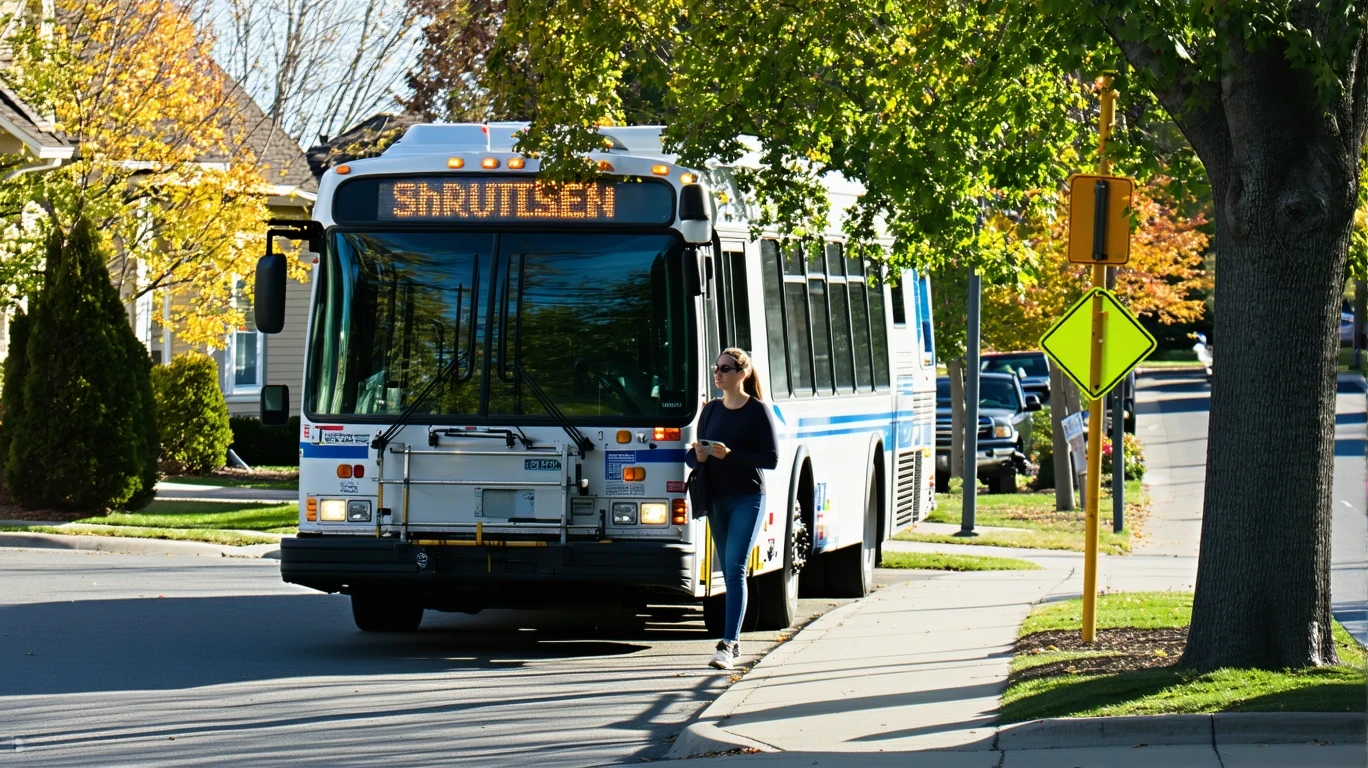
Brooklyn Park has bus service, but no rail. Public transit in Brooklyn Park often centers around systems such as Metro Transit, which connects the city to the broader Twin Cities region through a network of bus routes. Coverage is not uniform: certain corridors see regular service, while large residential areas sit outside easy walking distance from stops. For someone living near a well-served route and commuting to a destination also on the network, the bus can be a practical option. For someone whose home, workplace, or daily errands fall outside those corridors, transit quickly becomes impractical.
Bus service in Brooklyn Park functions as a supplement to driving, not a replacement. It works for commuters with predictable schedules, students, and households willing to plan trips around fixed routes and timing. It does not work well for multi-stop errands, late-night travel, or trips that require transfers and long waits. The absence of rail means there is no high-frequency, high-capacity backbone to the system—every trip depends on bus schedules, and those schedules reflect regional service priorities, not hyper-local Brooklyn Park demand.
Driving & Car Dependence Reality
Most people in Brooklyn Park drive because the city is built for it. Parking is abundant, roads are wide, and the distance between home and daily destinations—work, school, grocery stores, medical appointments—makes driving the fastest and most flexible option. For families managing multiple schedules, for workers with non-standard hours, and for anyone living outside the handful of walkable pockets near commercial nodes, the car is not a luxury; it is the infrastructure that makes daily life function.
Car dependence in Brooklyn Park is not about preference—it is about structure. The city’s land-use pattern separates residential areas from commercial corridors, and while some neighborhoods have sidewalks and bike paths, those networks connect to nearby parks and schools more often than they connect to grocery stores or transit hubs. Driving is the tool that closes the gap between where people live and where they need to go, and for most households, there is no realistic substitute.
Commuting Patterns & Daily Mobility
Commuting in Brooklyn Park typically means driving, either to a job within the metro area or to a park-and-ride lot for a longer regional trip. The city’s position within the Twin Cities metro gives residents access to a wide job market, but that access depends on mobility. Workers commuting downtown, to suburban office parks, or to shift-based jobs in logistics and healthcare rely on the car’s flexibility to navigate varying start times, routes, and distances.
For households with one working adult and predictable hours, the commute might be straightforward. For households juggling multiple jobs, school pickups, and errands, what a budget has to handle in Brooklyn Park includes not just transportation costs, but the time and logistics complexity that come with car dependence. The ability to leave when you need to, take the route that works, and make stops along the way is what makes driving dominant here—not speed alone, but control.
Who Transit Works For — and Who It Doesn’t
Public transit in Brooklyn Park works for a narrow slice of residents: those who live within walking distance of a bus stop on a well-served route, whose destination is also on the network, and who have schedules flexible enough to accommodate bus timing. That might include a student commuting to a community college, a worker traveling to a job downtown with standard hours, or a renter in a corridor-adjacent apartment building who can structure errands around transit access.
Transit does not work well for families with young children managing daycare and school schedules, for workers with evening or weekend shifts, for anyone whose job requires a car, or for households whose daily errands span multiple locations. It also does not work well for people living in the more residential, lower-density parts of Brooklyn Park, where bus stops are farther apart and service is less frequent. In those areas, even a short trip to the grocery store becomes a multi-stage journey involving walking, waiting, and transferring—a level of friction that makes driving the only practical choice.
How Place Structure Shapes Daily Errands and Mobility
The way Brooklyn Park is built—where stores sit relative to homes, how sidewalks and bike lanes connect neighborhoods to commercial nodes—shapes not just how people get around, but how much planning and time daily life requires. Food and grocery options in Brooklyn Park tend to cluster along certain corridors rather than distribute evenly across residential areas. That means some households can walk or bike to a store, while others face a trip that requires a car or a long bus ride.
Brooklyn Park has pockets where the pedestrian infrastructure is strong relative to the road network, and in those areas, walking for nearby errands is possible. The city also has notable cycling infrastructure, with bike-to-road ratios that support local trips by bike for those comfortable riding. But these features exist in parts of the city, not across the whole city. The result is a patchwork: some blocks feel walkable and connected, while others require a car for even the most basic errands. For households deciding where to live within Brooklyn Park, proximity to these walkable or bikeable pockets can make a meaningful difference in how much driving daily life demands.
Transportation Tradeoffs in Brooklyn Park
Choosing between transit and driving in Brooklyn Park is not about comparing two equal options—it is about understanding what each mode can and cannot do. Driving offers reach, flexibility, and control. It allows you to live anywhere in the city, work anywhere in the region, and structure your day without depending on schedules or routes set by someone else. The tradeoff is that driving requires owning or accessing a vehicle, managing maintenance and insurance, and absorbing the costs of fuel and parking.
Transit offers lower direct costs and removes the need to own a car, but it works only if your life fits the network. If your home and workplace align with bus routes, if your schedule allows for fixed departure times, and if you can manage errands on foot or by bike near where you live, transit can be viable. For everyone else, the tradeoffs tilt heavily toward driving. Brooklyn Park’s transportation reality is not that transit does not exist—it is that for most households, it does not exist in a form that supports the full scope of daily life.
FAQs About Transportation in Brooklyn Park (2026)
Is public transit usable for daily commuting in Brooklyn Park?
It depends on where you live and where you work. If both your home and workplace are near bus routes with regular service, and your schedule aligns with bus timing, transit can work. For most residents, though, the car is more practical and flexible.
Do most people in Brooklyn Park rely on a car?
Yes. The city’s layout, the distance between residential areas and commercial corridors, and the structure of the bus network mean that driving is the dominant mode of transportation for the majority of households.
Which areas of Brooklyn Park are easiest to live in without a car?
Areas near commercial corridors with bus service, walkable access to grocery stores, and nearby bike infrastructure offer the best chance of reducing car dependence. Even in those areas, most residents still drive for at least some trips.
How does commuting in Brooklyn Park compare to nearby cities?
Brooklyn Park’s commute patterns are similar to other suburban cities in the Twin Cities metro: car-dependent, with some bus access for regional trips. Cities closer to downtown Minneapolis or St. Paul may have more frequent transit service, but the overall structure—driving as default, transit as supplement—holds across much of the metro.
Can you bike for transportation in Brooklyn Park?
In some parts of the city, yes. Brooklyn Park has cycling infrastructure that supports local trips, especially in areas with higher pedestrian and bike path density. Biking works best for nearby errands and recreation, less so for longer commutes or trips that require crossing areas without protected bike lanes.
How Transportation Fits Into the Cost of Living in Brooklyn Park
Transportation in Brooklyn Park is not just a line item—it is a structural factor that shapes where you can live, how you spend your time, and what kind of flexibility you have in daily life. A household that can rely on transit or biking for some trips faces a different cost and time burden than a household that must drive for everything. A household that needs two cars to manage work and school schedules faces different financial pressure than a household that can share one vehicle.
Understanding what a budget has to handle in Brooklyn Park means recognizing that transportation costs are not just about gas prices or bus fares—they are about how the city’s layout and infrastructure create dependence on certain modes and limit the viability of others. For most people moving to Brooklyn Park, the question is not whether to own a car, but how much driving will be required and whether the city’s bus service, bike paths, or walkable pockets can reduce that dependence at the margins. The answer depends on where you live, where you work, and how much control over your schedule you have. Brooklyn Park offers options, but for the majority of residents, those options still center on the car.
How this article was built: In addition to public economic data, this article incorporates location-based experiential signals derived from anonymized geographic patterns—such as access density, walkability, and land-use mix—to reflect how day-to-day living actually feels in Brooklyn Park, MN.
—