
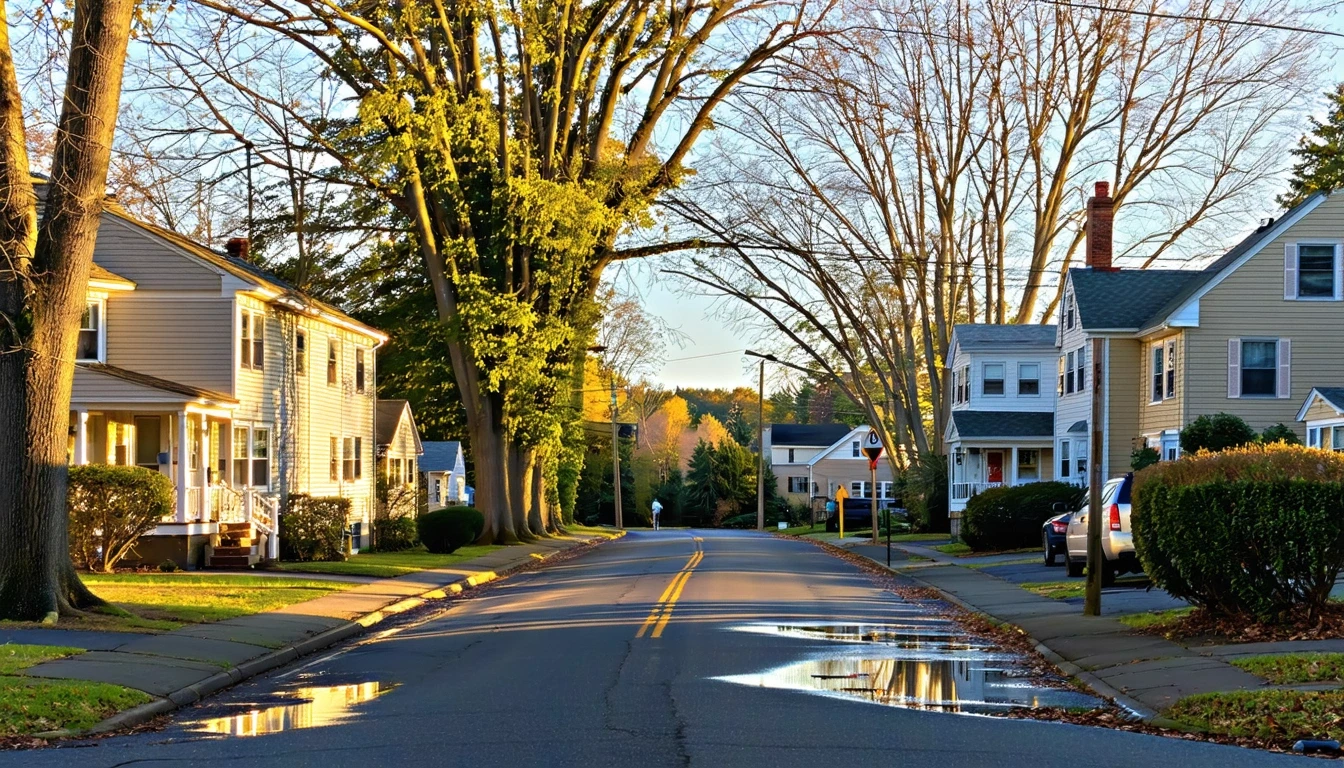
The conventional wisdom says Bristol is the pricier suburb while New Britain offers the budget-friendly alternative. But in 2026, that framing misses the structural reality: both cities sit in the Hartford metro with identical utility rates, identical gas prices, and identical regional employment conditions. The meaningful differences aren’t about one city being universally cheaper—they’re about where cost pressure concentrates, how housing entry barriers interact with income baselines, and which households feel friction in daily logistics versus long-term obligations. For families weighing space against predictability, singles prioritizing walkability over car dependence, or dual-income couples managing commute tradeoffs, the decision hinges on which cost mechanisms dominate your household, not which city wins on price.
Bristol and New Britain are separated by roughly ten miles, share the same energy infrastructure, and draw from overlapping labor markets. Yet their housing markets, neighborhood structures, and day-to-day accessibility patterns create distinct cost experiences. Bristol’s median home value sits at $235,700, with median rent at $1,228 per month, serving a median household income of $82,094 per year. New Britain’s median home value is $188,700, median rent $1,136 per month, and median household income $53,766 per year. These aren’t just price gaps—they’re signals of different housing stock, different income contexts, and different tradeoffs between entry cost and ongoing flexibility.
This comparison explains how the same gross income feels different in each city, where cost volatility shows up, and which households are more exposed to housing entry barriers versus ongoing obligations. It does not calculate total cost of living or declare a winner. Instead, it clarifies which structural differences matter most for your household in 2026.
Housing Costs
Housing is where Bristol and New Britain diverge most visibly. Bristol’s median home value of $235,700 creates a higher entry barrier for buyers, requiring larger down payments and higher monthly mortgage obligations before property taxes, insurance, and maintenance. New Britain’s median home value of $188,700 reduces that front-loaded cost by roughly $47,000, which translates to lower baseline mortgage payments and less capital required to enter homeownership. For first-time buyers or households stretching to qualify, that difference determines whether ownership is immediately viable or deferred.
Renters face a similar gap: Bristol’s median gross rent of $1,228 per month runs $92 higher than New Britain’s $1,136 per month. That gap compounds annually and affects how much flexibility remains after housing obligations are met. In Bristol, higher rent reflects access to neighborhoods with walkable pockets and mixed-height building character, where pedestrian infrastructure density exceeds typical suburban patterns. In New Britain, lower rent reflects a housing market serving a lower median income baseline, where cost sensitivity drives more decisions than neighborhood texture. Neither city offers a universal advantage—Bristol trades higher cost for established infrastructure and income alignment, while New Britain trades lower entry cost for tighter income-to-housing ratios.
Housing stock composition also matters. Bristol’s mixed-height character and land-use mix suggest a range of single-family homes, duplexes, and small multifamily buildings, creating options for households prioritizing walkability or yard space. New Britain’s housing market, serving a lower income baseline, likely emphasizes affordability over architectural variety, with more modest single-family homes and older apartment stock. Older housing stock in either city increases exposure to maintenance costs, heating inefficiency, and unexpected repairs—costs that don’t appear in rent or mortgage figures but accumulate over time.
| Housing Type | Bristol | New Britain |
|---|---|---|
| Median Home Value | $235,700 | $188,700 |
| Median Gross Rent | $1,228/month | $1,136/month |
| Median Household Income | $82,094/year | $53,766/year |
For renters, Bristol’s higher rent buys access to neighborhoods with better pedestrian infrastructure and mixed land use, reducing car dependency for some errands but not eliminating it—daily errands accessibility remains sparse, meaning most grocery and routine shopping still requires a vehicle. New Britain’s lower rent reduces baseline housing obligations but offers less certainty about walkability or transit convenience without localized infrastructure data. For buyers, Bristol’s higher home values align with higher household incomes, creating a market where entry cost matches earning power. New Britain’s lower home values serve a lower income baseline, making ownership more accessible in absolute terms but tighter relative to household earnings.
Housing takeaway: Bristol front-loads higher cost but serves households with higher income baselines and prioritizes neighborhood walkability in pockets. New Britain reduces entry barriers and ongoing rent obligations, fitting cost-sensitive households where income-to-housing ratio drives decisions. Renters prioritizing lower baseline obligations favor New Britain; buyers prioritizing established neighborhoods with walkable infrastructure favor Bristol. Families needing space at lower entry cost lean toward New Britain; singles or couples valuing pedestrian texture and mixed land use lean toward Bristol.
Utilities and Energy Costs
Utilities eliminate any location-based cost advantage between Bristol and New Britain. Both cities share identical electricity rates at 27.72¢/kWh and natural gas prices at $26.56/MCF, reflecting Connecticut’s regional energy infrastructure. This means utility cost differences are driven entirely by home size, insulation quality, heating system efficiency, and household behavior—not by city of residence. A 1,200-square-foot apartment in Bristol faces the same per-unit energy cost as an identical unit in New Britain. A drafty older single-family home in either city will generate higher heating bills than a newer, better-insulated townhouse, regardless of address.
Connecticut’s climate creates substantial heating exposure from November through March, with occasional cold snaps driving natural gas or electric heating usage well above baseline. Cooling costs remain moderate compared to southern states, but humid summer stretches still require air conditioning to maintain comfort. Households in older housing stock—common in both cities—face higher seasonal volatility due to poor insulation, single-pane windows, and aging HVAC systems. Newer construction or recently renovated units reduce that volatility, but availability varies by neighborhood and price tier.
Utility exposure varies more by housing type than by city. Single-family homeowners bear full responsibility for heating, cooling, and water heating across larger square footage, creating higher baseline usage and more seasonal swing. Apartment renters in smaller units benefit from shared walls that reduce heating and cooling loads, and some buildings include heat or hot water in rent, shifting cost predictability. Families in larger homes face compounding exposure—more square footage to condition, more occupants generating hot water demand, and more appliances running simultaneously. Singles or couples in smaller apartments experience lower absolute utility costs but less control over efficiency upgrades if renting.
Utility takeaway: Identical energy rates eliminate city-based differentiation. Households in older, larger single-family homes experience the highest seasonal volatility and baseline usage, regardless of whether they’re in Bristol or New Britain. Apartment renters in smaller units face lower absolute costs and benefit from shared-wall efficiency. Families managing larger homes should prioritize insulation quality and HVAC age over city choice when evaluating utility exposure. Neither city offers a structural advantage—cost pressure is driven by housing characteristics, not location.
Groceries and Daily Expenses

Grocery and daily expense pressure in Bristol and New Britain reflects identical regional price parity—both cities sit at an RPP index of 103, meaning consumer prices run roughly 3% above the national baseline. This eliminates any inherent cost advantage at the checkout. Where the cities diverge is in how grocery shopping and daily errands fit into household logistics. Bristol’s sparse daily errands accessibility means fewer grocery stores, convenience shops, and prepared food options within easy reach, increasing reliance on planned trips to larger supermarkets or big-box retailers. New Britain lacks detailed infrastructure data, but its lower income baseline and denser urban form suggest a mix of neighborhood grocers, discount chains, and convenience stores serving cost-sensitive shoppers.
Sparse errands accessibility in Bristol doesn’t mean groceries cost more—it means households spend more time planning trips, consolidating errands, and driving to access competitive pricing. Families managing weekly shopping for multiple people benefit from bulk-buying at larger stores, but that requires car access and time flexibility. Singles or couples who prefer frequent small trips or walkable access to fresh groceries face more friction in Bristol, where pedestrian infrastructure exists in pockets but doesn’t connect to daily errands destinations. In New Britain, the absence of detailed walkability data suggests a more traditional car-oriented suburban pattern, but the lower income baseline likely supports more discount grocery options and smaller-format stores serving price-conscious shoppers.
Dining out and convenience spending follow similar patterns. Bristol’s mixed land use and walkable pockets support some local cafes, takeout spots, and casual dining, but sparse errands accessibility limits density. Households prioritizing convenience—grabbing coffee on the way to work, picking up prepared meals on busy nights—face more friction and may spend more on delivery fees or drive farther to access options. New Britain’s lower income baseline suggests fewer upscale dining options but more accessible everyday takeout and fast-casual chains. For cost-sensitive households, New Britain’s structure may reduce the temptation to spend on convenience, while Bristol’s pockets of walkable commercial activity create more opportunities for incremental spending.
Groceries takeaway: Identical regional price parity means groceries cost the same at checkout in both cities. Bristol’s sparse errands accessibility increases planning burden and car dependency for routine shopping, fitting households comfortable with bulk trips and consolidated errands. New Britain’s lower income baseline likely supports more discount grocery options and smaller-format stores, fitting cost-sensitive shoppers prioritizing price over convenience. Families managing large weekly shopping trips face similar costs in both cities but different access patterns. Singles or couples valuing walkable access to fresh groceries or frequent small trips face more friction in Bristol and uncertain access in New Britain without localized data.
Taxes and Fees
Property taxes, local fees, and consumption taxes in Connecticut vary by municipality, but neither Bristol nor New Britain provides explicit tax rate data in available sources. What’s certain is that property taxes in Connecticut rank among the highest in the nation, and both cities rely heavily on property tax revenue to fund schools, public services, and infrastructure. Homeowners in Bristol, with a median home value of $235,700, face higher absolute property tax bills than New Britain homeowners at $188,700, even if mill rates were identical. That difference compounds annually and affects long-term affordability for buyers planning to stay several years.
Renters don’t pay property taxes directly, but landlords pass those costs through in rent. Bristol’s higher rent of $1,228 per month reflects not only housing demand but also the property tax burden embedded in landlord expenses. New Britain’s lower rent of $1,136 per month suggests either lower property tax exposure or lower landlord cost recovery expectations in a market serving a tighter income baseline. Either way, renters in both cities indirectly bear property tax costs, but the structure remains invisible compared to homeowners who receive annual tax bills.
Local fees—trash collection, water and sewer charges, parking permits, and special assessments—vary by municipality and housing type. Single-family homeowners typically pay these fees directly, while apartment renters may see them bundled into rent or charged separately. Older housing stock in both cities may face higher water and sewer costs due to aging infrastructure, and neighborhoods with HOAs or condo associations introduce additional monthly fees that don’t appear in mortgage or rent figures. Households planning to buy should verify whether HOA fees, special assessments, or mandatory service fees apply to specific properties, as these costs can add hundreds of dollars monthly and reduce flexibility.
Taxes and fees takeaway: Homeowners in Bristol face higher absolute property tax exposure due to higher home values, compounding long-term cost. Renters in both cities indirectly bear property tax costs through rent but lack visibility into the structure. Households planning to stay several years should prioritize understanding local mill rates, fee structures, and HOA obligations over assuming one city is universally cheaper. New Britain’s lower home values reduce baseline property tax obligations, fitting cost-sensitive buyers. Bristol’s higher home values increase tax exposure but align with higher household incomes, fitting buyers prioritizing established neighborhoods over minimizing tax bills.
Transportation & Commute Reality
Transportation costs between Bristol and New Britain start from identical fuel prices—$2.86 per gallon—eliminating any city-based advantage at the pump. Both cities share the same regional employment market in the Hartford metro, meaning commute distances depend more on job location than city of residence. What differs is how daily mobility and car dependency shape transportation exposure. Bristol’s walkable pockets and higher pedestrian-to-road ratio suggest some neighborhoods support walking for nearby errands or short trips, but sparse daily errands accessibility means most grocery shopping, medical appointments, and routine tasks still require a car. Bus service is present in Bristol, offering some transit coverage, but the lack of rail and limited route density means most households default to driving for reliability and time efficiency.
New Britain lacks detailed infrastructure data, but its lower income baseline and denser urban form suggest a more traditional car-oriented suburban pattern with limited transit alternatives. Households in either city planning to commute to Hartford, Waterbury, or other regional employment centers face similar drive times and fuel costs, but Bristol’s walkable pockets may reduce the frequency of short trips—walking to a nearby cafe or park instead of driving—while New Britain’s structure likely requires a car for nearly all errands. That difference doesn’t show up in fuel costs but affects how often households need to drive, how much time they spend in the car, and how much flexibility exists for single-car households.
Car dependency also intersects with housing costs. Households in Bristol paying higher rent or mortgage costs in walkable pockets may offset some transportation expense by reducing trip frequency, though sparse errands accessibility limits that benefit. Households in New Britain paying lower housing costs but driving more frequently face a different tradeoff—lower baseline obligations but higher time and fuel exposure for daily logistics. Single-car households, families managing school drop-offs and extracurricular schedules, and dual-income couples coordinating commutes all face different friction depending on how walkability and transit access align with their routines.
Transportation takeaway: Identical gas prices and regional employment markets eliminate fuel-based differentiation. Bristol’s walkable pockets reduce trip frequency for some errands but sparse daily accessibility limits car-free viability. New Britain’s structure likely requires a car for nearly all errands, fitting households already planning to drive daily. Single-car households and families managing complex schedules face more friction in both cities compared to walkable urban cores, but Bristol’s pedestrian infrastructure offers marginal relief in specific neighborhoods. Neither city supports car-free living—transportation exposure is driven by commute distance, household logistics, and trip frequency, not city choice.
Cost Structure Comparison
Housing dominates the cost structure difference between Bristol and New Britain. Bristol’s higher home values and rent create a front-loaded entry barrier that aligns with its higher median household income, serving buyers and renters who prioritize established neighborhoods, walkable pockets, and mixed land use. New Britain’s lower home values and rent reduce baseline housing obligations, fitting cost-sensitive households where income-to-housing ratio drives decisions more than neighborhood texture. For renters, that $92 monthly difference compounds over a year and affects how much flexibility remains after housing costs. For buyers, the $47,000 home value gap determines whether ownership is immediately viable or requires additional savings time.
Utilities introduce no differentiation—identical electricity and natural gas rates mean cost exposure is driven by home size, insulation quality, and household behavior, not city of residence. Families in older, larger single-family homes face the highest seasonal volatility in both cities, while apartment renters in smaller units benefit from shared-wall efficiency and lower baseline usage. Neither city offers a structural advantage on utilities; households should prioritize housing characteristics over location when evaluating energy cost exposure.
Daily living costs—groceries, dining, convenience spending—reflect identical regional price parity but different accessibility patterns. Bristol’s sparse errands accessibility increases planning burden and car dependency for routine shopping, fitting households comfortable with bulk trips and consolidated errands. New Britain’s lower income baseline likely supports more discount grocery options and smaller-format stores, fitting cost-sensitive shoppers prioritizing price over convenience. Neither city eliminates car dependency for groceries, but Bristol’s walkable pockets offer marginal relief for non-grocery errands in specific neighborhoods.
Transportation costs start from identical fuel prices, but Bristol’s pedestrian infrastructure reduces trip frequency for some households in walkable pockets, while New Britain’s structure likely requires driving for nearly all errands. That difference doesn’t show up in fuel costs but affects time spent in the car and logistics complexity for single-car households or families managing multiple schedules. Households sensitive to commute friction and daily logistics should weigh how walkability aligns with their routines, but neither city supports car-free living.
The better choice depends on which costs dominate your household. Households sensitive to housing entry barriers and ongoing rent obligations may prefer New Britain’s lower baseline costs, even if income-to-housing ratios remain tight. Households prioritizing walkable pockets, established neighborhoods, and alignment between income and housing cost may prefer Bristol, accepting higher entry cost for better pedestrian infrastructure. For families, the decision hinges on whether space needs and lower entry cost outweigh neighborhood texture. For singles or couples, the decision hinges on whether walkability and mixed land use justify higher rent or whether minimizing baseline obligations creates more flexibility.
How the Same Income Feels in Bristol vs New Britain
Single Adult
In Bristol, higher rent claims a larger share of gross income upfront, but walkable pockets reduce the need for some short trips, and mixed land use offers more nearby options for dining or errands. Flexibility depends on whether income comfortably covers the $1,228 median rent, leaving room for discretionary spending, or whether that baseline obligation tightens the budget. In New Britain, lower rent at $1,136 monthly creates more breathing room after housing costs, but car dependency for nearly all errands increases time cost and reduces spontaneity. The tradeoff is front-loaded housing cost versus ongoing transportation friction.
Dual-Income Couple
In Bristol, combined income more easily absorbs higher rent or mortgage costs, and walkable pockets offer some relief from constant car use, though sparse errands accessibility still requires planning for most shopping. Predictability comes from established neighborhoods and mixed-height building character, but higher housing costs reduce flexibility for other goals like travel or savings. In New Britain, lower housing costs free up income for other priorities, but both partners likely need reliable car access for commuting and errands, increasing coordination complexity. The tradeoff is predictable neighborhood structure versus lower baseline obligations and more discretionary income.
Family with Kids
In Bristol, higher home values and rent create a steeper entry barrier, but walkable pockets and mixed land use offer some relief from constant driving for non-grocery errands. Limited family infrastructure—school density below thresholds—means families may face longer school commutes or fewer nearby playgrounds, increasing logistics complexity. In New Britain, lower home values make ownership more accessible, and lower rent reduces baseline obligations, but car dependency for nearly all errands and uncertain walkability increase time cost for managing school drop-offs, extracurriculars, and daily shopping. The tradeoff is lower entry cost and ongoing obligations versus better pedestrian infrastructure in specific Bristol neighborhoods.
Decision Matrix: Which City Fits Which Household?
| Decision factor | If you’re sensitive to this… | Bristol tends to fit when… | New Britain tends to fit when… |
|---|---|---|---|
| Housing entry + space needs | Down payment size, monthly mortgage or rent obligations, alignment with income baseline | Higher income supports higher entry cost and you prioritize established neighborhoods with walkable pockets | Lower entry cost and reduced baseline obligations matter more than neighborhood texture or walkability |
| Transportation dependence + commute friction | Trip frequency, car dependency, time spent driving, single-car household logistics | Walkable pockets reduce some short trips and you value pedestrian infrastructure in specific neighborhoods | You’re already planning to drive daily and prioritize lower housing costs over marginal walkability gains |
| Utility variability + home size exposure | Seasonal heating and cooling costs, insulation quality, home age, square footage | Identical rates mean you prioritize housing characteristics like insulation and HVAC efficiency over city choice | Identical rates mean you prioritize housing characteristics like insulation and HVAC efficiency over city choice |
| Grocery strategy + convenience spending creep | Frequency of shopping trips, access to discount grocers, walkable access to fresh food, dining out habits | You’re comfortable with bulk trips and consolidated errands despite sparse daily accessibility | Lower income baseline supports more discount grocery options and you prioritize price over convenience |
| Fees + friction costs (HOA, services, upkeep) | Property taxes, HOA fees, water and sewer charges, special assessments, ongoing maintenance | Higher home values increase absolute property tax exposure but align with higher household income | Lower home values reduce baseline property tax obligations and fit cost-sensitive buyers |
| Time budget (schedule flexibility, errands, logistics) | Coordination complexity, school drop-offs, extracurriculars, managing multiple schedules | Walkable pockets offer some relief from constant car use and mixed land use reduces trip consolidation needs | Lower housing costs free up income but car dependency increases time cost for daily logistics |
Lifestyle Fit
Bristol and New Britain offer distinct lifestyle textures shaped by neighborhood structure, walkability, and access to green space and amenities. Bristol’s walkable pockets and mixed land use create neighborhoods where pedestrian infrastructure supports some errands on foot, cafes and small shops cluster in accessible areas, and mixed-height building character offers architectural variety. Park density sits in the moderate range, and water features add natural amenity access, fitting households that value outdoor space and neighborhood texture. Limited family infrastructure—school density below thresholds—means families may face longer school commutes or fewer nearby playgrounds, but the presence of clinics and pharmacies supports routine healthcare access without requiring trips to a hospital for non-emergency needs.
New Britain’s lower income baseline and denser urban form suggest a more traditional car-oriented suburban pattern, but the absence of detailed infrastructure data limits certainty about walkability, transit convenience, or family amenities. The lower cost structure fits households prioritizing affordability over neighborhood texture, and the proximity to Hartford offers access to regional employment, cultural institutions, and entertainment without requiring residence in a higher-cost urban core. For households comfortable with car dependency and prioritizing lower baseline housing obligations, New Britain offers a functional base with flexibility to access Hartford’s amenities when desired.
Both cities experience Connecticut’s four-season climate, with cold winters requiring heating and humid summers benefiting from air conditioning. Current temperatures sit in the mid-20s°F, reflecting winter’s grip, and both cities face similar seasonal exposure. Outdoor recreation, park access, and green space matter more in warmer months, when Bristol’s moderate park density and water features offer nearby options for walking, picnicking, or casual outdoor time. New Britain’s structure and amenities remain less certain without localized data, but its urban form and lower cost baseline suggest a focus on functional access over recreational infrastructure.
Bristol’s pedestrian-to-road ratio exceeds high thresholds, indicating substantial walkable infrastructure in parts of the city. New Britain’s median household income of $53,766 per year serves a cost-sensitive market where affordability drives more decisions than amenity density.
Frequently Asked Questions
Is Bristol or New Britain cheaper for renters in 2026?
New Britain’s median gross rent of $1,136 per month runs $92 lower than Bristol’s $1,228 per month, reducing baseline housing obligations. That difference compounds annually and affects how much flexibility remains after rent. Bristol’s higher rent buys access to neighborhoods with walkable pockets and mixed land use, but sparse daily errands accessibility means most grocery shopping still requires a car. New Britain’s lower rent fits cost-sensitive renters prioritizing reduced baseline obligations over neighborhood walkability, though car dependency for nearly all errands increases time cost.
Which city has lower home prices, Bristol or New Britain, in 2026?
New Britain’s median home value of $188,700 sits roughly $47,000 below Bristol’s $235,700, reducing the down payment requirement and baseline mortgage obligations for buyers. That difference determines whether ownership is immediately viable or requires additional savings time. Bristol’s higher home values align with a higher median household income of $82,094 per year, serving buyers who prioritize established neighborhoods and walkable infrastructure. New Britain’s lower home values serve a median household income of $53,766 per year, fitting cost-sensitive buyers where income-to-housing ratio drives decisions.
Do Bristol and New Britain have the same utility costs in 2026?
Yes. Both cities share identical electricity rates at 27.72¢/kWh and natural gas prices at $26.56/MCF, reflecting Connecticut’s regional energy infrastructure. Utility cost differences are driven entirely by home size, insulation quality, heating system efficiency, and household behavior—not by city of residence. Families in older, larger single-family homes face the highest seasonal volatility in both cities, while apartment renters in smaller units benefit from shared-wall efficiency and lower baseline usage. Neither city offers a structural advantage on utilities.
Is it easier to live without a car in Bristol or New Britain in 2026?
Neither city supports car-free living, but Bristol’s walkable pockets and higher pedestrian-to-road ratio offer marginal relief for some short trips in specific neighborhoods. Bus service is present in Bristol, but limited route density and the absence of rail mean most households default to driving for reliability. New Britain lacks detailed infrastructure data, but its lower income baseline and denser urban form suggest a traditional car-oriented suburban pattern. Both cities require a car for most grocery shopping, medical appointments, and routine errands, though Bristol’s pedestrian infrastructure reduces trip frequency for non-grocery tasks in walkable areas.
Which city fits families better, Bristol or New Britain, in 2026?
The answer depends on whether lower entry cost or better pedestrian infrastructure matters more. New Britain’s lower home values and rent reduce baseline housing obligations, fitting families prioritizing affordability and space over neighborhood walkability. Bristol’s walkable pockets and mixed land use offer some relief from constant car use, but limited family infrastructure—school density below thresholds—means families may face longer school commutes or fewer nearby playgrounds. Families needing lower entry cost and ongoing obligations favor New Britain; families valuing walkable neighborhoods and established infrastructure favor Bristol, accepting higher housing costs for better pedestrian access.
Conclusion
Bristol and New Britain don’t divide neatly into “expensive” and “affordable” categories. Instead, they offer different cost structures shaped by housing entry barriers, income baselines, and neighborhood accessibility patterns. Bristol’s higher home values and rent align with higher household incomes and serve buyers and renters prioritizing walkable pockets, mixed land use, and established neighborhoods. New Britain’s lower home values an