
Can you live in Boulder City without a car? For most households, the answer is no—but the reasons are more nuanced than you might expect. Boulder City sits roughly 25 miles southeast of Las Vegas, and while it offers some public transit and surprisingly strong pedestrian infrastructure in pockets, the city’s sparse grocery and food access means daily errands almost always require a vehicle. Understanding how people actually get around here—and why—matters whether you’re planning a move or trying to make sense of commute tradeoffs.
How People Get Around Boulder City
Boulder City is fundamentally car-dependent, but not because it lacks walkable streets. In fact, the pedestrian-to-road ratio in parts of the city exceeds thresholds you’d associate with more urban environments. Sidewalks, crosswalks, and pedestrian paths are woven into the street grid in meaningful ways. The challenge isn’t walking—it’s what you can walk to.
Food and grocery establishments are spread thin across Boulder City. Density falls below the thresholds that would support routine errands on foot or by transit. That means even residents in walkable neighborhoods typically drive to shop, pick up prescriptions, or handle weekly household tasks. The city’s low-rise, mixed-use form supports local strolls and short trips, but it doesn’t eliminate the friction of getting to a supermarket or pharmacy.
Most people here own at least one vehicle. The average commute is 23 minutes, and 35.8% of workers face long commutes, suggesting many Boulder City residents work in Las Vegas or other nearby areas. Only 4.2% work from home, which is notably low and reinforces the pattern: this is a place where people leave daily, and they leave by car.
Public Transit Availability in Boulder City
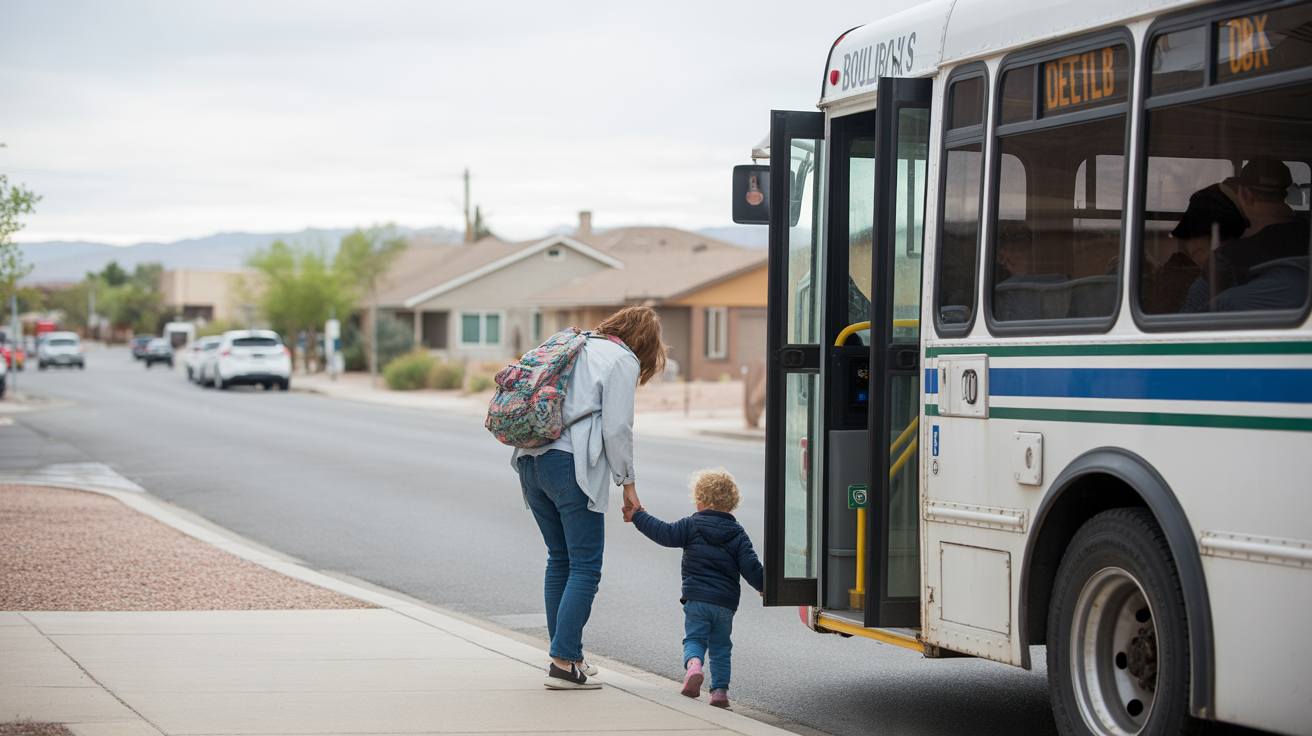
Boulder City does have bus service. Routes connect parts of the city and provide links to the broader Las Vegas metro area, including access to systems such as the Regional Transportation Commission of Southern Nevada (RTC). For residents who live near a bus stop and work along a served corridor, transit can be a practical option—especially for single-destination commutes.
But coverage is limited. Bus service works best for people whose routines align with existing routes and schedules. If your job, grocery store, or childcare provider sits outside those corridors, transit becomes a supplement rather than a primary solution. Late hours, weekend service, and multi-stop errands tend to fall outside what the bus network can reliably support.
Transit in Boulder City is not a substitute for driving—it’s an option for a narrow set of trips. Households that depend on it exclusively face real constraints around errands, flexibility, and access to services.
Driving & Car Dependence Reality
Driving is the default in Boulder City, and the city’s layout reinforces that. Parking is generally available and uncontested. Roads are designed to move cars efficiently, and the low-rise character of the built environment means destinations are spread across a wider area than you’d find in a denser city.
Car dependence here isn’t just about commuting—it’s about daily logistics. Grocery runs, medical appointments, school pickups, and errands all assume vehicle access. Gas prices in Boulder City currently sit at $3.35 per gallon, which matters when driving is non-negotiable rather than optional.
For families, owning a car (or two) is a structural necessity, not a lifestyle choice. The time and flexibility that come with driving outweigh the costs for most households, especially when transit can’t reliably serve the full range of weekly needs.
Commuting Patterns & Daily Mobility
Commuting in Boulder City often means commuting out of Boulder City. The city functions as a residential base for workers employed elsewhere in the Las Vegas metro. The 23-minute average commute reflects a mix of local jobs and longer drives into the valley.
For those working locally, commutes are short and predictable. For those heading to Las Vegas or Henderson, commutes stretch longer and depend heavily on traffic patterns along US-93 and other regional corridors. The high percentage of long commutes—over one-third of workers—suggests that proximity to Boulder City’s center doesn’t always mean proximity to work.
Daily mobility here is structured around the car. Multi-stop trips (work, daycare, grocery store) are common, and transit doesn’t accommodate that complexity well. Flexibility and control over timing matter more than they would in a city with dense, frequent transit service.
Who Transit Works For — and Who It Doesn’t
Public transit in Boulder City works for a specific subset of residents: those who live near a bus route, work along a served corridor, and don’t need to make frequent stops for groceries or errands. If your routine is simple and linear, the bus can be a viable option.
Transit doesn’t work well for families managing school schedules, households that shop weekly at distant supermarkets, or workers whose jobs require flexibility or off-hours availability. The sparse distribution of food and grocery options means even residents in walkable neighborhoods can’t rely on transit to handle daily household logistics.
Renters in core areas closer to bus stops have better access than those in peripheral neighborhoods, but access alone doesn’t solve the errands problem. Homeowners, especially those with children or irregular schedules, almost universally rely on personal vehicles.
Transportation Tradeoffs in Boulder City
Choosing between transit and driving in Boulder City isn’t really a choice for most people—it’s a question of whether your specific circumstances allow transit to work at all. The tradeoff isn’t cost versus convenience; it’s predictability and control versus limited flexibility.
Driving offers the ability to handle complex, multi-stop days. It allows you to live anywhere in Boulder City without worrying about route coverage. It gives you access to the full range of grocery stores, medical facilities, and services across the metro area. The downside is ongoing exposure to fuel prices, maintenance, insurance, and the time spent behind the wheel.
Transit offers lower direct costs and eliminates some of the hassles of car ownership, but only if your life fits within its narrow operational envelope. For most households, that fit doesn’t exist. The city’s structure—walkable in pockets, but sparse in daily services—means driving remains the practical default.
FAQs About Transportation in Boulder City (2026)
Is public transit usable for daily commuting in Boulder City?
It depends on where you live and work. If both your home and workplace sit along a bus route, transit can handle a straightforward commute. But if your job requires flexibility, involves multiple stops, or sits outside served corridors, driving becomes necessary. Most Boulder City residents drive.
Do most people in Boulder City rely on a car?
Yes. The city’s sparse grocery and food access, combined with limited transit coverage, makes car ownership essential for the vast majority of households. Even areas with strong pedestrian infrastructure don’t offer enough nearby services to support car-free living.
Which areas of Boulder City are easiest to live in without a car?
Areas near bus stops and within walking distance of at least some services offer the best chance of reducing car dependence, but no part of Boulder City fully supports a car-free lifestyle. Errands, grocery shopping, and healthcare access almost always require a vehicle.
How does commuting in Boulder City compare to nearby cities?
Boulder City’s 23-minute average commute is moderate, but over one-third of workers face long commutes, often into Las Vegas or Henderson. Compared to denser parts of the metro, Boulder City offers less transit frequency and coverage, making driving the dominant commute mode.
Can you get by with one car in Boulder City?
Some households manage with one vehicle, especially if work schedules align or one partner works from home. But the low work-from-home rate and the need for frequent errands mean many families find two cars more practical, particularly when children or irregular schedules are involved.
How Transportation Fits Into the Cost of Living in Boulder City
Transportation in Boulder City isn’t just a line item—it’s a structural factor that shapes where you can live, how you spend your time, and what tradeoffs you face daily. The city’s layout and service distribution mean monthly expenses almost always include vehicle costs: fuel, insurance, maintenance, and depreciation.
Because driving is essential rather than optional, transportation costs are less variable than they might be in a transit-rich city. You can’t easily substitute a bus pass for a car payment here. What you can control is how much you drive, where you choose to live relative to work, and how you structure errands to minimize redundant trips.
Understanding how people actually get around Boulder City—and why the city’s walkable pockets don’t translate into car-free living—helps clarify what moving here really requires. It’s not about whether you like driving; it’s about whether your household can function without it. For most, the answer is no, and planning accordingly makes the transition smoother and more realistic.
How this article was built: In addition to public economic data, this article incorporates location-based experiential signals derived from anonymized geographic patterns—such as access density, walkability, and land-use mix—to reflect how day-to-day living actually feels in Boulder City, NV.
—