
Transit Coverage & Typical Ride Context in Bothell
| Transit Type | Coverage Pattern | Typical Use Case |
|---|---|---|
| Bus Service | Corridor-clustered | Commute to Seattle core; limited local errands |
| Rail Transit | Not present | N/A |
| Bike Infrastructure | Notable throughout parts of city | Recreation and short trips in walkable pockets |
| Pedestrian Infrastructure | High ratio in pockets | Local errands in mixed-use areas |
How People Get Around Bothell
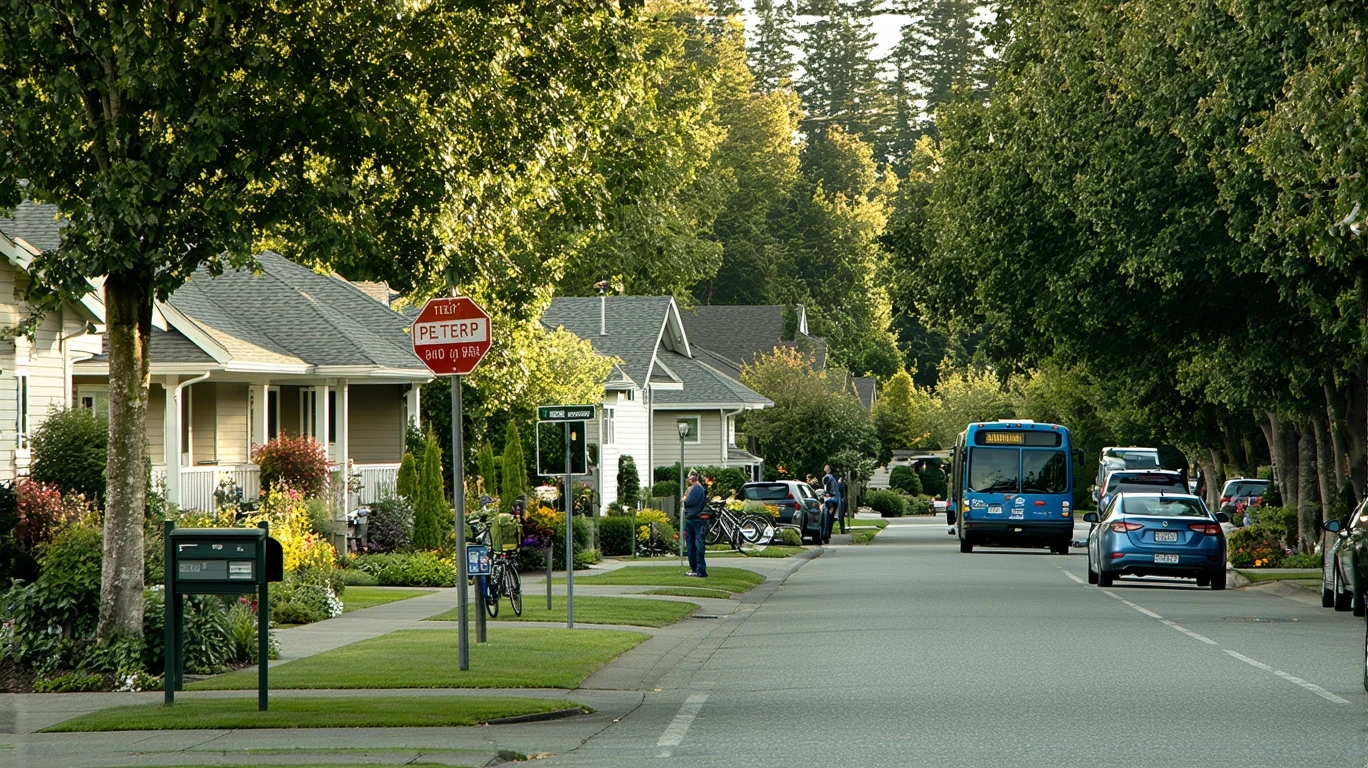
Transportation options in Bothell reflect a suburban structure with selective urban features. Most residents rely on personal vehicles for daily mobility, but the city supports walkable pockets with substantial pedestrian infrastructure and notable cycling networks. Bus service exists and connects residents to the broader Seattle metro, but it serves specific corridors rather than blanketing the city. Newcomers often expect either full suburban car dependence or urban transit convenience; Bothell delivers neither extreme. Instead, it offers a mixed environment where mobility depends heavily on where you live within city limits and where you need to go.
The layout matters more than the label. Bothell’s development pattern includes both low-rise residential zones and areas with mixed land use, meaning some neighborhoods support walking to grocery stores or cafes while others require driving for every errand. The pedestrian-to-road ratio exceeds typical suburban thresholds in certain areas, and bike infrastructure is present at levels that support recreational and short-trip cycling. But these features don’t eliminate the structural role of the car—they reduce its dominance in specific contexts.
Understanding how transportation works here requires recognizing that access is uneven. A household near a bus corridor with nearby food and grocery options experiences Bothell differently than a household in a peripheral residential zone. Both are part of the same city, but their daily mobility patterns, time costs, and flexibility differ significantly.
Public Transit Availability in Bothell
Public transit in Bothell often centers around systems such as King County Metro and Community Transit, though coverage varies by area. Bus service is present and connects key corridors, but it does not provide the frequency, span, or geographic reach that would make it a default option for most households. Transit works best for commuters traveling to Seattle’s core during peak hours and for residents living near major routes. It works poorly for multi-stop errands, off-peak travel, or trips within Bothell itself.
The absence of rail transit shapes the transit experience significantly. Without light rail or commuter rail, all public transportation depends on bus routes that share road space with cars, meaning travel times fluctuate with traffic conditions. This introduces unpredictability that affects reliability, especially for reverse commutes or cross-suburb trips. Residents who depend on transit for work typically structure their schedules around bus availability rather than their own preferences.
Transit coverage is corridor-clustered rather than evenly distributed. Areas near commercial centers or arterial roads have better access, while residential neighborhoods farther from these corridors may require a car just to reach a bus stop. This geographic unevenness means that transit viability is not a citywide characteristic—it’s a neighborhood-level variable. Households considering a move to Bothell should evaluate transit access block by block, not city by city.
Driving & Car Dependence Reality
Driving remains the primary mode of transportation for most Bothell residents, not because transit is absent but because the structure of daily life requires it. Grocery stores, schools, medical appointments, and social activities are often spread across distances that make walking impractical and transit slow or unavailable. Even in areas with good pedestrian infrastructure, the car provides flexibility that transit cannot match—particularly for households managing multiple stops, irregular schedules, or trips outside the city.
Parking is generally available and less constrained than in denser urban cores, which reduces one friction point associated with car ownership. However, car dependence introduces its own costs and tradeoffs. Households must budget for vehicle maintenance, insurance, and fuel—currently priced at $3.97 per gallon in Bothell—and they must accept that commute times and distances are largely non-negotiable. The car offers control and convenience, but it also locks in a baseline transportation expense that transit users can sometimes avoid.
The city’s mixed building heights and land-use patterns mean that some neighborhoods support car-light living in theory, but in practice, most households still own at least one vehicle. The question is not whether to own a car, but how often it must be used. Residents in walkable pockets may drive less frequently, but they rarely eliminate the car entirely.
Commuting Patterns & Daily Mobility
Commuting in Bothell often involves travel to Seattle or other parts of the metro area rather than within the city itself. The local economy provides jobs, but many residents work elsewhere, which shapes daily mobility patterns and time costs. Single-job commuters with fixed schedules and destinations along transit corridors may find bus service workable, particularly if their employer is located in Seattle’s downtown core. Multi-stop commuters, parents managing school drop-offs, or workers with variable hours typically rely on cars.
The structure of the commute matters as much as the distance. A straight shot to a transit-accessible job site is fundamentally different from a commute requiring transfers, waiting, or travel during off-peak hours when service is less frequent. Bothell’s bus network supports the former better than the latter. Residents who work in suburban office parks, retail centers, or industrial areas outside the urban core usually find that driving is the only practical option.
Daily mobility extends beyond commuting. Errands, healthcare appointments, and social activities all require transportation, and the accessibility of these destinations varies across Bothell. Food and grocery density is high in some areas and moderate in others, meaning some households can walk to a store while others cannot. This unevenness affects not just convenience but also the cumulative time cost of living in Bothell. Households that must drive for every task absorb more friction than those who can walk or bike for some errands.
Who Transit Works For — and Who It Doesn’t
Transit in Bothell works best for young renters living in walkable pockets near bus corridors who commute to Seattle’s core for work. These households benefit from the combination of local pedestrian infrastructure and regional bus connections, allowing them to minimize car use without sacrificing access to employment or amenities. They typically tolerate longer travel times in exchange for lower transportation costs and the ability to avoid car ownership entirely.
Transit works poorly for families, homeowners in peripheral areas, and anyone whose daily routine requires multiple stops or off-peak travel. Families managing school schedules, grocery runs, and extracurricular activities find that transit’s limited coverage and frequency make it impractical for coordinating household logistics. Homeowners in lower-density residential zones often live too far from bus stops to make transit a realistic option, even if they work along a transit corridor.
The fit is not about preference—it’s about structure. A household’s ability to use transit depends on where they live, where they work, and how many trips they need to make each day. Bothell’s transportation landscape rewards simplicity: single-destination commuters with flexible schedules and proximity to transit. It penalizes complexity: multi-stop errands, irregular hours, and geographic distance from corridors.
Transportation Tradeoffs in Bothell
Choosing between transit and driving in Bothell involves tradeoffs in predictability, control, flexibility, and exposure. Transit offers lower direct costs and eliminates vehicle maintenance, but it introduces time costs, schedule constraints, and geographic limitations. Driving offers convenience and flexibility, but it requires ongoing expense and ties households to fuel price volatility and parking availability.
Predictability differs between modes. Driving allows households to control departure times and routes, but traffic conditions introduce variability. Transit removes the driver from traffic decisions but imposes fixed schedules and transfer requirements that limit spontaneity. Households that value control and time efficiency typically choose driving. Those willing to trade time for cost savings and environmental impact may choose transit, but only if their geography and routine support it.
Flexibility is where driving holds the strongest advantage. A car enables multi-stop trips, last-minute changes, and travel to destinations not served by transit. This flexibility is particularly valuable for families and workers with variable schedules. Transit’s rigidity makes it a poor fit for households managing complex logistics, even when it serves their primary commute route.
Exposure to external factors also varies. Drivers absorb fuel price changes and vehicle repair costs. Transit users absorb service cuts, schedule changes, and fare adjustments. Neither mode eliminates exposure entirely—households simply choose which risks they prefer to manage.
FAQs About Transportation in Bothell (2026)
Is public transit usable for daily commuting in Bothell?
Public transit is usable for commuters traveling to Seattle’s core during peak hours, particularly those living near major bus corridors. It is less practical for trips within Bothell, off-peak travel, or commutes to suburban job sites. Viability depends on where you live and where you work.
Do most people in Bothell rely on a car?
Yes. Most Bothell residents rely on personal vehicles for daily mobility, even in areas with walkable infrastructure. The city’s layout, job distribution, and transit coverage make car ownership the default for most households, though some residents in walkable pockets near transit corridors reduce car dependence.
Which areas of Bothell are easiest to live in without a car?
Areas with high pedestrian infrastructure density, mixed land use, and proximity to bus stops offer the best conditions for car-light living. These tend to be near commercial corridors where food, grocery, and transit access overlap. Peripheral residential zones require a car for most daily tasks.
How does commuting in Bothell compare to nearby cities?
Bothell’s commute structure resembles other Seattle-area suburbs: car-dependent for local trips, bus-supported for Seattle-bound commutes. It lacks the rail access found in cities closer to Link light rail stations, which limits transit speed and frequency. Compared to denser urban cores, Bothell offers easier parking and less traffic congestion, but longer travel times for non-drivers.
Does Bothell have good bike infrastructure?
Bothell has notable bike infrastructure relative to typical suburban standards, with bike-to-road ratios exceeding high thresholds in parts of the city. This supports recreational cycling and short trips within walkable areas, but it does not replace the car for most daily errands or commutes. Bike infrastructure is present but not comprehensive.
How Transportation Fits Into the Cost of Living in Bothell
Transportation shapes the cost of living in Bothell not just through direct expenses like fuel and fares, but through its effect on housing choice, time, and flexibility. Households that prioritize transit access or walkability may pay more for housing in central locations, trading rent or mortgage costs for lower transportation expenses. Those who choose peripheral areas with lower housing costs typically absorb higher transportation costs and longer commutes.
The structural role of the car also affects household budgets indirectly. Car ownership requires insurance, maintenance, and fuel, all of which are recurring and largely non-negotiable. These costs do not appear in rent or mortgage payments, but they constrain disposable income just as much. Households evaluating [Your Monthly Budget in Bothell: Where It Breaks](/bothell-wa/monthly-budget/) should account for transportation as a fixed cost category, not a discretionary one.
Time is another cost that transportation imposes. Long commutes reduce time available for work, family, and leisure, even if they do not directly increase spending. Households that prioritize time over money may choose housing closer to work or transit, accepting higher rent in exchange for shorter commutes. Those willing to trade time for affordability may choose peripheral locations, but they should recognize that the tradeoff is real and cumulative.
Transportation decisions in Bothell are not isolated—they interact with housing, employment, and household structure. Understanding how people actually move through the city, manage errands, and structure their days provides the context needed to evaluate whether Bothell’s transportation landscape fits your routine. The city offers options, but it does not eliminate the need to choose between cost, time, and convenience.
How this article was built: In addition to public economic data, this article incorporates location-based experiential signals derived from anonymized geographic patterns—such as access density, walkability, and land-use mix—to reflect how day-to-day living actually feels in Bothell, WA.
—