
“It’s charming until you realize you need to drive 15 minutes just to grab something you forgot at the store — and even then, your options are limited.”
That tension — between Hill Country charm and the logistics of daily life — captures much of what people feel about living in Boerne. It’s a place that rewards those who want space, quiet, and a slower pace, but it asks you to accept that convenience and spontaneity aren’t part of the deal. Whether that tradeoff feels like relief or restriction depends entirely on what you’re leaving behind and what you’re hoping to find.
What Living in Boerne Actually Feels Like
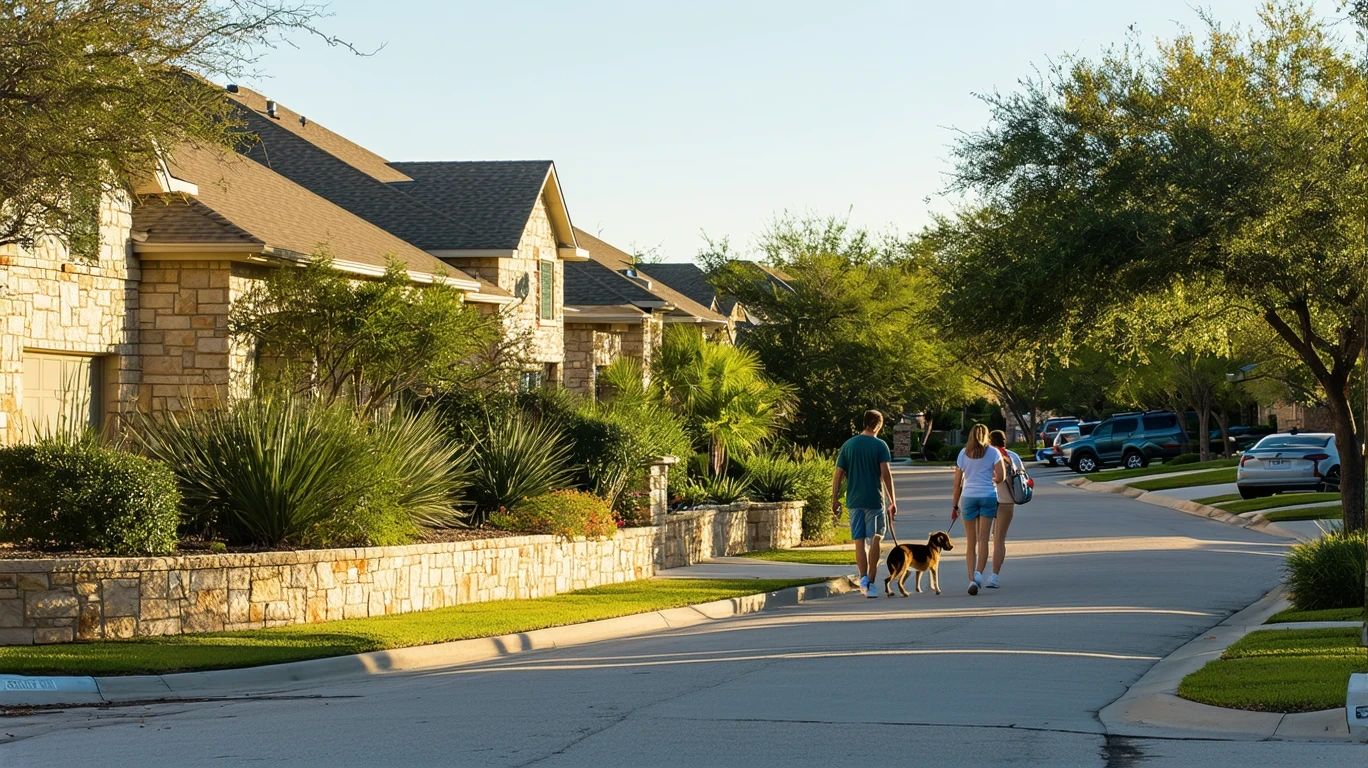
Boerne sits in that complicated middle ground: too close to San Antonio to feel truly remote, but far enough that you’re making a deliberate choice to live outside the metro’s daily texture. The town has grown steadily, and that growth shows up in new subdivisions, chain retailers along the main corridors, and a steady stream of newcomers drawn by the Hill Country setting and the promise of a quieter life.
But growth hasn’t changed the fundamental structure of the place. Boerne remains car-oriented, with errands clustered along a few key corridors rather than woven into neighborhoods. Pedestrian infrastructure is minimal, and while some cycling paths exist in pockets, they don’t form a network that supports daily errands or commuting. The town’s low-rise, spread-out form means that even when residential and commercial uses mix, they don’t create the kind of walkable density that lets you run out for coffee or groceries on foot.
For people who wanted to escape urban intensity, that’s exactly the point. For those who assumed “small town” would mean a charming downtown where everything is a short stroll away, it’s a surprise — and often a frustrating one. The reality is that living here means planning your errands, bundling trips, and accepting that your car is your primary tool for navigating daily life.
The Emotional Currents in Local Conversation
Public discussion about Boerne tends to revolve around identity and change. On platforms like Facebook and in local online groups, you’ll find pride in the town’s Hill Country character, protectiveness over what makes it feel distinct from San Antonio’s sprawl, and recurring anxiety about whether growth is eroding the qualities that drew people here in the first place.
Common themes include:
- Nostalgia vs. pragmatism: Long-time residents express affection for “old Boerne” while acknowledging that new retail and services have made life more convenient.
- Commute tension: Many households live in Boerne but work in San Antonio, and the daily drive becomes a recurring topic — sometimes framed as a worthy tradeoff, sometimes as a source of fatigue.
- Errand frustration: Newcomers often mention the learning curve of figuring out where things are and how far apart they sit, especially if they moved from a denser area.
- Community pride: There’s a strong sense of local identity, especially around schools, youth sports, and seasonal events, even as the town’s population diversifies.
Composite sentiments you might encounter:
“We moved here for the space and the schools, and we got that. But I didn’t realize how much time I’d spend in the car just managing the basics.”
“It’s peaceful, and that’s worth a lot. But if you’re used to being able to walk somewhere interesting, you’ll feel it.”
“Boerne still feels like a real town, not just a suburb. But you have to be okay with the fact that ‘real town’ doesn’t mean walkable downtown — it means driving to everything.”
How Local Coverage Frames the Town
Local news and community coverage in Boerne tends to focus on growth management, infrastructure adaptation, and the ongoing negotiation between preserving small-town character and accommodating new residents. The tone is rarely alarmist, but it’s not purely celebratory either — there’s an awareness that change brings both opportunity and friction.
Recurring story themes include:
- “New Development Brings Amenities and Questions About Pace”
- “Residents Weigh Convenience Against Quiet”
- “Schools Expand as Families Continue to Arrive”
- “Traffic and Commute Times Become Part of Daily Conversation”
- “Community Debates What Growth Should Look Like”
The framing tends to reflect a town in transition — not in crisis, but not static either. For readers trying to understand the vibe, that means Boerne is a place where change is visible and discussed, but where the pace still feels manageable compared to metro-area intensity.
What Reviews and Public Feedback Reveal
On platforms like Google, Yelp, and neighborhood forums, the pattern is clear: people who wanted suburban space, good schools, and a break from urban density tend to feel satisfied. People who expected walkability, variety, or easy access to nightlife and cultural amenities tend to feel let down.
Praise often centers on:
- Quiet neighborhoods and a slower pace of life
- Access to Hill Country scenery and outdoor spaces
- Strong sense of community, especially for families involved in schools and sports
- Proximity to San Antonio for occasional metro access without living in it
Criticism often focuses on:
- Limited dining and entertainment options compared to urban areas
- Car dependency and the time required to run errands
- Lack of walkable neighborhoods or transit alternatives
- Feeling of sameness in retail and housing, especially in newer developments
Neighborhood distinctions tend to be subtle. Older pockets near the historic downtown area offer more character and slightly shorter distances to local shops, but they’re still car-dependent. Newer planned communities farther out offer modern amenities and HOA-managed green space, but they amplify the sense of distance and require even more driving for daily needs.
How Boerne Compares to Nearby Cities
| Dimension | Boerne | San Antonio | New Braunfels |
|---|---|---|---|
| Overall Vibe | Quiet Hill Country suburb with growth tension | Metro energy, walkable pockets, transit options | Tourist-adjacent, family-friendly, similar car dependence |
| Walkability | Minimal; car required for nearly everything | Varies by neighborhood; some walkable districts | Low; similar suburban structure |
| Dining & Nightlife | Limited; chains dominate, few independent spots | Extensive variety, late-night options | Moderate; tourist-focused, family-oriented |
| Commute Reality | Many commute to San Antonio; adds daily time | Internal commutes; more job density | Similar commuter dynamic to San Antonio |
| Community Feel | Strong local identity, family-focused | Diverse, neighborhood-dependent | Family-oriented, tourism influences tone |
The comparison isn’t about declaring a winner — it’s about helping you predict alignment. If you value metro texture, spontaneous outings, and transit options, San Antonio will feel more accommodating. If you want Hill Country scenery and a slower pace but still need variety and walkability, you may find all three cities fall short in different ways. If you’re comfortable with car dependency and want a family-focused environment with access to outdoor space, Boerne and New Braunfels offer similar tradeoffs, with Boerne leaning slightly quieter and New Braunfels slightly more tourist-influenced.
Voices from Different Life Stages
“We moved here with two kids in elementary school, and it’s been great for that stage of life. The schools are solid, the neighborhoods feel safe, and there’s enough space for them to play. But I do miss being able to walk to a coffee shop or have a spontaneous dinner out without planning the whole evening around driving.”
— Family with young children
“I work remotely, so the commute isn’t an issue for me. What I love is the quiet and the access to trails. What I didn’t expect was how much I’d have to drive just to meet friends or grab something I needed. It’s peaceful, but it’s also isolating if you’re not intentional about staying connected.”
— Remote worker in their 30s
“We retired here because we wanted Hill Country views and a slower pace, but we didn’t want to be too far from medical care and shopping. Boerne checks those boxes, but you do need to be comfortable driving. If that ever becomes hard, we’ll have to rethink.”
— Retiree couple
“I thought ‘small town’ meant I could walk to the grocery store or ride my bike to run errands. That’s not how it works here. Everything is spread out, and there’s no real infrastructure for getting around without a car. It’s fine if that’s what you expect, but it wasn’t what I pictured.”
— Newcomer in their 20s
“I grew up here, and it’s definitely changed. More people, more traffic, more chain stores. But it still feels like Boerne. You still know people at the grocery store, and there’s still a sense of community. It’s just bigger now.”
— Long-time local
“The commute to San Antonio is the price we pay for living here, and some days it feels worth it, and some days it doesn’t. If you can work from home a few days a week, it’s much more manageable.”
— Commuter household
“It’s a good place to raise kids if you want them to have space and a safe environment. But if you’re looking for culture, variety, or walkable streets, you’re going to feel the limits pretty quickly.”
— Parent of teenagers
Does Boerne Feel Like a Good Fit?
Boerne doesn’t ask you to choose between rural isolation and urban intensity — it offers something in between. But that middle ground comes with specific tradeoffs, and whether they feel manageable or frustrating depends on what you’re optimizing for.
This tends to work for:
- Families who want space, good schools, and a slower pace, and who are comfortable with car dependency
- Retirees seeking Hill Country charm with proximity to San Antonio’s medical and cultural amenities
- Remote workers who don’t need daily urban texture and value quiet over convenience
- People who see the commute to San Antonio as a worthwhile tradeoff for living outside the metro
This tends to frustrate:
- Young professionals who want walkable neighborhoods, nightlife, and spontaneous social options
- Households without reliable cars or who hoped to reduce car dependence
- People who value variety in dining, entertainment, and cultural experiences
- Those who assumed “small town” would mean a charming, walkable downtown rather than a car-oriented suburb
The town’s emotional profile isn’t about happiness or unhappiness — it’s about alignment. If you’re moving to Boerne, the question isn’t whether it’s a “good” place. The question is whether the structure of daily life here matches the structure of the life you’re trying to build. If you’re still weighing [housing tradeoffs](/boerne-tx/housing-costs/), [monthly expenses](/boerne-tx/monthly-budget/), or [lifestyle requirements](/boerne-tx/lifestyle-requirements/), those pieces will help you see whether the fit is real or just appealing in theory.
How this article was built: In addition to public economic data, this article incorporates location-based experiential signals derived from anonymized geographic patterns—such as access density, walkability, and land-use mix—to reflect how day-to-day living actually feels in Boerne, TX.
The perspectives shown reflect commonly expressed local sentiment and recurring themes in public discussion, rather than individual accounts.