
Is Boerne expensive to live in? Boerne is considered moderately priced in 2026, with a median home value of $398,500 anchoring the cost structure. The value proposition depends on housing entry cost versus car dependence and commuting exposure.
When Maya and her partner started researching their move from Austin to the Hill Country, they expected Boerne to feel like a bargain. The home prices looked reasonable compared to the capital, and the idea of small-town life with San Antonio access seemed like a win. But as they dug into the details—fuel costs for daily errands, the reality of summer cooling bills, the need for two reliable vehicles—they realized the cost structure here doesn’t reveal itself in rent alone. Boerne’s expenses are shaped less by sticker prices and more by the rhythms of car-dependent suburban life, where distance, seasonality, and ownership all compound quietly over time.
Overall Cost of Living Snapshot
Boerne’s cost structure sits slightly below the national baseline, with a regional price parity index of 94. That positioning reflects a place where housing dominates financial pressure, but groceries, utilities, and transportation remain within reach for households prepared for the structural realities of suburban Texas living. The primary cost driver is homeownership: a median home value of $398,500 sets the entry threshold and defines long-term financial exposure. Renters face a median gross rent of $1,453 per month, but the rental market plays a secondary role here—this is a city built around ownership, equity, and the assumption of a car in every driveway.
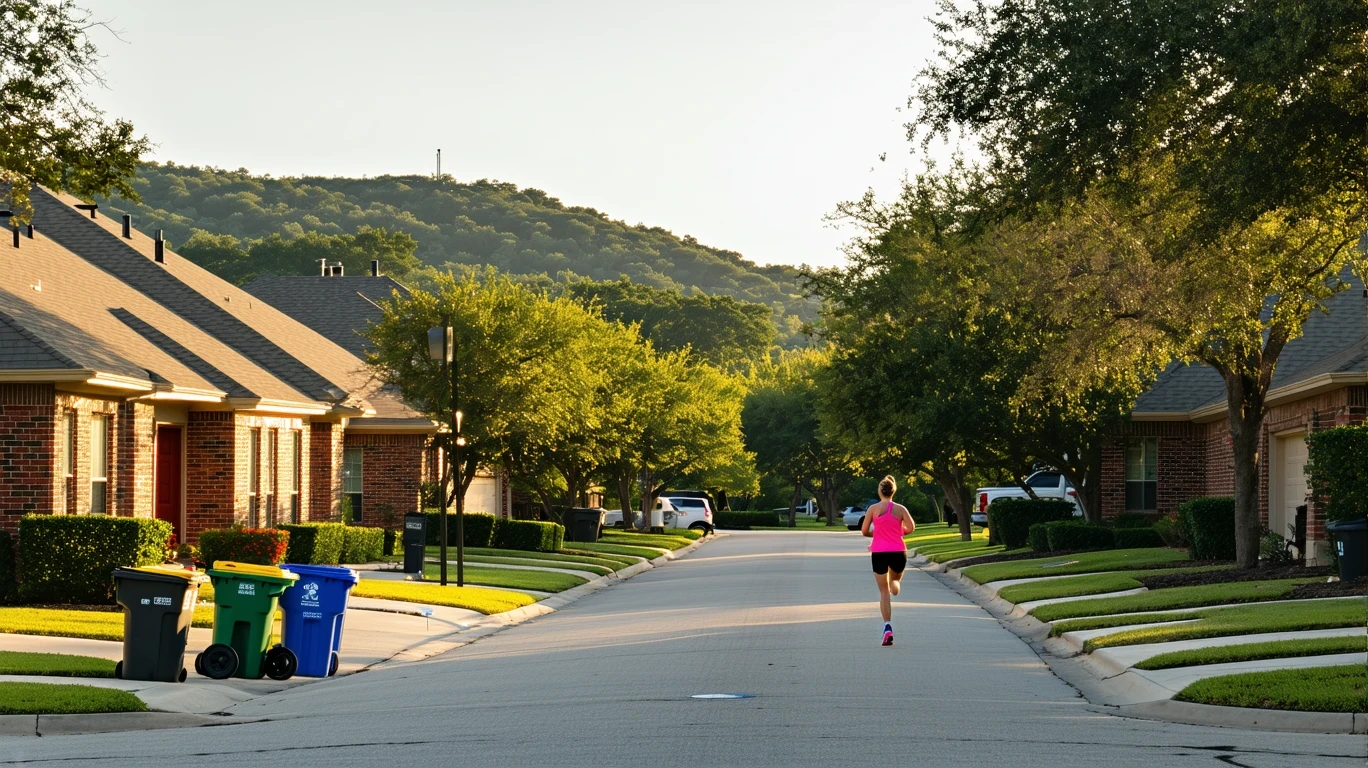
What surprises newcomers is not the price of any single category, but the cumulative weight of car dependency and seasonal utility swings. Boerne’s infrastructure is car-oriented, with pedestrian pathways well below density thresholds and food and grocery options clustered along corridors rather than distributed throughout neighborhoods. That means even short errands require planning, fuel, and time. Combine that with extended cooling seasons in triple-digit summer heat, and the cost profile becomes clear: this is a place where the biggest expenses are structural, not transactional.
Driver verdict: Housing entry cost and vehicle ownership dominate. Surprises come from the volume of driving required and the seasonal intensity of cooling bills, not from high per-unit prices.
Housing Costs (Primary Driver)
At $398,500, the median home value in Boerne reflects a market oriented toward single-family ownership in a low-rise, mixed-use environment. Homes here are not vertical or dense—average building levels fall well below thresholds for multi-story construction—but they do sit within a community where residential and commercial land use coexist. That means buyers are paying for space, privacy, and a slower pace, not walkable convenience or transit access.
For renters, the median gross rent of $1,453 per month offers an alternative, but it’s not the primary housing mode. Rental inventory exists, but the city’s structure and household composition tilt heavily toward ownership. The renting-versus-owning decision here hinges on timeline and mobility: renting makes sense for newcomers testing the market or those prioritizing flexibility, but long-term residents overwhelmingly choose to buy, locking in predictable housing costs and building equity in a market with limited rental depth.
Conclusion: Boerne is a buying city. Renting is a transitional option, not a long-term cost strategy.
| Housing Type | Cost Anchor | What That Buys You |
|---|---|---|
| Median Home Value | $398,500 | Single-family ownership in low-rise, car-oriented suburb with mixed land use |
| Median Gross Rent | $1,453/month | Transitional flexibility in a market built for owners |
Utilities & Energy Risk
Electricity in Boerne costs 16.11¢ per kilowatt-hour, a rate that becomes meaningful during the extended cooling season. Summer heat regularly climbs into triple digits, and air conditioning dominates household energy use from late spring through early fall. The intensity and duration of that exposure—not the per-unit rate—drive the financial impact. Households here experience pronounced seasonal swings in utility bills, with summer months creating the highest cost pressure.
Natural gas is priced at $30.71 per thousand cubic feet, but heating demand is minimal given the climate. Gas usage, when present, is concentrated in rare cold snaps rather than sustained winter heating. The result is a utility profile heavily skewed toward electricity, with volatility tied directly to temperature and cooling behavior.
Risk classification: Moderate. Seasonal cooling exposure is predictable but significant, and households without efficiency measures or budget cushion will feel the swing between mild and peak months.
Groceries & Daily Costs
Grocery costs in Boerne reflect the regional price parity adjustment, landing slightly below national baseline levels. Derived estimates suggest staples like bread cost around $1.72 per pound, eggs $2.55 per dozen, and ground beef $6.29 per pound, though these figures are modeled rather than observed and should be understood as illustrative context, not guarantees. The practical takeaway is that grocery pricing itself is not a major cost driver here—what matters more is access and logistics.
Because food and grocery establishments are clustered along corridors rather than distributed evenly, running errands requires intentional planning and vehicle use. There’s no walking to the corner store or grabbing milk on the way home from a bus stop. Every grocery trip is a driving trip, and that recurring transportation exposure compounds the true cost of feeding a household. For families managing multiple errands per week, the fuel and time costs add up faster than the groceries themselves.
Transportation Reality
Boerne’s infrastructure is built for cars, and the experiential signals confirm it. Pedestrian pathways are sparse relative to road networks, bike infrastructure exists only in limited pockets, and public transit is absent. The result is a place where every household needs at least one vehicle, and most need two. Errands, work commutes, school drop-offs, and social outings all require driving, and there is no viable alternative.
Gas prices sit at $2.46 per gallon, a favorable rate that softens the per-trip cost but does nothing to reduce the volume of trips required. The real transportation tradeoffs come from distance and frequency: how far you commute, how often you drive, and how many vehicles your household operates. For single-car households with short commutes, transportation remains manageable. For multi-car households with longer commutes or frequent errands, fuel and maintenance become a recurring, non-negotiable expense that rivals or exceeds utilities.
The unemployment rate of 3.3% suggests a stable local economy, but many residents commute to San Antonio or other nearby employment centers, adding mileage and time to the daily routine. Without commute-specific data, the safest assumption is that transportation is a high-exposure category for most households here.
Cost Exposure Profiles
In Boerne, cost exposure is defined by three structural factors: housing entry versus long-term ownership, transportation dependence, and utility volatility. Households with low exposure are those who own outright or have locked in favorable mortgage terms, work locally or from home, operate a single fuel-efficient vehicle, and have implemented cooling efficiency measures. These households experience Boerne as a stable, moderately priced environment with predictable monthly rhythms.
High-exposure households face a different reality. Recent buyers stretching to meet the $398,500 median home value carry large mortgage obligations. Multi-car households commuting to San Antonio rack up significant fuel and maintenance costs, even at $2.46 per gallon. Renters in older, less-efficient units face summer cooling bills that swing unpredictably. And families relying on corridor-clustered grocery access spend more time and fuel managing daily errands than they would in a walkable or transit-served community.
The key insight is that Boerne’s cost structure rewards stability and penalizes transition. Established owners with paid-off homes and short commutes enjoy low ongoing costs. Newcomers, renters, and long-distance commuters absorb the highest financial friction, not because prices are high, but because the place requires upfront investment and operational volume to function smoothly.
Frequently Asked Questions
Is Boerne more affordable than San Antonio in 2026? Boerne’s housing costs tend to be higher than many San Antonio neighborhoods, but the comparison depends on which part of the metro you’re evaluating. Boerne offers space and a small-town feel, while San Antonio provides more walkable pockets and transit options that can lower transportation costs.
What does a typical cost profile look like in Boerne? Most households here own single-family homes, operate two vehicles, and experience moderate seasonal utility swings. The dominant expenses are mortgage or rent, fuel and vehicle maintenance, and summer cooling bills.
Do utilities cost more in Boerne than nearby areas? Electricity rates in Boerne are comparable to the broader Texas market, but the extended cooling season and car-oriented layout mean total utility and transportation costs can run higher than in denser, more temperate parts of the state.
What costs tend to surprise newcomers in Boerne? The volume of driving required for daily errands and the intensity of summer cooling bills catch many people off guard. It’s not that any single trip or bill is shocking—it’s the cumulative frequency and seasonal swing that add up.
Are property taxes higher in Boerne than nearby cities? Property tax rates vary by jurisdiction and district within the region. Boerne sits in Kendall County, and rates can differ from neighboring counties, so it’s worth comparing effective tax rates for specific properties rather than assuming uniformity across the metro.
Is Boerne a good fit for renters long-term? Boerne’s housing market is built for owners, and rental inventory is more limited. Renting works well as a transitional step, but most long-term residents eventually buy to lock in costs and build equity.
How does car dependency affect the cost of living in Boerne? Car dependency is the defining feature of daily life here. Every household needs at least one vehicle, and most need two. Fuel, insurance, and maintenance become recurring, non-negotiable expenses that shape the overall cost structure as much as housing or utilities.
What’s the biggest cost lever households can control in Boerne? Commute length and vehicle count are the two most impactful levers. Choosing a home closer to work or managing errands efficiently can reduce fuel and time costs significantly, while cooling efficiency measures help stabilize summer utility bills.
How this article was built: In addition to public economic data, this article incorporates location-based experiential signals derived from anonymized geographic patterns—such as access density, walkability, and land-use mix—to reflect how day-to-day living actually feels in Boerne, TX.