
“I thought I could take the bus to work when I moved here,” a daily commuter to Vancouver recalls. “Turns out, the route exists—but the schedule doesn’t really line up with my shift. So now I drive, like everyone else.”
That experience captures the transportation reality in Battle Ground: options exist on paper, but in practice, most people rely on a car for daily life. Understanding how people actually get around here—and where transit fits in—matters as much as knowing what housing costs or what the weather does to your utility bill.
How People Get Around Battle Ground
Battle Ground sits in Clark County, close enough to the Portland metro area to pull commuters south, but far enough out that local mobility follows a suburban pattern. The city’s layout reflects that: residential neighborhoods spread across a mix of single-family subdivisions and newer developments, with commercial corridors clustered along main roads rather than woven into walkable districts.
Most residents drive. That’s not a preference—it’s a structural reality. Errands, work, school runs, and weekend plans typically require a car, even in neighborhoods where sidewalks and bike lanes exist. Public transit operates here, but it plays a supporting role rather than anchoring daily life.
What newcomers often misunderstand is that Battle Ground’s day-to-day costs are shaped as much by how you move as by where you live. Commute length, parking access, and transit coverage determine how much time and money you spend just getting from place to place.
Public Transit Availability in Battle Ground
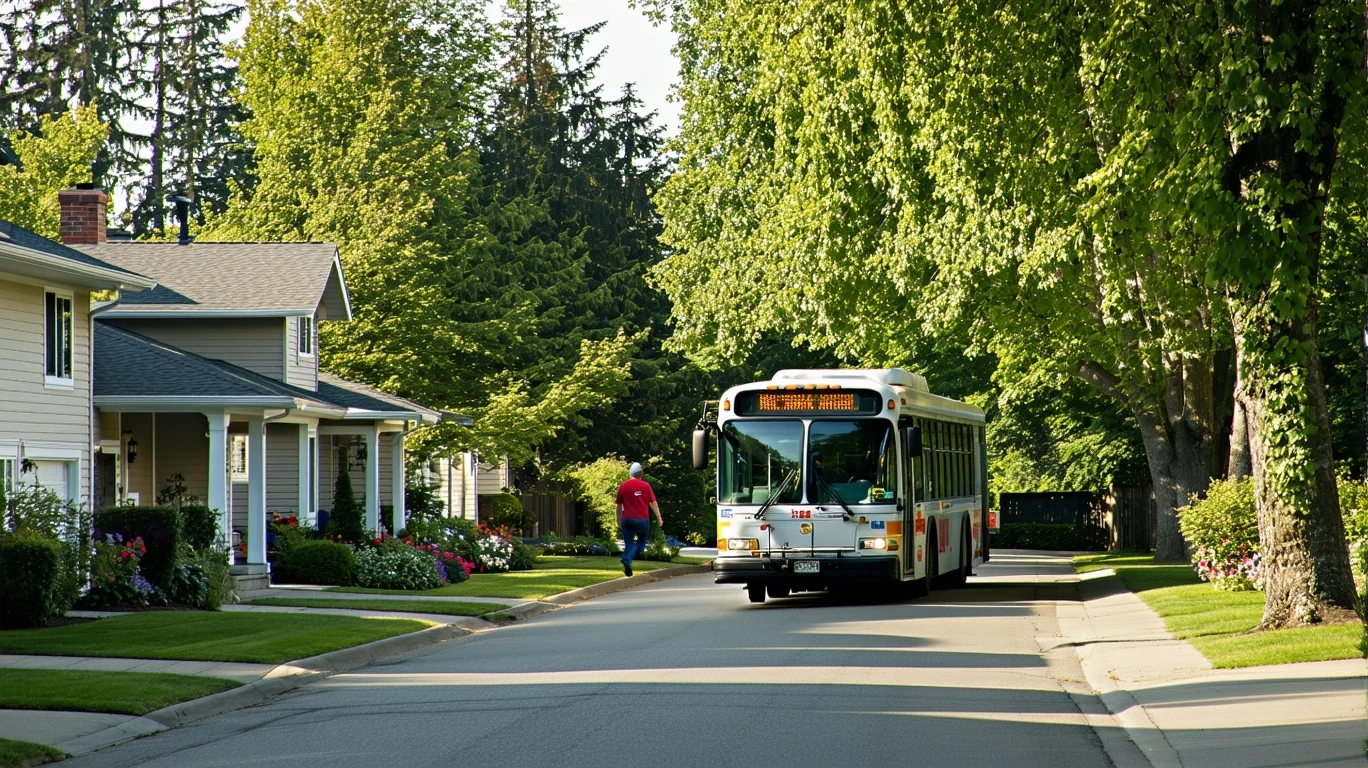
Public transit in Battle Ground centers around bus service, often provided through regional systems such as C-TRAN, which connects Clark County communities to each other and to the Portland metro area. Coverage exists, but it’s corridor-focused: routes run along major roads and serve key nodes, not every neighborhood.
Transit works best for residents near those main corridors—people who live within walking distance of a stop and whose destinations align with the route map. For everyone else, transit becomes a planning exercise: checking schedules, building in buffer time, and accepting that some trips just won’t be practical without a car.
Where transit falls short is in frequency and span. Evening service thins out, weekend schedules compress, and routes that connect Battle Ground to Vancouver or Portland require transfers and time. If your work schedule is rigid or your errands are scattered, transit becomes a backup option rather than a primary tool.
There’s no rail service here. Battle Ground doesn’t sit on a light rail or commuter rail line, so the transit experience is entirely bus-based. That limits speed and directness, especially for longer commutes.
Driving & Car Dependence Reality
Driving isn’t just common in Battle Ground—it’s the default. The city’s development pattern, with residential areas separated from commercial zones and employment centers often located outside city limits, makes car ownership nearly essential for most households.
Parking is rarely a problem. Homes come with driveways or garages, and commercial lots are sized for suburban traffic. That ease of parking reinforces car dependence: there’s little friction to driving, and plenty of friction to not driving.
Sprawl plays a role, too. Distances between home, work, grocery stores, and schools stretch beyond comfortable walking or biking range for most people. Even in neighborhoods with sidewalks and bike lanes—where infrastructure supports non-car travel—the distances involved make driving the faster, more practical choice for multi-stop days.
The tradeoff is predictability. Driving gives you control over timing, routing, and cargo capacity. You’re not waiting for a bus or adjusting plans around a schedule. But that control comes with exposure: fuel prices, maintenance costs, insurance, and the time spent behind the wheel all add up, even if they’re not always visible in a monthly budget.
Commuting Patterns & Daily Mobility
Commuting in Battle Ground often means leaving Battle Ground. Many residents work in Vancouver, Portland, or other parts of Clark County, and that geography shapes daily routines. The average commute here runs around 30 minutes, but nearly half of workers—49.3%—face what’s considered a long commute, typically defined as more than 30 minutes each way.
That long-commute figure reflects the city’s role as a bedroom community. People live here for the housing market, the space, and the quieter pace, then absorb the commute time as part of the tradeoff. For some, that works: the drive is straightforward, traffic is manageable outside peak hours, and the separation between home and work feels intentional.
For others, the commute becomes a daily friction point. Multi-stop errands—dropping kids at school, picking up groceries, getting to an evening appointment—require careful sequencing when everything is spread out and transit isn’t a viable fallback.
Work-from-home arrangements change the equation. Only 8.7% of Battle Ground workers report working from home, which is below the national average and suggests that most jobs here still require physical presence. That keeps commuting central to household logistics, even as remote work reshapes other cities.
Who Transit Works For—and Who It Doesn’t
Transit in Battle Ground works best for a narrow slice of residents: those who live near a bus route, work along a transit corridor, and have schedules flexible enough to absorb wait times and transfers. That might include renters in denser pockets near downtown, students commuting to nearby colleges, or workers whose employers sit on a direct route to Vancouver.
Transit doesn’t work well for families managing school drop-offs, workers with non-standard hours, or anyone whose daily routine involves multiple stops across different parts of the city. The infrastructure exists, but the coverage and frequency don’t support the complexity of most households’ daily patterns.
Homeowners in peripheral neighborhoods face the steepest transit disadvantage. Subdivisions on the edges of town rarely see frequent bus service, and walking to the nearest stop can mean a mile or more. At that point, driving becomes the only realistic option, and transit fades into irrelevance.
Renters closer to the core have more flexibility, but even then, transit serves as a supplement rather than a replacement for car ownership. It’s useful for specific trips—commuting to a single workplace, for example—but less useful for the full range of errands and obligations that fill a week.
Transportation Tradeoffs in Battle Ground
Choosing between transit and driving in Battle Ground isn’t really a choice for most people—it’s a question of whether transit is even viable for your situation. But for the households where both options exist, the tradeoffs come down to predictability, control, and exposure.
Transit offers lower direct costs and removes the need to manage a vehicle, but it sacrifices flexibility. You’re bound to the schedule, limited by the route map, and dependent on a system that doesn’t cover every corner of the city. If your life fits neatly into that structure, transit works. If it doesn’t, you’ll spend more time planning and waiting than you save.
Driving gives you control: you leave when you’re ready, take the route that makes sense, and handle multi-stop days without friction. But that control comes with ongoing exposure to fuel prices, maintenance needs, and the time cost of commuting. In a region where long commutes are common, that time adds up quickly.
The real tradeoff isn’t financial—it’s structural. Transit limits where you can live and work without friction. Driving limits how much time and money you’re willing to spend on mobility. Neither option is clearly better; both come with constraints that shape daily life in different ways.
FAQs About Transportation in Battle Ground (2026)
Is public transit usable for daily commuting in Battle Ground?
It depends on where you live and where you work. If both are near a bus route and your schedule aligns with service hours, transit can work. For most residents, though, transit serves as a backup or supplement rather than a primary commuting tool. Coverage is corridor-focused, and frequency doesn’t support the flexibility most households need.
Do most people in Battle Ground rely on a car?
Yes. The city’s layout, the distances involved, and the limited scope of transit coverage make car ownership nearly essential for most households. Even residents with access to transit often keep a car for errands, weekend trips, and situations where the bus schedule doesn’t line up.
Which areas of Battle Ground are easiest to live in without a car?
Neighborhoods near downtown and along main transit corridors offer the best chance of reducing car dependence, though even there, most residents find a car useful. Walkable pockets exist—areas where sidewalks, bike lanes, and nearby services make short trips manageable on foot or by bike—but those pockets are scattered, and they don’t eliminate the need for a car entirely.
How does commuting in Battle Ground compare to nearby cities?
Battle Ground’s commute patterns reflect its role as a suburban community on the edge of the Portland metro area. Commutes here tend to be longer than in more central cities, with nearly half of workers facing trips over 30 minutes. Compared to Vancouver or Portland, Battle Ground offers less transit coverage and more car dependence, but also less congestion and more straightforward driving routes.
Does Battle Ground have bike lanes or trails?
Yes. Bike infrastructure is notably present in parts of the city, with bike-to-road ratios that exceed typical suburban levels. That means some neighborhoods and corridors support cycling as a practical option for short trips. But cycling alone doesn’t replace a car for most households—it’s a supplement, useful for recreation or specific errands, but not a full mobility solution.
How Transportation Fits Into the Cost of Living in Battle Ground
Transportation isn’t just a line item in a budget—it’s a structural factor that shapes where you can live, how you spend your time, and what tradeoffs you’re willing to accept. In Battle Ground, mobility costs show up in fuel, maintenance, and insurance, but they also show up in commute time, schedule rigidity, and the limits transit places on housing choice.
If you’re evaluating whether Battle Ground fits your household, start by mapping your daily routine: where you work, where your kids go to school, where you buy groceries, and how often you need to move between those points. Then ask whether transit can realistically handle that pattern, or whether you’re planning around a car from day one.
For most households, the answer is clear: you’ll drive. The question then becomes whether the commute time, the fuel exposure, and the lack of transit fallback are acceptable tradeoffs for the housing and lifestyle Battle Ground offers.
Understanding those tradeoffs early—before you sign a lease or close on a house—gives you the clarity to choose a neighborhood and a routine that actually work. Transportation shapes daily life here as much as rent or utilities do, and getting it right makes everything else easier.
How this article was built: In addition to public economic data, this article incorporates location-based experiential signals derived from anonymized geographic patterns—such as access density, walkability, and land-use mix—to reflect how day-to-day living actually feels in Battle Ground, WA.