
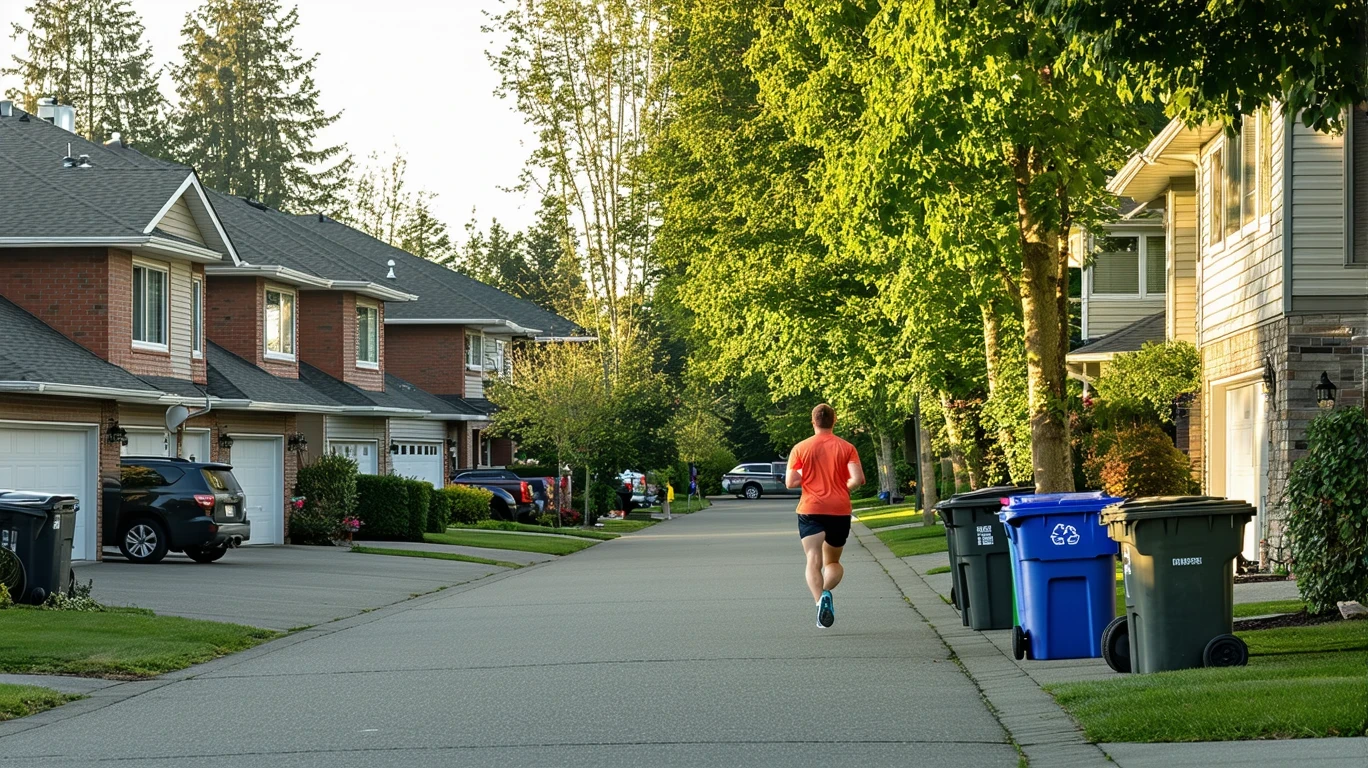
The Housing Market in Battle Ground Today
Battle Ground sits at the northern edge of the Portland metro area, functioning primarily as a commuter suburb where nearly half of all workers face long commutes. The median home value of $415,500 reflects this role: buyers trade proximity to Portland’s job centers for more space, newer construction, and a quieter residential environment. The city’s median household income of $94,360 positions many families within reach of ownership, but the decision hinges on whether the commute burden—averaging 30 minutes one way—fits their daily routine.
What newcomers often misunderstand is that Battle Ground is not uniformly car-dependent. While only 8.7% of workers telecommute and bus service exists without rail connections, the city features walkable pockets with high pedestrian-to-road ratios and broad access to food and grocery establishments. This creates a split experience: daily errands can often be managed on foot or with short drives, but employment commutes typically require a car and significant time investment. The housing market reflects this duality—buyers prioritize lot size and home condition over walkability to work, while renters weigh affordability against the friction of reaching Portland-area jobs.
Development patterns show mixed building heights and integrated land use, signaling gradual densification rather than static suburban sprawl. This matters for housing costs because it introduces variability: some neighborhoods offer single-family homes on larger lots, while others feature townhomes and smaller multifamily buildings. The result is a market where where money goes depends heavily on which part of Battle Ground you choose and how much commute time you’re willing to absorb.
Renting in Battle Ground
The median gross rent of $1,456 per month positions Battle Ground as a moderate-cost rental market within the Portland metro area, but that figure masks significant variation. Renters closer to Main Street or near grocery corridors often pay premiums for walkable access to errands, while those in outer residential zones may find lower rents but face longer drives to both work and daily services. Rental pressure is shaped less by local employment—given the low work-from-home rate and high commute share—and more by competition from Portland-area workers seeking affordability without sacrificing too much commute time.
Availability patterns reflect the city’s housing stock composition: single-family rentals are common, but multifamily options exist in pockets with higher density and mixed land use. Renters in apartments or townhomes near transit corridors benefit from bus service, though the absence of rail means most commutes still require a car. This creates a practical ceiling on rental appeal for cost-sensitive households—if you’re paying for a car, insurance, and fuel to reach work, the rent savings compared to closer-in Portland suburbs narrow quickly.
What renters gain in Battle Ground is predictability in monthly expenses beyond rent. The city’s strong park access, integrated green space, and broad grocery density mean that recreation and errands don’t require expensive memberships or long drives. For families or remote workers, this reduces hidden costs and makes the rental experience more livable. For commuters, however, the time and fuel costs become the dominant tradeoff, and rent alone doesn’t capture the full cost structure.
Owning a Home in Battle Ground
At a median home value of $415,500, ownership in Battle Ground is accessible to households earning near or above the city’s median income, but the cost experience extends well beyond the purchase price. Property taxes, homeowners insurance, and maintenance all behave differently here than in denser urban markets or rural areas. Washington State has no income tax, which shifts more of the tax burden onto property and sales taxes. While specific rates aren’t provided in local data, owners should expect property taxes to rise with assessed values over time, and those increases are less predictable than rent renewals because they depend on county budgets, school levies, and voter-approved measures.
Homeowners insurance costs are influenced by Battle Ground’s climate—wet winters, dry summers, and occasional windstorms—but the city avoids the extreme weather exposure seen in coastal or wildfire-prone zones. Maintenance costs, however, are driven by housing age and lot size. Many homes in Battle Ground sit on larger lots than typical urban properties, which means more landscaping, irrigation, and exterior upkeep. Roofs, siding, and HVAC systems all face stress from seasonal temperature swings, and older homes may require more frequent attention to insulation, windows, and heating systems.
Ownership also introduces governance exposure. Some neighborhoods are governed by homeowners associations, which can bundle services like landscaping or snow removal but also impose fees and restrict modifications. Even without an HOA, owners face municipal regulations on setbacks, fencing, and outbuildings. The key difference from renting is control: owners can upgrade insulation, install heat pumps, or add solar panels to reduce long-term utility exposure, but they also absorb the full cost of deferred maintenance and unexpected failures.
For families or remote workers, ownership in Battle Ground offers stability and space that renting rarely provides at this price point. For commuters, the decision depends on whether the home itself justifies the time and fuel costs of reaching Portland-area jobs. The housing stock supports both single-family homes and attached units, so buyers can choose between yard maintenance and lower upkeep, but the cost behavior differs significantly between these options.
Apartment vs House in Battle Ground — Cost Behavior Comparison
| Expense Category | Apartment | House |
|---|---|---|
| Base Housing Cost | Median gross rent $1,456/month; includes some utilities in older buildings | Median home value $415,500; property taxes and insurance billed separately |
| Heating & Cooling | Smaller footprint and shared walls reduce exposure; electric baseboard or forced air common | Larger square footage and detached structure increase heating demand in wet winters; cooling load moderate in dry summers |
| Outdoor Maintenance | None; landscaping and snow removal managed by property | Significant on larger lots; includes lawn care, irrigation, tree trimming, and seasonal cleanup |
| Commute Exposure | Apartments near Main Street or bus routes reduce daily driving for errands; work commute still car-dependent | Houses in outer zones require driving for most errands and work; fuel and vehicle wear increase with distance |
| Governance & Fees | Lease terms fixed annually; no HOA fees or special assessments | Property taxes adjust with assessed value; some neighborhoods have HOA fees; owners responsible for all municipal compliance |
Methodology Note: This comparison reflects cost behavior differences driven by Battle Ground’s housing stock composition, climate, and commuter role. Categories were included only where local factors—such as lot size, building density, or commute patterns—create meaningful distinctions. Generic cost differences that apply universally were omitted. Rows focus on exposure and volatility, not total monthly costs, because ownership costs depend on financing, down payment, and household-specific usage patterns not captured in aggregate data.
Utilities & Upkeep Differences
Utility exposure in Battle Ground is shaped by the Pacific Northwest climate: wet, mild winters and warm, dry summers. Heating dominates winter bills, while cooling costs remain moderate compared to regions with extreme summer heat. The electricity rate of 14.06¢/kWh and natural gas price of $24.71/MCF are both slightly above national averages, reflecting regional energy costs. For apartment dwellers, smaller square footage and shared walls reduce heating demand, and many units include water, sewer, or garbage in the rent. For homeowners, especially those in detached single-family houses, heating a larger footprint with older insulation or baseboard electric systems can create noticeable winter exposure.
Cooling costs are less intense than heating but still present. Battle Ground’s dry summers mean air conditioning is common, but the season is shorter and less extreme than in inland or southern climates. Homes with poor insulation or west-facing windows face higher cooling loads, but the overall exposure is moderate. Water and sewer costs depend on lot size and irrigation needs—larger yards with established landscaping require consistent watering during dry months, which adds to the utility baseline.
Maintenance exposure for houses is driven by lot size and housing age. Many properties in Battle Ground sit on larger lots than typical urban homes, which increases landscaping labor, irrigation system upkeep, and seasonal tasks like gutter cleaning and tree trimming. Roofs and siding face stress from wet winters and occasional windstorms, and older homes may need attention to crawl spaces, foundations, and drainage systems. Apartment renters avoid all of this, but they also lack control over efficiency upgrades or system replacements that could lower long-term costs.
The key difference is predictability. Renters face stable monthly bills with occasional adjustments at lease renewal. Homeowners face variable costs that spike with system failures, deferred maintenance, or seasonal intensity. In Battle Ground, the wet-dry seasonal cycle means that utility and upkeep costs don’t flatten out—they shift between heating, cooling, and outdoor work depending on the time of year.
Rent vs Buy: Long-Term Exposure in Battle Ground
The structural difference between renting and owning in Battle Ground is not about monthly cost totals—it’s about volatility, control, and how costs behave over time. Renters face annual lease renewals, which can bring rent increases, but those increases are bounded by market competition and the ability to relocate. Owners face property tax adjustments, insurance rate changes, and maintenance events that are less predictable and harder to avoid. In a city where nearly half of workers commute long distances, the decision also hinges on whether the housing choice locks you into a commute pattern you can sustain for years.
Renting offers flexibility. If your job changes, your commute becomes unsustainable, or your household size shifts, you can relocate without selling a home or absorbing transaction costs. In Battle Ground, this flexibility matters because the city’s role as a commuter suburb means that many residents’ cost structures are tied to employment locations outside the city. If that job disappears or relocates, renters can adjust quickly. Owners, by contrast, are exposed to the full cost of selling, moving, and potentially buying in a different market.
Ownership offers control and stability. Once you’ve locked in a fixed-rate mortgage, your principal and interest payments don’t change, even as rents rise around you. You can invest in insulation, HVAC upgrades, or solar panels to reduce utility exposure, and you’re not subject to landlord decisions about maintenance or property disposition. In Battle Ground, where housing stock includes both older homes and newer construction, ownership lets you choose the level of upkeep and efficiency you’re willing to manage. Over time, this control can reduce costs, but it requires upfront capital and tolerance for maintenance risk.
The long-term tradeoff is between predictability and flexibility. Renters avoid the risk of major repairs, tax increases, and market downturns, but they also miss the equity accumulation and cost stability that ownership provides. Owners gain control and long-term cost predictability, but they absorb all the risk of deferred maintenance, market shifts, and changes in local tax policy. In Battle Ground, where the housing market is shaped by commute tradeoffs and evolving density, the right choice depends on how long you plan to stay, whether your job is stable and local, and how much cost volatility you can tolerate.
FAQs About Housing Costs in Battle Ground
Is Battle Ground affordable for first-time homebuyers?
At a median home value of $415,500 and median household income of $94,360, Battle Ground is accessible to buyers earning near or above the city’s median, especially if they have stable employment and can manage the commute to Portland-area jobs. Affordability depends on down payment size, interest rates, and whether the household can absorb property taxes, insurance, and maintenance on top of the mortgage. First-time buyers with remote work or local employment face fewer commute costs, which improves the overall cost fit.
How does renting in Battle Ground compare to nearby cities?
Battle Ground’s median gross rent of $1,456 per month is moderate within the Portland metro area, typically lower than closer-in suburbs but higher than more distant rural areas. The key difference is commute exposure—renters in Battle Ground often face longer drives to Portland-area jobs, which adds fuel and vehicle costs that narrow the rent savings. For remote workers or those employed locally, Battle Ground offers better value. For daily commuters, the time and transportation costs become the dominant tradeoff.
What drives utility costs for homeowners in Battle Ground?
Heating dominates winter utility bills due to the Pacific Northwest’s wet, mild climate, especially for older homes with less insulation or electric baseboard systems. Cooling costs are moderate in summer, and water costs rise for homes with larger lots requiring irrigation. The electricity rate of 14.06¢/kWh and natural gas price of $24.71/MCF are both slightly above national averages, so efficiency upgrades like improved insulation, heat pumps, or programmable thermostats can reduce exposure over time.
Are there hidden costs to owning a home in Battle Ground?
Yes. Beyond the mortgage, owners face property taxes that adjust with assessed values, homeowners insurance that reflects local weather risks, and maintenance costs driven by lot size and housing age. Many homes sit on larger lots than urban properties, which increases landscaping and outdoor upkeep. Some neighborhoods have HOA fees that add monthly costs and restrict modifications. Owners also absorb the full cost of system failures—roof leaks, HVAC breakdowns, or plumbing issues—that renters never see.
Does Battle Ground’s walkability affect housing costs?
Indirectly, yes. Battle Ground features walkable pockets with high pedestrian-to-road ratios and broad access to food and grocery establishments, which reduces daily driving for errands. Homes or apartments in these areas often command higher prices or rents because they lower transportation costs and improve convenience. However, the city’s low work-from-home rate and high long-commute percentage mean that most residents still need a car for employment, so walkability affects daily errands more than overall transportation exposure.
Making Housing Choices in Battle Ground
Housing costs in Battle Ground are shaped by the city’s role as a commuter suburb, its evolving density, and the Pacific Northwest climate. The median home value of $415,500 and median rent of $1,456 per month are both moderate within the Portland metro area, but the cost experience depends heavily on commute patterns, household size, and whether you prioritize space over proximity. Nearly half of workers face long commutes, which adds time and fuel costs that renters and owners alike must account for. At the same time, the city’s walkable pockets, strong park access, and broad grocery density reduce daily errand friction, making the local cost structure more livable than raw housing figures suggest.
Renters gain flexibility and predictable monthly costs, but they absorb rent increases at lease renewal and lack control over efficiency upgrades or long-term stability. Owners gain control, equity accumulation, and the ability to reduce utility and maintenance exposure over time, but they face property tax adjustments, insurance rate changes, and the full cost of upkeep and repairs. The choice depends on how long you plan to stay, whether your job is stable and local, and how much cost volatility you can tolerate.
For families seeking space, remote workers avoiding commutes, or buyers willing to trade proximity for affordability, Battle Ground offers strong fit. For cost-sensitive renters or daily commuters to Portland, the city’s housing costs must be weighed against transportation exposure and time burden. The market is neither uniformly affordable nor prohibitively expensive—it rewards those who understand how commute patterns, housing stock, and local infrastructure shape the true cost of living here.
How this article was built: In addition to public economic data, this article incorporates location-based experiential signals derived from anonymized geographic patterns—such as access density, walkability, and land-use mix—to reflect how day-to-day living actually feels in Battle Ground, WA.