
Is Atascocita the kind of place you grow roots—or just pass through? For many, this unincorporated community northeast of Houston offers exactly what they’re looking for: suburban space, solid home values, and proximity to big-city amenities without the density. For others, the tradeoffs feel heavier—especially if you value walkability, spontaneous errands, or a neighborhood texture that doesn’t require constant driving. Understanding who tends to feel at home here, and who feels friction, comes down to how well your daily rhythms align with what Atascocita’s structure rewards.
The Emotional Tone of Atascocita
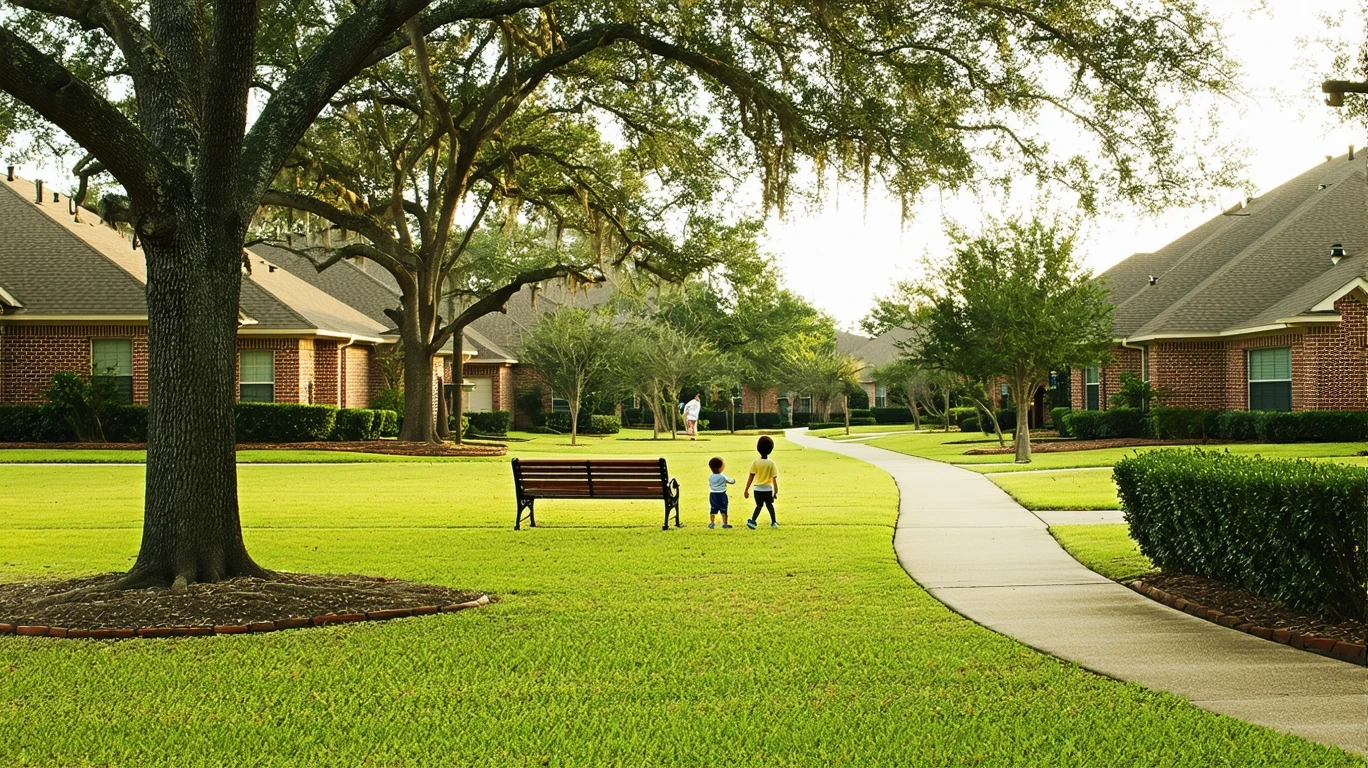
Atascocita’s vibe is shaped by a tension familiar to many suburban communities: it delivers on space, affordability, and family-friendly intentions, but it asks residents to accept car dependency and logistical planning as the cost of entry. People who thrive here tend to be those who don’t mind driving to get things done, who value square footage and yard space over walkable coffee shops, and who see Houston’s metro amenities as close enough when needed but far enough to preserve quiet.
The community feels like it’s in transition—no longer a sleepy bedroom enclave, but not yet a fully realized town center either. Growth brings new retail and dining options, but they arrive in clusters along major corridors rather than woven into neighborhoods. That pattern creates a specific kind of daily experience: errands require intentional trips, not casual strolls. For families with reliable transportation and routines built around driving, this feels normal. For those who hoped to walk to a grocery store or grab takeout without getting in the car, it feels limiting.
What keeps people here is often a pragmatic calculus: housing pressure is lower than in many Houston-area alternatives, the schools draw families despite infrastructure gaps, and the sense of suburban safety and space feels worth the tradeoff. What drives people away—or keeps them restless—is usually the same set of factors flipped: the lack of walkable texture, the sameness of chain retail, the feeling that every outing requires planning and a tank of gas.
Social Media Buzz in Atascocita
On platforms like Facebook and Reddit, Atascocita’s online conversation tends to circle around a few recurring themes: traffic and commute frustration, the arrival (or absence) of new restaurants and retail, school quality debates, and the emotional push-pull of growth. The tone is rarely extreme—more often, it’s a mix of cautious optimism and practical complaint.
Residents frequently express appreciation for the community’s family-friendly intentions and the value they get for their housing dollar, but that praise is often paired with frustration about logistics. One commonly expressed sentiment captures this well: “It’s a great place to raise kids if you don’t mind that everything requires a drive—grocery store, doctor, even just grabbing dinner.” Another theme that surfaces regularly is the tension between wanting more local amenities and worrying about losing the suburban quiet that drew people here in the first place: “We finally got some decent restaurants, but now the traffic is worse and it’s starting to feel crowded.”
There’s also a thread of protectiveness in local discussions—people who’ve been here a long time tend to defend Atascocita’s character against newcomers who compare it unfavorably to denser, more walkable neighborhoods. At the same time, newer residents often express surprise at how car-dependent daily life feels, especially if they moved from areas with more mixed-use development. One recurring refrain: “I thought being this close to Houston meant more convenience, but you still have to drive everywhere.”
Local News Tone
Local coverage of Atascocita tends to frame the community through the lens of growth, infrastructure catch-up, and identity negotiation. Headlines and story angles often reflect the community’s evolving role within the greater Houston metro—no longer a quiet outpost, but not yet a self-contained town with its own civic center.
Typical story themes include:
- “New Retail Development Brings Dining Options to Growing Community”
- “Residents Debate Traffic Solutions as Population Grows”
- “Families Weigh School Access and Commute Tradeoffs”
- “Community Identity Shifts as Atascocita Adds Amenities”
- “Flooding Concerns Resurface After Heavy Rain Events”
The tone is rarely celebratory or alarmist—it’s more observational, reflecting a community that’s adjusting to change rather than driving it. Coverage tends to acknowledge both the benefits of growth (more options, more investment) and the friction it creates (traffic, crowding, loss of the “small-town” feel). What’s notable is how often infrastructure and logistics dominate the conversation: roads, drainage, school capacity, and retail access come up far more than culture, nightlife, or civic identity.
Review-Based Public Perception
On Google, Yelp, and Nextdoor-style platforms, Atascocita’s public perception reflects a community that delivers well on suburban fundamentals but struggles to meet expectations for convenience, walkability, and spontaneous access to amenities. Reviews of the area itself—not just individual businesses—tend to fall into predictable camps.
Positive reviews often emphasize:
- Affordable housing with good square footage and yard space
- Family-friendly neighborhoods with a suburban, safe feel
- Proximity to Houston for work and entertainment without living in the city
- Newer retail and dining options improving over time
Critical or mixed reviews tend to focus on:
- Car dependency for every errand, even short trips
- Limited walkability and lack of neighborhood-level amenities
- Traffic congestion during commute hours and on major corridors
- Flooding risks and drainage concerns in certain pockets
- Feeling isolated without a car or for non-drivers
What emerges is a pattern: people who moved to Atascocita expecting suburban comfort and space tend to feel satisfied, while those who hoped for walkable errands, diverse dining, or a town-center vibe tend to feel disappointed. Neighborhood variation exists—newer planned developments often feel more polished and amenity-rich, while older pockets can feel more worn—but the overarching structure is consistent: this is a place built for cars, not feet.
Comparison to Nearby Cities
| Aspect | Atascocita | Humble | Kingwood |
|---|---|---|---|
| Overall Vibe | Suburban, car-dependent, family-focused with limited walkability | Small-town feel, more civic identity, slightly more walkable core | Master-planned, tree-lined, more cohesive amenities and trails |
| Walkability | Limited; errands require driving | Modest downtown area with some pedestrian activity | Better trail network and internal walkability within subdivisions |
| Amenities | Corridor-clustered retail, improving but spread out | More concentrated downtown, older retail mix | More integrated shopping and dining, planned amenities |
| Community Feel | Growing, transitional, less defined civic center | Established small-town identity, civic events | Strong HOA presence, planned community cohesion |
| Commute Tradeoff | Moderate distance to Houston, traffic can be heavy | Similar commute burden, slightly closer to some job centers | Comparable commute, but more internal amenities reduce daily trips |
Choosing between Atascocita, Humble, and Kingwood often comes down to what you’re willing to trade. If you prioritize affordability and space over walkability and don’t mind driving for errands, Atascocita offers solid value. If you want a bit more small-town character and a modest downtown core, Humble might feel more rooted. If you’re willing to pay more for a master-planned community with better internal walkability, trails, and cohesive amenities, Kingwood tends to deliver that—though it comes with HOA fees and a more uniform aesthetic.
None of these places will satisfy someone seeking urban density, spontaneous walkable errands, or vibrant nightlife. But within the suburban spectrum, they each offer a slightly different flavor of car-dependent family life.
What Locals Are Saying
“We moved here for the space and the schools, and we got what we expected. It’s quiet, the neighbors are friendly, and our kids have a yard. But yeah, you’re driving everywhere—grocery store, pediatrician, even just getting takeout. It’s not a stroll-around-the-block kind of place.” — Family with young children
“I work remotely, so the commute isn’t an issue for me, but I do feel a bit isolated. There’s no coffee shop I can walk to, no little downtown area to hang out in. If I want to do anything, I’m in the car. It’s fine, but it’s not what I pictured when I thought ‘suburb of Houston.’” — Remote worker, early 30s
“Atascocita is exactly what we needed after living in the city for years. We wanted space, a slower pace, and a place where the kids could ride bikes in the neighborhood. We knew we’d be driving more, and that’s been true, but the tradeoff has been worth it for us.” — Family who relocated from inner Houston
“The traffic has gotten noticeably worse over the past few years. It used to feel like a quick drive to get anywhere, but now the main roads are clogged during rush hour. I’m not sure the infrastructure is keeping up with how fast this area is growing.” — Long-time resident
“I like it here, but I do wish there were more local options for dining and entertainment. It feels like everything is a chain, and if you want something different, you’re driving into Houston. That gets old after a while.” — Young professional, renting
“We’re retirees, and Atascocita has been a good fit for us. It’s quiet, the cost of living is reasonable, and we’re close enough to Houston for doctors and entertainment when we want it. The only downside is that you really need a car—there’s no getting around that.” — Retired couple
“I moved here thinking it would be more convenient because it’s part of the Houston metro, but honestly, it feels pretty isolated. If you don’t have a car or don’t like driving, it’s tough. Everything is spread out, and there’s no real center to the community.” — Newcomer from out of state
Does Atascocita Feel Like a Good Fit?
Atascocita’s emotional profile is defined by a clear set of tradeoffs: it rewards people who prioritize space, affordability, and suburban quiet, and it asks them to accept car dependency, logistical planning, and limited walkability in return. For families with reliable transportation, routines built around driving, and a preference for single-family homes over dense urban texture, this tends to feel like a fair exchange. For people who value spontaneous errands, walkable neighborhoods, or a cohesive town center, the friction can feel constant.
The community is in transition—growing, adding amenities, and adjusting its identity—but that growth hasn’t yet resolved the core tension between suburban sprawl and neighborhood-level convenience. What you get is a place that feels functional and family-friendly, but not particularly distinctive or walkable. If that aligns with your priorities, Atascocita offers solid value within the Houston metro. If it doesn’t, you’ll likely feel the limitations every time you need to get in the car.
Ultimately, Atascocita tends to work for people who see driving as a neutral fact of suburban life, who value square footage over spontaneity, and who are comfortable with a community that’s still figuring out what it wants to be. It tends to frustrate people who hoped for more walkability, more local character, or less reliance on the car for every single errand.
If you’re still weighing whether Atascocita fits your needs, consider exploring where your money goes each month, what lifestyle factors matter most, or how the housing tradeoffs shape daily life. Understanding the structure beneath the sentiment can help you predict whether this place will feel like home—or just a stopover.
How this article was built: In addition to public economic data, this article incorporates location-based experiential signals derived from anonymized geographic patterns—such as access density, walkability, and land-use mix—to reflect how day-to-day living actually feels in Atascocita, TX.
The perspectives shown reflect commonly expressed local sentiment and recurring themes in public discussion, rather than individual accounts.