
How much is enough to feel at ease? In Atascocita, the answer depends less on hitting a specific number and more on whether your income can absorb the tradeoffs this community asks you to make. Comfort here isn’t about luxury—it’s about whether your paycheck gives you choices when housing, transportation, and summer utility bills all demand attention at once.
Atascocita sits in the Houston metro area with a median household income of $115,687 per year (gross). That figure reflects a community where dual incomes are common and expectations around space, convenience, and stability run high. But income alone doesn’t determine comfort. What matters is how well your earnings match the specific pressures this place generates—and whether you can handle the gaps when they appear.
What “Living Comfortably” Means in Atascocita
Comfort in Atascocita means having enough margin to handle the basics without constant recalibration. It means your housing choice doesn’t force you into a daily commute that drains time and fuel. It means summer cooling bills don’t derail your budget. It means you can run errands, get to work, and manage family logistics without every trip requiring advance planning.
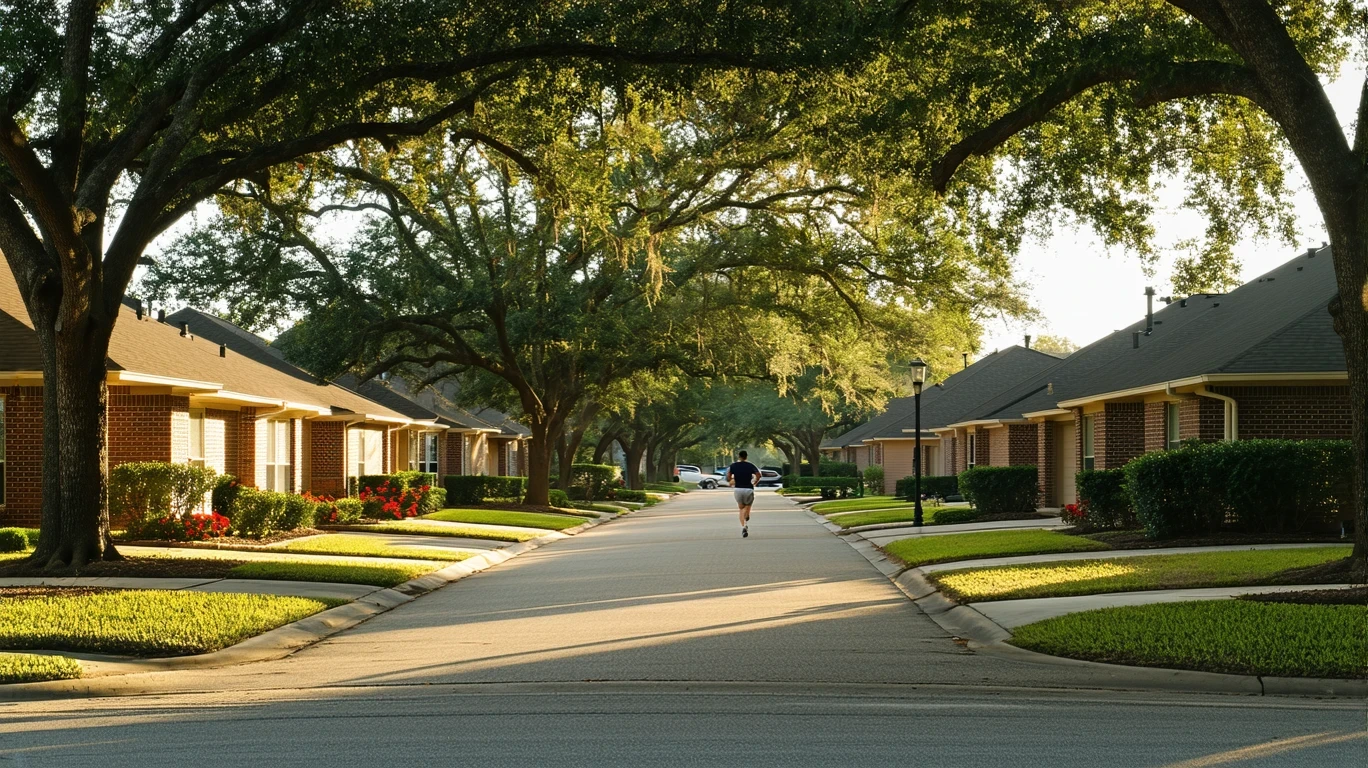
Locals expect single-family homes with yards, reliable air conditioning through long stretches of heat, and the ability to drive wherever they need to go. Walkable errands are limited—food and grocery options cluster along certain corridors rather than spreading evenly across neighborhoods. Parks and water features provide outdoor relief, but day-to-day life here assumes you’ll drive for most tasks.
Comfort also means absorbing the costs that come with suburban infrastructure: higher transportation expenses, utility swings tied to climate, and the time cost of car dependency. If your income can cover these without forcing you to skip maintenance, defer savings, or constantly choose between competing needs, you’re in the comfort zone. If it can’t, pressure builds quickly.
Where Income Pressure Shows Up First
Housing dominates the financial landscape. The median home value sits at $257,500, while median gross rent runs $1,706 per month. Neither figure is extreme by metro standards, but both demand a stable income base. Renters face annual lease renewals that can shift costs unpredictably. Buyers take on property taxes, insurance, and maintenance—expenses that don’t pause when other bills spike.
Transportation pressure comes next. Atascocita’s mixed pedestrian infrastructure supports some walking, but the ratio of walkable paths to roads remains moderate. Errands and daily tasks cluster along corridors, not within easy reach of every block. That means most households depend on cars for nearly everything—work, groceries, healthcare, schools. Fuel costs at $2.40 per gallon add up quickly when every trip requires a vehicle, and the time cost of driving everywhere compounds the financial one.
Utility volatility hits hardest in summer. Electricity rates stand at 16.11¢ per kWh, and extended heat drives cooling demand for months. Households that can’t absorb a sharp jump in their electric bill feel the squeeze immediately. Natural gas, priced at $30.71 per MCF, plays a smaller role in this climate, but the summer cooling load is relentless.
For families, where money goes gets more complex. School density falls below typical thresholds, meaning some families face longer drives or fewer nearby options. Healthcare access is routine—clinics and pharmacies are present, but no hospital. That’s fine for regular needs, but it adds friction when urgent care or specialized services are required. Errands accessibility is corridor-clustered, so running multiple errands in one trip takes planning rather than happening spontaneously.
How the Same Income Feels Different by Household
A single adult earning a solid income in Atascocita can live comfortably if they’re willing to drive and don’t need walkable spontaneity. Housing costs are moderate enough to leave room for savings and discretionary spending. But car dependency is non-negotiable, and the time cost of driving everywhere can feel isolating if you value walkable neighborhoods or easy access to social spaces.
Couples benefit from dual incomes, which ease housing pressure and create more flexibility around transportation and utilities. Two earners can absorb summer utility spikes without panic and afford more housing choice. But the same car dependency applies—both partners likely need vehicles, doubling transportation costs. If one partner works outside the immediate area, commute time and fuel expenses climb quickly.
Families face the most complexity. School density is low, so finding nearby, quality options may require driving farther or navigating limited choices. Errands cluster along corridors, meaning grocery runs, pharmacy stops, and routine appointments rarely align geographically. Healthcare access is routine-local—fine for checkups and minor issues, but hospital care requires travel. The combination of limited family infrastructure, car dependency, and corridor-clustered errands means family logistics demand more time, more fuel, and more planning than in denser or more walkable communities.
The Comfort Threshold (Qualitative)
Comfort in Atascocita arrives when your income creates breathing room around the big three: housing, transportation, and utilities. It’s the point where you stop choosing between fixing the car and paying the electric bill. Where summer cooling costs don’t force you to defer other expenses. Where housing tradeoffs feel like preferences, not compromises.
You know you’ve crossed the threshold when:
- Your housing choice reflects what you want, not just what you can afford
- Utility bills fluctuate, but you don’t have to adjust behavior every time they spike
- Transportation costs—fuel, maintenance, insurance—are predictable and absorbable
- Family logistics (if applicable) feel manageable rather than exhausting
- You can save consistently without skipping necessities
Below that threshold, every cost spike creates a cascade. A hot month drives up cooling costs, which delays car maintenance, which increases breakdown risk, which threatens your ability to get to work. One weak link pulls the whole structure taut.
Why Online Cost Calculators Get Atascocita Wrong
Most cost-of-living calculators treat Atascocita as a data point: median rent, average utilities, typical transportation. They produce a total and call it done. But totals don’t explain why two households at the same income level experience entirely different financial pressure.
Calculators miss the structure of daily life here. They don’t account for car dependency as a non-negotiable cost. They don’t explain that errands cluster along corridors, so convenience depends on where you live relative to those routes. They don’t flag that school density is low, meaning families may face longer drives or fewer nearby options. They don’t warn that summer cooling dominates utility costs for months, not just a few peak weeks.
They also assume you’ll behave like an average household. But if you value walkability, you’ll struggle here despite moderate costs. If you need hospital access nearby, you’ll feel the gap. If you expect errands to be spontaneous rather than planned, the corridor-clustered layout will frustrate you. The calculator sees a number; you’ll experience friction.
People feel surprised after moving because the costs that matter most—time, convenience, logistics—don’t show up in budget tables. Atascocita works well for households that align with its infrastructure. For those who don’t, even a comfortable income won’t eliminate the mismatch.
How to Judge Whether Your Income Fits Atascocita
Instead of asking “Is my income high enough?” ask these:
Can you absorb seasonal utility swings without adjusting other spending?
Summer cooling bills will spike. If a few hundred extra dollars in electricity during peak months forces you to defer other expenses, you’re too close to the edge.
Are you comfortable with car dependency for nearly everything?
Atascocita’s mixed pedestrian infrastructure supports some walking, but errands, work, and family logistics almost always require a vehicle. If you prefer walkable neighborhoods or want to minimize driving, this won’t feel comfortable regardless of income.
How much housing flexibility do you need?
Median home values and rents are moderate, but they still demand stable income. If you’re stretching to afford housing, every other cost becomes harder to manage. Comfort requires enough margin that housing doesn’t dominate your budget.
Can you handle family logistics that require planning?
If you have kids, expect longer drives to schools, corridor-based errands, and routine-only healthcare locally. If your schedule depends on spontaneous trips or nearby services, the infrastructure here will add friction.
Is time or money your limiting factor?
Car dependency costs both. Fuel, insurance, and maintenance add up, but so does the time spent driving everywhere. If your income is high but your time is scarce, the tradeoff may still feel uncomfortable.
FAQs About Living Comfortably in Atascocita
Is Atascocita affordable for single-income families?
It’s harder. Housing and transportation costs assume stable income, and limited walkability means car expenses are unavoidable. Single-income families can make it work, but margin for error is thin, especially when utilities spike or unexpected costs arise.
Do you need a high income to feel comfortable here?
Not necessarily high, but stable and sufficient to cover housing, transportation, and utility volatility without constant tradeoffs. Dual incomes ease pressure significantly. The key is whether your income creates flexibility or forces you to choose between competing needs every month.
How much do transportation costs really matter?
A lot. Car dependency is near-total. Errands cluster along corridors, schools may require longer drives, and walkable alternatives are limited. Every household member who drives adds fuel, insurance, and maintenance costs. If you’re used to walkable cities or strong transit, the shift will feel expensive in both money and time.
What’s the biggest financial surprise people face after moving here?
Summer cooling costs. Extended heat and high electricity usage drive bills up for months, not just a few peak weeks. Households that budget based on average monthly costs get caught off guard when cooling season hits.
Can you live comfortably here without owning a home?
Yes, but renting has its own tradeoffs. Median rent is $1,706 per month, which is manageable for stable earners but leaves you exposed to annual lease renewals and rent increases. Renters avoid maintenance and property tax volatility, but they also miss the equity-building and cost predictability that ownership can provide over time.
How this article was built: In addition to public economic data, this article incorporates location-based experiential signals derived from anonymized geographic patterns—such as access density, walkability, and land-use mix—to reflect how day-to-day living actually feels in Atascocita, TX.
Final Word
Atascocita can work well for households with stable income, dual earners, and expectations that align with suburban car-dependent infrastructure. It offers moderate housing costs, outdoor space, and a community built around driving. But comfort depends on whether your income can absorb utility swings, transportation costs, and the time burden of getting everywhere by car.
If your financial margin is thin, if you value walkability, or if family logistics feel overwhelming when schools and services aren’t nearby, this place will test you regardless of income. Atascocita rewards households that fit its structure. For those who don’t, even a solid paycheck won’t eliminate the friction.
The question isn’t whether you earn enough. It’s whether your income and expectations match what this community actually demands.
—