
Apex sits in the heart of the Research Triangle, close enough to Raleigh and the Research Triangle Park to feel connected, but far enough out to retain a suburban, car-first layout. That geography shapes everything about how people move through daily life here. Transportation options in Apex exist, but they’re unevenly distributed—some neighborhoods offer walkable errands and bus access, while others require a car for every trip. Understanding which pattern applies to your situation determines whether you’ll spend your days behind the wheel or whether you can occasionally leave the car at home.
Newcomers often assume Apex functions like a dense urban core with frequent transit and walkable everything, or they assume it’s purely suburban sprawl with no alternatives to driving. The reality is more textured. Apex has pockets of walkability, notable bike infrastructure, and bus service that connects to the broader Triangle transit network—but those assets don’t eliminate car dependence for most households. Where you live, where you work, and how you structure errands determine whether transit plays a meaningful role or remains a backup option.
How People Get Around Apex
Most residents in Apex drive most of the time. The city’s development pattern—residential subdivisions, shopping centers along major corridors, office parks scattered across the region—was built around car access. Parking is abundant, roads are wide, and the distance between home, work, and errands typically exceeds what’s practical on foot or by bike for daily routines.
That said, Apex isn’t uniformly car-dependent. The pedestrian-to-road ratio in parts of the city exceeds typical suburban thresholds, meaning some neighborhoods have sidewalks, crosswalks, and pedestrian infrastructure that support walking for nearby errands. Bike infrastructure is also more present than in many comparable suburbs—bike-to-road ratios are high enough to indicate intentional investment in cycling routes, though whether those routes serve commuters or recreational riders depends on where you live and where you’re going.
Grocery density is high along certain corridors, and food establishment density sits in the medium range, which means day-to-day costs related to errands can be managed without long drives—if you live near those corridors. Families in peripheral subdivisions, however, face a different reality: every trip requires a car, and the logistics of managing school drop-offs, activities, and shopping become tightly coupled to vehicle access and scheduling.
Public Transit Availability in Apex
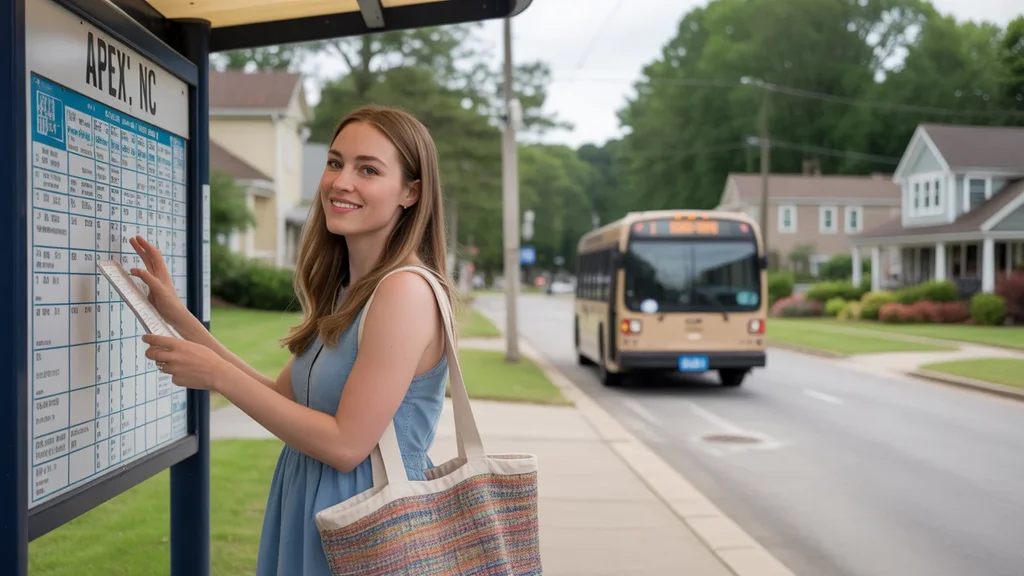
Public transit in Apex centers around bus service. Systems such as GoTriangle and GoRaleigh provide connections between Apex and Raleigh, the Research Triangle Park, and other parts of Wake County. Bus stops are present throughout the city, but service is not uniformly distributed. Transit works best for residents living near major corridors or within denser pockets where stops are closer together and destinations align with route coverage.
For commuters heading into Raleigh or RTP, bus service can reduce the need to drive the entire distance, particularly if parking costs or traffic predictability matter. But transit doesn’t function as a primary mobility solution for most Apex households. Coverage gaps, limited evening and weekend service, and the time cost of transfers make it difficult to rely on transit for multi-stop trips, errands with time constraints, or activities outside core commute hours.
Transit viability in Apex is location-dependent. Residents in walkable pockets near bus routes can integrate transit into their routines selectively. Residents in outer subdivisions, where bus stops are sparse and distances to destinations are longer, find transit impractical for daily use. The system exists, but it doesn’t replace the car—it supplements it, and only for households whose geography and schedule align with route structure.
Driving & Car Dependence Reality
Driving isn’t optional for most people in Apex—it’s the default. The city’s layout, the distance between residential areas and employment centers, and the structure of daily errands all assume car access. Parking is rarely a constraint. Traffic exists but doesn’t approach the density or unpredictability of larger urban cores. For households with predictable schedules and destinations along major routes, driving offers control, flexibility, and speed that transit can’t match.
Car dependence does introduce exposure. Fuel prices fluctuate, and while gas in Apex currently sits at $2.65 per gallon, that rate shifts with regional and national market conditions. Maintenance, insurance, registration, and the opportunity cost of vehicle ownership accumulate regardless of how much you drive. Households that require two cars to manage work, school, and errands face compounded exposure—not just to fuel costs, but to the fixed expenses that come with maintaining multiple vehicles.
For families, car dependence becomes logistical infrastructure. School drop-offs, activity schedules, and grocery runs require coordination, and the ability to manage those trips efficiently depends on having reliable vehicle access. Single-car households in Apex often face scheduling friction that two-car households avoid, particularly when work commutes and school hours overlap.
Commuting Patterns & Daily Mobility
Commuting in Apex typically means driving to Raleigh, Cary, or the Research Triangle Park. Some residents work locally, but the city’s role as a suburban bedroom community means many households structure their days around a primary commute to a regional employment center. The commute itself is car-first for most, though some commuters use park-and-ride lots to connect with bus service for the final leg into Raleigh or RTP.
Commute patterns vary by household type. Single professionals with fixed office schedules may find bus service viable if their destination aligns with transit routes. Families managing multiple stops—dropping kids at school, commuting to work, picking up groceries—rarely find transit practical for the full trip chain. Remote workers and hybrid schedules reduce commute frequency but don’t eliminate the need for car access when trips do occur.
Daily mobility in Apex isn’t just about commuting. Errands, appointments, and social activities all require movement, and the city’s corridor-clustered layout means those trips often involve driving even when distances are short. Walkable pockets exist, but they don’t cover the full range of destinations most households need to reach regularly. The result is a mobility pattern where driving dominates, walking supplements, and transit plays a limited, route-specific role.
Who Transit Works For—and Who It Doesn’t
Transit in Apex works best for single commuters living near bus routes with destinations in Raleigh or RTP. If your work location sits along a transit corridor and your schedule aligns with service hours, bus service can reduce driving frequency and eliminate parking costs at the destination. Renters in denser, corridor-adjacent neighborhoods have better access to transit than homeowners in outer subdivisions, simply because proximity to stops and walkable errands makes transit more practical.
Transit doesn’t work well for families managing complex trip chains. School locations, activity schedules, and the need to carry groceries or equipment make car trips more efficient than transit for households with children. Peripheral neighborhoods, where bus stops are sparse and distances to destinations are longer, don’t support transit reliance. Late-night or weekend trips, when service frequency drops, also push households back toward driving.
Retirees and older adults face mixed outcomes. Those living in walkable areas near bus routes may find transit sufficient for occasional trips, but the lack of frequent service and limited coverage makes transit less reliable than driving for appointments, errands, and social activities. Households without a car face significant mobility constraints in Apex unless they live in one of the few neighborhoods where walking, biking, and transit combine to cover daily needs.
Transportation Tradeoffs in Apex
Choosing between transit and driving in Apex isn’t about cost alone—it’s about predictability, control, and time. Driving offers flexibility: you leave when you’re ready, stop where you need to, and adjust routes in real time. Transit offers lower direct costs per trip but introduces time penalties, schedule constraints, and coverage gaps that limit where and when you can go.
For households with one primary commute destination and a schedule that aligns with bus service, transit can reduce driving frequency without eliminating car ownership. For households managing multiple stops, irregular schedules, or destinations outside transit corridors, driving remains the only practical option. The tradeoff isn’t binary—it’s situational, and it depends on where you live, where you work, and how you structure daily life.
Walkability and bike infrastructure add nuance. Residents in neighborhoods with high pedestrian density and notable bike routes can handle some errands without a car, reducing total vehicle miles and the frequency of trips. But those neighborhoods represent pockets, not the citywide norm. Most of Apex still requires a car for most trips, and the decision to rely on alternatives depends on intentional location choice and acceptance of reduced convenience for certain activities.
FAQs About Transportation in Apex (2026)
Is public transit usable for daily commuting in Apex?
Public transit is usable for some commuters, particularly those traveling to Raleigh or RTP along established bus routes. Service exists and connects Apex to regional employment centers, but frequency, coverage, and schedule alignment determine whether it works for your specific commute. Most residents still drive most of the time.
Do most people in Apex rely on a car?
Yes. The city’s layout, the distance between residential areas and destinations, and the structure of daily errands all assume car access. Transit and walkability exist in pockets, but they don’t eliminate the need for a vehicle for most households.
Which areas of Apex are easiest to live in without a car?
Neighborhoods near major corridors with bus access, high grocery density, and walkable infrastructure offer the best chance of reducing car dependence. Even in those areas, most households still own a car—they just use it less frequently for certain trips.
How does commuting in Apex compare to nearby cities?
Apex functions as a suburban commuter city within the Research Triangle. Commutes to Raleigh, Cary, or RTP are common and typically car-based. Compared to Raleigh, Apex has less transit coverage and fewer walkable neighborhoods. Compared to more distant suburbs, Apex offers better access to regional employment centers and some transit connectivity.
Can you bike for transportation in Apex, or is it mostly recreational?
Bike infrastructure in Apex is more developed than in many comparable suburbs, with bike-to-road ratios indicating intentional investment. Whether that infrastructure supports commuting or errands depends on where you live and where you’re going. Some residents bike for transportation, but most use bikes recreationally or for fitness rather than as a primary mobility tool.
How Transportation Fits Into the Cost of Living in Apex
Transportation isn’t just a line item—it’s a structural factor that shapes where you can live, how you spend your time, and what tradeoffs you accept. In Apex, car dependence is the baseline assumption for most households, which means vehicle ownership, fuel, insurance, and maintenance become fixed costs that don’t vary much with behavior. Reducing transportation costs requires either living in one of the walkable, transit-accessible pockets or accepting reduced convenience and longer trip times.
For a fuller picture of what a budget has to handle in Apex, including how transportation fits alongside housing, utilities, and other recurring expenses, the Monthly Budget article provides numeric context and household-level breakdowns. Transportation decisions in Apex are less about optimizing individual trips and more about choosing a location and lifestyle structure that aligns with your mobility needs and tolerance for car dependence.
Apex offers more transportation options than purely car-dependent suburbs, but fewer than dense urban cores. The city’s layout rewards intentional location choice: live near corridors, bus routes, and walkable amenities, and you’ll drive less. Live in peripheral subdivisions, and you’ll drive for everything. Understanding that geography—and your own household’s trip patterns—clarifies what transportation will cost, how much time it will take, and what tradeoffs you’ll face daily.
How this article was built: In addition to public economic data, this article incorporates location-based experiential signals derived from anonymized geographic patterns—such as access density, walkability, and land-use mix—to reflect how day-to-day living actually feels in Apex, NC.