
Transportation options in Escondido reflect a city built primarily around the car, but with meaningful rail access that changes the equation for certain households and commute patterns. The dominant reality is driving—most daily errands, school runs, and job commutes happen behind the wheel—but rail service and pockets of walkable infrastructure mean transit isn’t entirely off the table. What newcomers often misunderstand is that Escondido’s layout rewards proximity and planning: living near a rail station or commercial corridor opens up alternatives, while peripheral neighborhoods demand vehicle ownership almost by default. The city’s low-rise, mixed-use character creates commercial strips where errands cluster, but the pedestrian infrastructure that supports car-free living exists only in limited areas, not across the entire city.
Understanding how people actually move through Escondido—and what that means for daily logistics, time, and control—matters more than abstract transit availability. The structure of the city determines who can realistically use transit and who absorbs the friction of car dependence, and those differences shape your monthly budget in Escondido: where it breaks in ways that go far beyond fuel prices.
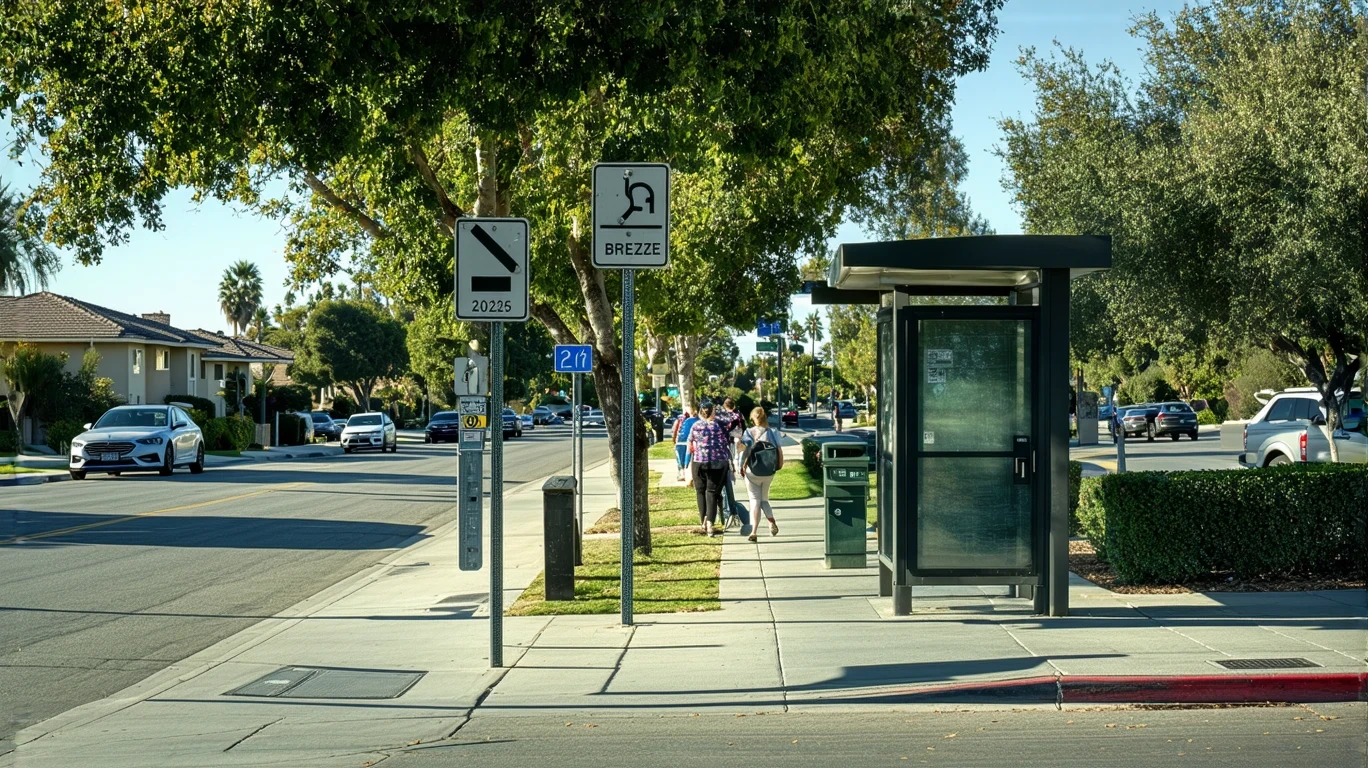
How People Get Around Escondido
Most residents drive. That’s the baseline. Escondido’s street network, commercial layout, and residential density were designed with cars in mind, and the infrastructure reflects that priority. Parking is widely available, roads are built for vehicle flow, and the distance between home, work, and errands typically exceeds what’s practical on foot or by bike for most households. But rail service does exist, and it matters for a specific slice of the population: commuters heading to regional employment centers, households living near stations, and residents who can structure their lives around fixed-route transit.
The pedestrian-to-road ratio in parts of Escondido exceeds typical suburban thresholds, meaning some neighborhoods support walking better than others. These walkable pockets tend to align with older commercial corridors and areas near transit stops, where sidewalks, crosswalks, and mixed-use development create a different mobility texture. Outside those zones, walking becomes less practical—not because it’s unsafe, but because distances stretch, sidewalks thin out, and destinations spread apart. Cycling infrastructure exists in limited areas, enough to support recreational riding or short errands for confident cyclists, but not enough to replace a car for most daily needs.
What this means in practice: if you live near a rail station and work along a transit line, you can reduce your driving significantly. If you live in a peripheral neighborhood or work off the rail corridor, you’ll drive almost everywhere. The city doesn’t force one pattern on everyone, but it clearly favors the car for flexibility and coverage.
Public Transit Availability in Escondido
Rail service is present in Escondido, which distinguishes it from purely car-dependent suburbs. The rail system connects the city to regional employment and activity centers, making it a viable option for commuters whose jobs align with the route. For those households, rail offers predictability, eliminates parking hassles, and reduces wear on a personal vehicle. But rail service works best for linear, single-destination commutes—if your job, errands, or childcare stops fall outside the rail corridor, transit becomes a partial solution at best.
Public transit in Escondido often centers around systems such as regional rail and bus service, though coverage varies by area. Bus service exists, but frequency, span, and geographic reach are more limited than in denser urban cores. Routes tend to serve major corridors and connect residential areas to commercial nodes and transit hubs, but they don’t blanket the city. Late-night service is sparse, weekend frequency drops, and multi-stop trips can stretch travel time significantly compared to driving.
Transit works best in Escondido for:
- Commuters traveling to regional job centers along rail lines
- Residents living within walking distance of rail stations or high-frequency bus stops
- Households willing to plan errands and schedules around fixed routes
- Single adults or couples without school-age children
Transit falls short for:
- Families managing multi-stop logistics (school, daycare, groceries, activities)
- Shift workers or anyone with non-standard hours
- Residents in peripheral neighborhoods far from rail or bus lines
- Households needing flexibility for spontaneous trips or emergencies
The grocery density in Escondido exceeds typical thresholds along certain corridors, meaning some residents can walk or take a short bus ride to food shopping. But food establishments overall cluster rather than distribute evenly, so access depends heavily on where you live. If your home sits outside a commercial corridor, even a grocery run becomes a driving trip.
Driving & Car Dependence Reality
Driving in Escondido isn’t just common—it’s structurally necessary for most households. The city’s low-rise development pattern, the distance between residential and commercial zones, and the limited reach of transit infrastructure all point toward car ownership as the default. Parking is abundant and typically free or low-cost, which removes one of the friction points that discourages driving in denser cities. Roads are designed for vehicle flow, and traffic congestion, while present during peak hours, rarely reaches gridlock levels that make driving prohibitively slow.
For families, car dependence intensifies. School drop-offs, activity shuttles, grocery hauls, and weekend errands don’t align neatly with bus schedules or rail stops. Even households that could technically use transit for one commute often find themselves driving for everything else, which means they still need to own, insure, maintain, and fuel a vehicle. The cost structure doesn’t change much whether you drive every day or just a few times a week—the fixed expenses remain.
Gas prices in Escondido currently sit at $4.64 per gallon, which is a meaningful line item for households driving regularly. But fuel is only one piece of car dependence. Insurance, maintenance, registration, and depreciation all layer on top, and those costs don’t fluctuate with how much you drive in the short term. The real tradeoff isn’t whether to drive, but whether you can structure your life to drive less—and for most Escondido residents, the city’s layout makes that difficult without sacrificing convenience, time, or access.
Commuting Patterns & Daily Mobility
Commuting in Escondido varies widely depending on where you work. Residents employed locally or in nearby North County cities often face shorter, more predictable drives. Those commuting to San Diego, Carlsbad, or other regional centers typically rely on either rail service or longer highway drives, and the choice between the two hinges on proximity to a station, work location, and schedule flexibility.
Rail commuters trade time predictability for reduced driving stress. They avoid parking costs, eliminate fuel burn during the commute, and can use travel time for reading or work. But they also lose flexibility—if a meeting runs late, a child gets sick, or an errand pops up mid-day, getting home or rerouting becomes complicated. Driving commuters retain control and can handle multi-stop days, but they absorb fuel costs, parking fees (if applicable), and the mental load of traffic variability.
Single-job commuters benefit most from rail. Multi-stop commuters—those who need to pick up kids, run errands, or visit clients—almost always drive. Households where both adults work in different directions or on different schedules typically end up owning two vehicles, which doubles the fixed cost base even if one car sits idle most of the time.
Daily mobility in Escondido also depends on neighborhood placement. Residents near commercial corridors can walk or bike for some errands, reducing the number of cold-start car trips that burn fuel inefficiently. Those in quieter residential zones farther from services drive for nearly everything, which increases both mileage and the frequency of refueling stops.
Who Transit Works For — and Who It Doesn’t
Transit in Escondido works for a narrow but real segment of the population. If you’re a single adult or couple without children, live within a half-mile of a rail station, and work along a transit line, you can structure a lifestyle that minimizes or even eliminates car ownership. Your daily errands might still require occasional driving or ride-hailing, but the bulk of your mobility—commuting, especially—can happen on transit. Renters in core neighborhoods near stations have the best shot at this, since they can choose housing based on transit access without the long-term commitment of buying.
Transit doesn’t work well for families with school-age children. School start times, activity schedules, and the need to move multiple people simultaneously don’t align with fixed-route bus service. Even families living near rail stations typically drive for everything except one adult’s commute, which means they still carry the full cost of car ownership.
Peripheral neighborhoods—those farther from rail stops and outside walkable commercial corridors—are functionally car-dependent. Transit might exist on paper, but the time penalty and logistical friction make it impractical for daily use. Homeowners in these areas almost universally own at least one vehicle, and most own two.
Shift workers, healthcare employees, service industry staff, and anyone working non-standard hours face the steepest transit barriers. Late-night and early-morning service is limited, and weekend frequency drops, which means even a theoretically transit-accessible job becomes a driving job if your schedule doesn’t align with peak service hours.
Transportation Tradeoffs in Escondido
The choice between transit and driving in Escondido isn’t about cost alone—it’s about predictability, control, and time. Transit offers fixed schedules, which can simplify planning, but it also removes flexibility. If your day changes, transit doesn’t adapt. Driving offers control and spontaneity, but it exposes you to fuel price swings, maintenance surprises, and the ongoing fixed costs of ownership.
For commuters, rail reduces stress and eliminates parking hassles, but it only works if your job sits near a station and your schedule aligns with service hours. Driving lets you leave when you want, stop where you need, and reroute on the fly, but it ties you to a vehicle and all the costs that come with it.
For daily errands, driving almost always wins on convenience. Grocery trips, kid pickups, and weekend outings are faster and easier by car, especially in a city where commercial destinations cluster rather than distribute evenly. Transit can handle some of these trips, but the time cost and planning burden rise quickly.
The tradeoff sharpens when you consider household composition. Single adults and couples can optimize around transit if they choose housing strategically. Families absorb the friction of car dependence because the alternative—managing multiple schedules and stops on transit—becomes unworkable. Retirees and older adults often prefer driving for the independence it provides, even if they drive less frequently than working-age households.
FAQs About Transportation in Escondido (2026)
Is public transit usable for daily commuting in Escondido?
Yes, but only for specific commute patterns. Rail service connects Escondido to regional employment centers, so if your job sits along a transit line and you live near a station, rail can handle your commute reliably. For jobs outside the rail corridor or in areas without direct transit access, driving remains the practical default. Bus service exists but operates with lower frequency and narrower coverage, making it less viable for time-sensitive commutes.
Do most people in Escondido rely on a car?
Yes. The city’s layout, residential density, and commercial distribution all favor car ownership. Most households own at least one vehicle, and many own two. Even residents who use transit for commuting typically drive for errands, family logistics, and non-work trips. Car dependence isn’t universal, but it’s the dominant pattern across most neighborhoods and household types.
Which areas of Escondido are easiest to live in without a car?
Neighborhoods within walking distance of rail stations and along commercial corridors with higher grocery and food establishment density offer the best chance of reducing car dependence. These areas combine transit access with walkable errands, though even there, most residents still own a vehicle for flexibility. Peripheral neighborhoods and residential zones farther from transit stops are functionally car-dependent.
How does commuting in Escondido compare to nearby cities?
Escondido sits in a regional context where most North County cities are car-oriented, but rail access distinguishes it from purely suburban neighbors. Compared to denser coastal cities with more extensive transit networks, Escondido offers less coverage and frequency. Compared to inland suburbs without rail, it provides a meaningful transit option for regional commuters. The comparison depends on where you work and how your schedule aligns with available service.
Can you get by in Escondido without owning a car?
It’s possible but uncommon. Single adults or couples living near rail stations, working along transit lines, and willing to use ride-hailing or car-sharing for occasional errands can make it work. Families, shift workers, and residents in peripheral areas will find car-free living impractical. The city’s infrastructure doesn’t prohibit it, but it doesn’t support it broadly either.
How Transportation Fits Into the Cost of Living in Escondido
Transportation in Escondido isn’t just a budget line—it’s a structural factor that shapes where you can live, how you spend your time, and what tradeoffs you accept. Households that can use rail for commuting reduce fuel and parking costs, but they still face the fixed expenses of car ownership unless they commit fully to a car-free lifestyle, which few do. Households that drive for everything absorb higher fuel costs, especially with gas at $4.64 per gallon, but they gain flexibility and control that transit can’t match.
The interaction between housing and transportation matters more than either category alone. Living near a rail station might cost more in rent or purchase price, but it can reduce commute time and fuel spend. Living farther out might lower housing costs, but it increases driving frequency and locks you into car dependence. The right choice depends on your work location, household composition, and how much you value time versus money.
For a fuller picture of where your money goes each month in Escondido, including how transportation costs interact with housing, utilities, and other essentials, the Monthly Budget article provides detailed context. Transportation decisions ripple through your entire cost structure, and understanding those connections helps you make choices that fit your priorities rather than defaulting to what the city’s layout assumes you’ll do.
Escondido gives you options, but it doesn’t make any of them effortless. Rail access is real and valuable for the right commuter. Walkable pockets exist for those who prioritize proximity. But the city’s bones are car-oriented, and most households will own and drive a vehicle regardless of how much they’d prefer not to. The question isn’t whether you’ll deal with transportation costs—it’s how you’ll structure your life to manage them on your terms.
How this article was built: In addition to public economic data, this article incorporates location-based experiential signals derived from anonymized geographic patterns—such as access density, walkability, and land-use mix—to reflect how day-to-day living actually feels in Escondido, CA.