
Fontana sits in the western Inland Empire, where housing costs reflect a tension between suburban scale and urban-style density. The median home value of $506,600 and median rent of $1,616 per month place Fontana in the middle tier of Southern California affordability—cheaper than coastal markets, but shaped by the same pressures of limited supply and long-distance commuting. What makes Fontana distinct is not just the price, but the structure beneath it: a car-oriented city with rail transit, walkable pockets embedded in a low-rise grid, and triple-digit summer heat that turns utility bills into a recurring cost driver. This article explains how housing costs behave here, what renters and buyers face over time, and which household types fit Fontana’s particular cost profile.
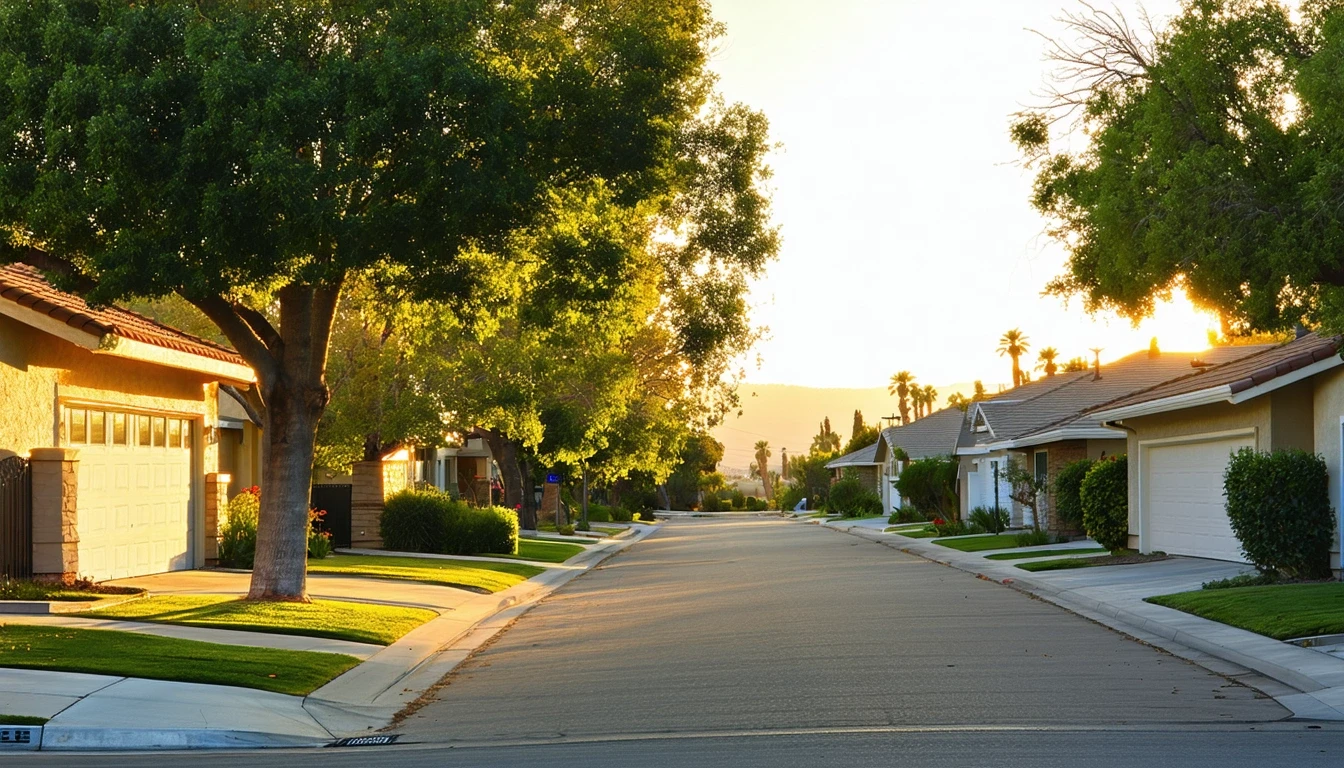
The Housing Market in Fontana Today
Fontana’s housing market is defined by its role as a commuter suburb with infrastructure that exceeds typical suburban minimums. The city has rail service—a rarity in the Inland Empire—and grocery and food establishments dense enough to support daily errands without long drives. Yet the pedestrian-to-road ratio, while high in certain pockets, does not extend citywide, meaning most residents still depend on cars for work, school, and errands outside their immediate neighborhood. This creates a cost structure where where money goes is split between fixed housing payments and variable transportation and cooling expenses.
Home values here reflect demand from buyers priced out of Los Angeles and Orange County, but unwilling to move farther east into the high desert. The result is a market where $506,600 buys a single-family home with a yard, but not necessarily walkable access to work or services. Renters face a similar tradeoff: $1,616 per month is manageable for households earning near the median income of $93,230 per year, but the rental stock skews toward larger units in car-dependent areas, meaning renters pay for space they may not need while absorbing commute costs they can’t avoid.
Renting in Fontana
Renting in Fontana offers flexibility in a market where ownership requires significant upfront capital, but it does not insulate tenants from the city’s structural cost pressures. The median gross rent of $1,616 per month includes utilities in some cases, but more often reflects base rent only, leaving tenants exposed to summer cooling bills driven by Fontana’s inland desert climate. Air conditioning is not optional here; it is a recurring cost that rises with temperature and housing age, and renters in older units or poorly insulated buildings face higher exposure than those in newer construction.
The rental market in Fontana is shaped by the same commute dynamics that define ownership. Most rental stock sits in neighborhoods designed for car access, meaning tenants without vehicles face friction even in areas with bus service. The presence of rail transit adds value for renters working in downtown Los Angeles or other rail-connected job centers, but the 33-minute average commute reflects the reality that most Fontana residents still drive. For renters, this means transportation costs—gas at $4.81 per gallon, insurance, and maintenance—stack on top of rent, creating a total monthly outflow that rivals ownership costs without building equity.
Rent increases in Fontana follow regional patterns rather than local rent control, meaning tenants should expect annual adjustments tied to demand and landlord turnover. The lack of predictability makes long-term renting a higher-risk strategy here than in cities with stronger tenant protections, particularly for families who need stable school assignments and cannot absorb sudden moves.
Owning a Home in Fontana
Ownership in Fontana locks in the largest cost—principal and interest—while exposing buyers to property taxes, insurance, maintenance, and utilities that vary with climate, housing age, and governance. The median home value of $506,600 translates to a significant monthly payment, but the structure of ownership here differs from coastal markets in important ways. Property taxes in California are governed by Proposition 13, which caps assessed value increases at 2% per year as long as the property does not change hands. This means buyers who purchase today will see predictable tax growth, while longtime owners pay far less. The result is a two-tier system where new buyers shoulder higher tax burdens relative to their neighbors, but gain protection against the kind of runaway increases common in states without assessment caps.
Insurance costs in Fontana reflect wildfire risk in the broader region, even though the city itself is not in a high fire zone. Premiums have risen across the Inland Empire as insurers reassess exposure, and buyers should expect this cost to behave less predictably than taxes. Maintenance costs are driven by Fontana’s climate: roofs degrade faster under intense sun, HVAC systems run longer and harder, and landscaping requires either significant water use or drought-tolerant redesign. These are not one-time expenses; they recur on a schedule determined by heat, age, and materials.
Homeownership in Fontana also means navigating governance structures that vary by neighborhood. Some developments have homeowners associations that bundle landscaping, exterior maintenance, or shared amenities into monthly fees; others leave all upkeep to the owner. The presence or absence of an HOA changes the cost profile significantly, but the feed does not provide prevalence data, so buyers must verify this during their search.
Apartment vs House in Fontana — Cost Behavior Comparison
The choice between renting an apartment and owning a house in Fontana is not just a question of monthly payment size—it is a question of which costs you control, which you absorb, and how your housing interacts with the city’s climate and infrastructure. The table below isolates cost categories that behave differently in Fontana specifically, based on local climate exposure, housing stock characteristics, and infrastructure patterns. Categories that would be identical across markets are omitted.
| Expense Category | Apartment (Renting) | House (Owning) |
|---|---|---|
| Cooling Costs | Moderate exposure; shared walls reduce heat gain, but older buildings lack modern insulation | High exposure; standalone structure with full sun exposure and larger square footage to cool during triple-digit summers |
| Property Tax | Not applicable | Predictable under Prop 13; new buyers pay higher rates than longtime owners, but growth capped at 2% annually |
| Exterior Maintenance | Landlord responsibility; tenant insulated from roof, HVAC, and landscape costs | Owner responsibility; desert climate accelerates roof wear, HVAC strain, and landscape water demand |
| Commute Interaction | Rental stock concentrated in car-dependent areas; rail access limited to specific corridors | Ownership neighborhoods vary; some near rail, most require driving; buyers can optimize for transit or accept car dependency |
| Rent/Payment Volatility | Rent increases follow regional demand; no cap, subject to landlord discretion at lease renewal | Principal and interest fixed (if financed at fixed rate); taxes and insurance rise, but more slowly than rent |
Why these categories? Fontana’s inland desert climate makes cooling a dominant cost driver, and the difference in building form (shared walls vs standalone) creates measurable exposure gaps. Property tax behavior under Prop 13 is specific to California and affects long-term ownership cost predictability. Exterior maintenance costs are amplified by heat and sun intensity, making the landlord/owner distinction more significant here than in milder climates. Commute interaction reflects Fontana’s unusual combination of car-oriented design and rail transit presence, which creates location-dependent cost tradeoffs. Rent volatility is included because Fontana lacks rent control, and regional demand pressure makes annual increases likely.
Categories like trash, water/sewer, and interior utilities are omitted because they do not vary meaningfully between apartments and houses in Fontana’s cost structure—they are either bundled similarly or driven by individual usage rather than housing type.
Utilities & Upkeep Differences
Utility costs in Fontana are shaped by climate, not choice. Electricity at 34.71¢ per kWh is among the highest in the nation, and summer cooling dominates household usage. Air conditioning is not a discretionary expense here—it is a health and habitability requirement during the extended cooling season, which runs from late spring through early fall. Apartment dwellers benefit from shared walls and smaller square footage, which reduce the total load, but they have no control over insulation quality or HVAC efficiency. Homeowners face higher absolute costs but can invest in efficiency upgrades, programmable thermostats, and insulation improvements that lower long-term exposure.
Natural gas, priced at $23.78 per thousand cubic feet, plays a smaller role in Fontana’s cost structure than in colder climates. Heating demand is minimal, and most gas usage goes to water heating and cooking. This makes gas bills predictable and secondary to electricity in the household budget.
Maintenance costs for homeowners are elevated by Fontana’s climate. Roofs degrade faster under constant sun exposure, and HVAC systems require more frequent filter changes and servicing due to dust and extended run times. Landscaping costs are either high (if maintaining grass and non-native plants) or require upfront investment in drought-tolerant design. Renters are insulated from these costs directly, but they are priced into rent over time, and tenants in poorly maintained buildings absorb the inefficiency through higher cooling bills.
Rent vs Buy: Long-Term Exposure in Fontana
The long-term cost difference between renting and owning in Fontana is not primarily about total dollars—it is about predictability, control, and exposure to external forces. Renters face annual lease renewals with no cap on increases, meaning their largest monthly expense can rise faster than income, particularly during periods of regional demand growth. Owners lock in their principal and interest payment (if financed at a fixed rate), and while property taxes and insurance do rise, they do so more slowly and predictably than rent. Over a decade, this gap compounds, and owners gain stability that renters cannot access.
However, ownership in Fontana also means absorbing costs that renters avoid entirely. Maintenance, repairs, and capital improvements—roof replacement, HVAC failure, water heater replacement—are the owner’s responsibility, and the timeline for these expenses is shortened by the city’s harsh climate. Owners also face insurance volatility tied to regional wildfire risk, even in neighborhoods far from fire zones, and this cost has proven less predictable than taxes in recent years.
The decision between renting and buying in Fontana depends on how long you plan to stay, whether you value cost predictability over flexibility, and whether you can absorb the upfront and recurring costs of ownership without financial strain. Renters who expect to leave within three to five years avoid the transaction costs and maintenance risk of ownership, but they pay for that flexibility with exposure to rent increases and lack of equity. Buyers who stay longer benefit from payment stability and home equity growth, but they must be prepared for the recurring costs of maintaining a house in a hot, dry climate.
How this article was built: In addition to public economic data, this article incorporates location-based experiential signals derived from anonymized geographic patterns—such as access density, walkability, and land-use mix—to reflect how day-to-day living actually feels in Fontana, CA.
FAQs About Housing Costs in Fontana
Is $1,616 per month typical for rent in Fontana?
$1,616 per month is the median gross rent, meaning half of renters pay more and half pay less. Actual rent depends on unit size, age, location, and whether utilities are included. Renters near rail transit or in newer developments typically pay above the median, while those in older buildings or car-dependent areas may pay less but face higher transportation costs.
How much do property taxes add to homeownership costs in Fontana?
California’s Proposition 13 caps annual property tax increases at 2% for existing owners, but new buyers are taxed based on purchase price. A home bought at $506,600 will have a higher initial tax burden than a comparable home owned for decades. The exact rate depends on local assessments and voter-approved bonds, but the structure ensures predictability over time.
Do homeowners in Fontana need to budget for high cooling costs year-round?
No. Cooling costs spike during the extended summer season, which runs from late spring through early fall, but winter heating demand is minimal. Homeowners should expect electricity bills to vary significantly by season, with summer months driving the majority of annual utility costs. Apartment dwellers face the same seasonal pattern but at lower absolute levels due to smaller square footage and shared walls.
Does Fontana’s rail transit make car ownership optional?
No. While Fontana has rail service—unusual for the Inland Empire—the city’s overall design remains car-oriented, and most jobs, schools, and services require driving. Rail access adds flexibility for commuters working in downtown Los Angeles or other rail-connected areas, but it does not eliminate the need for a vehicle for most households. The 33-minute average commute and 46.1% long-commute rate reflect the reality that most residents still drive daily.
Are housing costs in Fontana rising faster than income?
The feed does not provide historical trend data, but the relationship between the median home value ($506,600) and median household income ($93,230) suggests that ownership requires a significant share of income, even for median earners. Renters earning near the median can manage $1,616 per month, but those below the median face tighter margins, particularly when transportation and cooling costs are added. Long-term cost growth depends on regional demand, interest rates, and wage trends, none of which are predictable from current data alone.
Making Housing Choices in Fontana
Housing costs in Fontana are shaped by the city’s position as a commuter suburb with infrastructure that exceeds typical suburban minimums—rail transit, dense food and grocery access, and integrated park space—but a built environment that still requires cars for most daily activities. The median home value of $506,600 and median rent of $1,616 per month are not outliers in the Southern California context, but they carry different cost profiles depending on whether you rent or buy, where you live within the city, and how you manage exposure to cooling costs and commute distance.
Renters gain flexibility and avoid maintenance risk, but they face unpredictable rent increases and no equity accumulation. Owners lock in payment stability and build equity, but they absorb the full cost of utilities, maintenance, and climate-related wear in a hot, dry environment. Families with school-age children benefit from Fontana’s strong family infrastructure—schools and playgrounds both meet density thresholds—and ownership offers the stability needed for long-term school enrollment. Commuters working in Los Angeles or other rail-connected areas gain value from Fontana’s transit access, but those working locally or in car-dependent job centers face higher transportation costs that stack on top of housing payments.
The choice between renting and buying in Fontana is not a simple affordability calculation—it is a decision about which costs you control, which you accept, and how long you plan to stay. For more detail on how housing fits into the broader cost structure, see where your money goes across all major categories. If you’re planning a move, understanding moving company costs and options can help you budget for the transition.