
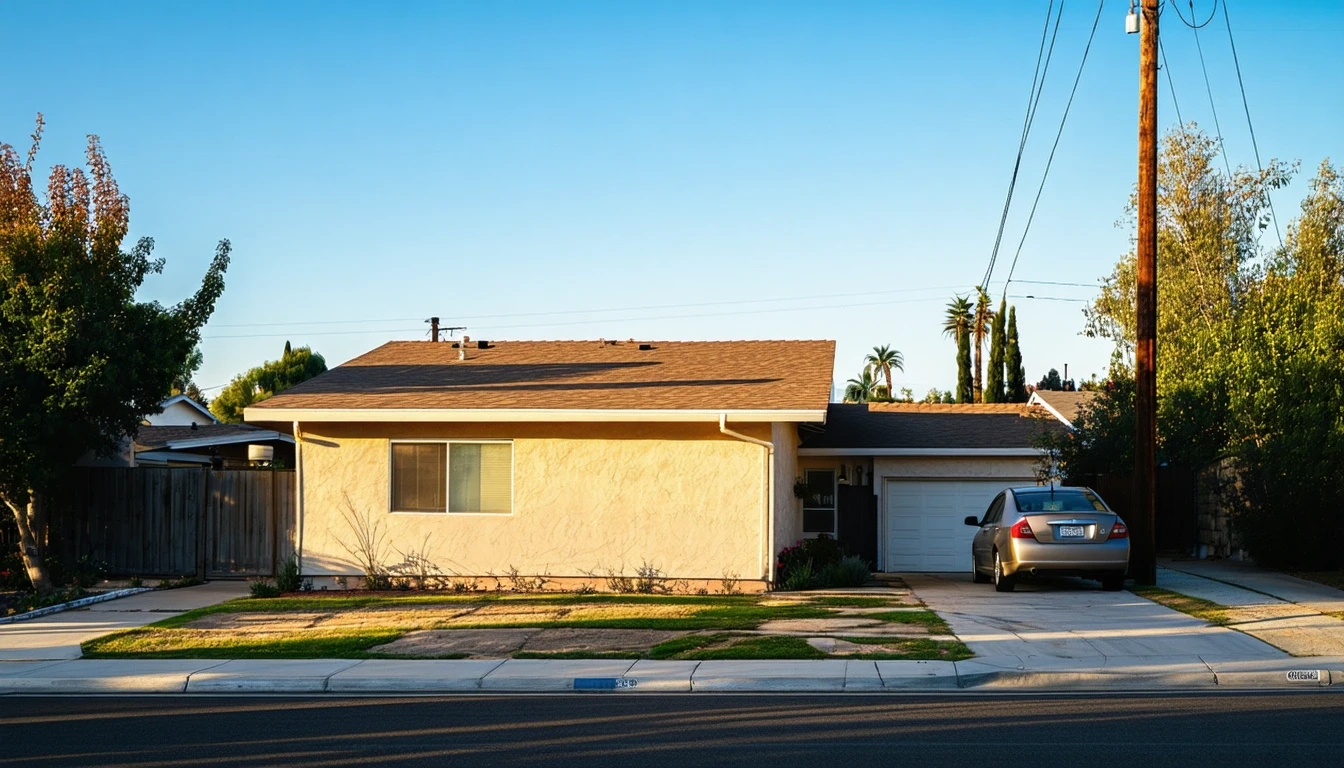
Apartment vs House in Escondido — Monthly Cost Comparison
| Expense Category | Apartment | House |
|---|---|---|
| Base Housing Cost | $1,833/month median rent | Mortgage on $616,400 median home (principal and interest only, before taxes/insurance) |
| Cooling (Summer) | Lower exposure; shared walls reduce heat gain | Higher exposure; detached homes absorb more heat in inland climate; electricity at 34.71¢/kWh amplifies cost |
| Heating (Winter) | Minimal; mild winters and shared-wall insulation reduce need | Low but present; detached homes lose more heat on rare cold nights; natural gas at $23.78/MCF |
| Maintenance & Upkeep | Landlord responsibility; renter has no direct cost but no control over timing or quality | Owner responsibility; age of housing stock and dry climate create landscaping, HVAC, and exterior upkeep demands |
| Parking & Transportation | Often included; proximity to rail and corridor-clustered groceries may reduce car dependency for some renters | Typically on-site; low-rise, spread-out form and limited school density increase car reliance for families |
Why these differences matter in Escondido: The city’s low-rise, detached housing stock and inland location create a meaningful cooling cost gap between apartments and houses. Apartments benefit from shared-wall insulation and smaller conditioned spaces, while single-family homes face full sun exposure during extended summer heat. The presence of rail transit and high grocery density along certain corridors offers renters in well-positioned apartments a chance to reduce transportation costs, but the overall urban form—with limited school density and car-oriented infrastructure—pushes most households, especially families, toward ownership of detached homes and the vehicle costs that follow.
Categories like HOA fees, property taxes, and homeowners insurance are excluded from this table because specific rates were not available for Escondido at the time of writing. These costs vary widely by neighborhood, home age, and coverage level, and should be verified directly when evaluating ownership.
—
The Housing Market in Escondido Today
Escondido sits inland in San Diego County, where the housing market reflects a tension between regional demand and local affordability. The median home value of $616,400 positions the city below coastal San Diego neighborhoods but still well above many inland California markets. For households earning the median income of $77,554 per year, ownership here requires stretching beyond traditional affordability guidelines or relying on dual incomes, savings, or family support.
What shapes this market is not scarcity of land but the structure of what gets built. Escondido’s housing stock is overwhelmingly low-rise and detached, with minimal high-density apartment construction. This creates a bifurcated experience: renters compete for a limited supply of multifamily units, while buyers navigate a market dominated by single-family homes that carry higher utility, maintenance, and transportation costs. The regional price index of 111 confirms that goods, services, and housing all cost more here than the national baseline, compressing purchasing power even for households with above-average incomes.
Newcomers often misunderstand Escondido as a straightforward suburban alternative to San Diego proper. In reality, it functions as a low-rise, car-oriented city with pockets of walkability and rail access, but without the density or transit coverage that would make car-free living practical for most households. The presence of the Sprinter light rail line offers a commute option toward the coast, but the city’s internal layout—corridor-clustered groceries, limited school density, and spread-out residential blocks—means that even transit-accessible renters still depend on cars for errands, school runs, and weekend logistics.
The housing market here rewards those who can afford both the purchase price and the ongoing costs of ownership in a climate that demands air conditioning, in a region where electricity rates are high, and in a built environment that assumes vehicle access. It penalizes renters through limited supply and households that need walkable access to schools, healthcare, and daily services.
—
Renting in Escondido
The median gross rent of $1,833 per month reflects moderate pressure relative to coastal San Diego, but it still represents a significant share of income for households earning near the city’s median. Renters here face a market where multifamily housing stock is limited, and much of what exists is concentrated along commercial corridors rather than distributed evenly across neighborhoods.
This corridor-clustered pattern creates uneven access. Renters who secure apartments near Grand Avenue or along the Sprinter line benefit from proximity to groceries, transit, and some walkable errands. Those in outlying complexes face car dependency for nearly every task, even though they’re paying comparable rents. The city’s low-rise form and limited mixed-use development mean that even “well-located” rentals rarely offer the convenience of urban living—you’re still navigating parking lots, crossing wide streets, and planning trips around vehicle access.
Rental availability fluctuates with regional migration patterns and the broader San Diego housing shortage. Escondido absorbs spillover demand from higher-cost coastal areas, which stabilizes rent growth but also limits turnover. Renters should expect competition for units near transit or with included utilities, and they should budget for transportation costs even if they’re close to rail, because the city’s internal layout makes car ownership nearly unavoidable for families or anyone with school-age children.
The rental experience here is shaped by climate as much as location. Apartments with shared walls and smaller floor plans stay cooler in summer, reducing electricity bills at 34.71¢/kWh. But renters have no control over insulation quality, HVAC efficiency, or whether landlords invest in shade trees or reflective roofing. Summer cooling costs can vary widely between identical floor plans depending on sun exposure and building age, and renters won’t know the true cost until they’ve lived through a full summer.
—
Owning a Home in Escondido
The median home value of $616,400 reflects the cost of entry into Escondido’s ownership market, but it doesn’t capture the full financial picture. Ownership here means taking on property taxes, homeowners insurance, and maintenance costs that rise with home age and climate exposure. The city’s housing stock skews toward single-family detached homes, many built decades ago, which carry higher upkeep demands than newer construction or attached housing.
Property taxes in California are governed by Proposition 13, which caps assessed value increases for existing owners but resets the tax base at purchase. Buyers entering the market today face taxes calculated on current home values, not the lower assessments held by long-term residents. This creates a two-tier system where neighbors in identical homes pay vastly different annual taxes depending on when they bought. New owners should expect their tax burden to reflect the $616,400 median, not the rates paid by established residents.
Homeowners insurance costs in Escondido are shaped by wildfire risk, even for properties not directly in fire zones. Inland San Diego County’s dry summers and Santa Ana wind events raise premiums across the region, and insurers have been tightening coverage and raising rates throughout California. Buyers should verify current premium quotes and policy availability before closing, as the insurance landscape has shifted significantly in recent years.
Maintenance exposure in Escondido is driven by heat, dryness, and the age of housing stock. Air conditioning systems work harder and fail sooner in extended summer heat. Landscaping requires irrigation investment or acceptance of drought-tolerant yards. Exterior paint, roofing, and siding degrade faster under intense sun. These aren’t catastrophic costs, but they’re persistent, and they compound over time in ways that renters never see.
Ownership also means navigating homeowners associations in many neighborhoods, particularly in planned developments and gated communities. HOA fees and rules vary widely, and they’re not always disclosed clearly during the buying process. Some associations cover landscaping, exterior maintenance, or shared amenities; others exist primarily for rule enforcement. Buyers should review CC&Rs and fee schedules carefully, because these costs and restrictions don’t go away and can’t be negotiated after purchase.
The ownership experience in Escondido rewards those who can absorb volatility—in insurance, in maintenance timing, in utility bills that spike during heat waves. It penalizes buyers who assume that a mortgage payment represents the full cost of housing, or who underestimate how much climate, home age, and regional cost structure will shape their monthly outflows.
—
Utilities & Upkeep Differences
Utility costs in Escondido are shaped by two forces: the inland climate and the region’s electricity rates. Summer heat drives cooling demand, and at 34.71¢/kWh, electricity costs here are well above the national average. This creates a sharp divide between apartments and houses. Apartments, especially those with shared walls and smaller square footage, stay cooler with less air conditioning. Houses, particularly older detached homes with poor insulation and full sun exposure, can see summer electricity bills that dominate the household budget.
Natural gas at $23.78/MCF is less of a factor in Escondido than in colder climates, but it still matters for water heating and the occasional winter evening when temperatures drop. Houses with gas furnaces and tank water heaters will see modest but consistent gas bills year-round, while apartments—especially newer ones with electric or tankless systems—may avoid gas costs entirely.
Upkeep exposure diverges sharply by housing type. Apartment renters face minimal direct maintenance costs, though they’re exposed to landlord decisions about system upgrades, landscaping quality, and repair timelines. Homeowners carry the full burden: HVAC servicing and replacement, irrigation system repairs, pest control in dry-season months, and exterior work that can’t be deferred without consequence. The city’s low-rise housing stock includes many homes built in the 1970s through 1990s, and these properties are reaching the age where major systems—roofs, water heaters, HVAC units—need replacement rather than repair.
The dry climate reduces some maintenance categories—no snow removal, minimal freeze-thaw damage, less mold risk—but it introduces others. Landscaping dies without irrigation, and water costs rise if homeowners try to maintain traditional lawns. Exterior wood and stucco crack under sun exposure. Dust infiltration is constant, particularly during Santa Ana wind events, which accelerates HVAC filter replacement and strains cooling systems.
For families in detached homes, these costs aren’t optional. The city’s layout—low school density, car-oriented errands, limited walkable infrastructure—means that most homeowners are also managing vehicle costs, which adds another layer of maintenance and fuel expense at $4.64/gal. The combination of high housing costs, elevated utilities, and car dependency creates a cost structure where ownership in Escondido requires not just income but cash reserves and tolerance for unpredictable outflows.
—
Rent vs Buy: Long-Term Exposure in Escondido
The decision between renting and buying in Escondido isn’t primarily about wealth building—it’s about which set of risks and volatilities a household can manage. Renters face annual lease renewals and the possibility of rent increases, but they avoid property tax resets, insurance market shifts, and the unpredictable timing of major home repairs. Owners gain stability in their base housing cost (fixed-rate mortgages don’t change), but they absorb every other form of volatility: tax reassessments at sale, insurance premium spikes, utility rate increases, and maintenance costs that arrive without warning.
In Escondido, this tradeoff is shaped by local conditions that amplify certain risks. Homeowners here are exposed to California’s property tax structure, where Proposition 13 protects long-term owners but resets assessments for new buyers. A household purchasing today at $616,400 will pay taxes on that valuation, while their neighbor who bought in 2005 pays taxes on a fraction of that amount. This isn’t a temporary gap—it persists for as long as both households stay in place.
Insurance volatility has become a defining feature of California homeownership. Wildfire risk, even in areas not directly threatened, has driven premium increases and policy non-renewals across inland regions. Buyers entering the market today cannot assume that insurance costs will remain stable, and they cannot assume that coverage will be available at any price. This is a structural risk that renters avoid entirely.
Utility exposure also diverges over time. Renters can move to a more efficient unit or a better-located apartment if cooling costs become unmanageable. Homeowners are locked into the energy performance of their property unless they invest in insulation, HVAC upgrades, or solar—capital expenses that require upfront cash and years to pay off. Electricity rates in California have been rising faster than inflation, and there’s no reason to expect that trend to reverse. Homeowners in older, poorly insulated houses will feel this more acutely than renters in newer, compact apartments.
Maintenance is the wildcard. Renters pay indirectly through rent, but they never face a $10,000 HVAC replacement or a $15,000 roof repair. Homeowners in Escondido’s aging housing stock should expect at least one major system failure per decade, and these costs don’t average out—they arrive in lumps, often during the worst possible financial moments. The dry climate and temperature extremes accelerate wear on roofs, exterior finishes, and cooling systems, compressing replacement cycles compared to milder regions.
The long-term case for ownership in Escondido depends on household stability, income predictability, and access to cash reserves. It’s not a financial optimization problem—it’s a question of whether a household can absorb the volatility that comes with owning a detached home in an inland climate with above-average costs and below-average infrastructure density. Renters sacrifice control and equity accumulation, but they retain flexibility and avoid the risks that California homeownership now carries.
—
FAQs About Housing Costs in Escondido
Is $616,400 the actual price most people pay for homes in Escondido?
The $616,400 figure represents the median home value, meaning half of homes are worth more and half are worth less. Actual purchase prices vary widely by neighborhood, home age, lot size, and condition. Buyers should expect significant variation above and below this midpoint, and they should budget for closing costs, inspections, and repairs that aren’t captured in the sale price.
How does Escondido’s $1,833 median rent compare to nearby cities?
Escondido’s rent sits below coastal San Diego neighborhoods but above many inland Riverside and San Bernardino County markets. The comparison depends on what you’re measuring—proximity to jobs, transit access, school quality, or apartment size. Renters paying near the median here are typically getting less walkable access and older housing stock than they would in denser urban cores, but more space and lower rent than in beach communities.
Do utility costs in Escondido make ownership more expensive than renting?
Utility costs affect both renters and owners, but the exposure is different. Owners of detached homes face higher cooling costs due to larger square footage and full sun exposure, and they pay directly for all utilities. Renters in apartments benefit from shared-wall insulation and smaller spaces, and some have utilities included in rent. Over time, owners can invest in efficiency upgrades, but renters can move to a cheaper unit. Neither option eliminates the cost—it’s a question of control versus flexibility.
Does Escondido’s rail transit make it possible to avoid car ownership?
The Sprinter light rail connects Escondido to Oceanside and other coastal cities, which helps commuters, but the city’s internal layout still requires a car for most households. Grocery stores are corridor-clustered rather than neighborhood-integrated, school density is low, and healthcare access is limited to clinics rather than hospitals. Renters near the rail line can reduce driving, but families and anyone managing regular errands will find car ownership nearly unavoidable.
What drives the biggest cost differences between apartments and houses in Escondido?
Cooling costs, maintenance responsibility, and transportation exposure create the largest gaps. Houses face higher summer electricity bills due to size and sun exposure, and owners carry all repair and upkeep costs. The city’s low-rise, car-oriented form also means that homeowners in detached houses are more likely to need multiple vehicles, adding fuel and maintenance costs at $4.64/gal. Apartments reduce or eliminate some of these expenses, but they offer less space and less control over living conditions.
—
Making Housing Choices in Escondido
Housing costs in Escondido are shaped by forces that don’t show up in median rent or home value figures: the inland climate that drives cooling costs, the low-rise built form that enforces car dependency, the regional price structure that raises the cost of everything, and the insurance and tax systems that create volatility for owners. Understanding your monthly budget in Escondido requires looking beyond the lease or mortgage payment to the full structure of expenses that follow from the type of housing you choose.
Renters here trade control for flexibility. They avoid property tax resets, insurance market chaos, and surprise maintenance costs, but they face limited housing supply, corridor-clustered access, and the likelihood of needing a car even if they’re near transit. Ownership offers stability in base housing costs but exposes households to every other form of volatility—utility rate increases, system failures, and the ongoing costs of maintaining a detached home in a climate that accelerates wear.
The city’s experiential structure—walkable pockets without citywide walkability, rail transit without transit-oriented density, high grocery access along corridors but low school density everywhere—means that housing decisions here are also transportation, time, and logistics decisions. Families will struggle without cars. Commuters can use rail but will still drive for errands. Renters near Grand Avenue get better access than those in outlying complexes, but everyone is navigating a built environment designed around vehicles, not people.
Escondido rewards households with stable incomes, cash reserves, and tolerance for managing complexity. It penalizes those who assume that median figures represent lived experience, or who underestimate how much climate, infrastructure, and regional cost structure will shape their day-to-day financial reality. The housing market here isn’t broken—it’s working exactly as designed. The question is whether that design fits your household’s needs, risks, and resources.
How this article was built: In addition to public economic data, this article incorporates location-based experiential signals derived from anonymized geographic patterns—such as access density, walkability, and land-use mix—to reflect how day-to-day living actually feels in Escondido, CA.