
Owning a home in Georgetown means managing more than a mortgage payment. Property taxes in Texas carry structural weight—the state funds services without income tax, shifting that burden to real estate. Homeowners insurance premiums reflect exposure to summer heat stress and occasional severe weather. Maintenance costs aren’t abstract: triple-digit temperatures age roofs, HVAC systems, and exterior paint faster than moderate climates. Utility bills during cooling season represent a recurring, non-negotiable expense that renters and owners both face, but owners absorb the capital cost of the systems themselves. These aren’t surprises—they’re the cost structure of ownership here.
The Housing Market in Georgetown Today
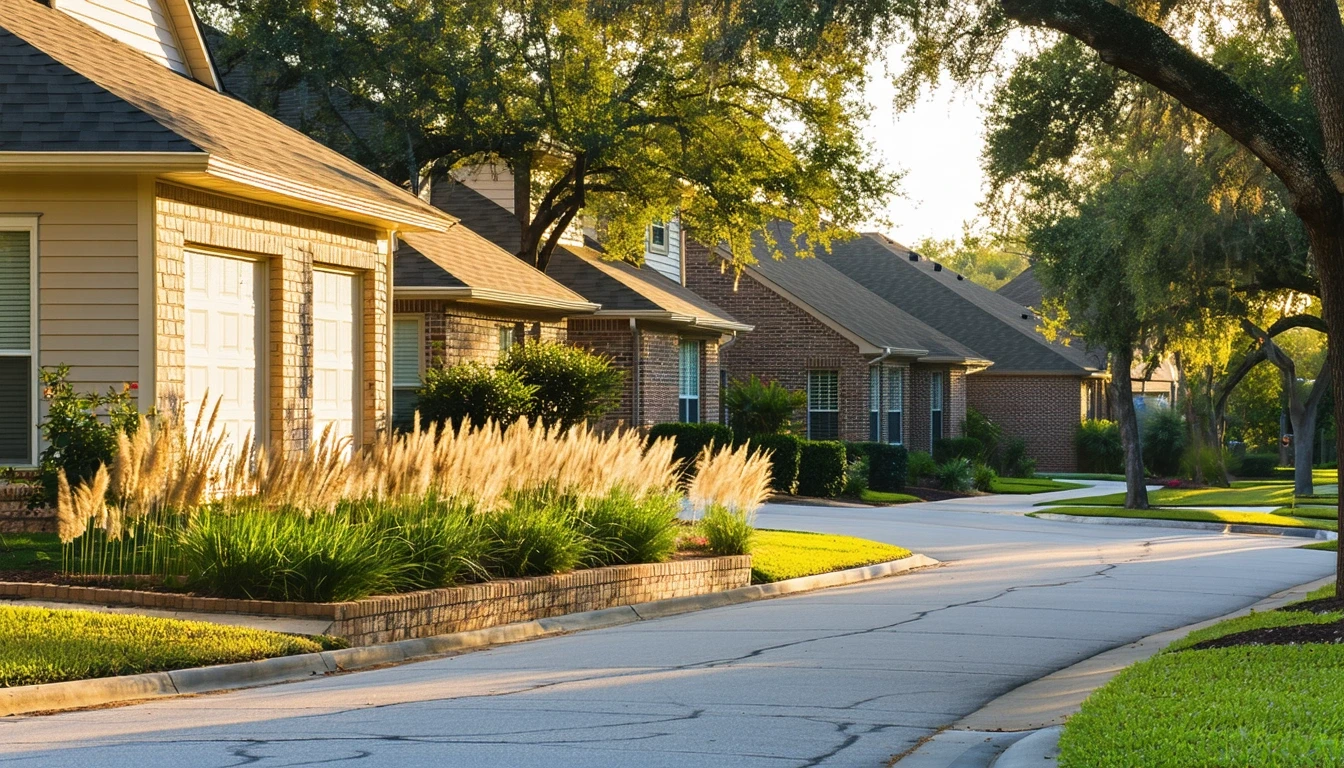
Georgetown’s housing market operates under pressure from two directions. Locally, it functions as a Williamson County seat with its own employment base and civic identity. Regionally, it absorbs demand from households seeking Austin metro access without Austin pricing. The median home value of $361,700 reflects that dual role—high enough to exclude many first-time buyers, but lower than comparable access points closer to the urban core.
The housing stock is predominantly low-rise and single-family, with both residential and commercial land use present but not uniformly mixed. Errands and grocery access cluster along specific corridors rather than distributing evenly across neighborhoods. That means what drives expenses in one part of Georgetown differs from another—not just in home price, but in how much driving, planning, and time households spend on daily logistics.
Newcomers often misread Georgetown as a uniform suburb. It isn’t. Walkable pockets exist where pedestrian infrastructure exceeds typical suburban ratios, but those areas are not the norm. Families evaluating neighborhoods face a more complex decision than price alone: school and playground density both fall below low thresholds citywide, meaning location selection carries extra weight for households with children.
Renting in Georgetown
Median gross rent sits at $1,575 per month, a figure that includes rent and essential utilities but excludes internet, renter’s insurance, and parking fees where applicable. For a household earning the median income of $87,465 per year, that rent represents roughly 22% of gross income—within conventional affordability guidelines, but only before accounting for transportation, food, and healthcare.
Rental availability and quality vary by corridor. Because grocery and food establishment density clusters rather than spreading evenly, renters in some areas face higher transportation costs or more frequent trips to access daily needs. Walkability exists in pockets, but most rental housing sits in car-oriented areas where pedestrian infrastructure is minimal relative to road networks.
Renters avoid property tax exposure and major maintenance costs, but they don’t escape Georgetown’s climate. Cooling costs during summer months are substantial regardless of tenure. Lease renewals can reflect broader regional rent pressure tied to Austin metro growth, though Georgetown’s distance from the core provides some insulation. Renters should expect landlords to pass through property tax increases over time, even if lease terms delay the adjustment.
Owning a Home in Georgetown
At $361,700, the median home value represents roughly 4.1 times the median household income—a multiple that requires careful financial planning and stable employment. Ownership in Georgetown means accepting long-term exposure to property taxes, which fund schools, infrastructure, and services in the absence of state income tax. Tax rates vary by jurisdiction and district, and while exemptions exist for some homeowners, the baseline obligation is significant.
Maintenance costs in Georgetown are driven by climate intensity. Summers regularly reach triple digits, stressing air conditioning systems, roofing materials, and exterior finishes. HVAC replacement is not a hypothetical expense—it’s a scheduled obligation. Roof lifespans shorten under sustained heat and UV exposure. Exterior paint fades and cracks faster than in temperate zones. These aren’t emergencies; they’re predictable costs that owners must budget for over a multi-year horizon.
Homeowners associations govern some neighborhoods, adding monthly or annual fees that cover common area maintenance, amenities, or deed restriction enforcement. HOA presence varies widely and is not uniform across the city. Where they exist, they add a layer of cost predictability (for covered services) and governance constraint (for property modifications).
Ownership also means control. Owners can install energy-efficient windows, upgrade insulation, or add solar capacity to reduce long-term utility exposure. Renters cannot. That control has value in a climate where cooling costs dominate household budgets for five to six months each year.
Apartment vs House in Georgetown — Cost Behavior Comparison
| Expense Category | Apartment | House |
|---|---|---|
| Cooling Costs (Summer) | Lower total usage due to smaller square footage and shared wall insulation; tenant pays utility bill but not system replacement | Higher total usage due to larger square footage and greater exterior surface area; owner pays both utility bill and system replacement |
| Exterior Maintenance | Landlord or property management absorbs roof, siding, and paint costs driven by heat and UV exposure | Owner absorbs all costs; Texas heat accelerates degradation of roofing, paint, and seals |
| Property Tax Exposure | Indirect exposure through rent adjustments; landlord pays tax but may pass increases through lease renewals | Direct annual obligation; Texas structure places significant burden on real estate to fund services |
| Yard and Landscape | Typically maintained by property management; tenant avoids water costs and labor | Owner pays water, labor, or service costs; summer heat increases irrigation demand and plant stress |
Why these categories? Each row reflects a cost behavior that differs meaningfully in Georgetown due to climate intensity, tax structure, or housing stock characteristics. Categories like basic utilities or internet were excluded because they behave similarly across housing types. The distinctions above are driven by Georgetown’s triple-digit summer heat, Texas property tax reliance, and the low-rise single-family housing form that dominates the city.
Utilities & Upkeep Differences
Electricity rates in Georgetown sit at 16.04¢ per kilowatt-hour. During summer months, cooling a house can easily consume 1,500 to 2,500 kWh per month depending on square footage, insulation quality, and thermostat settings. Apartments, with smaller footprints and shared walls, typically see lower absolute usage, though per-square-foot costs can be comparable if insulation is poor.
Natural gas, priced at $25.56 per thousand cubic feet, plays a smaller role in Georgetown than in northern climates. Heating demand is modest and seasonal. The dominant utility exposure here is cooling, and it’s not optional—it’s a safety and habitability requirement during the extended summer season.
Upkeep differences between apartments and houses are driven by Georgetown’s housing form and climate. Houses are overwhelmingly low-rise and detached, meaning owners manage all exterior maintenance individually. Roof replacement, HVAC service, and exterior painting are owner obligations, and the timeline for each is compressed by heat exposure. Apartments centralize these costs under property management, insulating tenants from both the expense and the decision-making burden.
Water costs for landscaping are another house-specific exposure. Native and drought-tolerant plants reduce irrigation demand, but many neighborhoods feature turf grass that requires consistent watering during the long, dry summer. Apartments typically include water in rent or manage it centrally, removing the variable cost from tenant budgets.
Rent vs Buy: Long-Term Exposure in Georgetown
Renting in Georgetown offers cost predictability within a lease term and flexibility to relocate as household needs or employment circumstances change. Renters avoid property tax increases, major maintenance events, and the capital risk of home value fluctuations. The tradeoff is lack of control: renters cannot modify units to improve energy efficiency, and they remain exposed to rent increases driven by regional demand pressure from the Austin metro.
Owning a home in Georgetown means accepting volatility in property taxes, maintenance costs, and utility bills, but gaining control over those variables. Owners can invest in insulation, HVAC efficiency, and roofing quality to reduce long-term costs. They benefit from fixed-rate mortgage payments that don’t rise with inflation or regional rent pressure. They also absorb the risk that home values may not appreciate as expected, or that major systems fail earlier than planned.
The decision between renting and buying in Georgetown is not primarily financial—it’s structural. Renters optimize for flexibility and short-term cost containment. Owners optimize for control and long-term stability, accepting higher upfront costs and ongoing maintenance exposure in exchange for insulation from rent volatility and the ability to modify their living environment.
Households planning to stay in Georgetown for fewer than three to five years face significant transaction costs in buying and selling that erode any ownership advantage. Households planning longer timelines must evaluate whether they can absorb property tax obligations, manage maintenance in a high-heat climate, and navigate the corridor-clustered errands structure that makes some neighborhoods more car-dependent than others.
How Day-to-Day Living Shapes Housing Decisions in Georgetown
Housing costs in Georgetown aren’t just about the monthly payment—they’re about how the city’s physical structure affects daily logistics. Grocery and food access clusters along specific corridors rather than distributing evenly, meaning households in some neighborhoods drive more frequently for routine errands. That pattern adds transportation costs and time, both of which vary by where you live, not just whether you rent or own.
Walkable pockets exist where pedestrian infrastructure is strong, but they’re not the norm. Most of Georgetown remains car-oriented, with minimal pedestrian paths relative to road networks. For households evaluating where money goes each month, transportation exposure is a function of neighborhood selection as much as housing tenure. Renters and owners alike face this tradeoff, but owners make a longer-term commitment to a specific location’s access profile.
Family-oriented households face additional constraints. School and playground density both fall below typical thresholds citywide, meaning families must prioritize location more carefully than households without children. Parks are present and water features exist, but the distribution is uneven. Families choosing housing in Georgetown are effectively choosing a specific neighborhood’s infrastructure, not just a price point.
Healthcare access is routine-local: clinics are available, but no hospital is present within city limits. That doesn’t eliminate access, but it does mean certain medical needs require travel. For older adults or households managing chronic conditions, proximity to healthcare becomes a location variable that intersects with housing cost.
How this article was built: In addition to public economic data, this article incorporates location-based experiential signals derived from anonymized geographic patterns—such as access density, walkability, and land-use mix—to reflect how day-to-day living actually feels in Georgetown, TX.
FAQs About Housing Costs in Georgetown
What is the median home value in Georgetown, TX?
The median home value in Georgetown is $361,700. This figure reflects Georgetown’s position as both a Williamson County seat and an Austin metro access point, with pricing lower than closer-in suburbs but higher than more distant exurban areas.
How much does it cost to rent in Georgetown, TX?
Median gross rent in Georgetown is $1,575 per month, which typically includes rent and basic utilities. Actual rent varies by neighborhood, unit size, and proximity to corridors with better errands accessibility. Renters should budget separately for internet, renter’s insurance, and transportation costs.
Are property taxes high in Georgetown, TX?
Texas funds state and local services without an income tax, placing significant reliance on property taxes. While specific rates vary by jurisdiction and district within Georgetown, homeowners should expect property taxes to represent a material portion of total housing costs. Exemptions exist for some homeowners, but the baseline obligation is substantial compared to states with income taxes.
How do cooling costs affect housing expenses in Georgetown, TX?
Georgetown experiences triple-digit summer heat for extended periods, making air conditioning a non-negotiable expense. Electricity rates are 16.04¢ per kilowatt-hour, and cooling a typical house during summer months can consume 1,500 to 2,500 kWh or more depending on size and insulation. Apartments generally see lower total usage due to smaller square footage, but cooling costs are significant regardless of housing type.
Is Georgetown, TX a good place for families to buy a home?
Georgetown offers lower home values than closer-in Austin suburbs, but families must evaluate neighborhood-level infrastructure carefully. School and playground density fall below typical thresholds citywide, and errands accessibility clusters along corridors rather than distributing evenly. Families benefit from selecting neighborhoods based on proximity to schools, parks, and daily services, not just home price. The low-rise housing stock and moderate park access provide space for family life, but location within Georgetown matters significantly.
Making Housing Choices in Georgetown
Housing costs in Georgetown reflect the city’s dual identity: a regional center with its own economic base and a commuter option for Austin metro households. Home values, rent levels, and ongoing expenses are shaped by that position, but they’re also shaped by Texas’s property tax structure, the intensity of summer heat, and the uneven distribution of walkability and errands access across neighborhoods.
Renters gain flexibility and avoid property tax and maintenance exposure, but they remain vulnerable to rent increases driven by regional demand. Owners gain control and long-term cost stability, but they absorb climate-driven maintenance costs, property tax obligations, and the responsibility to manage a home in a high-heat environment.
The right choice depends on household timeline, risk tolerance, and how much weight you place on control versus flexibility. Households planning to stay in Georgetown for several years and willing to manage maintenance in a demanding climate may find ownership advantageous. Households prioritizing mobility, uncertain about long-term plans, or seeking to minimize upfront costs may find renting a better fit.
Georgetown’s housing market rewards careful neighborhood selection. Walkable pockets, corridor-clustered errands, and limited family infrastructure mean that where you live within the city affects daily costs and logistics as much as whether you rent or own. For more detail on how monthly expenses break down across categories, see our budget guide. If you’re planning a move and need logistical support, see our 2025 moving company picks.