
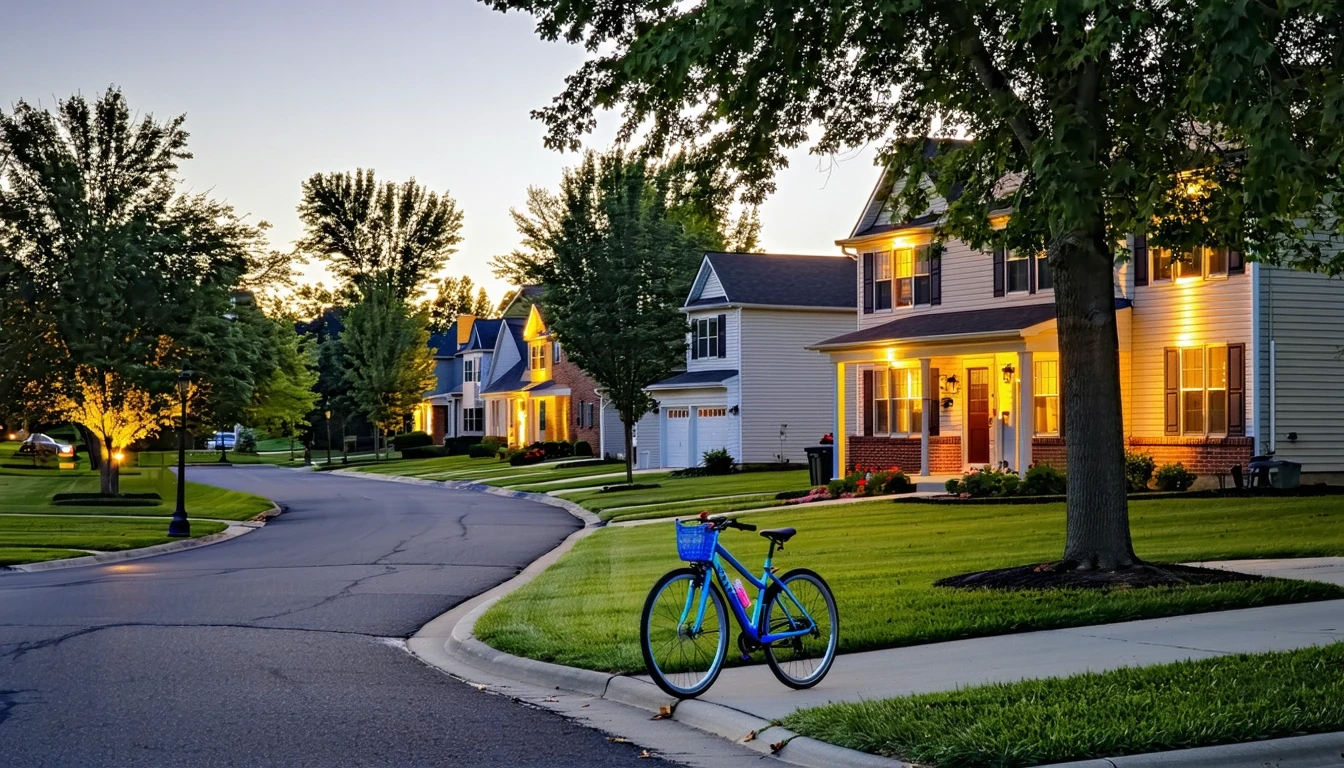
The Housing Market in Ofallon Today
O’Fallon, Illinois sits in a unique position within the St. Louis metropolitan area, straddling the line between established suburban stability and ongoing growth. Located in St. Clair County just 15 miles east of downtown St. Louis across the Mississippi River, O’Fallon has experienced steady population growth over the past two decades, expanding from roughly 21,000 residents in 2000 to over 32,000 today. This growth stems largely from Scott Air Force Base, the region’s largest employer with over 13,000 military and civilian personnel, which anchors the local economy and creates consistent housing demand from military families, contractors, and civilian employees seeking proximity to the base.
The cost of living in Ofallon, IL: what you’ll really spend reflects this military-influenced market dynamic. Unlike volatile coastal markets, O’Fallon’s housing prices have remained relatively stable, with moderate appreciation that tracks regional economic conditions rather than speculative bubbles. New residential construction continues in developments along the city’s western and southern edges, particularly near Interstate 64 corridors, where builders target first-time buyers and military families with move-in-ready homes priced between $200,000 and $350,000. This ongoing development keeps inventory flowing and prevents the supply constraints that drive rapid price escalation in more landlocked suburbs.
Compared to neighboring Belleville or Fairview Heights, O’Fallon commands a slight premium for newer construction and top-rated schools within the O’Fallon Township High School District 203. However, housing costs remain significantly lower than comparable St. Louis County suburbs west of the river like Webster Groves or Clayton, where median home prices exceed $400,000. For buyers and renters evaluating the bi-state metro area, O’Fallon represents an affordable entry point with solid amenities, though it requires accepting the eastward commute for those working in Missouri’s employment centers.
Renting in Ofallon: Typical Costs and Trends
Rental inventory in O’Fallon concentrates in apartment complexes built primarily between 2000 and 2020, clustered along major commercial corridors like Green Mount Road and near the intersection of Highway 50 and Interstate 64. These properties cater predominantly to three renter demographics: young military personnel and contractors assigned to Scott Air Force Base, healthcare workers employed at local medical facilities, and young professionals commuting to St. Louis who prefer Illinois tax structures. As of 2025, a one-bedroom apartment typically rents for $950 to $1,200 per month, while two-bedroom units range from $1,150 to $1,450, depending on age, amenities, and proximity to the base.
Neighborhoods near Scott Air Force Base’s main gates see the highest rental demand and fastest turnover, as military reassignments create consistent vacancy-and-fill cycles. Complexes offering flexible lease terms and furnished options command premium rents in these areas, sometimes reaching $1,500 for a two-bedroom with modern finishes. Conversely, older garden-style apartments along the eastern edges of the city, farther from major employment centers, offer more budget-friendly options starting around $900 for one-bedroom units, though these properties may lack updated appliances or community amenities like fitness centers.
Commute patterns significantly influence rental pricing in O’Fallon. Renters working at Scott Air Force Base prioritize proximity over price, accepting higher rents for 10-minute commutes versus 25-minute drives from cheaper alternatives in nearby Shiloh or Fairview Heights. Those commuting westward to St. Louis face a different calculation: O’Fallon sits roughly 25 minutes from downtown St. Louis via Interstate 64 during off-peak hours, but morning rush traffic can extend that to 40 minutes. This commute reality keeps O’Fallon rents competitive with Missouri suburbs offering similar drive times, though Illinois residents benefit from lower personal property taxes on vehicles and no earnings tax for St. Louis city workers living outside city limits.
Owning a Home in Ofallon: Prices, Taxes, and HOA Fees
The median home price in O’Fallon currently sits around $265,000, reflecting a market dominated by single-family homes built after 1990. Buyers can find entry-level three-bedroom ranch homes starting near $200,000 in established neighborhoods, while newer construction four-bedroom colonials in developments like Thornbury Estates or Deer Creek subdivisions list between $300,000 and $400,000. The upper end of O’Fallon’s market, featuring custom builds on larger lots or executive homes with finished basements and premium upgrades, reaches $500,000 to $600,000, though inventory above $450,000 remains limited compared to demand at lower price points.
Property taxes in O’Fallon reflect St. Clair County’s assessment structure and local taxing districts. The effective property tax rate averages approximately 2.8% to 3.1% of assessed home value annually, which translates to roughly $7,400 to $8,200 per year on a $265,000 home, or $615 to $685 monthly. This rate incorporates levies for O’Fallon Township High School District 203, local elementary districts, the city, county, and various special districts. While higher than Missouri’s statewide average property tax rate, Illinois homeowners avoid Missouri’s personal property tax on vehicles, which can offset several hundred dollars annually depending on vehicle value.
HOA fees exist primarily in O’Fallon’s newer planned developments and townhome communities built after 2005. Monthly HOA dues typically range from $50 to $150 in single-family neighborhoods, covering:
- Common area landscaping and entrance monument maintenance
- Neighborhood pool and clubhouse operations in larger developments
- Street lighting for private roads within subdivisions
- Snow removal on community sidewalks and shared driveways
Townhome and condominium communities charge higher fees, usually $175 to $275 monthly, which include exterior building maintenance, roof replacement reserves, and trash collection. However, many of O’Fallon’s established single-family neighborhoods, particularly those built before 2000, have no HOA structure at all, allowing homeowners to avoid these recurring fees entirely. Buyers should verify HOA status during home searches, as the presence or absence of these fees significantly impacts long-term ownership costs.
Apartment vs House in Ofallon: Side-by-Side Costs
Understanding the full sample monthly budgets for living in Ofallon requires comparing all housing-related expenses beyond base rent or mortgage payments. The following table breaks down typical monthly costs for a two-bedroom apartment versus a three-bedroom house in O’Fallon:
| Monthly Expense | Apartment (2BR) | House (3BR) |
|---|---|---|
| Rent/Mortgage Payment | $1,300 | $1,650 (assuming $265,000 purchase, 20% down, 6.5% rate) |
| Property Tax | N/A (included in rent) | $650 |
| Utilities | $120 (electric, water/sewer included) | $185 (electric, gas, water/sewer) |
| Insurance | $18 (renters insurance) | $110 (homeowners insurance) |
| HOA Fees | N/A | $100 (if applicable) |
| Maintenance/Repairs | N/A (landlord responsibility) | $150 (estimated reserve) |
| Monthly Total | $1,438 | $2,845 |
Methodology: Housing estimates for 2025 in O’Fallon use published rent and sale price data from regional real estate platforms, St. Clair County property tax rates, and typical HOA fees reported in local subdivision disclosures. Mortgage calculations assume conventional financing with 20% down payment at current market interest rates. Utility costs reflect Illinois energy rates and typical consumption for property sizes common in O’Fallon. Maintenance reserves follow standard guidance of 1% annual home value. All totals are rounded and expressed as monthly costs. Actual expenses vary depending on neighborhood, housing type, household size, and individual usage patterns.
The nearly $1,400 monthly difference between renting and owning reflects not just the mortgage principal and interest, but the accumulated costs of property taxes, insurance, maintenance, and HOA fees that renters avoid. However, homeowners build equity through mortgage principal payments (roughly $400 monthly in this scenario), while renters’ payments generate no ownership stake. This equity-building component becomes the central consideration in long-term financial planning.
Utility & Upkeep Differences
Utility costs in O’Fallon vary significantly between apartments and houses due to square footage differences and building efficiency. Most apartment complexes built after 2000 feature modern insulation and energy-efficient HVAC systems, keeping electric bills manageable even during Illinois’s humid summers and cold winters. Tenants in two-bedroom apartments typically pay $80 to $120 monthly for electricity, with water, sewer, and trash often included in rent. Some older complexes meter water separately, adding $30 to $50 monthly, but this remains the exception rather than standard practice.
Single-family homeowners face higher utility expenses across all categories. A typical three-bedroom house in O’Fallon consumes $110 to $140 in electricity during moderate months, rising to $160 to $200 during peak summer air conditioning season and winter heating periods. Natural gas heating, common in O’Fallon homes, adds $60 to $90 monthly during winter months but drops to minimal pilot light costs in summer. Water and sewer bills run $50 to $70 monthly for typical family usage, while trash collection costs $20 to $25 monthly through city contracts. These combined utility expenses average $185 to $220 monthly, compared to $120 or less for apartment dwellers.
Maintenance responsibilities create the starkest difference between renting and owning. Apartment tenants call property management for repairs, paying nothing beyond their lease obligations for HVAC failures, appliance replacements, or plumbing issues. Homeowners shoulder all maintenance costs, from routine tasks like furnace filter changes and lawn care to major expenses like roof replacements, water heater failures, or foundation repairs. Financial advisors recommend reserving 1% to 2% of home value annually for maintenance, translating to $220 to $440 monthly for a $265,000 home. While not every month incurs actual expenses, this reserve ensures funds exist when the furnace fails in January or the roof needs replacement after a storm.
5-Year Rent vs Buy Outlook
Evaluating whether to rent or buy in O’Fallon requires projecting costs over a meaningful timeframe that accounts for both recurring expenses and wealth-building through home equity. Over a five-year period, a renter paying $1,300 monthly with typical 3% annual increases will spend approximately $84,500 in rent, ending with no asset value but also no maintenance obligations or transaction costs. This calculation assumes the renter invests no additional funds and maintains flexibility to relocate without selling a property.
A homebuyer purchasing a $265,000 house with 20% down ($53,000) and financing $212,000 at 6.5% interest faces different mathematics. Monthly mortgage payments of $1,650 plus $650 property tax, $110 insurance, $100 HOA fees, and $150 maintenance reserves total $2,660 monthly, or approximately $159,600 over five years. However, this buyer builds roughly $32,000 in equity through principal payments, and if O’Fallon home values appreciate at the modest 2% annually typical of stable Midwest markets, the home’s value increases by approximately $27,500. Combined, the buyer holds roughly $59,500 in equity after five years, though selling would incur 6% to 7% transaction costs (roughly $18,500), netting approximately $41,000 after sale expenses.
The financial comparison shows homeownership costing roughly $75,000 more out-of-pocket over five years ($159,600 minus $84,500 in rent) but generating $41,000 in net equity after transaction costs, creating an effective $34,000 premium for ownership. This premium buys stability, control over the property, and protection from rent increases, while the renter maintains flexibility and avoids maintenance headaches. For military families expecting reassignment within three years, renting clearly wins. For civilian employees planning decade-long tenure in the region, buying builds wealth despite higher short-term costs. The decision hinges on personal timelines, career stability, and lifestyle priorities rather than pure financial optimization.
FAQs About Housing Costs in Ofallon
How much are HOA fees in Ofallon?
HOA fees in O’Fallon’s single-family neighborhoods typically range from $50 to $150 monthly, covering common area maintenance, neighborhood amenities like pools, and services such as snow removal on community sidewalks. Townhome and condominium communities charge higher fees, usually $175 to $275 monthly, which include exterior building maintenance and roof replacement reserves. However, many established O’Fallon neighborhoods built before 2000 have no HOA structure, allowing homeowners to avoid these fees entirely.
What is the property tax rate in Ofallon?
The effective property tax rate in O’Fallon averages approximately 2.8% to 3.1% of assessed home value annually, incorporating levies for schools, city, county, and special districts. On a median-priced $265,000 home, this translates to roughly $7,400 to $8,200 annually, or $615 to $685 monthly. While higher than Missouri’s average rates, Illinois homeowners avoid Missouri’s personal property tax on vehicles, which partially offsets the difference.
Is renting cheaper than buying long-term in Ofallon?
Renting costs less monthly and requires no down payment, making it cheaper short-term. However, over five to ten years, homeownership builds equity through mortgage principal payments and property appreciation, potentially offsetting higher monthly costs. For residents planning to stay in O’Fallon beyond five years, buying typically proves more financially advantageous despite higher upfront and monthly expenses. Renters maintain flexibility and avoid maintenance costs but build no ownership stake.
Do houses have higher utility costs than apartments?
Yes, significantly. Single-family homes in O’Fallon average $185 to $220 monthly for all utilities including electricity, natural gas, water, sewer, and trash collection. Two-bedroom apartments typically cost $120 or less monthly, with many complexes including water, sewer, and trash in rent. The difference stems from larger square footage, less efficient building envelopes in older homes, and separate metering for all services in houses versus shared utilities in apartment buildings.
What’s the monthly cost difference between apartments and houses in Ofallon?
A two-bedroom apartment in O’Fallon costs approximately $1,440 monthly including rent, utilities, and renters insurance. A three-bedroom house costs roughly $2,845 monthly including mortgage, property tax, insurance, HOA fees, utilities, and maintenance reserves. This $1,400 difference reflects not just larger living space but the accumulated costs of ownership, though homeowners build equity while renters do not.
Making Smart Housing Choices in Ofallon
O’Fallon’s housing market offers a rare combination of affordability, stability, and quality that attracts both military families and civilian residents seeking value within the St. Louis metro area. The decision between renting and buying hinges less on financial optimization than on personal timelines and lifestyle priorities. Military personnel facing reassignment cycles benefit from rental flexibility and freedom from maintenance obligations, while civilian employees planning long-term tenure build wealth through homeownership despite higher monthly costs and responsibilities.
The city’s ongoing development ensures inventory availability across price points, preventing the supply constraints that drive rapid appreciation in landlocked markets. This stability works both ways: buyers shouldn’t expect dramatic short-term gains, but neither should they fear volatile downturns. For those committed to the region, O’Fallon’s combination of rated schools, proximity to Scott Air Force Base, and reasonable commute access to St. Louis creates a foundation for sound housing decisions. When considering moving companies, costs, and logistics, factor in the long-term housing cost structure rather than just immediate monthly payments, as the true cost difference between renting and owning emerges over multi-year periods rather than single lease terms.
Understanding property taxes, HOA structures, and utility patterns specific to O’Fallon’s climate and infrastructure allows residents to budget accurately and avoid surprises. The bi-state metro area’s unique tax structures create opportunities for strategic housing choices, with Illinois property taxes offset partially by vehicle tax savings and the absence of St. Louis city earnings taxes for Illinois residents. These regional factors make O’Fallon’s housing costs more competitive than surface-level comparisons suggest, particularly for households with multiple vehicles or St. Louis-based employment.