
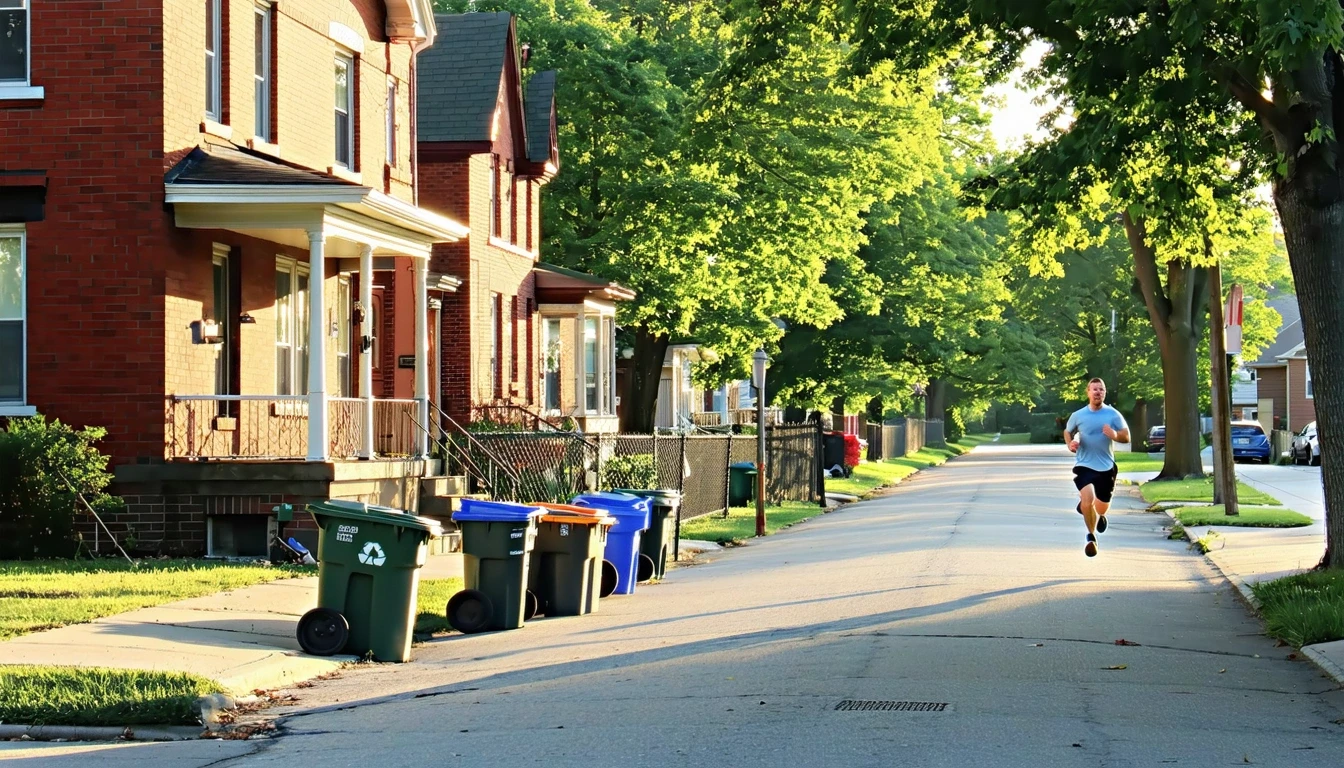
The Housing Market in Granite City Today
Granite City sits just across the Mississippi River from St. Louis, offering a distinctly affordable alternative to metro Missouri housing while maintaining easy access to the broader bi-state region. The city’s housing market reflects its industrial heritage and working-class roots, with **median home prices hovering around $95,000 to $115,000** as of 2025—significantly below both the Illinois state average and neighboring communities like Edwardsville or Collinsville. This affordability stems partly from decades of population decline as steel manufacturing contracted, though recent stabilization efforts and the presence of U.S. Steel’s Granite City Works continue to anchor the local economy.
What makes Granite City’s market unique is its mix of pre-war bungalows, mid-century brick ranches, and newer subdivisions on the city’s eastern edges. Unlike rapidly gentrifying neighborhoods in St. Louis proper, Granite City maintains consistent pricing with minimal year-over-year volatility. The market attracts first-time buyers, retirees downsizing from larger metro areas, and workers employed at nearby industrial facilities or healthcare systems. Compared to Alton to the north or Belleville to the southeast, Granite City offers lower entry costs but fewer amenities and slower appreciation rates.
Understanding this market means recognizing its trade-offs: exceptional affordability balanced against limited inventory turnover and modest resale potential. For buyers prioritizing low monthly costs and proximity to St. Louis employment centers via I-270 and I-55/70, Granite City delivers value that’s increasingly rare in the metro area. The question isn’t whether housing is cheap—it objectively is—but whether the surrounding community infrastructure and long-term investment outlook align with your lifestyle and financial goals.
Renting in Granite City: Typical Costs and Trends
Rental inventory in Granite City consists primarily of older apartment complexes, converted multi-family homes, and small-scale landlord properties scattered throughout residential neighborhoods. As of 2025, **one-bedroom apartments typically rent between $550 and $700 per month**, while **two-bedroom units range from $650 to $850**, depending on condition, location, and included utilities. These figures represent some of the lowest rental costs in the St. Louis metro area, reflecting both the city’s affordability and its aging housing stock.
The renter demographic skews toward hourly workers, young adults starting out, and retirees on fixed incomes who prioritize low overhead. Areas near downtown Granite City and along Nameoki Road tend to offer the most rental options, though quality varies considerably. Properties closer to the eastern city limits near Pontoon Beach command slightly higher rents due to newer construction and proximity to shopping corridors. Unlike college towns or downtown St. Louis neighborhoods, Granite City sees minimal seasonal rent fluctuation and relatively stable vacancy rates.
Commute considerations play a significant role in rental decisions here. Residents working in St. Louis proper face a 20-30 minute drive via I-270, making Granite City viable for those willing to trade urban amenities for lower housing costs. However, public transit options are extremely limited—Metro Transit’s bus service provides minimal coverage—so renters almost universally need personal vehicles. This transportation dependency should factor into any monthly budget calculation, as car ownership costs effectively offset some rental savings compared to transit-accessible neighborhoods across the river.
Owning a Home in Granite City: Prices, Taxes, and HOA Fees
Homeownership in Granite City centers on single-family detached houses, with median sale prices ranging from **$95,000 to $115,000** for move-in-ready properties. Fixer-uppers and estate sales occasionally dip below $80,000, while newer construction or extensively renovated homes in desirable pockets can reach $140,000 to $160,000. This pricing structure makes Granite City one of the most accessible markets for first-time buyers in the Illinois portion of the metro area, requiring down payments and monthly mortgage obligations well below regional averages.
Property taxes in Granite City reflect Madison County’s assessment practices and Illinois’s relatively high tax burden. The **effective property tax rate typically falls between 2.8% and 3.2%** of assessed home value annually. For a $110,000 home, this translates to approximately **$3,080 to $3,520 per year, or $257 to $293 monthly**. These taxes fund local schools, municipal services, and county operations, and they represent a significant ongoing cost that renters don’t directly face. Illinois property taxes are notably higher than Missouri’s across the river, which surprises some buyers relocating from St. Louis County.
HOA fees are uncommon in Granite City’s housing landscape. The city developed primarily during eras when homeowners associations were rare, and most neighborhoods consist of individually owned lots without shared amenities or mandatory membership organizations. A few newer subdivisions on the city’s eastern edges may have modest HOA structures covering basic landscaping or entrance maintenance, typically charging $20 to $50 monthly, but these represent exceptions rather than the norm. For most Granite City homeowners, housing costs consist of mortgage principal and interest, property taxes, insurance, and utilities—without the additional layer of association dues that characterize newer suburban developments.
Apartment vs House in Granite City: Side-by-Side Costs
Comparing monthly expenses between renting an apartment and owning a house in Granite City reveals the true cost difference beyond just rent versus mortgage payments. The following table breaks down typical monthly obligations for a two-bedroom apartment versus a modest three-bedroom house:
| Monthly Expense | Apartment (2BR) | House (3BR) |
|---|---|---|
| Rent/Mortgage Payment | $750 | $620 (based on $110,000 purchase, 20% down, 7% rate) |
| Property Tax | N/A (included in rent) | $275 |
| Utilities | $120 (often partial coverage) | $180 (full responsibility) |
| Insurance | $20 (renter’s insurance) | $85 (homeowner’s insurance) |
| HOA Fees | N/A | N/A (uncommon in Granite City) |
| Maintenance Reserve | N/A | $100 (estimated annual costs) |
| Monthly Total | $890 | $1,260 |
This comparison illustrates that while mortgage payments may be lower than rent, total homeownership costs in Granite City typically exceed rental expenses by $300 to $400 monthly once property taxes, insurance, utilities, and maintenance are factored in. The gap narrows if comparing newer apartments with higher rents to older, paid-off homes, but for typical scenarios involving financed purchases, renting remains the lower-cost short-term option.
Methodology: Housing estimates for 2025 in Granite City use published rent and sale price data from regional real estate platforms, Madison County property tax rates, and typical homeowner insurance costs for Illinois. Mortgage calculations assume a 20% down payment and prevailing interest rates around 7%. Utility estimates reflect Ameren Illinois service costs and typical consumption for older housing stock. Maintenance reserves represent average annual costs spread monthly. Actual expenses vary depending on specific property condition, financing terms, and household usage patterns.
Utility & Upkeep Differences
Utility costs in Granite City vary significantly between apartments and houses, driven primarily by square footage, insulation quality, and heating system efficiency. The region experiences hot, humid summers and cold winters, requiring both air conditioning and substantial heating. Apartment dwellers typically pay **$100 to $140 monthly** for electricity, gas, water, and trash combined, with some landlords covering water and trash collection. House owners face **$150 to $220 monthly** for the same services, with older homes featuring poor insulation or outdated HVAC systems pushing costs toward the higher end.
Maintenance responsibilities create the starkest difference between renting and owning. Apartment tenants call landlords when appliances fail, roofs leak, or plumbing issues arise—these repairs cost renters nothing beyond potential inconvenience. Homeowners shoulder full responsibility for all repairs and replacements, from furnace maintenance to roof shingles to water heater failures. In Granite City’s aging housing stock, where many homes date from the 1940s through 1970s, deferred maintenance and outdated systems are common. Budgeting **$1,200 to $1,800 annually** for home maintenance and repairs is prudent, though actual costs fluctuate dramatically year to year.
Yard maintenance adds another dimension for house owners. Granite City’s typical lot sizes require regular mowing, seasonal leaf removal, and occasional tree trimming—tasks apartment dwellers never face. DIY-inclined owners can manage these with modest equipment investments, but those hiring services should budget $80 to $150 monthly during growing season. These ongoing responsibilities don’t appear in simple rent-versus-mortgage comparisons but significantly impact both time and money for homeowners.
5-Year Rent vs Buy Outlook
Evaluating the five-year financial outlook for renting versus buying in Granite City requires realistic assumptions about appreciation, rent increases, and opportunity costs. If you rent a two-bedroom apartment at $750 monthly with typical 3% annual increases, you’ll pay approximately **$48,600 total over five years** with no equity accumulation but also no maintenance costs or property tax obligations. Your financial flexibility remains high—you can relocate with minimal friction and avoid unexpected repair expenses.
Buying a $110,000 home with 20% down ($22,000) and financing $88,000 at 7% creates different dynamics. Monthly mortgage payments of $620 plus $275 property tax, $85 insurance, and $100 maintenance reserve total $1,080. Over five years, you’ll pay approximately **$64,800 in housing costs**, but you’ll also build roughly **$12,000 in equity** through mortgage principal reduction. If Granite City home values appreciate modestly at 1-2% annually (conservative given historical trends), your home might gain $5,500 to $11,000 in value, though this remains uncertain given the market’s stability.
The break-even analysis favors renting in the short term purely on cash flow, but buying begins making financial sense if you plan to stay beyond five years and value stability over flexibility. The real advantage of homeownership in Granite City isn’t rapid appreciation—it’s locking in predictable housing costs while building modest equity in an extremely affordable market. For those confident in long-term residency and comfortable with maintenance responsibilities, buying offers a path to eventual mortgage-free living that renting never provides. However, if career mobility or lifestyle uncertainty factor into your planning, Granite City’s low rents make staying flexible an economically rational choice.
FAQs About Housing Costs in Granite City
How much are HOA fees in Granite City? Most Granite City neighborhoods have no HOA fees at all, as the housing stock predates the homeowners association model. A few newer subdivisions on the eastern edges may charge $20 to $50 monthly for basic entrance landscaping, but these represent rare exceptions. Buyers should assume zero HOA costs unless specifically purchasing in one of these limited newer developments.
What is the property tax rate in Granite City? Granite City property owners pay an effective tax rate between 2.8% and 3.2% of assessed home value annually, reflecting Madison County assessments and Illinois tax structures. For a typical $110,000 home, this means approximately $3,080 to $3,520 yearly, or $257 to $293 monthly. These rates are notably higher than comparable Missouri communities across the river.
Is renting cheaper than buying long-term in Granite City? Renting costs less monthly when comparing total expenses including taxes, insurance, and maintenance. However, buying builds equity and locks in predictable costs, making it financially advantageous over periods longer than five to seven years if you plan to stay. The decision depends more on lifestyle stability and maintenance willingness than pure cost comparison.
Do houses have higher utility costs than apartments? Yes, significantly. Houses in Granite City typically cost $150 to $220 monthly for utilities compared to $100 to $140 for apartments, due to larger square footage, full responsibility for all services, and often poorer insulation in older housing stock. The gap widens during extreme weather when heating and cooling demands peak.
What’s the monthly cost difference between apartments and houses in Granite City? When comparing total expenses—not just rent versus mortgage—apartments typically cost $890 to $950 monthly while houses run $1,200 to $1,400 monthly including mortgage, taxes, insurance, utilities, and maintenance reserves. Houses cost roughly $300 to $400 more per month but build equity rather than paying a landlord.
Making Smart Housing Choices in Granite City
Granite City’s housing market rewards buyers who prioritize affordability and long-term stability over rapid appreciation or trendy amenities. The combination of low purchase prices and modest property taxes creates genuine homeownership accessibility, particularly for first-time buyers or those downsizing from more expensive markets. However, the trade-offs are real: aging infrastructure, limited inventory turnover, and the need for reliable transportation given minimal transit options. Understanding these dynamics helps frame realistic expectations about what homeownership or renting in this community actually entails.
The rent-versus-buy decision here hinges less on financial optimization than on lifestyle certainty. If you’re confident about staying in the Granite City area for five-plus years, value predictable housing costs, and don’t mind maintenance responsibilities, buying makes practical sense despite higher monthly outlays. If your career path remains uncertain or you prefer flexibility without yard work and repair obligations, the city’s low rental costs make staying a renter entirely reasonable. Neither choice is inherently superior—they serve different priorities within the same affordable housing landscape.
For those evaluating Granite City as part of broader bi-state housing searches, comparing total living costs beyond just housing helps clarify whether the savings justify the location. The city delivers on affordability but requires realistic assessment of commute patterns, community amenities, and long-term investment potential. Whether you’re planning a move to the area or already here weighing your options, Granite City’s housing market offers straightforward value for those whose priorities align with what this working-class community provides.