
The 5:47 a.m. alarm isn’t optional if you’re catching the MetroBus from Collinsville into downtown St. Louis. You drive seven minutes to a park-and-ride lot off Bluff Road, wait under fluorescent lights, and watch your breath fog in the pre-dawn cold. The bus arrives—usually—and you settle in for a ride that strings together stops in Fairview Heights, Swansea, and East St. Louis before crossing the Poplar Street Bridge. By the time you walk into your office, it’s been ninety minutes since you left home. Your coworker who drives the same route? She left at 6:45 and arrived ten minutes ago.
That contrast captures the transportation reality in Collinsville. This isn’t a city where you choose between transit and driving based on preference or values. You choose based on whether your life fits into the narrow lanes where transit actually functions—and for most households, it doesn’t. Collinsville is a sprawling, car-first suburb built along the I-55 and I-70 corridors east of St. Louis, where commercial strips, residential subdivisions, and job sites spread across a low-density landscape that public transit was never designed to serve. Understanding how people get around here means understanding that mobility is less about options and more about infrastructure reality.
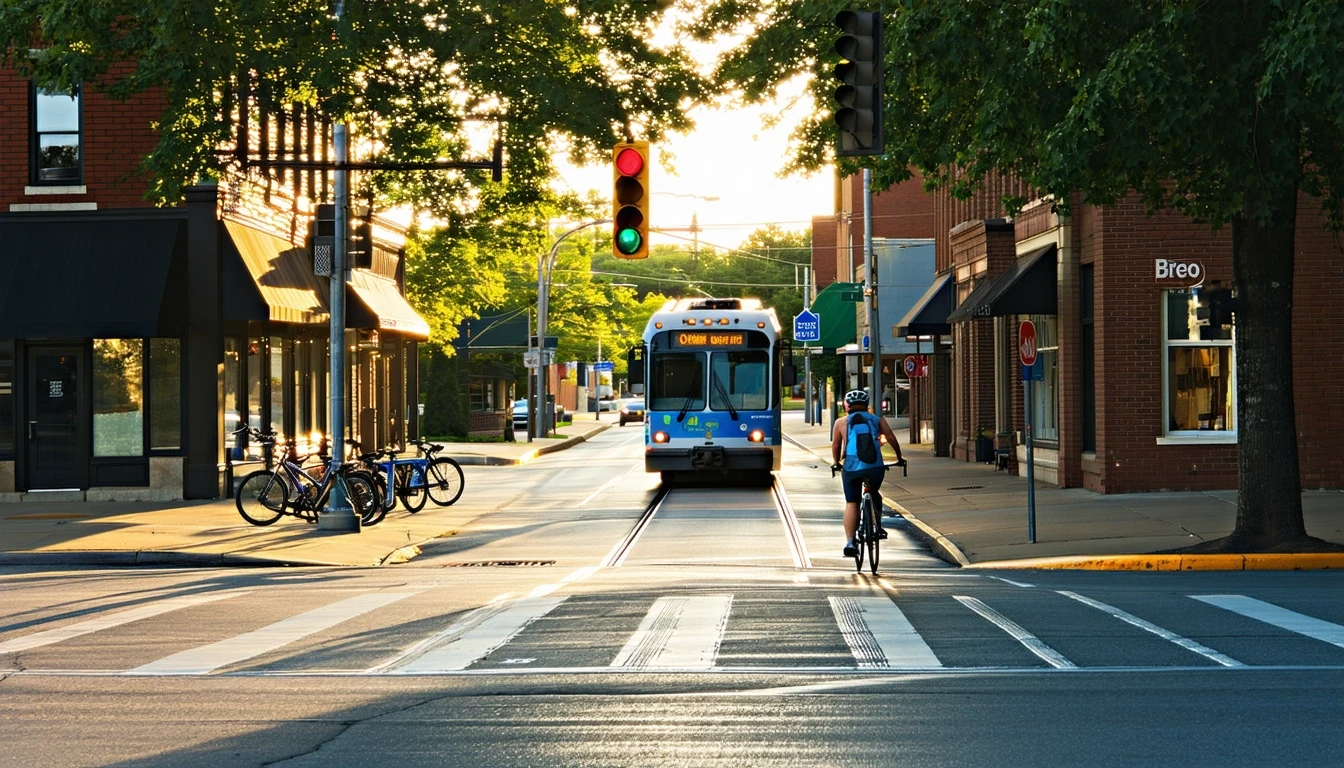
How People Get Around Collinsville
Collinsville operates as a car-dependent suburb, and that’s not a judgment—it’s a description of how the city is built. The street grid favors arterials like Belt Line Road, Vandalia Street, and Collinsville Road, which connect big-box retail, chain restaurants, and residential neighborhoods designed around garage access and driveway parking. Sidewalks exist in pockets, but they’re disconnected. Bike infrastructure is minimal. The layout assumes every household has at least one vehicle, and most have two.
Public transit exists in Collinsville, but it plays a supporting role rather than a lead one. MetroBus operates a handful of routes that connect Collinsville to neighboring cities and, for those willing to transfer, to the MetroLink light rail system that serves the broader St. Louis metro. But these routes don’t blanket the city. They serve specific corridors—primarily along Main Street and Bluff Road—and they’re timed for peak commuting hours rather than all-day flexibility. If your job, your grocery store, your doctor’s office, and your kids’ school all happen to line up along a bus route, transit might work. For everyone else, it’s a car.
What newcomers often misunderstand is that proximity to St. Louis doesn’t mean Collinsville inherits St. Louis transit infrastructure. The MetroLink Red Line terminates miles away in Shiloh, and while that station is technically accessible, getting there requires either a car or a bus transfer that adds significant time. Collinsville is close enough to St. Louis to be part of the metro economy, but far enough—and sprawling enough—that it functions as its own car-oriented ecosystem.
Public Transit Availability in Collinsville
Public transit in Collinsville often centers around systems such as MetroBus, which provides regional connections rather than intracity circulation. A few routes pass through the city, linking Collinsville to Fairview Heights, Granite City, and East St. Louis, with some routes continuing to downtown St. Louis or connecting to MetroLink stations. These routes are most useful for commuters traveling to fixed destinations along established corridors during weekday business hours.
Transit works best—if it works at all—for people living near Main Street or Bluff Road who commute to jobs in downtown St. Louis, Fairview Heights, or other transit-served employment centers. It’s a linear solution: if your origin and destination both fall along the line, and your schedule aligns with the bus timetable, transit becomes viable. But step outside that narrow geography or timeframe, and the system stops being practical.
Where transit falls short is everywhere else. Collinsville’s residential neighborhoods spread east and west of the main corridors, and most commercial development sits in strip malls and standalone stores that require parking lot access. If you live in a subdivision off Horseshoe Lake Road, or if you work at a warehouse near the industrial parks off I-55, or if you need to run errands after 7 p.m., transit isn’t a realistic option. There’s no frequent grid, no late-night service, and no coverage in the low-density residential zones where most families live.
The MetroLink light rail system, while part of the regional conversation, doesn’t directly serve Collinsville. The nearest station is in Shiloh, roughly a fifteen-minute drive south. Some commuters drive to that station and park, using MetroLink to reach downtown St. Louis or Lambert Airport, but that’s a hybrid approach that still requires car ownership. It’s not a substitute for local transit—it’s a regional amenity you access by driving first.
Driving & Car Dependence Reality
Driving isn’t just the default in Collinsville—it’s the infrastructure. The city’s layout assumes you’ll drive to work, drive to the grocery store, drive your kids to school, and drive to meet friends for dinner. Parking is abundant and free in nearly every context: shopping centers, restaurants, medical offices, and employers all provide surface lots. There’s no parking scarcity to nudge people toward alternatives, and there’s no density to make walking or biking practical for daily needs.
Car dependence here is tied to geography and development patterns, not preference. Collinsville grew during the post-war suburban boom, when highways and personal vehicles shaped city planning. The result is a spread-out city where jobs, services, and housing are separated by distances that make sense in a car but feel insurmountable on foot or by bike. A trip to the grocery store might be two miles—easy in a car, impractical on foot, especially in summer heat or winter cold.
For most households, the question isn’t whether to own a car—it’s whether one car is enough. Families with two working adults, or with teenagers who need to get to school and extracurriculars, often find that a second vehicle isn’t a luxury but a logistical necessity. Shift workers, parents managing multi-stop errands, and anyone whose job requires travel during the day all face the same reality: without a car, your radius of possibility shrinks to nearly nothing.
The tradeoff is predictability and control. When you drive, you leave when you’re ready, take the route you prefer, and adjust on the fly if plans change. You’re not waiting for a bus that may or may not arrive on time, and you’re not limited to destinations along fixed routes. But that control comes with exposure—to gas prices, to maintenance costs, to the need for insurance, registration, and repairs. In Collinsville, that exposure is unavoidable for nearly everyone.
Commuting Patterns & Daily Mobility
The average commute in Collinsville is 30 minutes, which reflects a mix of local employment and regional travel. Some residents work in Collinsville itself—at retail stores, healthcare facilities, schools, or light industrial sites near the I-55 and I-70 interchange. Others commute west into St. Louis, south toward Belleville, or north toward Edwardsville and Alton. The 20.4% of workers with long commutes—generally defined as 45 minutes or more—suggests a significant share of residents are traveling well beyond the immediate area, likely crossing the Mississippi River or reaching outer metro job centers.
Work-from-home rates in Collinsville are notably low at 3.0%, meaning the vast majority of residents must physically travel to work. That’s a higher in-person rate than many metro areas saw even before the pandemic, and it underscores the city’s role as a bedroom community for industries that require on-site presence: healthcare, education, manufacturing, logistics, and retail. Remote work isn’t reshaping commute patterns here the way it has in tech-heavy cities.
Daily mobility in Collinsville is structured around the car commute, but it’s rarely a simple home-to-work-to-home loop. Parents drop kids at school before heading to work. Shift workers leave at odd hours when transit isn’t running. People chain errands—gas, groceries, pharmacy—into a single trip because everything requires driving anyway. The car isn’t just a commuting tool; it’s the hub of daily logistics.
For those who do use transit, the structure is different. Commutes are longer and less flexible, requiring advance planning and schedule adherence. Multi-stop errands become difficult or impossible. Spontaneity—picking up a sick kid from school, running out for a forgotten ingredient, meeting a friend after work—requires either a backup car or a willingness to call a ride. Transit users in Collinsville tend to be those with fixed, predictable schedules and destinations that align with bus routes, or those for whom car ownership isn’t financially or legally accessible.
Who Transit Works For—and Who It Doesn’t
Public transit in Collinsville works for a narrow slice of residents: those who live near a bus route, work along a transit-served corridor, and maintain a schedule that aligns with weekday peak hours. That might include a renter in a Main Street apartment commuting to a downtown St. Louis office, or a service worker traveling between Collinsville and Fairview Heights retail jobs. It requires geographic luck, schedule compatibility, and a willingness to accept longer travel times in exchange for not owning a car.
Transit doesn’t work well for families, especially those with children. School drop-offs, after-school pickups, weekend activities, and emergency flexibility all demand the kind of mobility that transit can’t provide. It also fails shift workers whose hours fall outside the weekday commuter window—early morning warehouse shifts, late-night healthcare roles, weekend retail schedules. And it’s impractical for anyone whose job requires travel during the day, whether that’s a home health aide, a sales rep, or a contractor moving between sites.
Renters living in older, denser parts of Collinsville—near downtown or along Main Street—have the best shot at making transit work, but even then, it’s usually a supplement to car ownership rather than a replacement. Homeowners in subdivisions, particularly those east or west of the main corridors, face layouts where the nearest bus stop might be a mile away with no sidewalk to reach it. For them, transit isn’t even a theoretical option.
The distinction isn’t about income or values—it’s about infrastructure fit. Collinsville’s transit network serves a specific use case, and if your life doesn’t match that use case, the system offers little. That’s not a failure of the people who rely on cars; it’s a reflection of how the city is built.
Transportation Tradeoffs in Collinsville
Choosing between transit and driving in Collinsville isn’t a balanced decision—it’s a question of whether transit is even viable for your situation. For the small number of residents whose lives align with bus routes and schedules, transit offers predictability: no gas price swings, no maintenance surprises, no parking hassles. But it sacrifices time, flexibility, and geographic reach. A 15-minute drive becomes a 45-minute bus ride. A quick evening errand becomes impossible. A job offer across town might be out of reach.
Driving offers autonomy and speed. You control your departure time, your route, and your stops. You can live anywhere in Collinsville and work anywhere in the metro. You can handle emergencies, manage complex schedules, and adapt on the fly. But that autonomy comes with ongoing exposure: fuel costs fluctuate, maintenance demands attention, insurance and registration are non-negotiable, and breakdowns can derail everything. In a car-dependent city, those costs aren’t optional—they’re the price of participation.
The tradeoff isn’t transit versus driving in a vacuum—it’s transit’s predictability and lower cost against driving’s necessity and convenience. For most households in Collinsville, that’s not a real choice. The city’s layout, job distribution, and service infrastructure all assume car access. Transit exists, but it’s a niche solution rather than a viable alternative for daily life.
FAQs About Transportation in Collinsville (2025)
Is public transit usable for daily commuting in Collinsville?
Public transit is usable for a small subset of commuters—those living near bus routes and traveling to destinations along fixed corridors during weekday peak hours. For most residents, especially those in residential subdivisions or with non-traditional work schedules, transit isn’t practical for daily commuting. The system is designed for regional connections rather than intracity circulation, and coverage is limited.
Do most people in Collinsville rely on a car?
Yes. Collinsville’s sprawling layout, low-density development, and limited transit coverage make car ownership essential for nearly all households. The city’s infrastructure assumes personal vehicle access for work, errands, school, and healthcare. Even residents who occasionally use transit typically own a car for tasks that fall outside bus routes or schedules.
Which areas of Collinsville are easiest to live in without a car?
The areas closest to Main Street and Bluff Road—particularly older, denser neighborhoods near downtown—offer the best chance of living without a car, though even there it’s difficult. These areas have closer proximity to bus stops and some walkable errands. However, Collinsville as a whole is not designed for car-free living, and even residents in these areas often find that car ownership significantly improves quality of life.
How does commuting in Collinsville compare to nearby cities?
Collinsville’s 30-minute average commute reflects its role as a bedroom community with both local employment and regional commuters traveling into St. Louis or other metro job centers. Compared to denser cities with more robust transit, Collinsville commutes are more car-dependent and less flexible. Compared to rural areas, commutes are shorter and highway access is better. The city sits in a middle zone: suburban infrastructure with regional connectivity but limited local transit.
Can you get by in Collinsville with just one car for a household?
It depends on the household structure. Single adults or couples with aligned schedules can often manage with one car, especially if both work near each other or if one works from home. Families with children, or households with two adults working in different directions or on different shifts, typically find that one car creates significant logistical friction. Collinsville’s lack of transit alternatives means that losing access to the household car—even temporarily—can disrupt work, school, and errands.
How Transportation Fits Into the Cost of Living in Collinsville
Transportation in Collinsville isn’t just a line item—it’s a structural factor that shapes where you can live, where you can work, and how much flexibility you have in daily life. Car dependence means that monthly expenses must account for fuel, insurance, maintenance, and registration, and those costs don’t disappear when money is tight. They’re the price of access.
For households evaluating Collinsville, transportation should be understood as a fixed cost with variable exposure. You’ll almost certainly need a car, and many households will need two. Gas prices fluctuate, and while Collinsville’s current rate of $2.94 per gallon is moderate, your actual fuel spend depends on commute length and frequency. Maintenance and repairs are unpredictable but inevitable. Insurance rates vary by driver history and vehicle type. All of these factors sit outside your control, but they’re unavoidable if you want to live and work here.
The tradeoff is that car dependence also enables access to Collinsville’s lower housing costs and more space compared to denser, transit-rich cities. You’re trading transportation flexibility and cost predictability for housing affordability and square footage. That’s a reasonable tradeoff for many households, especially those who value homeownership, yards, and proximity to good school districts. But it’s a tradeoff you should enter with clarity, not surprise.
If you’re planning a move to Collinsville, factor transportation into your decision from the start. Know your commute route and distance. Understand that errands, appointments, and social life will all require driving. Budget for two cars if your household structure demands it. And recognize that while public transit exists, it’s not a safety net you can rely on if car ownership becomes difficult.
Collinsville is a car city. That’s not a flaw—it’s a feature of how the city is built and how the metro region is organized. The question isn’t whether you’ll need a car. It’s whether the life you can build here, with that car, is worth the trade.