
Moving from Denver to Austin: What Changes in 2026
Denver and Austin attract similar demographics—young professionals, tech workers, outdoor enthusiasts, and people seeking alternatives to coastal metros. Yet the two cities organize daily life very differently. Denver sits at altitude with mountain access and four distinct seasons; Austin sprawls across Central Texas with heat-dominated weather and a car-centric layout. Both cities have experienced rapid growth, but the pressures that growth creates show up in different places.
This guide explains how cost pressure, lifestyle rhythms, and logistical patterns shift when you move from Denver to Austin. It does not calculate whether Austin is “cheaper” or predict your household budget. Instead, it clarifies where expenses concentrate, how housing markets behave differently, and what daily routines feel like after the move. The goal is to help you understand where pressure moves, not whether the move pencils out financially.
Cost Pressure Shifts Between Denver and Austin
Both Denver and Austin are considered high-cost metros relative to national averages, but the structure of expenses differs. Denver’s altitude and climate create seasonal utility swings—heating costs rise in winter, though summers remain mild. Austin’s heat dominates cost behavior year-round: air conditioning runs from April through October, and summer energy bills can surprise newcomers unfamiliar with Texas electricity markets.
Grocery costs in both cities reflect their growth and relative isolation from major agricultural distribution hubs. Neither city offers a dramatic grocery advantage, though product mix and sales tax treatment vary. Texas has no state income tax, which shifts tax pressure toward property taxes and sales taxes. Colorado has a flat state income tax, and property tax rates tend to be lower than Texas, though home values in Denver have risen sharply over the past decade.
Transportation costs in Austin tend to be higher for households that rely on driving. The metro is less compact than Denver, and public transit coverage is limited outside the urban core. Denver offers more robust light rail and bus networks, which can reduce car dependency for some households. However, both cities still lean heavily on personal vehicles for most errands and commutes.
Housing and Neighborhood Patterns
Denver’s housing market has seen sustained price growth, driven by limited buildable land (mountains to the west, plains to the east) and steady in-migration. Entry barriers for homeownership are high, and rental inventory has tightened in desirable neighborhoods close to downtown and transit corridors. Property taxes in Colorado are relatively low compared to Texas, but home prices and HOA fees can be significant.
Austin’s housing market has also experienced rapid appreciation, but the structure differs. Texas property taxes are among the highest in the nation, and homeowners should expect ongoing tax obligations that rise with assessed values. HOA fees are common in newer developments, and many neighborhoods include mandatory membership in community associations. Rental markets in Austin have seen volatility, with new apartment construction creating pockets of competition in some submarkets while older neighborhoods remain tight.
Neighborhood form affects daily costs in both cities. Denver’s older neighborhoods closer to downtown tend to be more walkable, with mixed-use corridors and access to transit. Austin’s urban core has walkable pockets, but much of the metro consists of suburban-style development with limited sidewalk infrastructure and car-dependent retail. This pattern influences not just transportation costs, but also how often you eat out, how you access services, and how much time you spend in your car.
Lifestyle and Daily Rhythms
Denver’s climate creates a rhythm organized around seasons. Winters bring snow and cold, but also abundant sunshine and access to mountain recreation. Summers are warm but rarely oppressive, and evenings cool down reliably. Outdoor activity is central to the city’s identity, and many residents structure weekends around hiking, skiing, or mountain biking. The altitude affects newcomers differently—some adjust quickly, others notice fatigue or dehydration for weeks or months.
Austin’s climate is heat-forward. Summers are long, hot, and humid, with temperatures regularly exceeding 100°F from July through September. Air conditioning is not optional, and outdoor activity shifts to early mornings or evenings during peak heat. Winters are mild, with occasional cold snaps but little snow. The city’s outdoor culture revolves around water access—rivers, lakes, and swimming holes—rather than mountains. Social life in Austin tilts heavily toward live music, food culture, and neighborhood bars, with a pace that feels more relaxed than Denver’s fitness-oriented intensity.
Commute patterns differ as well. Denver’s light rail system connects downtown to the airport and several suburban nodes, and bus service covers much of the metro. Traffic congestion is significant during rush hours, especially on I-25 and I-70, but transit offers alternatives for some commuters. Austin’s public transit system is less developed, and the metro’s sprawl means longer average commute times for many residents. Traffic on I-35, MoPac, and other major corridors can be severe, and most households rely on personal vehicles for daily errands.
Relocation Logistics and Practical Friction
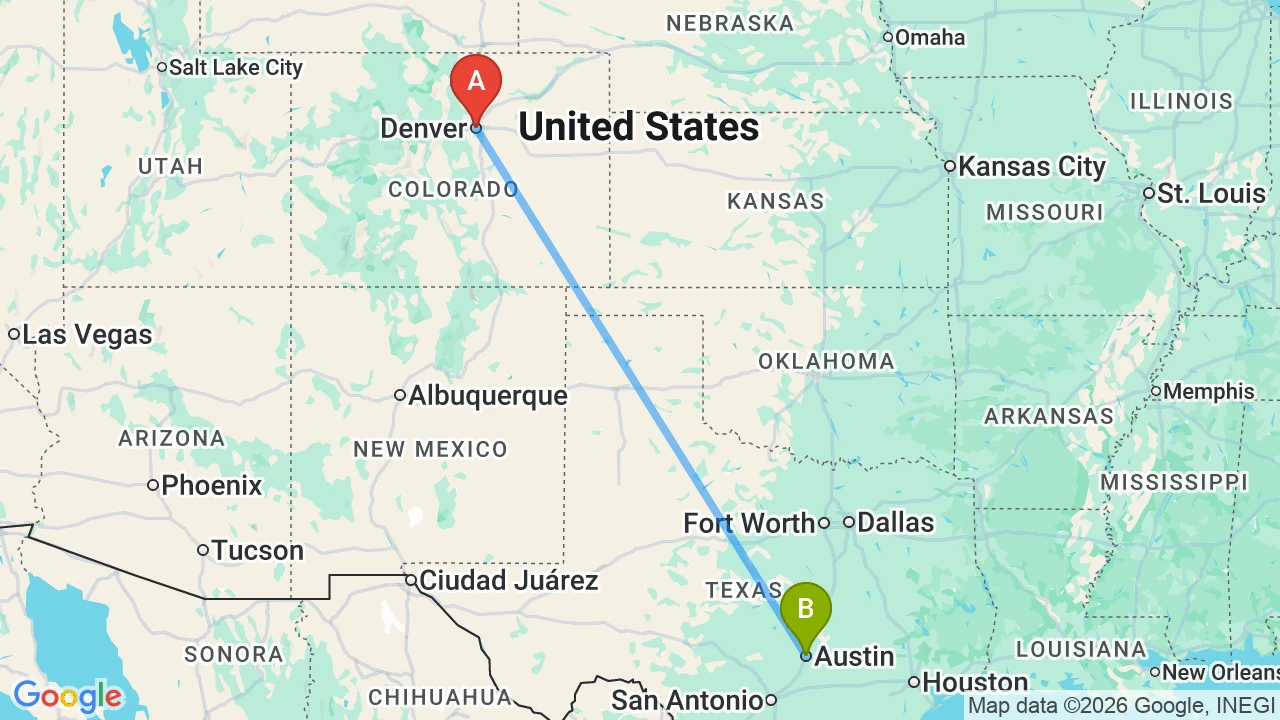
The drive from Denver to Austin covers roughly 900 miles and typically takes 13 to 15 hours, depending on route and stops. Most movers either hire professional movers or rent a truck and drive it themselves. Summer moves can be challenging in Austin due to heat, and securing rental housing or closing on a home often requires at least one advance trip to tour neighborhoods and meet landlords or agents.
Utility setup in Austin can involve navigating deregulated electricity markets, where residents choose from multiple retail providers. This differs from Denver’s regulated utility structure and can feel confusing at first. Water and trash services are typically managed by the city or local utility districts, and some neighborhoods have mandatory recycling or composting programs.
Vehicle registration and driver’s license transfers are required within 30 days of establishing residency in Texas. Texas does not require vehicle emissions testing in most counties, but the state does require annual vehicle inspections. Colorado requires emissions testing in certain metro counties, so the shift may feel simpler for some households. Auto insurance rates vary by ZIP code in both states, and Austin’s higher traffic density can push premiums higher for some drivers.
School enrollment timelines differ by district, and Austin’s rapid growth has created capacity pressures in some highly rated public schools. Families moving with school-age children should research enrollment deadlines and neighborhood school assignments well in advance. Denver’s school choice system allows some flexibility, but popular schools fill quickly, and the transition may require patience and persistence in either city.
Frequently Asked Questions
- Is Austin, TX more expensive than Denver, CO?
- Both cities are high-cost metros, but expenses concentrate differently. Austin’s heat drives higher summer utility bills, and Texas property taxes are significantly higher than Colorado’s. Denver’s housing entry costs have risen sharply, and altitude-related expenses (heating, vehicle maintenance) add pressure. Neither city is uniformly cheaper; the question is which cost structure fits your household better.
- How do housing markets differ between Denver, CO and Austin, TX?
- Denver’s market is constrained by geography and has seen sustained price growth, with relatively low property taxes but high entry costs. Austin’s market has grown rapidly with higher property taxes and more volatile rental dynamics due to new construction cycles. Both cities have competitive markets, but the ongoing tax obligation in Austin is a significant difference for homeowners.
- What lifestyle differences do people notice when moving from Denver, CO to Austin, TX?
- Denver’s lifestyle revolves around mountain access, four-season outdoor activity, and altitude. Austin’s culture is heat-driven, with a focus on water recreation, live music, and food scenes. Daily rhythms shift from fitness-oriented and seasonal in Denver to more car-dependent and heat-adapted in Austin. Social pace tends to feel more relaxed in Austin, more intense in Denver.
- When is the best time of year to move to Austin, TX?
- Spring (March through May) and fall (October through November) offer the most moderate weather and avoid peak summer heat. Summer moves mean dealing with temperatures above 100°F, which complicates loading and unloading. Winter moves are logistically easier but may coincide with holiday schedules. Rental markets tend to be most active in spring and late summer.
- What are common challenges when relocating from Denver, CO to Austin, TX?
- Adjusting to Austin’s heat and humidity is the most frequently cited challenge, especially for households used to Denver’s dry, mild summers. Traffic congestion and car dependency can feel more intense in Austin. Navigating deregulated electricity markets and higher property taxes surprises many newcomers. The loss of mountain access and seasonal variety is a lifestyle adjustment that affects outdoor enthusiasts significantly.
- Who tends to benefit most when moving from Denver, CO to Austin, TX, and who may struggle?
- Households seeking no state income tax, a more relaxed social pace, and access to live music and food culture tend to adapt well. Remote workers and those with flexible schedules can avoid peak traffic and heat. Families who prioritize mountain recreation, four-season variety, and walkable neighborhoods may feel the loss acutely. Renters and homeowners should carefully model property tax obligations before committing.
Conclusion
Moving from Denver to Austin trades mountain access and seasonal variety for heat, live music culture, and no state income tax. Cost pressure shifts from high housing entry barriers and altitude-related expenses in Denver to higher property taxes, summer utility bills, and car dependency in Austin. Neither city is universally more affordable; the question is which structure aligns with your household’s priorities and tolerances.
This move works best for people who value tax structure flexibility, prefer heat over cold, and can adapt to a car-centric metro with limited transit. It may challenge households that rely on walkability, prioritize outdoor recreation tied to mountains and seasons, or underestimate the cumulative cost of property taxes and cooling expenses. Understanding where pressure moves—not just whether costs rise or fall—is the key to making a decision that fits your life.