
Introduction: Why Chicago Residents Consider Raleigh
The Chicago-to-Raleigh corridor attracts professionals seeking warmer winters, lower unemployment, and a different pace of urban life. This move typically shifts cost pressure away from property taxes and heating bills toward cooling expenses and car dependence, while trading Chicago’s extensive transit network for Raleigh’s job growth and milder climate.
This guide explains how costs behave differently between these cities—not which one costs more overall. The goal is to help you understand where financial pressure concentrates in each place, how daily logistics change, and which household types tend to feel the transition most acutely.
We’re comparing cost structure and lifestyle friction, not calculating whether you’ll save money. That depends entirely on your housing choices, commute patterns, and how you adapt to a fundamentally different urban form.
Cost Pressure Shifts: Where Expenses Concentrate Differently
Chicago’s cost pressure centers on property ownership: high property taxes, heating bills that spike during long winters, and the ongoing expense of maintaining older housing stock through freeze-thaw cycles. Raleigh shifts that pressure toward transportation fuel, cooling costs during extended summer heat, and rent that has climbed faster than the national average as the Research Triangle attracts transplants.
Chicago’s median household income sits at $71,673 per year, while Raleigh’s reaches $78,631—a meaningful difference that reflects Raleigh’s tighter labor market (3.1% unemployment versus Chicago’s 5.4%). However, Raleigh’s median home value of $347,000 exceeds Chicago’s $304,500, and median rent is slightly higher at $1,371 per month compared to Chicago’s $1,314.
The regional price parity tells a complementary story: Chicago’s overall cost level registers at 103 (3% above the national baseline), while Raleigh sits at 98 (2% below). This suggests that non-housing categories—groceries, services, and goods—tend to cost slightly less in Raleigh, even as housing entry costs run higher.
Electricity rates flip the script: Chicago pays 18.74¢/kWh while Raleigh pays 15.05¢/kWh. But Raleigh’s extended cooling season means households often use more total electricity despite the lower rate. Natural gas shows the reverse pattern—Chicago pays $15.48/MCF versus Raleigh’s $25.54/MCF—though Raleigh’s milder winters mean far less gas consumption overall. The net effect: utility bills shift from winter heating dominance to summer cooling dominance.
Transportation costs favor Raleigh at the pump—$2.65/gallon versus Chicago’s $2.90—but Chicago’s 34-minute average commute benefits from transit options that Raleigh largely lacks. In Chicago, 14.6% of workers commute from home, compared to limited remote work data for Raleigh, and 59.7% of Chicago workers face commutes over 30 minutes. Raleigh’s car-dependent geography often means shorter distances but near-universal driving, which changes the calculus for households used to monthly transit passes.
Grocery and Everyday Expenses
Day-to-day grocery costs run slightly lower in Raleigh across most staples. Derived estimate based on national baseline adjusted by regional price parity; not an observed local price. In Chicago, bread costs approximately $1.84/lb compared to Raleigh’s $1.75/lb; ground beef runs $6.74/lb versus $6.41/lb; and milk costs $4.12/half-gallon compared to $3.92. These differences reflect Raleigh’s lower regional price parity and matter most for larger households buying in volume.
The gap isn’t dramatic—you won’t notice it on a single grocery trip—but over months, the 5% regional price difference compounds across rent, services, dining, and household goods. Chicago households accustomed to neighborhood grocers and ethnic markets may find Raleigh’s retail landscape more car-oriented, with fewer walkable options and more reliance on chain stores in suburban-style centers.
Housing and Neighborhood Patterns: Entry Barriers vs. Ongoing Obligations
Chicago’s housing market punishes owners with high property taxes and deferred maintenance costs, but rewards renters with relatively stable lease terms and diverse neighborhood options at multiple price points. Raleigh’s market does the opposite: lower property tax burdens and newer housing stock reduce ongoing ownership costs, but rapid rent growth and limited supply create pressure for renters, especially near downtown and the Research Triangle employment centers.
Chicago’s median home value of $304,500 reflects a mature market with wide variation—historic bungalows in need of updates, mid-century brick homes, and new construction all coexist. Raleigh’s $347,000 median skews toward newer builds in subdivisions and townhome communities, where HOA fees often bundle services but add another fixed monthly cost. Chicago homeowners face higher property tax rates that fund extensive municipal services; Raleigh’s lower rates mean fewer built-in amenities and more reliance on private solutions (lawn care, trash service, recreation).
For renters, Chicago’s $1,314 median reflects a market with both older walk-up apartments and newer high-rises, while Raleigh’s $1,371 median increasingly represents garden-style complexes and single-family rentals in car-dependent neighborhoods. Raleigh’s rental market has tightened as job growth outpaces construction, meaning less negotiating room and faster rent escalation at renewal time.
Neighborhood form matters more than price alone. Chicago’s grid layout and transit lines create walkable pockets where households can reduce car dependence; Raleigh’s growth pattern favors cul-de-sac subdivisions and office parks connected by arterial roads, which increases transportation costs even when housing costs drop. A Chicago renter who walks to the L and shops on foot may find Raleigh’s lower rent offset by the need for a second car, parking fees, and longer errand loops.
Lifestyle and Daily Rhythms: How Place Structure Shapes Costs
Chicago’s urban density and transit infrastructure allow some households to avoid car ownership entirely or limit driving to weekends. Raleigh’s dispersed layout makes that nearly impossible—most residents drive for work, errands, childcare, and recreation. This isn’t just a preference difference; it’s a structural reality that changes monthly expenses, time budgets, and household logistics.
Chicago’s 34-minute average commute often involves a combination of walking, bus, and rail, with predictable timing and no fuel cost. Raleigh commutes may be shorter in minutes but require a personal vehicle, parking costs, and exposure to traffic volatility on I-40 and I-440. The shift from transit passes to fuel, insurance, and maintenance changes both the cost profile and the mental load of managing transportation.
Climate exposure flips entirely. Chicago’s long, cold winters mean heating costs dominate utility bills from November through March, with natural gas furnaces running daily and older homes losing heat through single-pane windows and uninsulated walls. Raleigh’s mild winters—where freezing nights are rare and snow is occasional—eliminate that pressure but replace it with extended air conditioning season from May through September. Triple-digit summer heat and high humidity make cooling non-negotiable, and the lower electricity rate doesn’t fully offset the longer season.
Daily errands and household logistics shift from vertical to horizontal. Chicago households often live above or near their grocery store, pharmacy, and dry cleaner; Raleigh households drive to strip malls and shopping centers where parking is plentiful but walking between stores is impractical. This affects not just fuel costs but time—errands that took 20 minutes on foot in Chicago may require 40 minutes of driving and parking in Raleigh, even if the stores are technically closer in miles.
Outdoor access changes texture. Chicago’s lakefront, neighborhood parks, and forest preserves require transit or driving to reach, but offer concentrated amenities once you arrive. Raleigh’s greenway system, state parks, and suburban trails are more dispersed, requiring a car to access but offering less crowded, more naturalistic experiences. Families with young children may find Raleigh’s pace and outdoor space appealing; urbanists who value spontaneous walkability may feel isolated.
Relocation Logistics and Practical Friction
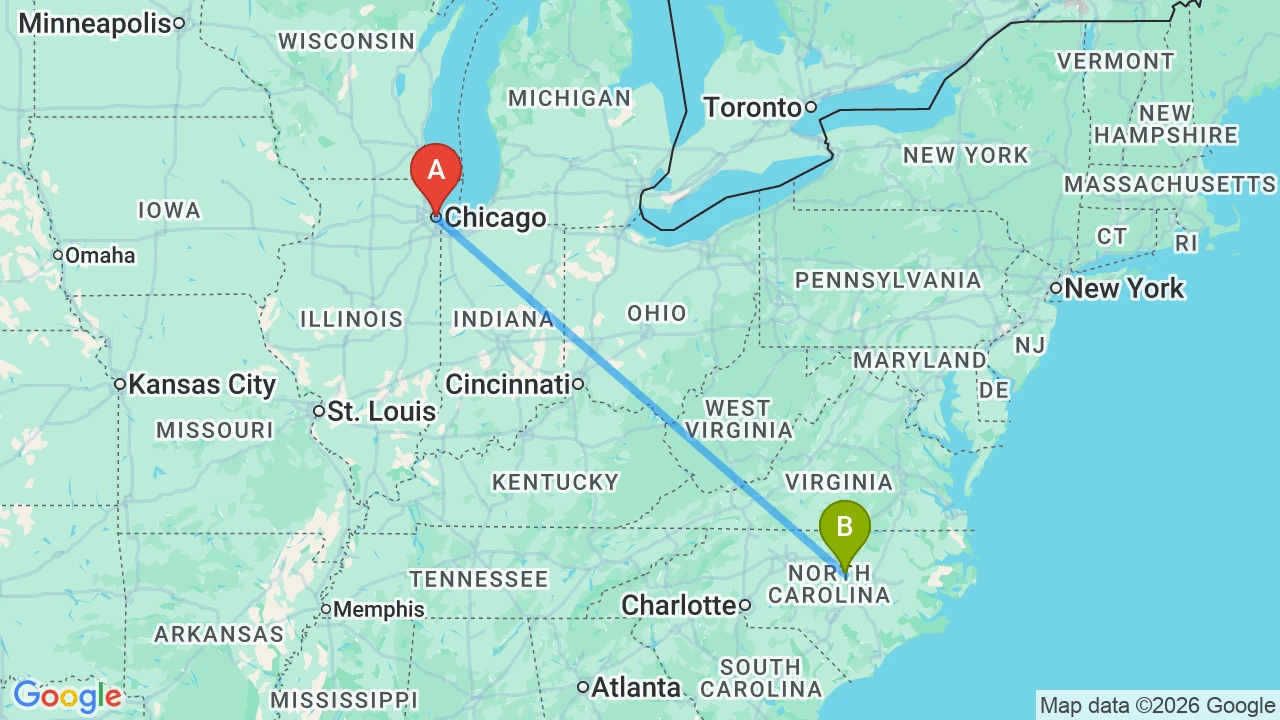
The Chicago-to-Raleigh move spans roughly 750 miles, typically requiring professional movers or a multi-day DIY drive. Most relocating households choose late spring or early fall to avoid Chicago’s winter weather and Raleigh’s peak summer heat, though Raleigh’s housing market stays competitive year-round due to steady job growth.
Utility setup differs meaningfully. Chicago households often deal with landlord-managed heat and shared building systems; Raleigh renters and owners typically manage all utilities directly, including trash, water, and sometimes HOA fees that bundle services. This creates more accounts to set up, more bills to track, and more variability in monthly costs.
Driver’s license and vehicle registration timelines are straightforward in both states, but Raleigh households should budget for vehicle inspections and property tax assessments that differ from Illinois procedures. North Carolina requires annual safety and emissions inspections, and vehicle property taxes are billed separately from registration fees—a structure that surprises many Midwestern transplants.
Social and professional networks take time to rebuild. Chicago’s density and transit access make it easier to maintain friendships across neighborhoods without coordinating driving; Raleigh’s car-dependent geography means social plans require more logistical planning. Professional networking in Raleigh centers on the Research Triangle’s tech, biotech, and university sectors, which may feel more specialized and less industrially diverse than Chicago’s economy.
What surprises Chicago movers most: the lack of walkable retail density, the necessity of a second car for dual-income households, and the way summer heat dominates daily routines. Raleigh’s greenery, newer infrastructure, and lower unemployment appeal to many, but the shift from urban to suburban living patterns requires adjustment even for households who thought they wanted “more space and quiet.”
Frequently Asked Questions
- Does Raleigh, NC feel more or less expensive than Chicago, IL?
- Cost pressure shifts rather than disappears. Raleigh reduces property tax and heating burdens but increases transportation dependence and cooling costs. Renters may face faster rent growth in Raleigh’s tight market, while Chicago homeowners escape higher ownership taxes but deal with older housing maintenance. Where you feel the difference depends on whether you rent or own, how much you drive, and how you use urban amenities.
- How do housing markets differ between Chicago and Raleigh?
- Chicago offers lower median home values ($304,500 vs. $347,000) but higher property taxes and older housing stock that requires more maintenance. Raleigh’s newer homes and lower tax rates reduce ongoing ownership costs, but rapid appreciation and limited inventory create competition. Renters face slightly higher baseline costs in Raleigh ($1,371 vs. $1,314) with less rent stability due to demand from Research Triangle job growth.
- What feels different about daily life after moving from Chicago to Raleigh?
- The shift from transit-accessible density to car-dependent sprawl changes how you structure errands, socializing, and commuting. Chicago’s walkable neighborhoods and L trains give way to Raleigh’s subdivisions and highway commutes, which increases driving time and reduces spontaneous access to retail and dining. Climate reverses from winter-dominant to summer-dominant, changing when you stay indoors and how you plan outdoor activities.
- When does the Chicago-to-Raleigh move feel easiest?
- Late spring and early fall offer the best balance—avoiding Chicago’s harsh winter and Raleigh’s peak summer heat and humidity. Raleigh’s housing market stays competitive year-round due to steady job growth, so timing for lease breaks or closing dates matters more than seasonal pricing advantages. Households with school-age children typically prioritize summer moves to align with academic calendars.
- What adjustment pressures catch Chicago movers off guard?
- The necessity of a second car for most dual-income households, the lack of walkable neighborhood retail, and the intensity of summer cooling costs surprise many transplants. Chicago’s extensive transit network and dense commercial corridors don’t translate to Raleigh’s suburban form, meaning errands take longer and require more planning even when housing feels more spacious and affordable.
- Who does this move work best for—and who struggles?
- Professionals in tech, biotech, and research fields benefit from Raleigh’s job market and lower unemployment, especially if they value newer housing and milder winters. Families seeking yards, good schools, and outdoor access often thrive. Urbanists who rely on walkability, public transit, and dense cultural amenities may feel isolated. Renters on fixed incomes face pressure from Raleigh’s rapid rent growth, while Chicago homeowners escaping high property taxes often find Raleigh’s ownership costs more manageable.
Conclusion: Tradeoffs, Not Totals
The Chicago-to-Raleigh move trades property tax pressure and heating costs for transportation dependence and cooling expenses. It exchanges transit accessibility and urban density for job market strength and milder winters. Neither city is universally cheaper—costs concentrate differently, and the financial outcome depends entirely on how your household adapts to Raleigh’s car-oriented geography and employment opportunities.
Renters face tighter inventory and faster rent growth in Raleigh, while owners benefit from lower property taxes and newer housing stock. Professionals in Research Triangle industries gain access to a strong labor market with lower unemployment, but households that value walkability and spontaneous urban access may struggle with Raleigh’s suburban form.
The decision hinges on whether you’re moving toward Raleigh’s strengths—job growth, climate, outdoor access—or away from Chicago’s constraints. If you’re seeking lower ownership costs, milder winters, and a slower pace, Raleigh’s tradeoffs may align with your priorities. If you depend on transit, dense retail, and walkable neighborhoods, the adjustment will require significant lifestyle changes and potentially higher transportation costs.
For deeper analysis of housing costs, utility breakdowns, and neighborhood-level data in both cities, explore the full Chicago and Raleigh cost guides on IndexYard. Understanding how your specific household profile maps onto each city’s cost structure will clarify whether this move reduces pressure or simply relocates it.
How this article was built: In addition to public economic data, this article incorporates location-based experiential signals derived from anonymized geographic patterns—such as access density, walkability, and land-use mix—to reflect how day-to-day living actually feels in Chicago, IL and Raleigh, NC.