
Introduction: Why Boston Residents Consider Huntersville
The move from Boston, MA to Huntersville, NC represents one of the more dramatic relocation shifts in the Southeast corridor—trading a dense, historic metro core for a suburban town in the Charlotte region. People make this move for varied reasons: job transfers to Charlotte’s banking and tech sectors, the appeal of newer housing stock at lower entry costs, or simply the desire to step off the treadmill of Northeast metro expenses. What changes isn’t just the price tags—it’s where cost pressure concentrates, how daily routines unfold, and what trade-offs become visible only after arrival.
This guide explains how cost behavior, lifestyle rhythms, and household logistics shift between these two places. It does not calculate savings, declare a winner, or predict your financial outcome. Instead, it maps where expenses tend to show up differently, which households feel relief, and which may encounter new friction. Both cities have their own cost textures; understanding the contrast helps you prepare for what actually changes day to day.
Cost Pressure Shifts: Where Money Flows Differently
Boston’s cost pressure is front-loaded and relentless. The median home value of $684,900 and median gross rent of $1,981 per month create a high barrier to entry, and that pressure doesn’t ease once you’re in. Utilities, groceries, and services all reflect the region’s elevated price environment, with a regional price parity index of 108—meaning the overall cost of goods and services runs about 8% above the national baseline.
Huntersville’s cost structure feels different from the start. The median home value of $393,200 and median gross rent of $1,624 per month lower the entry threshold significantly, and the regional price parity index of 97 means everyday purchases tend to cost slightly less than the national average. But this isn’t a simple “everything costs less” story. What changes is the distribution of cost pressure: housing entry becomes more accessible, but car dependence, commute logistics, and the need to manage a larger property can introduce new ongoing obligations.
Electricity rates illustrate the shift in operational costs. Boston’s rate of 31.37¢/kWh is nearly double Huntersville’s 15.05¢/kWh, which can meaningfully reduce monthly utility bills—especially in a region where air conditioning drives summer usage. Natural gas pricing moves in the opposite direction, with Huntersville at $25.54/MCF compared to Boston’s $22.50/MCF, though heating demand in North Carolina’s milder winters tends to be lower overall. Gas prices favor Huntersville slightly at $2.67/gal versus Boston’s $2.90/gal, but the real transportation cost question hinges on how much you drive—and in Huntersville, that’s typically more.
Income context matters here. Huntersville’s median household income of $112,893 per year is higher than Boston’s $89,212 per year, reflecting the town’s role as an affluent suburban node in the Charlotte metro. But that income advantage doesn’t automatically translate to financial ease—it often reflects dual-income households managing longer commutes, childcare logistics, and the costs of maintaining a suburban lifestyle. The unemployment rate is slightly lower in Huntersville at 3.7% compared to Boston’s 3.9%, suggesting stable labor market conditions in both places.
Housing & Neighborhood Patterns: Entry vs. Ongoing Obligations
Boston’s housing market is defined by scarcity, age, and density. Much of the housing stock is older, with quirks that come with historic construction—radiator heat, limited parking, smaller kitchens, and layouts that weren’t designed for modern appliances or remote work setups. Renting is common, and lease renewals can bring sharp increases in tight markets. Ownership is aspirational for many, but the entry cost and ongoing property taxes make it a long-term financial commitment that requires careful planning.
Huntersville’s housing landscape skews newer, larger, and more car-oriented. Subdivisions dominate, many built in the past two decades with open floor plans, two-car garages, and homeowners association (HOA) governance. The lower entry cost makes ownership more accessible, but ongoing obligations shift: HOA fees, lawn care, larger utility footprints, and the need for reliable vehicles become part of the baseline. Renters in Huntersville often find single-family homes or townhomes rather than urban apartments, which can mean more space but also more responsibility for maintenance and upkeep.
Neighborhood form affects daily costs in subtle but persistent ways. In Boston, proximity to transit, walkable errands, and dense services can reduce car dependence, even if rent is high. In Huntersville, errands typically require driving, and the spacing of retail, schools, and services means households often juggle multiple trips. The average commute in Huntersville is 28 minutes, slightly shorter than Boston’s 30 minutes, but only 6.9% of Huntersville workers work from home compared to 11.1% in Boston. The share of workers with long commutes (over 45 minutes) is 44.0% in Huntersville versus 52.3% in Boston, reflecting the region’s sprawl and the reality that many Huntersville residents commute into Charlotte proper.
Lifestyle & Daily Rhythms: Pace, Access, and Climate Exposure
Boston’s daily rhythm is shaped by density, transit infrastructure, and the constraints of an older urban grid. Walking to errands, taking the T, and navigating tight parking are part of the texture. The city’s climate brings long, cold winters with significant heating demands and moderate summers where air conditioning is helpful but not always essential. The current temperature of 11°F (feels like -2°F) reflects the kind of winter cold that defines much of the year’s cost exposure.
Huntersville’s rhythm is suburban and car-centric. Most errands—groceries, pharmacy runs, school pickups—require driving, and the town’s layout assumes vehicle access. The climate is milder overall, with hot, humid summers that drive air conditioning costs and brief, mild winters. The current temperature of 22°F (feels like 22°F) is on the colder end for the region, but extended freezing periods are rare. The longer cooling season and lower electricity rates create a different utility cost profile than Boston’s heating-dominated pattern.
Grocery costs reflect the regional price difference. In Huntersville, derived estimates suggest bread around $1.78/lb, chicken at $1.96/lb, and eggs at $2.63/dozen—all noticeably lower than Boston’s $1.98/lb, $2.18/lb, and $2.93/dozen respectively. Ground beef shows a larger gap, with Huntersville at $6.49/lb versus Boston’s $7.22/lb. These differences add up over time, especially for larger households. (Derived estimate based on national baseline adjusted by regional price parity; not an observed local price.)
Access to services, healthcare, and cultural amenities shifts as well. Boston offers dense, walkable access to hospitals, universities, museums, and entertainment—often without needing a car. Huntersville provides suburban convenience and newer facilities, but specialized services often require a drive into Charlotte. Families with school-age children may find Huntersville’s newer schools and recreational infrastructure appealing, while those who value spontaneous urban access may feel the loss of Boston’s density.
Relocation Logistics & Practical Friction
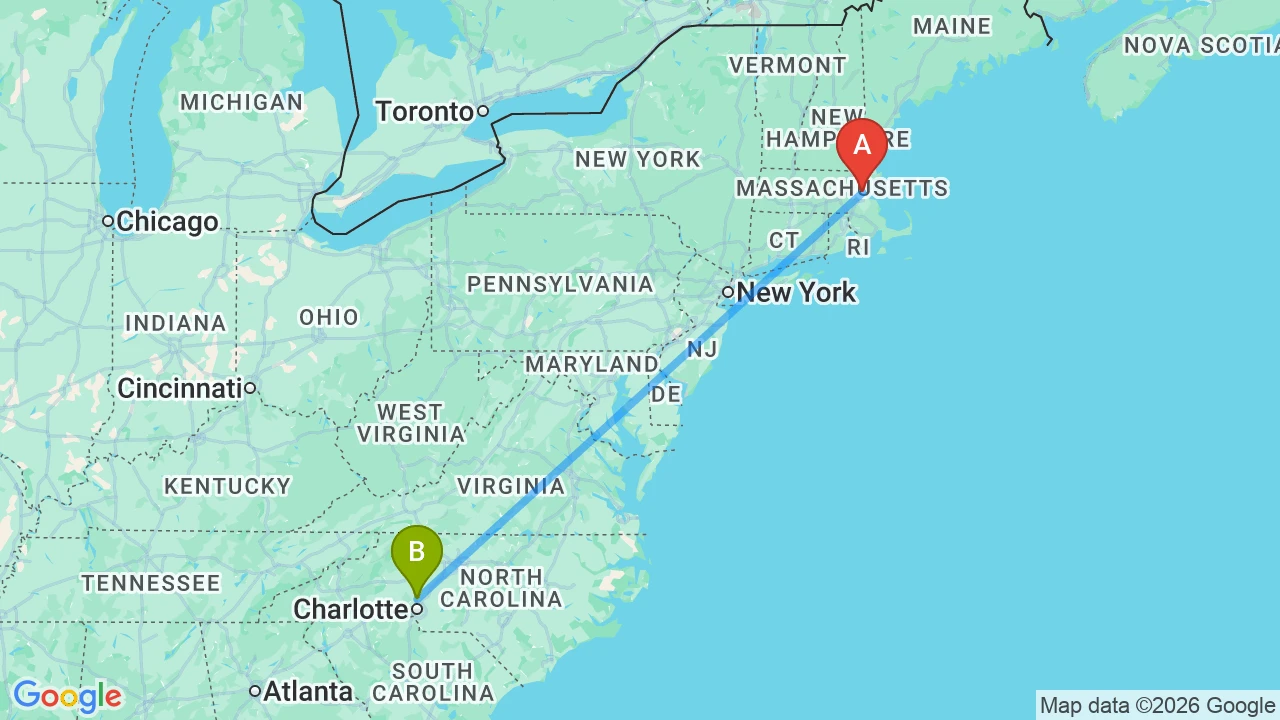
The physical move from Boston to Huntersville spans roughly 840 miles, typically a two-day drive or a direct flight into Charlotte Douglas International Airport. Moving costs vary widely depending on volume, timing, and whether you hire full-service movers or rent a truck. Summer months tend to be the busiest and most expensive for relocation services, while late fall and winter may offer more flexibility.
What surprises many movers is the adjustment to car dependence. In Boston, it’s possible—even common—to live without a car or use one sparingly. In Huntersville, a reliable vehicle becomes essential for nearly every aspect of daily life. If you’re moving from a one-car or no-car household, budgeting for a second vehicle, insurance, maintenance, and registration is a real consideration. North Carolina’s vehicle property tax and annual registration fees differ from Massachusetts’ structure, and it’s worth understanding those obligations before arrival.
Another friction point is the shift in how you access services. In Boston, many errands can be batched on foot or via short transit trips. In Huntersville, errands are typically car-based and spread out, which can feel inefficient at first. Parents managing school drop-offs, extracurriculars, and playdates often find themselves spending more time in the car than they anticipated. Remote workers may appreciate the space and quiet, but those who thrive on spontaneous collaboration or urban energy may feel isolated.
Utility setup, HOA onboarding, and understanding local service providers (trash, recycling, internet) also require attention. Huntersville’s suburban infrastructure often means fewer choices for some services, and it’s common to encounter bundled HOA fees that cover landscaping, amenities, or neighborhood maintenance—costs that weren’t part of the equation in a Boston apartment.
Frequently Asked Questions
- Does Huntersville, NC feel more or less expensive than Boston, MA?
- Huntersville lowers the entry cost for housing significantly, and everyday expenses like groceries and electricity tend to run below Boston’s levels. But the cost structure shifts rather than disappears—car dependence, larger homes, and suburban logistics introduce ongoing obligations that can offset the initial savings. Households that value lower housing entry and don’t mind driving tend to feel financial relief; those who relied on Boston’s walkability and transit may find new costs in vehicle ownership and time spent commuting.
- How do the housing markets differ between Boston and Huntersville?
- Boston’s market is defined by scarcity, older stock, and high entry costs for both renters and buyers. Huntersville offers newer construction, lower purchase prices, and more space, but often comes with HOA fees and the expectation of maintaining a larger property. Renters in Huntersville typically find single-family homes or townhomes rather than urban apartments, which changes both cost and responsibility. Ownership becomes more accessible, but the trade-off is a shift from dense urban living to car-oriented suburban life.
- What feels different about daily life after moving from Boston to Huntersville?
- The pace slows, the space increases, and the car becomes central. Errands that were once walkable now require driving, and spontaneous urban access gives way to planned trips. Families often appreciate the newer schools, recreational amenities, and quieter neighborhoods, while singles or couples who valued Boston’s density and cultural access may feel the loss of walkable vibrancy. Climate exposure shifts from long, cold winters to hot, humid summers with milder heating seasons.
- When does the move from Boston to Huntersville tend to feel easiest or hardest?
- Spring and fall offer the most comfortable weather for moving and settling in, avoiding both Boston’s harsh winter and Huntersville’s peak summer heat. Families with school-age children often time moves to align with the academic calendar, aiming for summer arrival to ease the transition. The adjustment period tends to feel smoothest for those who embrace car-dependent routines quickly and hardest for those who miss the spontaneity and walkability of urban Boston life.
- What are the most common challenges people face when relocating from Boston to Huntersville?
- Adjusting to car dependence is the most frequent friction point—especially for households that relied on walking or transit in Boston. The loss of dense, spontaneous access to services, culture, and social life can feel isolating at first. Managing a larger home, navigating HOA rules, and understanding new utility and service structures also require attention. Remote workers may struggle with the quieter pace, while families often adapt more quickly to the space and suburban amenities.
- Who tends to benefit most from moving from Boston to Huntersville, and who may struggle?
- Families seeking space, newer schools, and lower housing entry costs tend to benefit, especially if both adults are comfortable with commuting and car-based logistics. Dual-income households with stable remote or hybrid work arrangements often find the trade-off worthwhile. Singles, young professionals, and those who value walkable urban culture may struggle with the isolation and car dependence. Retirees or near-retirees may appreciate the milder winters and lower cost of living, but should consider healthcare access and the need for reliable transportation as they age.
Conclusion: Understanding the Trade-Offs
Moving from Boston to Huntersville is not a simple cost reduction—it’s a restructuring of where money, time, and energy flow. Housing becomes more accessible, utilities and groceries tend to cost less, and the climate shifts from heating-dominated to cooling-focused. But car dependence increases, suburban logistics require more planning, and the dense, spontaneous access that defines Boston life gives way to a quieter, more spread-out rhythm.
This move works best for households that value space, newer infrastructure, and lower housing entry costs, and who are comfortable with driving as the primary mode of daily life. It’s more challenging for those who thrive on urban density, walkability, and the cultural vibrancy of a historic metro core. Income levels in both places suggest stable employment, but the higher median income in Huntersville often reflects the demands of dual-income, car-dependent suburban living rather than pure financial advantage.
If you’re seriously considering this move, explore the detailed cost breakdowns, neighborhood guides, and lifestyle insights available on IndexYard’s Boston and Huntersville city hubs. Understanding the full texture of each place—not just the headline numbers—will help you make a decision that fits your household’s priorities and tolerances.
How this article was built: In addition to public economic data, this article incorporates location-based experiential signals derived from anonymized geographic patterns—such as access density, walkability, and land-use mix—to reflect how day-to-day living actually feels in Huntersville, NC.