
A newcomer stands in a driveway in Avon, Connecticut, surveying the quiet cul-de-sac, and asks the question that matters most: Will I actually like living here? The answer depends less on what Avon offers and more on what you’re willing to trade for it. This is a town that rewards those who value residential calm, strong schools, and financial stability—but it asks you to accept car dependency, sparse spontaneity, and a rhythm that prioritizes planning over improvisation.
Avon sits in the Hartford metro area with a median household income of $146,153 per year and a median home value of $434,000. These numbers frame a community built around affluence and intentionality. The unemployment rate of 3.8% reflects economic stability, and the regional price level sits just above the national baseline. But the emotional experience of living here isn’t captured by income alone—it’s shaped by how place structure interacts with daily life, and whether that structure matches what you actually need.
What Defines Avon’s Emotional Landscape
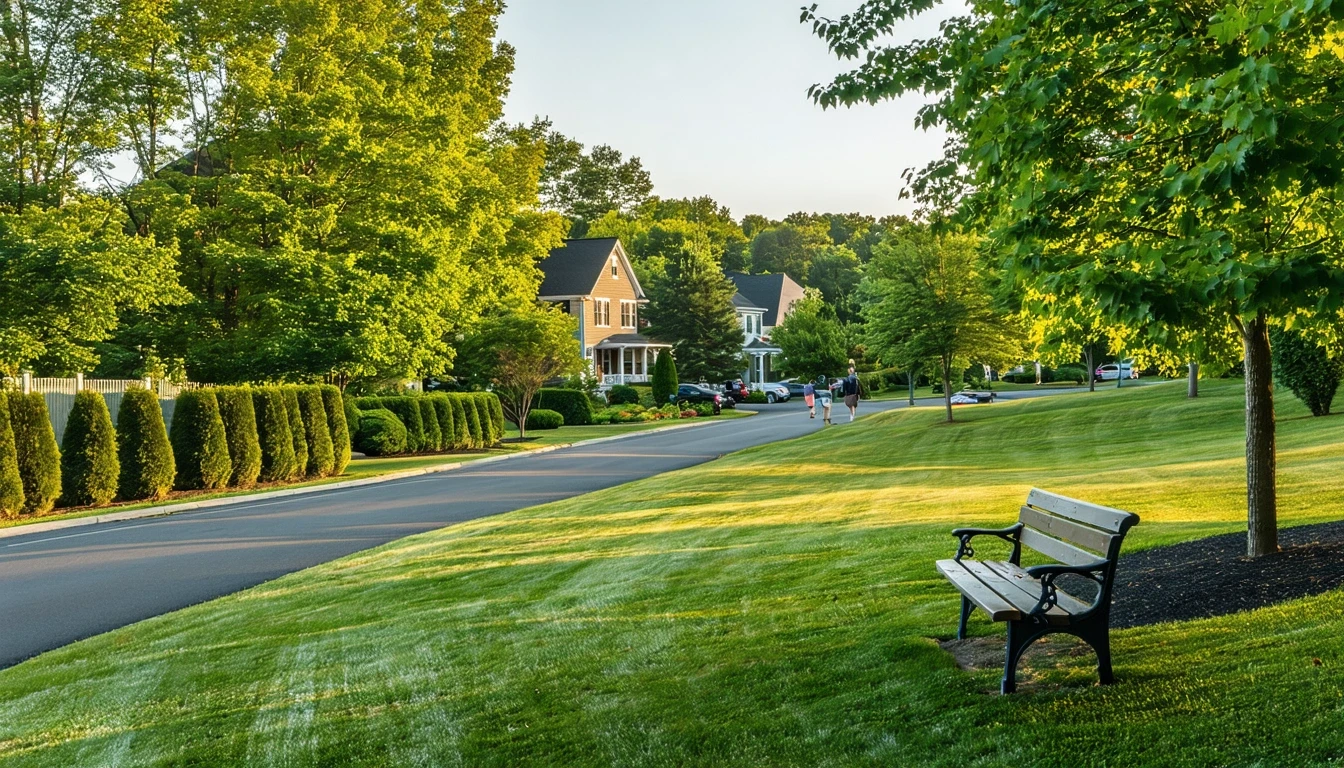
Avon’s vibe is rooted in a specific tradeoff: residential serenity in exchange for logistical friction. The town features walkable pockets where pedestrian infrastructure exceeds typical suburban norms, and mixed building heights create varied visual texture. Both residential and commercial land use coexist, giving parts of the town a less monotonous feel than purely residential enclaves. But daily errands remain sparse—food and grocery density falls below convenience thresholds, meaning even routine tasks require planning, driving, and time.
This creates a lived experience where people feel settled but not always spontaneous. Families who prioritize yard space, school quality, and neighborhood safety tend to describe Avon as exactly what they wanted. Those who expected walkable coffee runs, quick grocery stops, or evening strolls to dinner often feel the gap between suburban aesthetics and urban convenience.
Public transit exists in the form of bus service, and some cycling infrastructure appears in pockets, but the dominant mode is the car. Households that embrace this—and can afford the associated costs—tend to feel at home. Those who hoped to reduce car dependency, or who find driving every errand exhausting, often describe a mismatch between expectation and reality.
The Pulse of Public Conversation
In online forums and local Facebook groups, Avon residents tend to discuss the town through the lens of protection and pride. Conversations often center on school performance, property values, and the desire to preserve the town’s character amid regional growth pressures. There’s a protective instinct around what makes Avon feel distinct from neighboring communities—less dense, more affluent, quieter.
“We moved here for the schools and the space, and we got exactly that. But you do have to plan your day around errands—nothing’s just around the corner.”
“It’s peaceful, but sometimes it feels too peaceful. If you want energy or spontaneity, you’re driving to West Hartford or Hartford.”
“People here value privacy and calm. That’s the whole point. If you’re looking for street life or walkable everything, this isn’t the place.”
The tone is rarely defensive, but it’s often clarifying—residents seem aware of what Avon is and isn’t, and they’re comfortable with that identity. Frustration tends to surface around the logistics of daily life rather than dissatisfaction with the town itself. The recurring theme is alignment: people who chose Avon for what it offers tend to stay content; people who expected something else tend to feel restless.
How Local Coverage Frames the Town
Local news and community bulletins tend to frame Avon through themes of stability, growth management, and quality of life preservation. Coverage doesn’t dwell on crisis or controversy—it focuses on incremental change, school achievements, and debates about how much development the town should absorb.
Recurring headline-style themes include:
- “Community Weighs New Development Proposals”
- “School District Highlights Academic Performance”
- “Residents Discuss Balancing Growth and Character”
- “Town Explores Infrastructure Improvements”
- “Local Businesses Adapt to Suburban Demand”
The framing is rarely urgent or alarmist. Instead, it reflects a town that sees itself as managing rather than reacting. The tone suggests a community that feels in control of its trajectory, even as regional pressures nudge it toward gradual change. For prospective residents, this translates to predictability—but also to a certain sameness that can feel either reassuring or stifling, depending on temperament.
What Review Platforms Reveal About Expectations
On Google Reviews, Yelp, and Nextdoor-style platforms, Avon’s public perception splits along expectation lines. People who wanted suburban comfort, safety, and space tend to leave positive reviews emphasizing exactly those qualities. People who wanted walkability, variety, or street-level energy tend to express mild disappointment—not with what’s broken, but with what’s absent.
Positive themes include appreciation for well-maintained neighborhoods, strong schools, and a sense of safety that feels effortless. Families with children often describe Avon as a place where they can relax into routines without constant vigilance. The playground density sits in a moderate range, and family infrastructure is present, even if not comprehensive. For households prioritizing child-rearing over nightlife, this balance works.
Critical themes tend to focus on housing pressure, errand logistics, and limited spontaneity. The sparse food and grocery density means even quick trips require intention. Park density falls below expectations for a suburban setting, which surprises some newcomers who assumed green space would be abundant. Healthcare access is routine-local—clinics are present, but no hospital—which matters more to some households than others.
Neighborhood variation exists, though it’s often described in broad strokes: newer planned areas versus older pockets, larger lots versus more compact developments. The mixed building heights and land use create texture, but the overall rhythm remains car-dependent and planning-intensive.
How Avon Compares to Nearby Towns
| Dimension | Avon | West Hartford | Simsbury |
|---|---|---|---|
| Walkability & Errands | Sparse errands, walkable pockets exist | More walkable, denser commercial corridors | Similar car dependency, more rural feel |
| Social Energy | Quiet, residential, low street activity | More vibrant, dining and nightlife options | Calm, family-oriented, less urban texture |
| Housing Cost Pressure | High home values, affluent baseline | High but more rental options available | Comparable affluence, larger lot sizes |
| Family Infrastructure | Present, moderate playground density | Strong, more diverse amenities | Present, emphasis on outdoor space |
Avon occupies a middle position in the Hartford suburbs—more affluent and quieter than some, less walkable and less vibrant than West Hartford, but more structured and less rural than Simsbury. The choice between them hinges on priorities: if you want residential calm and strong schools without needing street-level energy, Avon fits. If you want more spontaneous walkability and dining variety, West Hartford offers that. If you want even more space and a rural-adjacent feel, Simsbury leans that direction.
None of these towns is objectively better—they serve different temperaments. Avon rewards people who are comfortable with day-to-day costs that include frequent driving, who value predictability over surprise, and who prioritize long-term stability over short-term convenience.
Voices from the Community
“We’ve been here five years, and it’s exactly what we needed—good schools, safe streets, and space for the kids. You do drive everywhere, but that’s the tradeoff.”
“I work remotely and thought I’d love the quiet, but I underestimated how much I’d miss being able to walk to a coffee shop or grab groceries on a whim. Everything requires a plan.”
“Avon feels like a place where people have arrived. It’s stable, affluent, and predictable. If that’s what you want, it’s great. If you’re looking for energy or change, you’ll feel it’s too settled.”
“The schools are strong, and the neighborhoods are well-kept. But the lack of parks surprised me—I expected more green space in a suburban town.”
“It’s a commuter town, and that shapes everything. People work in Hartford and come home to relax. The vibe is more about retreat than engagement.”
“I appreciate the mix of building types and the walkable pockets, but the sparse errands accessibility means you’re still driving constantly. It’s not as car-dependent as some suburbs, but it’s close.”
“If you’re raising a family and you can afford it, Avon makes sense. If you’re young, single, or on a tighter budget, you’ll probably feel out of place.”
Does Avon Feel Like a Good Fit?
Avon doesn’t ask you to love it unconditionally—it asks you to decide whether its tradeoffs align with your priorities. This is a town that works beautifully for established families, high-earning professionals, and people who value residential calm over urban texture. It rewards those who are comfortable with car dependency, who plan their days intentionally, and who prioritize long-term stability over spontaneous convenience.
It tends to frustrate people who expected walkable errands, abundant green space, or street-level energy. The sparse daily errands accessibility creates logistical friction that some households absorb easily and others find exhausting. The limited park density surprises those who assumed suburban living would mean effortless outdoor access. The quiet, commuter-town rhythm feels either restful or stifling, depending on what you need from a place.
If you’re asking whether Avon will make you happy, the better question is whether you’re willing to embrace what it actually offers—and whether the things it doesn’t offer are things you can live without. For some, that answer is an easy yes. For others, it’s a signal to keep looking.
To understand how these tradeoffs translate into quality of life factors and financial planning, exploring related topics can help clarify whether Avon’s structure matches your household’s needs.
How this article was built: In addition to public economic data, this article incorporates location-based experiential signals derived from anonymized geographic patterns—such as access density, walkability, and land-use mix—to reflect how day-to-day living actually feels in Avon, CT.
The perspectives shown reflect commonly expressed local sentiment and recurring themes in public discussion, rather than individual accounts.