
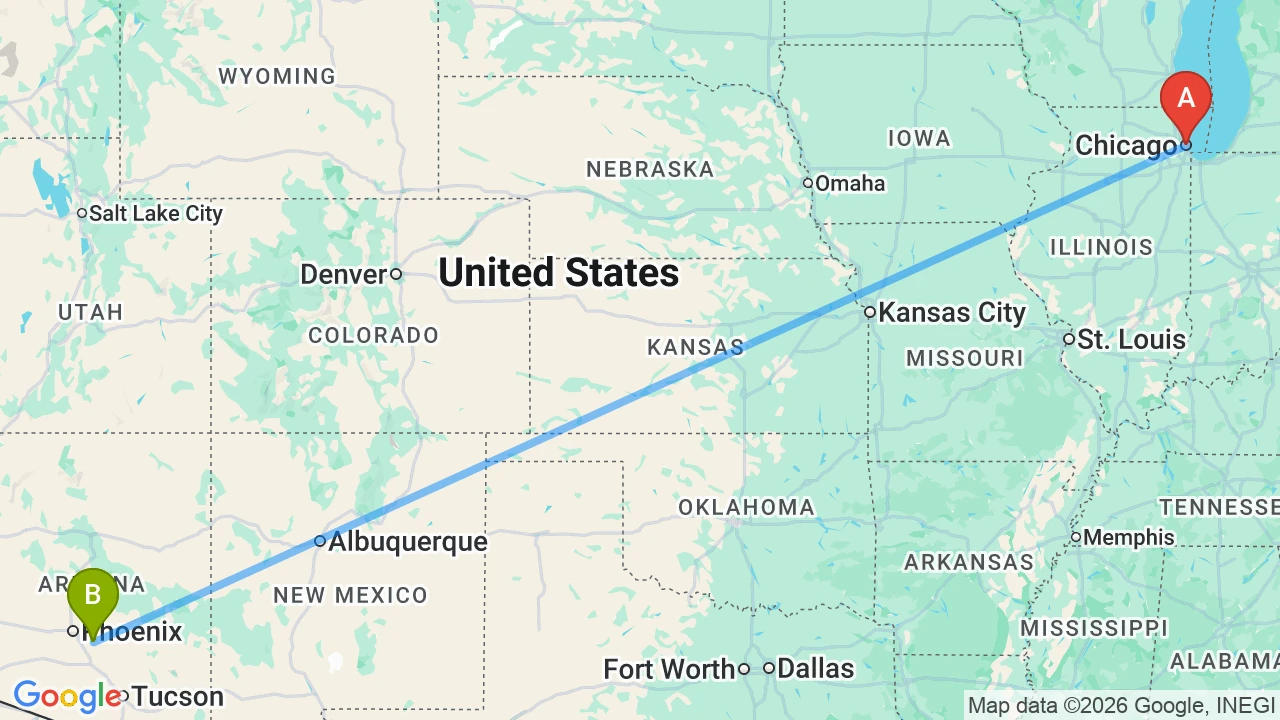
Moving from Chicago, IL to Queen Creek, AZ: A 2026 Relocation Guide
The move from Chicago to Queen Creek represents one of the more dramatic lifestyle and cost structure shifts you can make within the United States. You’re leaving a dense, transit-connected urban center in the Midwest for a rapidly growing suburban community in the Phoenix metro area’s southeastern corner. This isn’t simply a warmer-weather version of the same life—nearly everything about how you’ll spend money, move around, and structure your day will change.
This guide explains where cost pressure concentrates in each place, how housing markets differ, what daily logistics look like, and which household types tend to feel more or less financial friction after the move. We’re not here to declare one city “better” or “cheaper” in total—we’re here to show you where costs show up, how they behave, and what tradeoffs you’re actually making.
Understanding the Two Cost Environments
Chicago and Queen Creek operate on fundamentally different cost models. Chicago’s expense profile is shaped by density, age, and infrastructure complexity. Queen Creek’s costs reflect rapid suburban growth, car dependence, and desert climate exposure.
In Chicago, median household income sits at $71,673 per year, while Queen Creek households earn a median of $127,182 per year—a substantial difference that reflects both the types of households each place attracts and the income levels typically required to manage local cost structures. Chicago’s median home value is $304,500, with median rent at $1,314 per month. Queen Creek’s housing costs run considerably higher: $493,700 median home value and $2,030 per month median rent.
The regional price parity index stands at 103 for Chicago and 106 for Queen Creek, indicating that overall price levels run slightly above the national baseline in both places, with Queen Creek showing marginally higher general cost levels. But these summary numbers mask the real story: where you feel cost pressure differs dramatically between the two cities.
Where Cost Pressure Shifts
Moving from Chicago to Queen Creek typically means trading ongoing urban living expenses for higher upfront housing costs and car-dependent infrastructure.
Housing: Entry Barriers vs. Monthly Obligations
The most immediate financial reality of this move is housing. Queen Creek’s median home value runs over $189,000 higher than Chicago’s, and median rent is more than $700 per month higher. This isn’t a marginal difference—it’s a structural one that shapes who can make this move and under what circumstances.
Queen Creek’s housing market reflects its role as a newer suburban growth area attracting families with higher incomes. The housing stock tends toward single-family homes built in the past two decades, often in master-planned communities with homeowners association structures. Chicago’s housing landscape is far more varied: vintage multi-unit buildings, post-war bungalows, newer high-rises, and everything in between, with rental options spanning studio apartments to single-family homes.
If you’re renting, the jump from $1,314 to $2,030 per month represents a significant increase in baseline housing obligation. If you’re buying, you’re looking at substantially higher mortgage payments, property taxes calculated on a higher base value, and often mandatory HOA fees that may bundle services but add another layer of monthly obligation.
The tradeoff: Queen Creek typically offers more space, newer construction, and lower density for that higher price. Chicago offers proximity, walkability, and access to urban amenities at a lower entry cost but often in older buildings with their own maintenance considerations.
Transportation: Infrastructure and Daily Patterns
Chicago’s average commute runs 34 minutes, with 59.7% of workers facing longer commutes and only 14.6% working from home. Queen Creek’s average commute is slightly shorter at 30 minutes, but 54.5% face long commutes and just 7.5% work from home. The critical difference isn’t commute duration—it’s how you commute and what that costs.
Chicago’s urban form supports multiple transportation modes. The city shows substantial pedestrian infrastructure relative to its road network, with rail transit service present and notable cycling infrastructure throughout parts of the city. Many Chicago residents can—and do—live without cars, relying on the CTA’s bus and rail network, walking, or cycling for daily needs. Even those who own cars may drive less frequently, reducing fuel, insurance, parking, and maintenance costs.
Queen Creek operates on an entirely different model. As a suburban community in the Phoenix metro area, it’s built around car ownership. There’s no rail transit, limited walkable infrastructure, and daily errands—groceries, healthcare, work, school—typically require driving. Gas prices are nearly identical ($2.94 per gallon in Chicago vs. $2.98 in Queen Creek), but you’ll likely drive far more miles per week in Queen Creek.
For a household moving from Chicago’s transit-accessible neighborhoods, this shift can add substantial transportation costs: car payments or lease costs if you didn’t own before, insurance (often higher for newer drivers or those without continuous coverage), registration, maintenance, and fuel for daily use rather than occasional trips. For households already driving in Chicago, the shift may feel less dramatic, though the sheer necessity of driving for every errand can still increase total mileage and wear.
Utilities: Climate and Seasonal Exposure
Chicago’s electricity rate sits at 18.31¢/kWh, while Queen Creek’s rate is lower at 15.66¢/kWh. Natural gas costs tell a different story: Chicago pays $15.48/MCF, while Queen Creek’s rate is $23.77/MCF. But rates alone don’t determine what you’ll actually spend—climate and housing type drive consumption patterns.
Chicago’s utility exposure is shaped by cold winters requiring sustained heating, often via natural gas. Summer cooling loads exist but tend to be shorter and less intense than winter heating demands. Queen Creek faces the opposite pattern: extended periods of triple-digit summer heat create sustained air conditioning loads that dominate annual electricity consumption. Cooling season in Queen Creek isn’t a few months—it’s the defining utility exposure of the year.
Newer construction in Queen Creek often includes better insulation and more efficient HVAC systems than Chicago’s older housing stock, which can help moderate consumption. But the intensity and duration of desert heat mean that summer electricity bills in Queen Creek typically represent the single largest utility expense of the year, often substantially higher than winter heating costs in Chicago.
For households moving from Chicago apartments where heat was included or buildings with shared systems, the shift to managing full climate control in a detached single-family home in Queen Creek can be a significant adjustment both in cost and in household management.
Daily Errands and Household Logistics
How you accomplish daily tasks—groceries, pharmacy runs, doctor visits, getting kids to activities—changes fundamentally between these two cities, and that shift has cost implications beyond the direct price of goods.
Chicago shows high food and grocery establishment density, with options broadly accessible throughout much of the city. The combination of walkable neighborhoods, transit access, and dense commercial corridors means many households can handle routine errands on foot, by bike, or via short transit trips. Park density exceeds high thresholds, with water features integrated throughout the city. Healthcare access includes hospital facilities and pharmacies distributed across neighborhoods. The urban form mixes residential and commercial land use, with building heights in the medium range creating a layered, accessible environment.
Queen Creek’s suburban form concentrates services along major corridors rather than distributing them throughout residential areas. Grocery stores, medical facilities, and other services exist, but reaching them almost always requires driving. The time cost of errands doesn’t necessarily increase—you might drive to a grocery store in 10 minutes—but the requirement to drive for every task, the need to plan trips more deliberately, and the reduced ability to handle quick errands on foot or between other activities changes how households manage time and logistics.
For families, this often means more time spent as household chauffeur: driving kids to school, activities, friends’ houses, and appointments. Chicago’s density and transit options give older children and teens more independence to move around on their own. Queen Creek’s suburban form typically extends the years parents spend driving children everywhere, which has both time and vehicle cost implications.
Employment and Economic Context
Chicago’s unemployment rate stands at 5.4%, while Queen Creek’s is 3.1%. These figures reflect different economic contexts: Chicago’s diverse urban economy with its mix of corporate headquarters, healthcare, education, manufacturing, and services, versus Queen Creek’s position in the broader Phoenix metro employment landscape, where many residents commute to jobs in other parts of the valley.
Queen Creek itself is primarily residential, with employment concentrated in retail, services, and local government. Most professional workers commute to Phoenix, Tempe, Chandler, or other employment centers, which explains the high percentage of workers facing longer commutes despite the 30-minute average. Chicago offers more employment density within the city itself, though many residents also commute to suburban job centers.
The income difference between the two cities—Chicago’s $71,673 median versus Queen Creek’s $127,182—reflects both self-selection (higher-income households choosing Queen Creek’s suburban lifestyle and higher housing costs) and necessity (needing higher income to manage Queen Creek’s cost structure). This isn’t a story of Queen Creek being “more expensive” in simple terms—it’s about different household types sorting into different cost environments based on income, preferences, and life stage.
Climate, Seasonality, and Lifestyle Adaptation
Chicago’s current temperature of 23°F (feels like 19°F) versus Queen Creek’s 59°F (feels like 56°F) captures a snapshot of the dramatic climate difference you’re navigating. Chicago’s winters are long, cold, and snowy, with extended periods well below freezing. Summers are warm and humid but generally manageable. Queen Creek offers mild, pleasant winters—the season when outdoor life flourishes—but summers bring extended periods of extreme heat that fundamentally constrain outdoor activity and drive people indoors to air conditioning.
This climate shift affects costs in multiple ways beyond utilities. Outdoor recreation patterns change: Chicago’s summers invite outdoor activity, while Queen Creek’s summers push recreation to early morning, late evening, or indoor facilities. Clothing needs shift from heavy winter gear to sun protection and cooling fabrics. Vehicle stress differs: Chicago’s road salt and freeze-thaw cycles versus Queen Creek’s intense sun and heat affecting paint, interiors, and tire wear. Landscaping in Queen Creek often requires irrigation systems and drought-tolerant planning, while Chicago’s rainfall patterns support different vegetation with different maintenance needs.
For households with children, the climate shift changes how kids spend time: Chicago’s seasonal outdoor play versus Queen Creek’s pool culture and indoor activity spaces during summer heat. For retirees or those with health considerations, the absence of winter ice and snow may reduce fall risks and mobility challenges, while extreme heat creates different health management considerations.
Who This Move Tends to Favor
This relocation typically works best for:
- Higher-income families seeking space and newer housing: Households with combined incomes well above $100,000 who prioritize single-family homes, yards, and newer construction, and who can absorb both higher housing costs and car-dependent transportation expenses.
- Remote workers with geographic flexibility: Those who can maintain Chicago-level (or higher) incomes while living in Queen Creek, avoiding long commutes and benefiting from year-round mild weather for home-based work.
- Households seeking outdoor recreation access: People drawn to desert hiking, proximity to Arizona’s natural landscapes, and year-round outdoor activity (accepting summer heat constraints).
- Those who prefer driving to transit: Households already car-dependent in Chicago who won’t miss walkability or transit access and who value the suburban driving environment.
Who May Face More Pressure
This move tends to create challenges for:
- Moderate-income households: Those earning closer to Chicago’s median income will find Queen Creek’s housing costs difficult to manage without significant income increases or lifestyle compromises.
- Car-free or car-light households: People who’ve built Chicago lives around walking, cycling, and transit will face substantial adjustment and added transportation costs in Queen Creek’s car-dependent environment.
- Young professionals seeking urban amenities: Those who value dense nightlife, cultural institutions, walkable neighborhoods, and spontaneous social access will find Queen Creek’s suburban form limiting.
- Households with teens seeking independence: Families with older children who’ve gained mobility through Chicago’s transit system may find Queen Creek extends parental driving obligations for several more years.
- Those sensitive to extreme heat: People with health conditions affected by high temperatures, or who simply prefer four distinct seasons, may find Queen Creek’s extended summer heat oppressive.
Practical Relocation Considerations
Beyond ongoing costs, the move itself carries logistical weight. Chicago to Queen Creek spans roughly 1,700 miles, making this a long-distance relocation requiring professional movers or significant DIY planning. The distance makes preliminary house-hunting trips more expensive and time-consuming, and it complicates the transition period if you need to overlap housing in both cities.
Timing matters: moving during Chicago’s winter means navigating cold and potential snow, while moving during Queen Creek’s summer means managing extreme heat. Spring and fall transitions offer more moderate weather in both locations. If you have school-age children, aligning the move with the school year break reduces educational disruption, though Queen Creek’s school calendar may differ from Chicago’s.
Establishing new systems takes time: finding doctors, dentists, and other service providers; learning new grocery stores and shopping patterns; building social networks; understanding local regulations and systems. The suburban form of Queen Creek means these tasks typically require more driving and deliberate planning than they might have in Chicago’s denser environment.
FAQ
- Does Queen Creek feel more or less expensive than Chicago?
- Queen Creek concentrates cost pressure in housing and transportation, with substantially higher home prices, rents, and car-dependent expenses. Chicago spreads costs differently, with lower housing entry barriers but urban living expenses and older infrastructure. Higher-income households often find Queen Creek manageable; moderate-income households typically face more pressure than they did in Chicago. The question isn’t which city costs more in total—it’s where you feel the costs and whether your income and priorities align with that structure.
- How do housing markets differ between Chicago and Queen Creek?
- Chicago offers diverse, older housing stock with lower median prices and rents, supporting a wider income range and more varied living arrangements. Queen Creek’s market emphasizes newer single-family homes in master-planned communities with higher prices and often mandatory HOA fees. Chicago provides more rental flexibility and urban density; Queen Creek delivers more space and newer construction at higher cost. The markets serve different household types with different priorities.
- What feels different about daily life after moving from Chicago to Queen Creek?
- The shift from urban density to suburban sprawl changes nearly everything: you’ll drive instead of walk or take transit, plan errands more deliberately, spend more time in air conditioning during summer, and likely have more indoor and outdoor space at home. Social patterns shift from spontaneous neighborhood encounters to planned gatherings. The pace feels slower and more spread out, with less ambient activity and more deliberate scheduling.
- When does this move tend to feel easiest?
- Spring or fall transitions offer moderate weather in both cities, avoiding Chicago’s harsh winter and Queen Creek’s extreme summer heat. Aligning the move with school breaks reduces disruption for families. Having housing secured before arrival and at least one income source confirmed reduces financial pressure during adjustment. Remote workers often find the transition smoother since they’re not simultaneously learning a new job and new city.
- What adjustment pressures surprise people most?
- The car dependency catches many off guard—the inability to walk to anything and the need to drive for every errand, every social visit, every activity. Summer heat intensity and duration often exceeds expectations, constraining outdoor life more than anticipated. The extended commutes many Queen Creek residents face to reach Phoenix-area jobs can feel grinding. Social network rebuilding takes longer in suburban environments where chance encounters are rare. Higher housing costs may force compromises on space or location that weren’t expected.
- Who tends to benefit most from moving to Queen Creek, and who struggles?
- Higher-income families seeking space, newer housing, and year-round mild winters tend to thrive, especially if they can work remotely or have short commutes. Those who prefer driving, value outdoor recreation access, and don’t mind summer heat constraints often find the lifestyle appealing. Moderate-income households, car-free urbanites, young professionals seeking density and spontaneity, and those who dislike extreme heat or car dependence typically face more friction. The move works when your income, life stage, and preferences align with suburban, car-dependent desert living.
Making the Decision
Moving from Chicago to Queen Creek isn’t a simple cost arbitrage—it’s a fundamental lifestyle restructuring. You’re trading urban density, transit access, and walkability for suburban space, newer housing, and car-dependent convenience. You’re exchanging cold winters and moderate summers for mild winters and extreme summer heat. You’re shifting from lower housing costs with urban living expenses to higher housing costs with different ongoing obligations.
The move makes sense when your household income can comfortably absorb Queen Creek’s higher housing and transportation costs, when you value space and newer construction over urban amenities, when you prefer driving to transit, and when desert climate and outdoor recreation access align with your lifestyle priorities. It creates pressure when income is moderate, when you’ve built life patterns around walkability and transit, when you need urban density and cultural access, or when extreme heat feels oppressive rather than manageable.
This guide has shown you where costs concentrate, how daily logistics differ, and which household types tend to feel more or less friction in each environment. The next step is yours: exploring Queen Creek neighborhoods in depth, understanding specific commute patterns for your work location, calculating your household’s actual transportation costs under car-dependent living, and honestly assessing whether the tradeoffs align with your priorities and financial capacity.
How this article was built: In addition to public economic data, this article incorporates location-based experiential signals derived from anonymized geographic patterns—such as access density, walkability, and land-use mix—to reflect how day-to-day living actually feels in Chicago, IL.
For deeper exploration of Queen Creek’s cost structure, see our complete Queen Creek living guide. To understand Chicago’s urban cost environment in more detail, visit our Chicago hub.