
Introduction: Why Los Angeles to Dallas?
The move from Los Angeles to Dallas represents one of the most common relocation corridors in the U.S., driven by a combination of housing affordability, job market growth, and a fundamentally different cost structure. While Los Angeles median home values sit at $822,600, Dallas counters with $270,700—a dramatic difference that reshapes not just homeownership timelines, but the entire relationship between income, housing, and discretionary spending.
But lower entry costs don’t tell the whole story. This move shifts where your money goes and how daily life unfolds. Commute patterns change: Los Angeles averages 31 minutes with 52.1% of workers facing long commutes, while Dallas clocks in at 26 minutes with 40.2% in the long-commute category. Climate exposure flips from mild, temperate conditions to extended triple-digit summer heat. And the urban fabric itself—how you run errands, access services, and move through your day—operates on different assumptions about car dependence and neighborhood density.
This guide explains how cost pressure, lifestyle rhythms, and daily logistics shift when you relocate from Los Angeles to Dallas. It does not calculate whether you’ll save money overall or whether the move is “worth it.” Instead, it clarifies where costs concentrate, which expenses become more or less predictable, and who tends to adjust most easily to the structural differences between these two metros.
Cost Pressure Shifts: Where Your Money Goes Differently
The most visible cost shift is housing. Los Angeles median gross rent stands at $1,791 per month, compared to Dallas at $1,305 per month. For renters, that’s roughly $486 less per month in baseline shelter cost—before factoring in neighborhood, unit size, or lease terms. For buyers, the gap widens dramatically: the difference between an $822,600 median home in Los Angeles and a $270,700 median in Dallas translates to hundreds of thousands of dollars in mortgage principal, interest, property tax base, and insurance premiums.
But housing savings don’t exist in isolation. Other cost categories shift in ways that reshape monthly cash flow. Electricity rates in Dallas run 16.11¢/kWh, compared to Los Angeles at 33.60¢/kWh—a significant advantage on paper. However, Dallas summers bring extended periods of extreme heat, often requiring air conditioning to run continuously for months. Los Angeles benefits from mild coastal and inland Mediterranean climates that reduce cooling demand substantially. The result: lower per-unit electricity costs in Dallas may be offset by higher consumption intensity during peak summer months.
Transportation costs follow a similar pattern of trade-offs. Gas prices in Dallas average $2.40/gallon, compared to $4.27/gallon in Los Angeles—a meaningful difference for daily commuters. Yet Dallas is more car-dependent in practice. Work-from-home rates sit at 7.2% in Dallas versus 13.1% in Los Angeles, and the city’s sprawling layout often requires longer drive distances for errands, healthcare, and social activities, even if commute times are shorter on average.
Grocery costs show modest differences. Items like bread, cheese, chicken, and eggs cost slightly more in Dallas than Los Angeles when adjusted for regional price parity—for example, eggs run about $2.95/dozen in Dallas compared to $2.86/dozen in Los Angeles.* These differences are small on a per-item basis but reflect a broader pattern: Dallas sits at a regional price parity index of 103, slightly above the national baseline, while Los Angeles sits at 100, exactly at baseline. The implication is that non-housing costs in Dallas don’t drop as sharply as housing costs do.
*Derived estimate based on national baseline adjusted by regional price parity; not an observed local price.
Income context matters here. Los Angeles median household income is $76,244 per year, compared to $63,985 in Dallas. That $12,259 annual gap means that while housing becomes more accessible in Dallas, the income base supporting all other expenses is lower. For households moving with remote work or transferring at the same salary, the income-to-housing ratio improves dramatically. For those taking local Dallas jobs, the housing savings may be partially offset by lower earning potential, depending on industry and role.
Unemployment rates also differ: 5.8% in Los Angeles versus 4.1% in Dallas. A tighter labor market in Dallas can mean more job security and faster hiring timelines, but it doesn’t automatically translate to higher wages across all sectors.
Housing & Neighborhood Patterns: Entry vs. Ongoing Obligations
The housing market shift from Los Angeles to Dallas is not just about lower prices—it’s about a fundamentally different relationship between entry barriers and ongoing obligations. In Los Angeles, the primary challenge is getting in: down payments, competition, and qualification thresholds dominate the homeownership conversation. In Dallas, entry is easier, but the ongoing cost structure—property taxes, insurance, maintenance, and climate-driven wear—becomes the central concern.
For renters, the $486 monthly difference in median rent creates immediate breathing room, but lease renewal behavior and rent volatility differ between the two markets. Los Angeles rent increases tend to be constrained by rent control in certain jurisdictions and by sheer market saturation. Dallas, operating in a faster-growth, lower-regulation environment, can see sharper year-over-year increases in high-demand neighborhoods, particularly in suburbs close to corporate campuses and new development corridors.
Homeownership in Dallas often means navigating HOA fees, which are common in newer suburban subdivisions and can range from modest monthly dues to several hundred dollars depending on amenities and neighborhood services. These fees are less universal in older Los Angeles neighborhoods, where housing stock predates the HOA-dominated development model. In Dallas, HOAs frequently cover landscaping, community pools, and sometimes trash or water—services that in Los Angeles might be billed separately or managed individually.
Property taxes in Texas are notably higher than in California due to the absence of state income tax. While California’s Proposition 13 caps annual property tax increases for existing homeowners, Texas property taxes are reassessed regularly and can rise with market values. For new buyers in Dallas, this means the property tax burden grows over time if home values appreciate, creating a different kind of long-term cost exposure than in Los Angeles.
Neighborhood form also shapes daily costs in subtle ways. Dallas subdivisions often prioritize single-family homes on larger lots, with commercial corridors separated from residential areas. This layout increases driving frequency for errands and reduces walkable access to groceries, pharmacies, and services. Los Angeles, despite its reputation for sprawl, contains more mixed-use pockets and denser commercial strips within residential neighborhoods, allowing some households to consolidate trips or walk for certain needs.
Lifestyle & Daily Rhythms: Commute, Climate, and Access
Daily life in Dallas operates on different assumptions about mobility, climate exposure, and access than Los Angeles. The average commute in Dallas is five minutes shorter, but the texture of that commute—and the broader pattern of how you move through the city—differs in ways that affect time, cost, and convenience.
Dallas is more car-dependent in practice. Public transit exists, but work-from-home rates are lower and the city’s layout assumes car ownership for most households. Errands that might be clustered in a single trip in denser parts of Los Angeles often require multiple separate drives in Dallas, where grocery stores, medical offices, and retail are spread across disconnected commercial nodes. This increases not just fuel costs, but time spent in the car and wear on vehicles.
Climate exposure shifts dramatically. Los Angeles benefits from mild, temperate conditions year-round, with rare temperature extremes. Dallas summers bring extended periods of triple-digit heat, often lasting from June through September. Air conditioning becomes non-negotiable, running continuously for months and driving up electricity consumption despite the lower per-kWh rate. Winters are generally mild, but occasional cold snaps can create short-term heating demand and, in rare cases, strain on infrastructure not designed for sustained freezing conditions.
The extended cooling season in Dallas also affects housing maintenance, outdoor activity patterns, and even grocery shopping behavior. Households adjust by shifting errands to early morning or evening, relying more on delivery services, and budgeting for higher summer utility bills. In Los Angeles, outdoor activities and errands are feasible year-round without significant seasonal adjustment.
Access to services, healthcare, and recreation also varies. Dallas is a major metro with strong healthcare infrastructure and a growing cultural scene, but the geographic spread means that specialized services may require longer drives than in Los Angeles, where density concentrates options within smaller areas. For families, this can mean more time coordinating school drop-offs, extracurriculars, and appointments across a wider area.
How this article was built: In addition to public economic data, this article incorporates location-based experiential signals derived from anonymized geographic patterns—such as access density, walkability, and land-use mix—to reflect how day-to-day living actually feels in Dallas, TX.
Relocation Logistics & Practical Friction
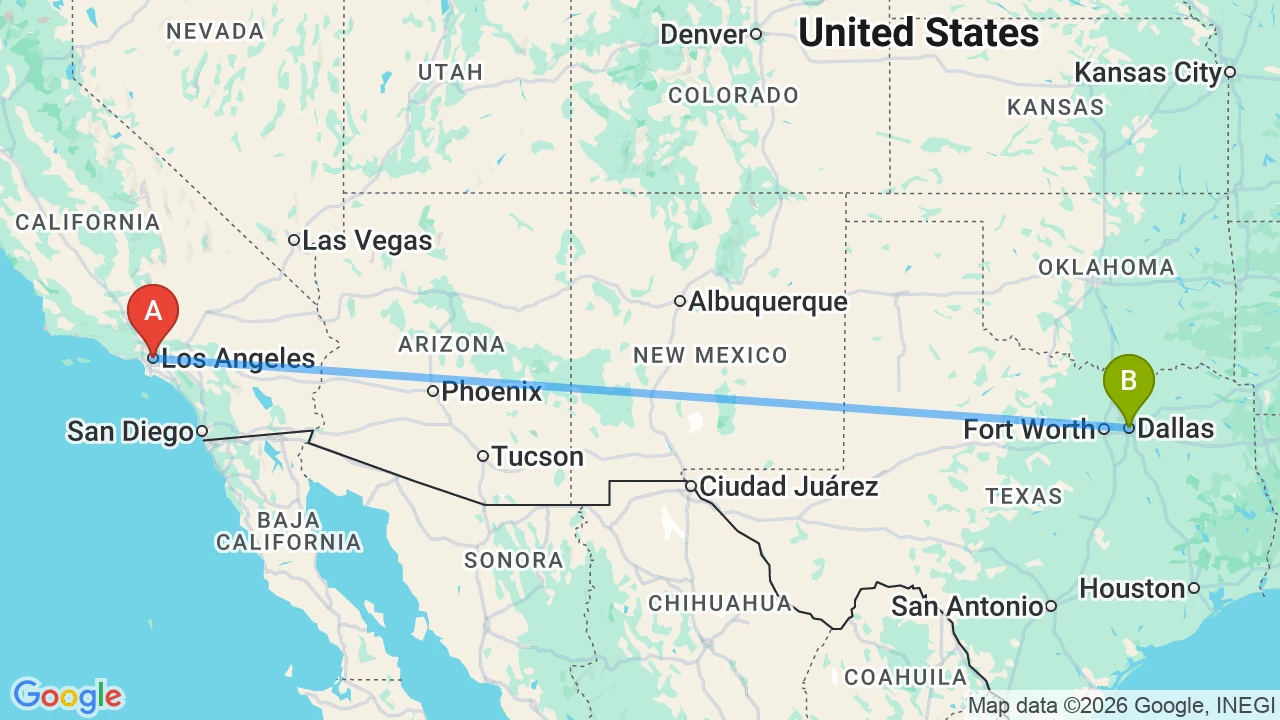
The physical move from Los Angeles to Dallas covers roughly 1,400 miles, typically requiring professional movers, multi-day transit, and careful timing. Peak moving season (May through September) coincides with Dallas’s hottest months, which can complicate unloading and settling in. Many movers prefer spring or fall transitions to avoid both extreme heat and the logistical bottlenecks of summer demand.
Vehicle registration and driver’s license transfers must happen within 30 days of establishing residency in Texas. Texas does not require vehicle safety inspections for most passenger cars, but emissions testing applies in certain counties. California vehicles moving to Texas may need title transfers and updated insurance policies that reflect Texas liability requirements and, often, higher premiums due to hail risk and uninsured motorist rates.
Utility setup in Dallas typically involves separate accounts for electricity (often through a deregulated retail provider), water, trash, and natural gas. This contrasts with some Los Angeles areas where utilities are bundled or managed through a single municipal provider. New residents often underestimate the time required to research electricity plans, compare rates, and understand contract terms in Texas’s deregulated market.
School enrollment timelines differ as well. Texas public schools operate on district-based enrollment with some open-enrollment charter options. Families moving mid-year may face waitlists or limited availability in high-demand schools. Los Angeles operates under a similar district model, but the transition often requires re-establishing proof of residency, immunization records, and sometimes supplemental documentation depending on the district.
What surprises many movers most is the pace of suburban life in Dallas. Even in urban neighborhoods, the rhythm feels slower and more car-oriented than Los Angeles, where density and mixed-use development create more spontaneous foot traffic and street-level activity. This shift can feel liberating for those seeking space and quiet, or isolating for those accustomed to walkable urban environments.
Frequently Asked Questions
- Does Dallas feel more or less expensive than Los Angeles?
- Dallas concentrates cost pressure differently. Housing—both rent and purchase price—drops sharply, creating immediate relief for shelter costs. But transportation, utilities, and daily logistics often require more driving, more cooling, and more time, which shifts expenses into fuel, electricity, and vehicle maintenance. Who feels the savings most depends on whether you’re buying, renting, working remotely, or taking a local job at Dallas wage levels.
- How do housing markets differ between Los Angeles and Dallas?
- Los Angeles presents a high-barrier entry market where the primary challenge is qualifying and competing for housing. Dallas offers easier entry but higher ongoing obligations in the form of property taxes, insurance, and HOA fees. Renters in Dallas gain immediate monthly savings, but lease renewals in high-growth areas can be less predictable than in rent-controlled or saturated Los Angeles neighborhoods.
- What feels different about daily life after moving from LA to Dallas?
- Daily rhythms in Dallas assume car dependence for nearly all errands and activities. Commutes are shorter on average, but trips are more frequent and spread across a wider area. Climate exposure shifts from year-round mild conditions to extended summer heat requiring constant air conditioning. The overall pace feels slower and more suburban, even in urban Dallas neighborhoods.
- When does the move from Los Angeles to Dallas tend to feel easiest?
- Spring and fall offer the most comfortable conditions for moving and settling in, avoiding both peak summer heat and the logistical congestion of high moving season. Families with school-age children often prefer summer moves to align with academic calendars, but should plan for intense heat during unloading and setup. Job transitions that allow remote work during the first few months reduce pressure to establish routines immediately.
- What are the most common adjustment pressures after moving to Dallas?
- New residents often underestimate how much more driving is required for daily errands, how intense the summer heat feels, and how much time it takes to establish service providers—doctors, dentists, mechanics—across a geographically spread metro. The deregulated electricity market can also be confusing for those used to single-utility systems. Socially, building networks takes time in a car-oriented environment where spontaneous interaction is less common.
- Who does this move work best for, and who might struggle?
- This move tends to work well for remote workers or those transferring at the same salary, families seeking larger homes and yards, and buyers priced out of Los Angeles homeownership. It can be more challenging for renters taking local Dallas jobs at lower wages, households without reliable vehicles, and individuals who prioritize walkability, public transit, or dense urban environments. The shift rewards those who value space, lower housing costs, and car-based convenience over density and spontaneous street life.
Conclusion: Tradeoffs, Not Totals
The move from Los Angeles to Dallas is not a simple cost reduction—it’s a structural shift in how expenses, time, and daily logistics are distributed. Housing costs drop sharply, creating real financial breathing room for many households. But transportation demands increase, climate exposure intensifies, and the rhythm of daily life assumes car dependence and geographic spread.
Who benefits most? Remote workers and transferring employees who keep Los Angeles-level salaries while accessing Dallas housing costs. Families seeking homeownership, larger spaces, and lower entry barriers. Households comfortable with car-oriented suburban rhythms and extended summer heat.
Who may feel more pressure? Renters taking local Dallas jobs at lower wages, where housing savings are partially offset by income differences. Households relying on walkability, public transit, or dense urban amenities. Individuals sensitive to heat or those who prioritize spontaneous, street-level city life.
This guide has focused on cost behavior and lifestyle structure, not total budgets or savings calculations. For deeper exploration of Dallas neighborhoods, housing strategies, and cost breakdowns, visit the Dallas city hub on IndexYard. For Los Angeles-specific cost context, see the Los Angeles overview.
Relocation decisions are personal, shaped by income, household composition, career stage, and lifestyle priorities. The goal here is not to declare a winner, but to clarify where pressure moves—so you can decide whether that shift aligns with what you need next.