
Understanding transportation options in League City means recognizing a fundamental truth about suburban Houston living: this is a place built around the car, but with enough infrastructure variation that your daily mobility experience depends heavily on where you live and where you need to go. League City sits in a geographic position that makes it both a bedroom community for Houston-area workers and a self-contained suburb with its own employment centers, and that dual role shapes how people actually move through their days.
The city’s layout reflects decades of auto-oriented development—wide arterials, shopping centers set back from the road, residential subdivisions designed around internal circulation rather than external connectivity. But within that framework, pockets of pedestrian-friendly infrastructure have emerged, particularly in newer mixed-use developments and older established neighborhoods. The result is a transportation landscape that doesn’t fit neatly into “car-dependent suburb” or “transit-accessible community” categories. Instead, League City operates as a place where most households need a vehicle for most trips, but where certain neighborhoods and certain errands can sometimes happen on foot or by bus, if the stars align.
What newcomers often misunderstand is that proximity to Houston doesn’t translate into Houston-level transit access. League City’s position in Galveston County, south of the core metro area, means it sits outside the primary service zones of Houston’s more robust transit networks. The transportation options that do exist here serve specific corridors and specific trip types, leaving significant gaps that only a personal vehicle can fill.
Public Transit Availability in League City
Public transit in League City exists, but in a supporting role rather than as a primary mobility solution for most residents. Bus service operates in the area, connecting League City to broader regional destinations and serving key corridors within the city. This isn’t a system designed to replace car ownership—it’s infrastructure that helps specific populations make specific trips, particularly commuters heading to employment centers along predictable routes and residents who live near major thoroughfares.
The absence of rail transit is the defining limitation. Without fixed-guideway service, transit in League City means buses operating in mixed traffic, subject to the same congestion and delays that affect drivers. For someone commuting from a neighborhood near a bus stop to a workplace near another bus stop, along a route the system serves, transit can work. For everyone else—and that’s most households—the lack of coverage, frequency, and speed makes transit impractical for daily reliance.
Where transit tends to work best is along the city’s main commercial corridors, where density is higher and destinations cluster. Bus stops appear near shopping centers, medical facilities, and employment nodes, serving riders who can structure their lives around fixed routes and schedules. Where it falls short is in the residential subdivisions that make up most of League City’s footprint. Cul-de-sac layouts, low-density development, and the distance between neighborhoods and transit stops create a first-mile/last-mile problem that many households simply solve by driving the entire trip.
The practical reality: if your daily routine involves dropping kids at school, stopping at a grocery store, and commuting to an office park in a different part of the metro area, transit won’t cover that complexity. If your commute is a single, linear trip along a served corridor and you live within walking distance of a stop, it might.
Driving & Car Dependence Reality
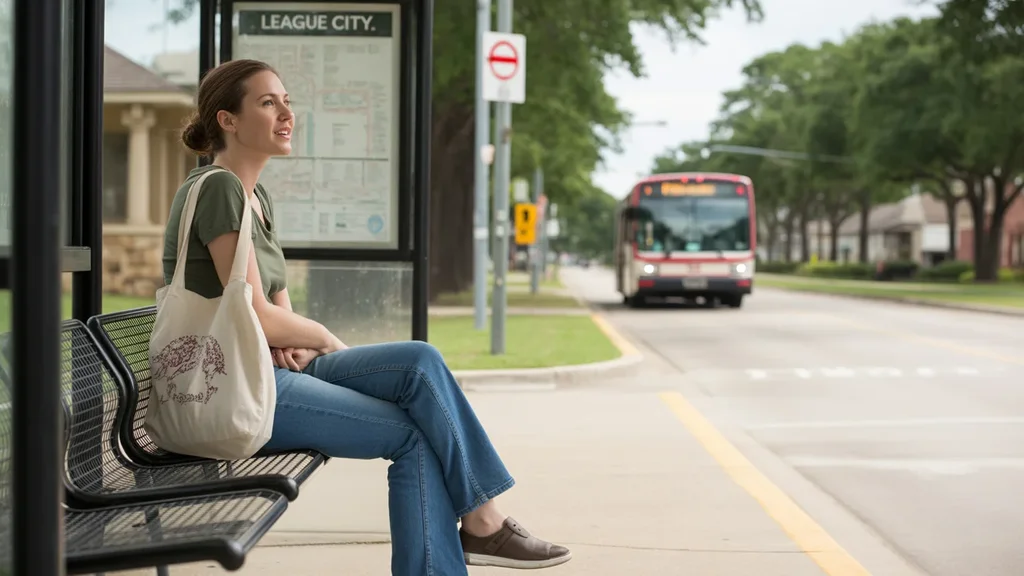
League City’s transportation reality centers on the automobile, and that’s not a failure of planning—it’s a reflection of the city’s geographic scale, development density, and the trip patterns its residents actually need to make. The city sprawls across enough territory that even internal trips—home to school, school to grocery store, grocery store to home—often involve distances that make walking impractical and that transit doesn’t serve efficiently.
Parking is abundant and free in most contexts, which removes one of the friction points that makes car ownership costly in denser urban environments. Shopping centers, employers, medical facilities, and recreational destinations provide dedicated parking, and residential properties typically include garages or driveways. This infrastructure makes driving convenient, but it also reflects an underlying truth: the city is designed with the assumption that visitors and residents will arrive by car.
The tradeoff is flexibility. A car lets you live in one part of League City, work in another part of the metro area, and handle errands scattered across multiple locations without coordinating schedules or routes. It lets you leave when you want, stop where you need to, and adjust plans on the fly. That flexibility comes with costs—fuel, insurance, maintenance, depreciation—but for most households, those costs are unavoidable because the alternative (structuring your entire life around limited transit routes) imposes constraints that feel even more expensive in terms of time and opportunity.
Car dependence also means exposure to volatility. Gas prices fluctuate, and at $3.61 per gallon, filling a tank represents a recurring expense that households can’t easily avoid. Maintenance needs arise unpredictably, and vehicle replacement eventually becomes necessary. But in League City, these aren’t optional costs you can eliminate by choosing a different transportation strategy—they’re structural costs of living in a place where mobility depends on personal vehicle ownership.
Commuting Patterns & Daily Mobility
Commuting in League City often means leaving League City. Many residents work in Houston proper, in Clear Lake, or in other parts of the metro area, which turns the daily commute into a regional trip rather than a local one. These commutes typically happen by car, on highways like I-45 or FM 518, and they introduce time and distance that transit can’t easily compress.
The structure of these commutes varies. Some households have a single earner making a single trip to a single workplace—the kind of pattern that could theoretically work with transit if the route were served. But many households involve multiple earners, multiple destinations, or multi-stop trips that include dropping kids at school or daycare. Those patterns don’t fit transit’s linear, fixed-route model, and they’re part of why car dependence persists even in households that might prefer alternatives.
For residents who work locally—in League City’s retail centers, medical facilities, or service businesses—the commute is shorter but not necessarily more transit-friendly. Local jobs are often scattered across different parts of the city, and the lack of dense employment centers means that even short commutes usually require a car to navigate efficiently.
Daily mobility in League City also involves errands, and this is where the city’s infrastructure creates friction for non-drivers. Food and grocery options exist, but they cluster along corridors rather than distributing evenly across neighborhoods. That corridor-based pattern means some households can walk or bike to a grocery store, while others face a trip that realistically requires a vehicle. The difference often comes down to which subdivision you live in and how close it sits to a commercial corridor.
Who Transit Works For — and Who It Doesn’t
Transit in League City serves a narrow slice of the population effectively: individuals or households with predictable, single-destination commutes along routes the bus system covers, who live within walking distance of a stop, and who don’t need the flexibility to make multi-stop trips or adjust schedules on short notice. That’s not no one, but it’s not most people.
Renters living in apartments near major corridors have better odds of making transit work, particularly if they’re commuting to employment centers that the bus system prioritizes. The ability to structure a routine around fixed departure times and the willingness to accept longer trip durations in exchange for lower direct costs can make transit viable for this group.
Families, on the other hand, face structural barriers. School drop-offs, daycare pickups, grocery runs with multiple bags, and the unpredictability of kids’ schedules all push households toward car dependency. Even in neighborhoods with decent pedestrian infrastructure, the complexity of managing a household’s logistics without a vehicle becomes a friction point that most families aren’t willing to absorb.
Homeowners in peripheral subdivisions—the single-family neighborhoods that define much of League City’s residential fabric—have the least access to transit and the most need for a car. These areas sit outside walkable distance to bus stops, and the internal street networks don’t connect efficiently to external destinations. For these households, car ownership isn’t a choice; it’s a prerequisite.
The walkable pockets that do exist in League City create micro-zones where short trips—a walk to a nearby park, a bike ride to a local coffee shop—become feasible. But these pockets don’t eliminate the need for a car; they just reduce the number of trips that require one. A household in one of these areas might drive less often, but they’ll still own a vehicle for the trips that walking or transit can’t handle.
Transportation Tradeoffs in League City
Choosing between transit and driving in League City isn’t really a choice for most households—it’s a question of whether transit can supplement a car-dependent lifestyle in limited contexts. The tradeoffs aren’t balanced; they tilt heavily toward driving because the infrastructure, geography, and trip patterns all assume vehicle ownership.
Transit offers predictability in one sense: if the bus runs, you know when it will arrive and what it will cost. But it introduces unpredictability in another sense: you can’t adjust your route, you can’t make an unplanned stop, and you’re dependent on the system maintaining its schedule. Driving flips that equation—your costs are less predictable (fuel prices change, maintenance needs arise), but your control is absolute. You leave when you want, go where you need, and adapt to changing circumstances without consulting a timetable.
For households trying to minimize direct transportation costs, transit can help—but only if your life fits the routes. For households prioritizing time, flexibility, and the ability to manage complex logistics, driving is the only practical option, and the costs associated with it become part of what a budget has to handle in League City.
The bike infrastructure that exists in League City adds a third option, but only for certain trips. Cycling works for short distances in areas with dedicated lanes or low-traffic streets, and it can reduce car trips for errands or recreation. But it doesn’t replace a car for commuting, for trips in bad weather, or for hauling groceries or kids. It’s a supplement, not a substitute.
FAQs About Transportation in League City (2026)
Is public transit usable for daily commuting in League City?
Public transit in League City can work for daily commuting if your trip fits a narrow set of conditions: you live near a bus stop, your workplace sits along a route the system serves, and you’re willing to accept longer travel times and less flexibility than driving offers. For most residents, particularly those commuting to scattered employment centers across the Houston metro area or managing multi-stop trips, transit doesn’t provide a practical primary solution. It functions better as a supplemental option for specific trips than as a replacement for car ownership.
Do most people in League City rely on a car?
Yes. League City’s layout, density, and the regional nature of many residents’ commutes make car ownership the dominant transportation mode. Even households in neighborhoods with better pedestrian infrastructure or proximity to bus routes typically own at least one vehicle, because the range of trips people need to make—work, school, errands, medical appointments—extends beyond what transit or walking can cover efficiently. The city’s infrastructure assumes car access, and most households structure their lives accordingly.
Which areas of League City are easiest to live in without a car?
The areas with the best chance of reducing car dependency are neighborhoods that combine proximity to bus routes, walkable access to grocery stores or other daily-needs retail, and internal pedestrian infrastructure that makes short trips feasible on foot. These tend to be pockets near commercial corridors where density is higher and mixed-use development creates closer proximity between housing and services. But even in these areas, most households still own a car for trips that walking or transit can’t handle—living with reduced car use is more realistic than living entirely car-free.
How does commuting in League City compare to nearby cities?
Commuting in League City shares characteristics with other suburban communities in the Houston metro area: it’s car-dependent, often involves regional trips rather than local ones, and lacks the transit density that would make car-free commuting viable for most residents. Compared to communities closer to Houston’s urban core, League City offers less transit frequency and coverage. Compared to more distant exurbs, it benefits from somewhat better access to regional routes and shorter distances to major employment centers. The experience falls into the middle range of suburban Houston commuting—not the worst, not the best, but firmly centered on the automobile.
Does League City have bike lanes or trails for commuting?
League City has some cycling infrastructure, with bike-to-road ratios that fall into a medium band, meaning dedicated lanes or paths exist in parts of the city but don’t form a comprehensive network. This infrastructure works better for recreational riding or short errands in specific neighborhoods than for commuting across the city or to regional destinations. Weather, distance, and the lack of connectivity between bike routes and major employment centers limit cycling’s role as a primary commuting mode, though it can reduce car trips for households living in areas with better bike access.
How Transportation Fits Into the Cost of Living in League City
Transportation in League City isn’t just a line item in a budget—it’s a structural factor that shapes where you can live, where you can work, and how much time and money you’ll spend managing the distance between the two. The city’s car-dependent infrastructure means that vehicle ownership, fuel, insurance, and maintenance become unavoidable costs for most households, and those costs interact with housing choices in ways that aren’t always obvious upfront.
Choosing a home farther from work might save money on rent or mortgage payments, but it increases fuel consumption and vehicle wear. Choosing a neighborhood with walkable access to groceries might reduce short-trip driving, but it doesn’t eliminate the need for a car for commuting or regional errands. The tradeoffs are real, and they require households to think about transportation not as an isolated expense but as part of a broader system of costs and constraints.
The presence of bus service and pockets of pedestrian infrastructure means that some households—particularly those with simpler commute patterns and fewer logistical demands—can reduce their transportation costs by relying more on transit or walking. But for families, for multi-earner households, and for anyone whose daily routine involves scattered destinations, the flexibility and coverage that a car provides outweigh the savings that transit might offer.
Transportation also affects time, and time has a cost. A longer commute, whether by car or bus, means less time for other parts of life—less time with family, less time for errands, less time for rest. League City’s position in the metro area means that many residents absorb significant commute time as part of their daily routine, and that time cost is harder to quantify than fuel or fares but no less real.
Understanding how transportation shapes your cost of living in League City means recognizing that mobility is infrastructure, and infrastructure creates constraints. The city offers enough variation—walkable pockets, bus routes, bike lanes—that some households can carve out strategies to reduce car dependency at the margins. But the baseline assumption remains: you’ll need a car, and the costs associated with that need are part of what it means to live here.
How this article was built: In addition to public economic data, this article incorporates location-based experiential signals derived from anonymized geographic patterns—such as access density, walkability, and land-use mix—to reflect how day-to-day living actually feels in League City, TX.
—