
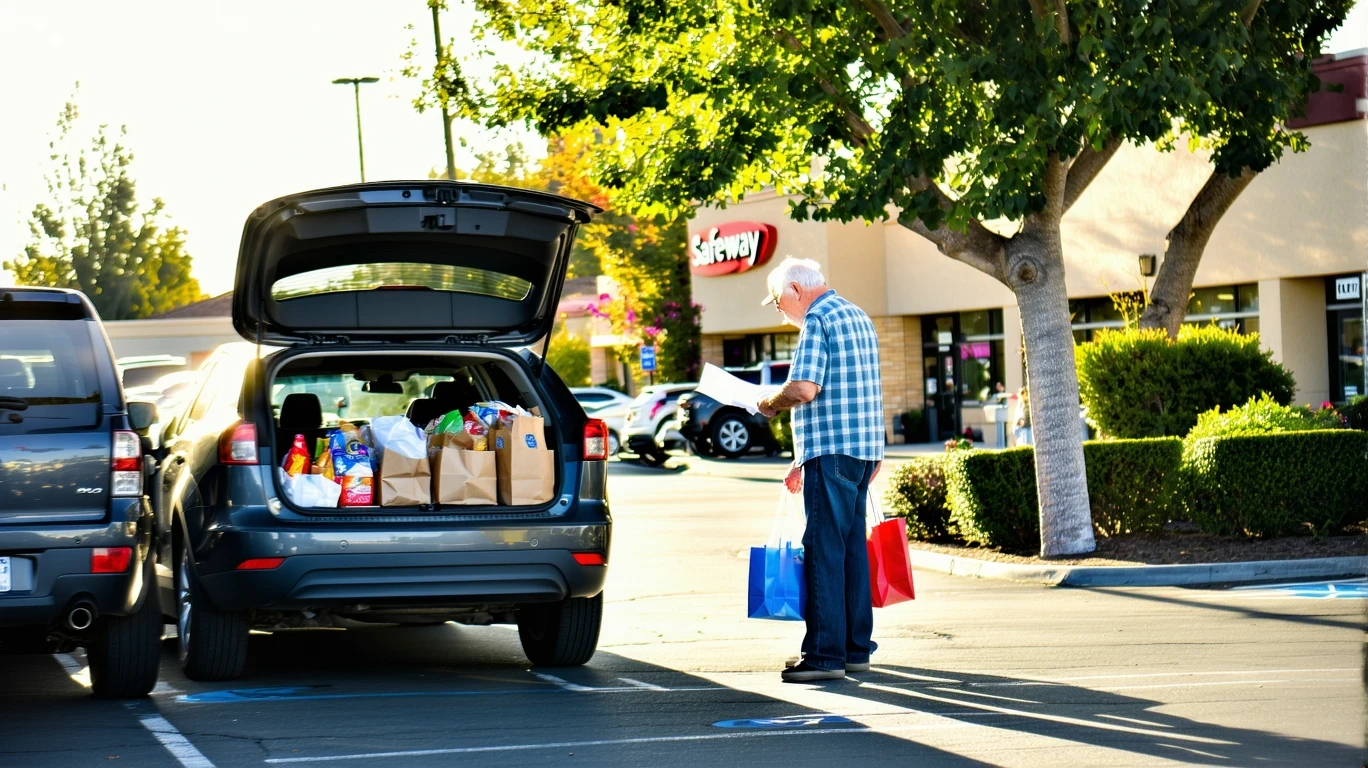
How Grocery Costs Feel in Campbell
Grocery prices in Campbell track closely to the national average, offering a neutral baseline that contrasts sharply with the city’s elevated housing and ownership costs. With a regional price parity index of 100—identical to the U.S. benchmark—Campbell’s food prices don’t carry the premium you’d expect in a Silicon Valley suburb. For households earning near or above the city’s $141,794 median income, grocery spending registers as a manageable line item rather than a source of financial strain. But income stratification matters here: while dual-earner tech households absorb food costs without much thought, single earners and service workers feel the pressure more acutely, especially when juggling Campbell’s high rent or mortgage payments alongside weekly shopping trips.
The experience of grocery shopping in Campbell is shaped less by price and more by access and choice. The city’s food and grocery infrastructure is broadly accessible, with high densities of both supermarkets and smaller food retailers distributed throughout residential areas. This reduces the friction of running errands—you’re rarely more than a few minutes from a viable shopping option, and the mixed land-use character of Campbell means commercial corridors sit close to neighborhoods. For families managing tight schedules or households without reliable car access, this proximity translates into real convenience. It also expands the practical range of store choices, allowing households to toggle between discount chains, mid-tier grocers, and premium markets depending on budget and preference.
Who notices grocery costs most in Campbell? Singles and small households feel the per-person impact more sharply than larger families, particularly when income is modest relative to the city’s cost structure. A single earner making $60,000 annually will spend a larger share of take-home pay on food than a dual-income household pulling in $150,000, even if both shop at the same stores. Families with children face higher absolute spending but benefit from economies of scale—buying in bulk, cooking larger batches, and spreading fixed costs across more people. The result is a segmented grocery landscape where pressure correlates tightly with income and household composition, not just the price tags on the shelf.
Grocery Price Signals (Illustrative)
The table below shows illustrative prices for common staple items in Campbell, derived from national baselines adjusted by regional price parity. These figures reflect how staple items tend to compare locally—not a complete shopping list or a snapshot of any single store’s pricing. Prices vary by retailer, season, and product brand, but these anchors help contextualize the relative cost positioning of everyday groceries in Campbell.
| Item | Price |
|---|---|
| Bread (per pound) | $1.79/lb |
| Cheese (per pound) | $4.72/lb |
| Chicken (per pound) | $2.04/lb |
| Eggs (per dozen) | $2.86/dozen |
| Ground beef (per pound) | $6.54/lb |
| Milk (per half-gallon) | $4.00/half-gallon |
| Rice (per pound) | $1.06/lb |
Note: Derived estimate based on national baseline adjusted by regional price parity; not an observed local price.
These prices sit squarely in the middle of the national distribution—neither bargain-bin cheap nor premium-inflated. Ground beef and cheese carry the highest per-pound costs, reflecting broader protein and dairy pricing trends, while staples like rice and bread remain accessible even for budget-conscious shoppers. Eggs and chicken offer relative value, particularly for households prioritizing protein intake without stretching into premium cuts or specialty products. The key takeaway: Campbell’s grocery prices don’t amplify cost-of-living pressure the way housing does. The challenge isn’t the price per item—it’s how those items add up against a household’s remaining income after rent, utilities, and transportation costs are paid.
Store Choice & Price Sensitivity
Grocery price pressure in Campbell varies significantly by store tier, not by a single “average” shopping experience. The city’s broadly accessible food retail landscape includes discount chains, mid-tier supermarkets, and premium grocers, each serving different household priorities and budget constraints. Discount-tier stores—typically no-frills formats emphasizing private-label products and high-volume staples—offer the lowest per-item costs and attract price-sensitive shoppers, including single earners, retirees on fixed incomes, and families managing tight budgets. Mid-tier grocers strike a balance between price and selection, providing name-brand options, prepared foods, and broader produce variety without the premium markup. Premium markets cater to households prioritizing organic, specialty, or convenience-focused products, often charging 20–40% more than discount equivalents for comparable items.
For Campbell households, store choice directly shapes how grocery costs feel. A family shopping exclusively at discount chains can hold weekly spending steady even as household size grows, while a household defaulting to premium grocers will see costs climb faster as preferences shift toward organic, pre-prepped, or specialty items. The city’s high median income means many households can afford to shop at mid or premium tiers without financial stress, but income stratification creates a bifurcated experience: tech workers and dual-earner professionals treat store choice as a lifestyle preference, while service workers and single parents treat it as a financial necessity. The walkable pockets and mixed land use in parts of Campbell mean some residents can access multiple store tiers on foot or with minimal driving, reducing the logistical penalty of comparison shopping or splitting trips between discount and mid-tier locations.
Price sensitivity also shifts with household composition and cooking habits. Singles and couples without children often prioritize convenience over bulk savings, gravitating toward mid-tier stores with better prepared-food sections and smaller package sizes. Families with kids lean harder into discount and bulk formats, where per-unit savings compound across higher volumes. Households that cook frequently and from scratch extract more value from discount-tier staples, while those relying on pre-prepped or grab-and-go options pay a convenience premium regardless of store tier. In Campbell, the practical implication is clear: grocery costs feel tighter or looser depending on where you shop and how you shop, not just what you buy.
What Drives Grocery Pressure Here
Income interaction is the dominant force shaping grocery pressure in Campbell. With a median household income of $141,794, the city sits well above the national median, creating a cushion that absorbs food costs for many residents. But income distribution matters more than the median alone: households earning below $80,000 annually—including service workers, retail employees, and single parents—face meaningful grocery budget pressure, particularly when housing costs consume 40–50% or more of take-home pay. For these households, even neutral grocery pricing feels tight because the dollars left over after rent, utilities, and transportation are limited. High earners, by contrast, treat grocery spending as a minor variable expense, easily absorbed within discretionary budgets that remain large even after fixed costs are paid.
Household size amplifies sensitivity to grocery costs in predictable ways. A single adult earning $60,000 may spend $300–400 monthly on groceries without strain, but a family of four earning $100,000 will see food costs rise to $800–1,000 or more, depending on dietary preferences and store choices. Larger households benefit from economies of scale—buying in bulk, cooking larger portions, and reducing per-person waste—but absolute spending still climbs with each additional mouth to feed. In Campbell, where family-oriented infrastructure is strong (high school density, ample playgrounds), many households include children, which pushes grocery spending higher in absolute terms even as per-person costs moderate.
Regional distribution and access patterns also influence how grocery pressure registers. Campbell’s broadly accessible food retail network means most households face minimal travel friction to reach a grocery store, reducing the hidden costs of time, fuel, and logistical complexity. This accessibility matters most for households without reliable car access or those managing tight work schedules—being able to walk or bike to a nearby grocer, or to split shopping trips across multiple nearby stores, lowers the effective cost of grocery shopping by reducing ancillary expenses. Seasonal variability plays a quieter role: produce prices fluctuate with growing seasons and supply-chain conditions, but Campbell’s year-round moderate climate and proximity to California’s agricultural regions help stabilize availability and dampen extreme seasonal swings in fresh food costs.
Practical Ways People Manage Grocery Costs
Households in Campbell manage grocery costs primarily through behavioral strategies that emphasize control, not optimization. Shopping at discount-tier stores for staples while reserving mid or premium grocers for specialty items allows families to capture bulk savings without sacrificing variety or quality on items that matter most. Buying in bulk—particularly for non-perishables like rice, pasta, canned goods, and household staples—reduces per-unit costs and spreads shopping trips further apart, lowering both spending and logistical overhead. Cooking from scratch rather than relying on pre-prepped or convenience foods cuts costs significantly, though it requires time and kitchen confidence that not all households can spare.
Meal planning and list-based shopping reduce impulse purchases and food waste, two of the largest sources of hidden grocery spending. Households that plan weekly menus around sale items, seasonal produce, and pantry staples tend to hold spending steadier than those who shop reactively or without structure. Leveraging store loyalty programs, digital coupons, and app-based discounts adds incremental savings without requiring extreme couponing or logistical complexity. For families, splitting shopping trips between discount stores for bulk staples and mid-tier grocers for fresh produce or specialty items balances cost control with dietary preferences.
Reducing reliance on packaged snacks, beverages, and single-serve items also helps households stretch grocery budgets. These categories carry high per-unit markups and add up quickly, particularly in households with children. Substituting home-cooked meals for convenience foods—even simple swaps like making coffee at home instead of buying it daily—compounds over weeks and months. The goal isn’t to eliminate convenience or preference, but to identify where small behavioral shifts reduce spending without creating friction or dissatisfaction. In Campbell, where household incomes vary widely, these strategies matter most for families earning below the median or managing high fixed costs elsewhere in their budget.
Groceries vs Eating Out (Directional)
The tradeoff between grocery spending and dining out shapes how households experience food costs in Campbell, though the balance varies by income, schedule, and preference. Cooking at home consistently costs less per meal than eating out, but the gap narrows when accounting for time, effort, and opportunity cost. For high-earning households, the convenience of dining out or ordering delivery often outweighs the incremental savings of home cooking, particularly on busy weeknights or when managing dual careers and family logistics. For budget-conscious households, the opposite holds: every restaurant meal represents several home-cooked meals forgone, making dining out a discretionary expense reserved for special occasions rather than a routine convenience.
Campbell’s food retail accessibility supports home cooking by reducing the friction of grocery shopping—short travel distances, multiple store options, and walkable access in some neighborhoods make it easier to keep a stocked pantry and cook regularly. But the city’s proximity to Silicon Valley’s robust dining scene also creates temptation and social norms around eating out, particularly for younger professionals and dual-income couples without children. The result is a segmented pattern: families with kids and cost-conscious households lean heavily into groceries and home cooking, while singles and high earners toggle between the two depending on schedule and preference.
The financial implication is straightforward: households that cook most meals at home will see grocery spending rise in absolute terms but total food costs fall relative to households that dine out frequently. The inverse is also true—reducing grocery spending by eating out more often almost always increases total food costs unless meals are limited to fast-casual or budget formats. In Campbell, where income levels support discretionary dining for many households, the key decision isn’t whether to cook or eat out, but how to balance the two in ways that align with budget, time, and lifestyle priorities.
FAQs About Grocery Costs in Campbell (2026)
Is it cheaper to shop in bulk in Campbell? Yes, buying in bulk reduces per-unit costs for non-perishables and household staples, particularly at discount-tier stores or warehouse clubs. Bulk shopping works best for larger households or those with storage space and the ability to use items before expiration.
Which stores in Campbell are best for low prices? Discount-tier grocers and no-frills chains offer the lowest per-item costs, focusing on private-label products and high-volume staples. Mid-tier supermarkets balance price and selection, while premium markets charge more for organic, specialty, and convenience-focused products.
How much more do organic items cost in Campbell? Organic products typically carry a premium over conventional equivalents, with markups varying by category and store tier. Produce, dairy, and meat see the largest premiums, while dry goods and packaged items show smaller differences.
How do grocery costs for two adults in Campbell tend to compare to nearby cities? Campbell’s regional price parity index of 100 places grocery costs at the national baseline, meaning prices align closely with U.S. averages and tend to be lower than in more expensive Bay Area cities. Nearby cities with higher price indices will see elevated grocery costs, while those with lower indices may offer modest savings.
How do households in Campbell think about grocery spending when cooking at home? Most households view grocery spending as a controllable variable expense that responds to store choice, meal planning, and cooking habits. Families prioritize bulk staples and discount stores to hold costs steady, while high-income households treat groceries as a minor budget line and prioritize convenience and quality over price.
Does Campbell’s walkability affect grocery shopping habits? In neighborhoods with high pedestrian infrastructure and mixed land use, some residents can walk or bike to nearby grocers, reducing transportation costs and enabling more frequent, smaller shopping trips. Car-dependent areas require planned trips and favor bulk shopping to minimize travel frequency.
How does household size affect grocery pressure in Campbell? Larger households face higher absolute grocery spending but benefit from economies of scale through bulk buying and batch cooking. Singles and couples spend less in total but often pay higher per-person costs due to smaller package sizes and less opportunity to leverage bulk discounts.
How Groceries Fit Into the Cost of Living in Campbell
Grocery costs in Campbell occupy a relatively modest position within the city’s broader cost-of-living structure, particularly when compared to housing and ownership expenses. With food prices tracking the national baseline and a median household income of $141,794, grocery spending represents a manageable share of monthly budgets for most residents—typically far smaller than rent, mortgage payments, or utilities. The real pressure point isn’t the grocery bill itself, but how it compounds with other fixed costs. For households already stretched by high housing costs, even neutral grocery pricing can feel tight because the dollars remaining after rent and utilities are limited. High earners, by contrast, absorb grocery costs easily, treating food spending as a minor variable expense that rarely requires active management.
The interaction between grocery costs and other expenses matters most for households earning below the city’s median income. A family spending $1,200 monthly on groceries may find that figure entirely manageable if housing costs are moderate, but the same grocery bill becomes a source of strain when rent exceeds $3,000 or mortgage payments push past $4,500. In Campbell, where median rent sits at $2,619 per month and median home values reach $1,473,700, housing dominates household budgets, leaving less room for flexibility in other categories. Grocery spending, while neutral in absolute terms, competes for dollars with transportation, utilities, and discretionary expenses—all of which add up quickly in a high-cost region.
For a complete picture of how groceries fit into monthly expenses—including housing, utilities, transportation, and discretionary spending—readers should consult Your Monthly Budget in Campbell: Where It Breaks, which provides a structured breakdown of where household dollars go and how different income levels experience Campbell’s cost structure. Understanding grocery costs in isolation is useful, but the real decision value comes from seeing how food spending interacts with every other line item in a household budget. Campbell’s grocery prices won’t surprise you—but the cumulative weight of all costs together might, particularly if you’re moving from a lower-cost region or adjusting to Silicon Valley’s financial realities for the first time.
How this article was built: In addition to public economic data, this article incorporates location-based experiential signals derived from anonymized geographic patterns—such as access density, walkability, and land-use mix—to reflect how day-to-day living actually feels in Campbell, CA.