
A first-time renter in Doral faces a monthly housing cost around $2,393 before utilities—high enough to dominate a budget, but paired with access to jobs, schools, and daily errands that reduce other friction. A first-time buyer confronts a $468,800 median home value, which translates to a substantial down payment and mortgage, but also locks in the housing line item against future rent increases. Both paths require navigating a market shaped by Doral’s role as a commercial and residential hub in the Miami metro, where housing costs reflect proximity, infrastructure, and a development pattern that blends suburban car dependency with pockets of walkability.
This article explains how housing costs behave in Doral—what drives rent and ownership expenses, how apartments and houses differ in cost structure, and which tradeoffs matter most when choosing between renting and buying in a city where overall living costs sit above the national baseline.
The Housing Market in Doral Today
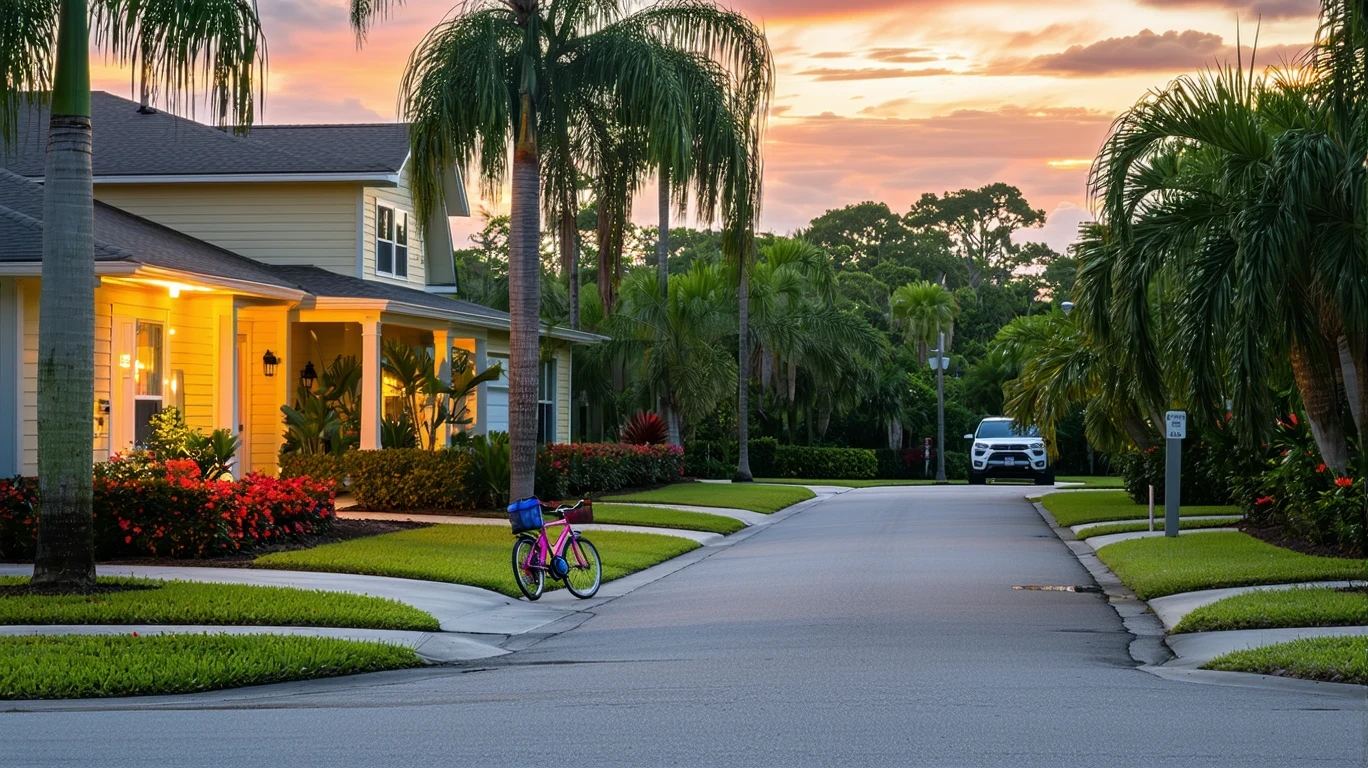
Doral’s housing market is defined by its position within the broader Miami-Fort Lauderdale metro—a region where demand for housing consistently outpaces supply, and where proximity to employment centers, international commerce, and quality schools commands a premium. The city’s development over the past two decades has produced a mix of single-family homes, townhouses, and mid-rise apartment complexes, many built within master-planned communities that include retail, dining, and recreational amenities.
What newcomers often misunderstand is that Doral’s housing costs are not purely a function of the Miami metro’s overall expense; they also reflect the city’s specific infrastructure advantages. High food and grocery density, strong family-oriented amenities (schools and playgrounds both exceed density thresholds), and integrated park access create a lived environment where daily errands and household logistics require less time and planning than in more sprawling suburbs. This accessibility reduces some of the indirect costs of living—less driving to meet basic needs, more options within short distances—but it does not lower the direct cost of securing housing.
The result is a market where both renters and buyers face elevated entry costs, but where the tradeoff includes tangible convenience and infrastructure that supports family life and daily routines without requiring constant car trips or long detours.
Renting in Doral
Median gross rent in Doral sits at $2,393 per month, a figure that includes base rent but not utilities, parking fees, or renter’s insurance. This level of rent reflects competition for units in a city with low unemployment (2.4%) and strong job access, where rental demand comes from young professionals, families seeking school access, and households prioritizing proximity to work over homeownership.
Rental availability in Doral tends to concentrate in apartment complexes and townhouse communities, many of which are managed by corporate landlords or HOA-governed associations. Lease terms typically run 12 months, with renewal increases tied to metro-wide rent trends rather than individual landlord discretion. Renters should expect that annual increases will reflect broader market pressure, not just the condition or desirability of a specific unit.
What distinguishes renting in Doral from other South Florida submarkets is the density of daily amenities within short distances. The city’s high grocery and food establishment density means that renters can often walk or make quick trips for essentials, reducing the logistical burden that typically accompanies suburban apartment living. Bus service is present throughout the city, though the absence of rail transit means that most renters still rely on personal vehicles for commuting and errands beyond the immediate neighborhood.
For renters, the primary exposure is rent volatility. Unlike ownership, where property taxes and insurance fluctuate but the mortgage principal remains fixed, rent can adjust annually in response to metro-wide demand, new development, and landlord strategy. This creates less predictability over time, but also less responsibility for maintenance, repairs, and long-term capital expenses.
Owning a Home in Doral
The median home value in Doral is $468,800, a figure that reflects both the city’s infrastructure advantages and its position within a high-demand metro. For a buyer, this translates to a down payment in the range of tens of thousands of dollars (depending on loan type and lender requirements), followed by a monthly mortgage payment that will remain stable in nominal terms but will be accompanied by property taxes, homeowners insurance, HOA fees (common in many Doral communities), and maintenance costs that rise over time.
Ownership in Doral means taking on exposure to Florida’s property insurance market, which has experienced significant volatility in recent years due to hurricane risk, litigation trends, and insurer exits from the state. While insurance costs are not included in the provided data, buyers should expect that annual premiums will be material and subject to sharp increases, particularly for properties in flood zones or older construction.
Property taxes in Florida are governed by a combination of millage rates set by local governments and the Save Our Homes cap, which limits annual assessment increases for homesteaded properties. New buyers do not benefit from the cap in their first year, meaning that the initial tax bill reflects the purchase price rather than a capped assessment. Over time, the cap provides some insulation against rapid tax increases, but it does not eliminate exposure to rising millage rates or special assessments levied by municipalities or HOAs.
Many Doral neighborhoods are governed by homeowners associations, which collect monthly or annual fees to cover common area maintenance, landscaping, security, and amenities such as pools, fitness centers, and clubhouses. These fees are mandatory and can increase annually, adding a layer of cost that renters do not face. Buyers should verify the HOA’s financial health, reserve funding, and history of special assessments before closing, as these factors directly affect long-term cost predictability.
Maintenance and repair costs are the owner’s responsibility and vary by home age, construction quality, and climate exposure. Doral’s subtropical climate—characterized by high heat, humidity, and intense summer sun—accelerates wear on roofs, HVAC systems, exterior paint, and landscaping. Buyers should budget for air conditioning replacement or repair on a timeline shorter than in temperate climates, as systems run nearly year-round and face heavy loads during the extended cooling season.
Apartment vs House in Doral — Cost Behavior Comparison
| Expense Category | Apartment | House |
|---|---|---|
| Cooling costs | Lower total usage due to smaller square footage and shared walls; landlord may cover water heating | Higher usage due to larger space, more exterior exposure, and full responsibility for HVAC operation and replacement |
| Exterior maintenance | Covered by landlord or HOA; tenant not responsible for roof, siding, or landscaping | Owner responsible for roof, exterior paint, irrigation, and yard care; climate accelerates replacement cycles |
| HOA or association fees | Typically included in rent or minimal; covers common areas and amenities | Often mandatory and substantial; covers neighborhood amenities, landscaping, and sometimes security; subject to annual increases |
| Insurance | Renter’s insurance required by most landlords; covers personal property and liability, not structure | Homeowners insurance required by lender; covers structure and liability; Florida market volatility creates significant annual cost uncertainty |
| Parking | May be assigned or require additional monthly fee; limited guest parking in many complexes | Garage or driveway included; no additional cost; more flexibility for multiple vehicles |
Why these categories differ in Doral: The comparison above reflects Doral’s subtropical climate (which drives cooling and maintenance intensity), the prevalence of HOA-governed communities (which shifts cost structure for both renters and owners), and the city’s mixed building stock (which creates meaningful differences in square footage, exterior exposure, and amenity access). Categories such as water, trash, and basic utilities were excluded because they vary more by provider and lease terms than by housing type, and because the feed does not provide sufficient local detail to distinguish them meaningfully in this market.
Utilities & Upkeep Differences
Utility exposure in Doral is dominated by cooling costs. The city’s location in South Florida means that air conditioning runs nearly year-round, with peak demand during the long, humid summer months when outdoor temperatures regularly reach the 90s and heat indices climb higher. Electricity rates in the area sit at 15.78¢ per kWh, and a typical household can expect cooling to account for the majority of the monthly electric bill during the extended cooling season.
Apartment dwellers benefit from smaller square footage and shared walls, which reduce the total conditioned space and limit heat gain from exterior exposure. Many apartment leases also include water and sometimes water heating, shifting some utility cost to the landlord. However, tenants still face variable electric bills tied to thermostat settings, occupancy patterns, and the efficiency of the building’s HVAC systems—factors largely outside their control.
Homeowners face higher absolute utility costs due to larger square footage, more exterior walls and windows, and full responsibility for system efficiency. Older homes or those with single-pane windows, insufficient insulation, or aging HVAC equipment will see notably higher bills. The intensity of Doral’s heat and humidity also accelerates wear on cooling systems, meaning that owners should expect more frequent service calls and earlier replacement timelines than in milder climates.
Upkeep differences between apartments and houses in Doral are driven primarily by exterior exposure and climate stress. Homeowners are responsible for roof maintenance (a significant cost in a region with intense sun and occasional tropical storms), exterior paint (which degrades faster in high UV and humidity), and landscaping (which requires consistent irrigation during dry periods). These are not minor or occasional expenses; they are recurring obligations that increase as the home ages.
Apartment renters are insulated from these costs, but they also lack control over when and how maintenance is performed. A landlord’s decision to delay roof replacement or use lower-quality materials can affect comfort, utility costs, and even habitability, but the tenant has limited recourse beyond lease terms and local tenant protections.
Rent vs Buy: Long-Term Exposure in Doral
The choice between renting and buying in Doral is not primarily a question of monthly cost equivalence; it is a question of which exposures a household is prepared to manage over time.
Renters face annual rent increases that reflect metro-wide demand, new construction, and landlord pricing strategies. These increases are unpredictable in magnitude and timing, and they compound over time. A renter who stays in Doral for five or ten years will almost certainly pay significantly more in year ten than in year one, with no equity accumulation and no control over the timing or size of increases. However, renters also avoid exposure to property tax changes, insurance market volatility, major repair costs, and HOA fee increases. When a roof fails or an HVAC system dies, the landlord bears the cost and the logistical burden.
Buyers lock in the mortgage principal, which provides stability for the largest component of the monthly housing cost. However, they take on exposure to property taxes (which can rise due to millage rate increases or reassessment), homeowners insurance (which has become notably volatile in Florida), HOA fees (which increase annually in many communities), and maintenance costs (which grow as the home ages and as climate stress accelerates wear). These costs are less predictable than the mortgage payment, and they do not remain fixed over time.
Ownership also creates exposure to market risk. A buyer who needs to sell during a market downturn may face a loss, particularly if they have not owned the home long enough to build significant equity. A renter can leave at the end of a lease with no capital loss, though they may face difficulty finding comparable housing at a lower price.
The long-term tradeoff in Doral is between the predictability of the mortgage payment and the volatility of rent increases on one side, and the accumulation of equity against the exposure to taxes, insurance, and maintenance on the other. Neither path eliminates cost growth; they simply allocate it differently.
How Day-to-Day Living Shapes Housing Decisions in Doral
Housing costs in Doral do not exist in isolation from the city’s physical structure and daily accessibility. The presence of walkable pockets—areas where the pedestrian-to-road ratio exceeds typical suburban thresholds—means that some neighborhoods allow residents to reach grocery stores, restaurants, and services on foot or with short drives, reducing the logistical burden that often accompanies suburban life. High food and grocery density throughout the city ensures that households are rarely more than a few minutes from essential errands, which lowers the time cost of daily tasks even when a car is required.
For families, the city’s strong school and playground infrastructure reduces the need to drive children to distant parks or arrange complex activity schedules. Both schools and playgrounds meet density thresholds that indicate broad availability, meaning that family households can often access these amenities within their immediate neighborhood. This does not lower the cost of housing, but it does reduce the indirect costs—time, fuel, and planning complexity—that families face in less accessible suburbs.
The absence of rail transit and the presence of only bus service means that most Doral residents rely on personal vehicles for commuting and errands beyond the immediate neighborhood. The average commute time of 25 minutes reflects this car dependency, and the 38.7% of workers with long commutes indicates that a substantial share of residents travel significant distances for work. For renters and buyers alike, this means that housing location decisions must account for vehicle ownership, fuel costs, and the time burden of driving—all of which add to the total cost of living in the city.
The mixed building heights and land use patterns in Doral create neighborhoods that feel less uniform than traditional single-family subdivisions, with apartments, townhouses, and houses often located near commercial corridors. This proximity can be an advantage for households that value convenience, but it also means that noise, traffic, and parking pressure vary significantly by block. Renters and buyers should evaluate specific locations carefully, as the lived experience of housing in Doral depends heavily on immediate surroundings, not just citywide averages.
How this article was built: In addition to public economic data, this article incorporates location-based experiential signals derived from anonymized geographic patterns—such as access density, walkability, and land-use mix—to reflect how day-to-day living actually feels in Doral, FL.
FAQs About Housing Costs in Doral
Is renting or buying more common in Doral?
Both renting and buying are common in Doral, with the choice often driven by household stage, income stability, and willingness to take on long-term cost exposure. Renters tend to prioritize flexibility and lower upfront costs, while buyers seek to lock in housing costs and build equity despite higher entry barriers and ongoing ownership expenses.
How much do utilities add to housing costs in Doral?
Utilities in Doral are dominated by cooling costs due to the subtropical climate and year-round air conditioning demand. Apartment dwellers typically see lower absolute costs due to smaller square footage, while homeowners face higher bills driven by larger spaces and full responsibility for system efficiency. Electricity rates sit at 15.78¢ per kWh, and usage intensity varies by home size, insulation, and thermostat settings.
Do most homes in Doral have HOA fees?
Many neighborhoods in Doral are governed by homeowners associations, particularly in master-planned communities and townhouse developments. HOA fees are mandatory where they exist and typically cover common area maintenance, landscaping, amenities, and sometimes security. Fees vary widely by community and can increase annually, adding a recurring cost that renters do not face.
How does Doral’s housing market compare to nearby cities?
Doral’s housing costs reflect its position within the Miami-Fort Lauderdale metro, where demand consistently exceeds supply and proximity to jobs, schools, and amenities commands a premium. Compared to more distant suburbs, Doral offers shorter commutes and higher daily accessibility, but at a higher entry cost for both renters and buyers.
What should first-time buyers know about buying in Doral?
First-time buyers in Doral should expect a median home value of $468,800, which requires a substantial down payment and creates a significant monthly mortgage obligation. Beyond the mortgage, buyers take on exposure to property taxes, homeowners insurance (which is notably volatile in Florida), HOA fees, and maintenance costs that increase over time. The climate accelerates wear on roofs, HVAC systems, and exteriors, meaning that repair and replacement timelines are shorter than in temperate regions.
Making Housing Choices in Doral
Housing costs in Doral are high in absolute terms, but they reflect a market where infrastructure, accessibility, and family amenities reduce some of the indirect costs that accompany suburban living. Renters gain flexibility and avoid maintenance exposure, but face unpredictable annual increases and no equity accumulation. Buyers lock in the mortgage payment and build equity, but take on exposure to taxes, insurance, HOA fees, and climate-driven maintenance costs that grow over time.
The decision between renting and buying in Doral is not primarily about which option costs less in the short term; it is about which set of exposures a household is prepared to manage, and whether the city’s accessibility and infrastructure justify the elevated entry cost. For households that value proximity to jobs, schools, and daily errands, and that can absorb the upfront and ongoing costs, Doral offers a lived environment where housing costs are high but logistical friction is lower than in more sprawling alternatives.