
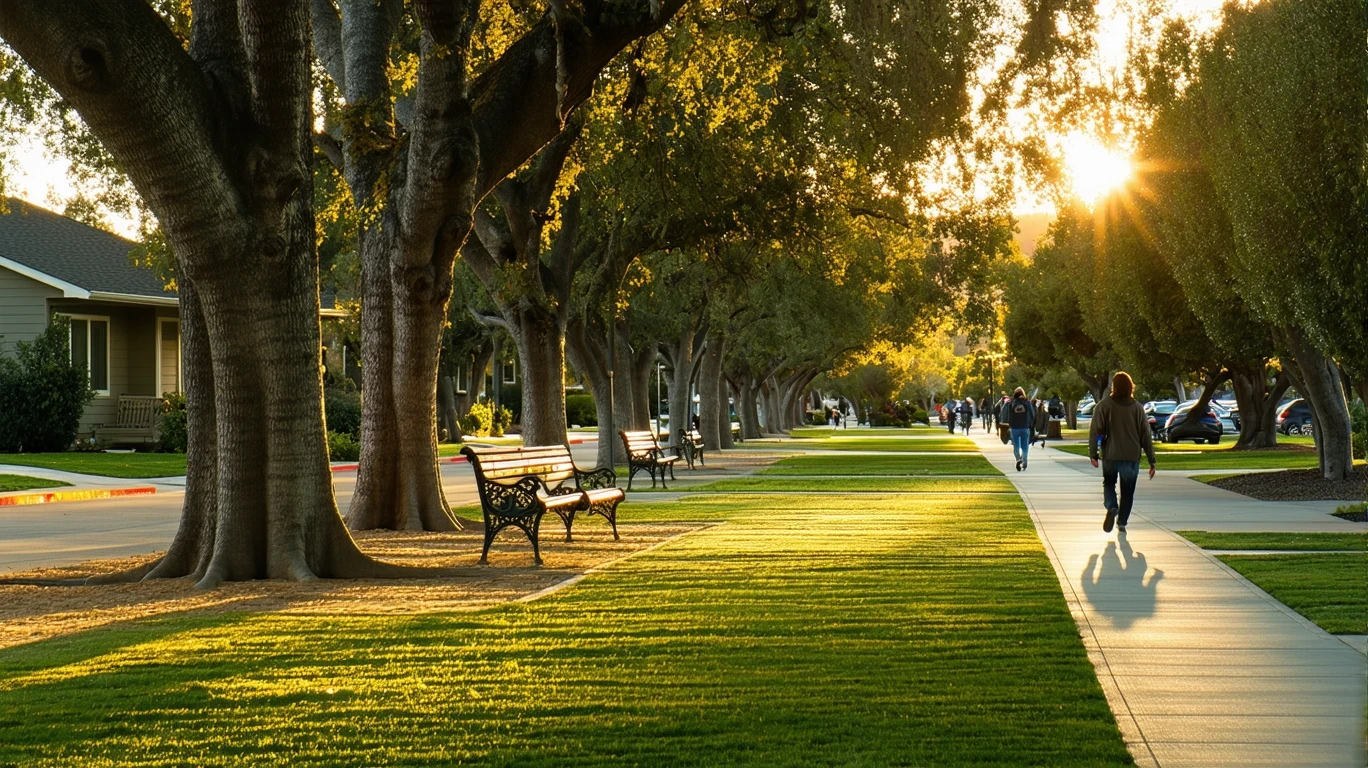
Imagine two households, both earning the same tech-sector salary, sitting down to compare their monthly spreadsheets. One lives in Cupertino, paying $3,501 in rent for a two-bedroom apartment and spending $4.22 per gallon to fuel a 43-mile daily commute. The other lives in Santa Clara, paying $2,841 for a similar unit and driving 25 miles round-trip to work. On paper, the second household has more breathing room. But when you account for where grocery stores cluster, how often you need a car for errands, and whether your neighborhood has sidewalks that actually go somewhere, the picture gets more complex. In 2026, choosing between Cupertino and Santa Clara isn’t about finding the cheaper city—it’s about understanding which cost pressures dominate your household, and which trade-offs you’re willing to make.
Both cities sit in the heart of Silicon Valley, share the same utility rates, and face the same regional price environment for groceries and gas. But cost structure diverges sharply when you look at housing entry barriers, commute friction, and the infrastructure that shapes daily logistics. Cupertino’s median home value sits above $2,000,001, while Santa Clara’s hovers around $1,440,200. Renters face a similar gap: $3,501 per month in Cupertino versus $2,841 in Santa Clara. These aren’t small differences, and they don’t just affect your monthly housing line—they ripple into how much flexibility you have for everything else, from utilities to transportation to the time cost of running errands.
This article breaks down how cost pressure shows up differently in each city, using only observed data and place-specific patterns. We’ll compare housing entry and ongoing obligations, explain how commute patterns and infrastructure affect transportation exposure, and walk through how daily errands, utilities, and fees behave for different household types. By the end, you’ll have a clear framework for deciding which city fits your priorities in 2026—not based on totals, but on where your household is most exposed and what kind of predictability you need.
Housing Costs: Entry Barriers and Ongoing Pressure
Housing dominates the cost experience in both cities, but the magnitude and type of pressure differ. Cupertino’s median home value of $2,000,001 creates a steep entry barrier for buyers, requiring substantial down payments and locking households into significant ongoing mortgage obligations. Santa Clara’s median home value of $1,440,200 is lower, but still represents a major financial commitment. For first-time buyers or households stretching to enter the market, that $560,000 gap translates directly into how much liquidity you need upfront and how much of your monthly income gets locked into housing before you pay for anything else.
Renters face a similar dynamic. Cupertino’s median gross rent of $3,501 per month is higher than Santa Clara’s $2,841 per month—a difference of $660 per month, or nearly $8,000 per year. That gap doesn’t just affect your housing line; it determines how much flexibility you have for utilities, transportation, groceries, and discretionary spending. In Cupertino, renters are more likely to face trade-offs between housing location and commute distance, especially if they work outside the immediate area. In Santa Clara, the lower rent baseline provides more room to absorb volatility in other categories, but you’re still operating in a high-cost regional environment where housing takes up a large share of income.
The type of housing stock also matters. Cupertino’s neighborhoods include a mix of single-family homes, townhomes, and apartment complexes, with some areas showing walkable infrastructure and mixed land use. Santa Clara offers similar variety, but the distribution of housing types and proximity to transit or commercial corridors can vary widely. For families prioritizing space, yard access, or proximity to schools, Cupertino’s higher housing costs may feel justified if the neighborhood infrastructure reduces friction in other areas—like walkable errands or integrated parks. For single adults or couples prioritizing lower fixed costs and shorter commutes, Santa Clara’s housing market may offer better alignment.
| Housing Type | Cupertino | Santa Clara |
|---|---|---|
| Median Home Value | $2,000,001 | $1,440,200 |
| Median Gross Rent | $3,501/month | $2,841/month |
| Entry Barrier | Higher down payment, larger mortgage obligation | Lower down payment, moderate mortgage obligation |
| Ongoing Pressure | High fixed housing cost limits flexibility | Moderate fixed housing cost, more flexibility |
Housing takeaway: Cupertino imposes higher upfront and ongoing housing costs, which means households need more income stability and liquidity to enter the market and sustain monthly obligations. Santa Clara offers a lower entry barrier and more breathing room for other expenses, but both cities require careful planning around housing before committing to a lease or purchase. Renters sensitive to monthly cash flow may find Santa Clara more manageable, while buyers prioritizing neighborhood infrastructure and walkability may accept Cupertino’s premium if it reduces friction elsewhere.
Utilities and Energy Costs: Same Rates, Different Exposure
Both cities share identical utility rates: 33.60¢ per kWh for electricity and $21.94 per MCF for natural gas. This means the price you pay per unit of energy is the same whether you live in Cupertino or Santa Clara. But your total exposure depends on factors that vary by household: home size, insulation quality, heating and cooling needs, and how much time you spend at home. In Silicon Valley’s mild Mediterranean climate, cooling dominates summer bills, while heating needs remain modest compared to colder regions. Households in larger single-family homes will see higher baseline usage than those in smaller apartments, regardless of which city they choose.
The age and construction quality of your home plays a significant role in how much energy you actually consume. Older homes with single-pane windows, minimal insulation, and older HVAC systems tend to leak conditioned air, driving up both heating and cooling costs. Newer construction or recently renovated units often include double-pane windows, better insulation, and more efficient appliances, which reduces usage even if the rate stays the same. In both cities, renters have limited control over these structural factors, while homeowners can invest in efficiency upgrades to lower long-term exposure—but those upgrades require upfront capital and time.
Household size and daily routines also shape utility costs. A single adult working long hours outside the home will use less electricity and gas than a family of four with kids at home during the day, running laundry, cooking multiple meals, and keeping the thermostat adjusted for comfort. Families in larger homes face compounding exposure: more square footage to heat and cool, more appliances running, and more people using hot water. Couples or single adults in smaller units benefit from lower baseline usage, but they’re still subject to the same rate structure and seasonal volatility.
Neither city offers a structural advantage in utility costs—the rates are identical, and the climate exposure is similar. The difference comes down to the housing stock you choose and how efficiently it uses energy. If you’re comparing a newer apartment in Santa Clara to an older single-family home in Cupertino, the apartment will likely show lower utility bills due to size and construction quality, not location. Conversely, a newer townhome in Cupertino may perform better than an older apartment in Santa Clara. The key is to evaluate the specific unit, not assume one city is inherently cheaper to heat or cool.
Utility takeaway: Utility costs in Cupertino and Santa Clara are driven by home size, construction quality, and household behavior, not by differences in rates or climate. Families in larger, older homes face higher exposure regardless of location, while single adults or couples in smaller, newer units benefit from lower baseline usage. Predictability comes from understanding your housing stock and usage patterns, not from choosing one city over the other.
Groceries and Daily Expenses: Access, Habits, and Price Sensitivity
Both Cupertino and Santa Clara operate within the same regional price environment, with identical regional price parity indices. This means the baseline cost of groceries—staples like bread, milk, eggs, chicken, and rice—doesn’t vary between the two cities. What does vary is how you access those groceries, how much time and friction it takes to shop, and whether your household leans toward cooking at home or relying on convenience options like takeout and prepared foods. These structural differences don’t show up as line-item price gaps, but they shape how much you spend and how much control you have over that spending.
Cupertino shows high grocery and food establishment density, with broadly accessible options distributed throughout the city. This means most households can reach a supermarket, specialty grocer, or farmers market without long drives, and the concentration of options creates competition that can support price flexibility. Walkable pockets and mixed land use also mean some residents can combine errands on foot or by bike, reducing the need to drive separately for groceries, coffee, or household goods. For families managing large weekly shopping trips, this density doesn’t eliminate the need for a car, but it does reduce the time cost and fuel expense of running errands.
Santa Clara’s grocery access patterns aren’t captured in the same detail, but the city’s lower housing costs and slightly shorter average commute suggest households may have more time flexibility to shop strategically—comparing prices, buying in bulk, or cooking at home more frequently. However, if grocery stores are more spread out or concentrated along specific corridors, households without cars or those relying on transit may face higher friction costs: longer travel times, fewer options, and less ability to take advantage of sales or bulk pricing. This doesn’t make groceries more expensive per pound, but it can push households toward convenience spending—grabbing takeout on the way home, ordering delivery, or shopping at smaller, pricier stores closer to home.
Price sensitivity also depends on household size and income stability. Single adults or couples with predictable schedules can plan meals, batch-cook, and minimize waste, keeping grocery spending tight even in a high-cost region. Families with kids face less flexibility: more mouths to feed, more frequent trips, and more reliance on quick, easy options when schedules get chaotic. In both cities, the difference between a $400 monthly grocery bill and a $700 bill often comes down to how much you cook at home versus how often you default to convenience—and that’s shaped as much by infrastructure and time pressure as by prices.
Grocery takeaway: Grocery prices don’t differ between Cupertino and Santa Clara, but access patterns and household routines do. Cupertino’s high food establishment density and walkable pockets reduce friction for households that can take advantage of proximity and competition. Santa Clara’s lower housing costs may free up time and cash for strategic shopping, but households relying on transit or facing longer errand loops may drift toward convenience spending. Families feel grocery pressure more acutely in both cities, while single adults and couples have more room to optimize.
Taxes and Fees: Predictability vs. Magnitude
Property taxes, sales taxes, and local fees don’t vary dramatically between Cupertino and Santa Clara—both cities operate under California’s Proposition 13 framework, which caps annual property tax increases at 2% for existing owners and resets assessed value only when a property changes hands. This means long-term homeowners benefit from predictable, relatively stable property tax bills, while recent buyers face higher assessments based on current market values. In Cupertino, where the median home value exceeds $2,000,001, a new buyer’s property tax bill will be substantially higher than in Santa Clara, where the median sits around $1,440,200. That difference compounds over time, even with the 2% cap, because the baseline is higher.
Sales taxes in both cities hover around the same regional rate, typically near 9.25% to 9.5% depending on local add-ons. This affects all households equally when buying goods, dining out, or purchasing services, but it hits harder for families with higher consumption volumes—groceries (when taxable), clothing, household goods, and discretionary spending. Renters don’t pay property taxes directly, but they absorb them indirectly through rent, as landlords factor tax obligations into lease pricing. This means renters in Cupertino face higher embedded tax costs than those in Santa Clara, even if they never see a property tax bill.
Local fees—trash collection, water, sewer, and parking—vary by housing type and neighborhood. Some apartment complexes bundle utilities and fees into rent, simplifying budgeting but reducing transparency. Single-family homeowners typically pay these fees separately, which adds predictability but also increases the number of monthly obligations to track. Homeowners’ association (HOA) fees are common in both cities, especially in townhome and condo developments, and can range from modest monthly dues covering landscaping and exterior maintenance to more substantial fees that include amenities like pools, gyms, or security. These fees are recurring, non-negotiable, and can increase over time, adding another layer of fixed cost on top of mortgage and property taxes.
Tax and fee takeaway: Cupertino’s higher home values translate into higher property tax bills for new buyers, even with Proposition 13 protections. Santa Clara offers lower baseline property tax exposure, which matters most for recent movers and first-time buyers. Sales taxes hit both cities equally, but consumption-heavy households feel the impact more. Fees and HOA dues depend on housing type and neighborhood, not city, so the key is to evaluate the specific property and understand what’s bundled versus what’s billed separately.
How People Actually Get Around Cupertino and Santa Clara
Commute patterns and transportation infrastructure shape daily life in both cities, but the friction and time costs differ. Cupertino shows an average commute time of 25 minutes, with 43.5% of workers facing long commutes—defined as significantly above the regional average. Only 3.7% of workers in Cupertino work from home, which means the vast majority are driving, taking transit, or carpooling to jobs elsewhere in Silicon Valley or the broader Bay Area. Santa Clara’s average commute is slightly shorter at 23 minutes, and the long-commute share drops to 30.8%, with 4.7% working from home. These differences suggest Santa Clara residents face less extreme commute exposure on average, though both cities remain car-dependent for most workers.
Cupertino’s infrastructure includes notable bike presence and walkable pockets, with pedestrian-to-road ratios exceeding high thresholds in parts of the city. This means some neighborhoods support walking or biking for errands, school drop-offs, or short trips, reducing the need to drive for every task. Bus service is present, but rail transit is not, which limits options for workers commuting to San Francisco, San Jose, or other regional job centers without cars. For households with one car or those trying to minimize driving, Cupertino’s walkable areas offer meaningful friction reduction—but only if you live and work within those pockets.
Santa Clara’s transportation infrastructure isn’t captured in the same experiential detail, but the city’s proximity to Caltrain and VTA light rail stations provides more transit options for workers commuting along the Peninsula or into San Jose. This doesn’t eliminate car dependence—most households still need a vehicle for groceries, errands, and trips outside transit corridors—but it does offer an alternative for commuters willing to trade time flexibility for lower fuel and parking costs. Gas prices in both cities sit at $4.22 per gallon, so the cost per mile driven is identical; the difference comes down to how many miles you drive and whether you can substitute transit, biking, or walking for some trips.
For families managing multiple schedules—school drop-offs, after-school activities, grocery runs—car dependence is nearly universal in both cities, regardless of infrastructure. Single adults or couples with predictable work schedules have more flexibility to experiment with transit, carpooling, or biking, especially if they live near job centers or transit hubs. But the time cost of commuting still matters: a 25-minute average commute in Cupertino means 50 minutes per day in the car, or roughly 200 hours per year. Santa Clara’s 23-minute average shaves off a few hours annually, but the real difference comes from whether your specific commute falls into the long-commute category—and that depends on where you work, not just where you live.
Transportation takeaway: Cupertino’s longer average commute and higher long-commute share mean more time and fuel spent on transportation for many households, though walkable pockets reduce friction for errands and short trips. Santa Clara’s slightly shorter commute and better transit access offer modest relief, but both cities require cars for most households. The key is to evaluate your specific commute distance and whether you can take advantage of walkability, transit, or bike infrastructure in your neighborhood.
Where Cost Pressure Concentrates
Housing pressure dominates both cities, but the magnitude differs. Cupertino’s higher median home values and rents create steeper entry barriers and lock more of your monthly income into fixed housing costs before you pay for anything else. Santa Clara’s lower housing baseline provides more breathing room, but you’re still operating in a high-cost regional environment where housing takes up a large share of income. For renters, the $660 monthly gap between Cupertino and Santa Clara translates directly into how much flexibility you have for utilities, transportation, and groceries. For buyers, the $560,000 home value gap determines how much liquidity you need upfront and how large your ongoing mortgage obligation will be.
Utilities introduce the same rate structure in both cities, so exposure depends on home size, construction quality, and household behavior, not location. Families in larger, older homes face higher bills regardless of which city they choose, while single adults or couples in smaller, newer units benefit from lower baseline usage. Predictability comes from understanding your housing stock and usage patterns, not from choosing one city over the other.
Transportation patterns matter more in Cupertino, where longer commutes and higher long-commute shares mean more time and fuel spent on the road. Santa Clara’s slightly shorter average commute and better transit access offer modest relief, but both cities remain car-dependent for most households. The difference is whether you can take advantage of walkable infrastructure, transit options, or bike-friendly routes to reduce friction for errands and short trips. For families managing multiple schedules, car dependence is nearly universal in both cities, but Cupertino’s walkable pockets may reduce the number of trips you need to make.
Groceries and daily expenses don’t vary in price between the two cities, but access patterns and household routines do. Cupertino’s high food establishment density and walkable pockets reduce friction for households that can take advantage of proximity and competition. Santa Clara’s lower housing costs may free up time and cash for strategic shopping, but households relying on transit or facing longer errand loops may drift toward convenience spending. Families feel grocery pressure more acutely in both cities, while single adults and couples have more room to optimize.
The decision isn’t about which city is cheaper overall—it’s about which cost pressures dominate your household and which trade-offs you’re willing to make. Households sensitive to housing entry barriers and monthly fixed costs may prefer Santa Clara’s lower baseline, even if it means less walkable infrastructure or slightly longer errand loops. Households prioritizing walkability, integrated parks, and reduced errand friction may accept Cupertino’s higher housing costs if those features reduce time pressure and transportation exposure elsewhere. The key is to understand where your household is most exposed and what kind of predictability you need.
How the Same Income Feels in Cupertino vs Santa Clara
Single Adult
For a single adult, housing becomes the first non-negotiable cost, and the $660 monthly rent gap between Cupertino and Santa Clara determines how much flexibility remains for everything else. In Cupertino, higher rent locks more income into fixed costs upfront, leaving less room to absorb volatility in utilities, transportation, or discretionary spending. In Santa Clara, the lower rent baseline provides more breathing room, but you’re still operating in a high-cost regional environment where housing takes up a large share of income. Commute distance matters more than average commute time—if you work in Cupertino but live in Santa Clara, you may save on rent but spend more time and fuel on the road. Walkable infrastructure in Cupertino reduces friction for errands and short trips, but only if you live in one of those pockets.
Dual-Income Couple
For a dual-income couple, housing pressure remains the dominant fixed cost, but the ability to split rent or mortgage payments provides more flexibility than a single adult faces. In Cupertino, higher housing costs still limit how much you can save or invest, but two incomes make it easier to absorb the premium if one or both partners work nearby. In Santa Clara, lower housing costs free up cash for other priorities—retirement contributions, travel, or building an emergency fund. Transportation exposure depends on where both partners work: if one commutes to San Francisco and the other to San Jose, living in Santa Clara near Caltrain or VTA may reduce time and fuel costs. If both work in Cupertino or nearby, living in Cupertino’s walkable pockets may reduce the need for two cars or frequent long drives.
Family with Kids
For a family with kids, housing size and location become non-negotiable first, and the cost gap between Cupertino and Santa Clara compounds when you need more bedrooms, yard space, or proximity to schools. In Cupertino, higher housing costs are front-loaded, but integrated parks, strong family infrastructure, and walkable pockets reduce the time and friction of managing school drop-offs, errands, and after-school activities. In Santa Clara, lower housing costs provide more flexibility for other expenses—childcare, extracurriculars, or saving for college—but you may face longer errand loops or more car dependence if infrastructure is less walkable. Commute friction matters more for families managing multiple schedules: a 25-minute average commute in Cupertino becomes 50 minutes per day, which cuts into time for dinner, homework, or bedtime routines.
Decision Matrix: Which City Fits Which Household?
| Decision factor | If you’re sensitive to this… | Cupertino tends to fit when… | Santa Clara tends to fit when… |
|---|---|---|---|
| Housing entry + space needs | You need lower upfront costs and more monthly flexibility | You prioritize walkable neighborhoods and integrated parks over lower rent | You prioritize lower fixed housing costs and more breathing room for other expenses |
| Transportation dependence + commute friction | You want to minimize time and fuel spent on the road | You work nearby and can take advantage of walkable pockets for errands | You work along transit corridors or need shorter average commute times |
| Utility variability + home size exposure | You want predictable bills and lower baseline usage | You choose newer, smaller units with efficient construction | You choose newer, smaller units with efficient construction |
| Grocery strategy + convenience spending creep | You want to avoid defaulting to takeout or delivery due to access friction | You value high grocery density and walkable access to reduce errand friction | You have time flexibility to shop strategically and cook at home |
| Fees + friction costs (HOA, services, upkeep) | You want to minimize recurring obligations beyond rent or mortgage | You accept higher property taxes in exchange for neighborhood infrastructure | You prioritize lower baseline property tax exposure and fewer embedded costs |
| Time budget (schedule flexibility, errands, logistics) | You need to minimize time spent on errands and household logistics | You value walkable pockets and integrated parks that reduce car trips | You have predictable schedules and can plan errands around longer loops |
Lifestyle Fit: How Daily Life Feels Different
Beyond the numbers, daily life in Cupertino and Santa Clara feels different because of how infrastructure, access, and neighborhood design shape routines. Cupertino shows walkable pockets with high pedestrian-to-road ratios, notable bike infrastructure, and integrated parks distributed throughout the city. This means some neighborhoods support walking or biking for errands, school drop-offs, or short trips, reducing the need to drive for every task. Families with kids benefit from strong family infrastructure—schools and playgrounds meet density thresholds in medium bands—and broadly accessible grocery and food options that reduce the time cost of running errands. For households that prioritize reducing friction in daily logistics, Cupertino’s infrastructure offers meaningful relief, even if housing costs are higher.
Santa Clara’s lifestyle patterns aren’t captured in the same experiential detail, but the city’s proximity to Caltrain and VTA light rail provides more transit options for workers commuting along the Peninsula or into San Jose. This doesn’t eliminate car dependence, but it does offer an alternative for commuters willing to trade time flexibility for lower fuel and parking costs. The city’s lower housing costs also provide more breathing room for discretionary spending—dining out, entertainment, or travel—which can improve quality of life even if you’re spending more time in the car or managing longer errand loops. For households prioritizing lower fixed costs and more cash flexibility, Santa Clara’s trade-offs may feel more manageable.
Both cities benefit from Silicon Valley’s mild Mediterranean climate, with warm, dry summers and cool, wet winters. Outdoor recreation is accessible year-round, and neither city faces extreme heating or cooling demands compared to other U.S. regions. Cupertino’s integrated parks and water features provide more immediate access to green space, which matters for families with young kids or households that prioritize outdoor activity as part of daily routines. Santa Clara offers similar access to regional parks and trails, but the distribution and walkability of those spaces may vary by neighborhood.
Quick fact: Cupertino’s average commute time of 25 minutes means roughly 200 hours per year spent in the car, compared to Santa Clara’s 23 minutes, which translates to about 190 hours annually—a modest difference, but one that compounds over time.
Quick fact: Both cities share the same electricity rate of 33.60¢ per kWh, but a family in a 2,000-square-foot single-family home will face higher bills than a single adult in a 700-square-foot apartment, regardless of location.
Common Questions About Cupertino vs Santa Clara in 2026
Is Cupertino or Santa Clara more affordable for renters in 2026?
Santa Clara shows lower median gross rent at $2,841 per month compared to Cupertino’s $3,501, which provides more breathing room for renters managing other expenses like utilities, transportation, and groceries. The $660 monthly gap translates directly into how much flexibility you have for discretionary spending or building savings. However, affordability depends on where you work and whether you can take advantage of walkable infrastructure or transit options to reduce transportation costs. Renters in Cupertino may face higher fixed housing costs, but walkable pockets and integrated parks can reduce friction for errands and short trips.
How do commute patterns differ between Cupertino and Santa Clara in 2026?
Cupertino shows a higher share of long commutes at 43.5% compared to Santa Clara’s 30.8%, and the average commute time is slightly longer at 25 minutes versus 23 minutes. This means Cupertino residents are more likely to face extended time