
Housing in Davie doesn’t follow the same rhythm as coastal South Florida markets or dense urban cores. It’s a college town with strong family infrastructure, integrated green space, and a mixed building character that creates pockets of walkability inside a car-oriented layout. That structure shapes what you pay, how you pay it, and what kind of exposure you take on when you commit to living here.
Median home values sit at $405,100, while median gross rent runs $1,805 per month. Those figures reflect a suburban market where ownership is accessible to households with stable income and savings, but renting offers less flexibility than the numbers alone suggest. The city’s infrastructure—corridor-clustered grocery access, bus-only transit, and routine local healthcare—means most households depend on cars regardless of tenure. That changes the real cost of both renting and owning.
This article explains housing pressure, ownership exposure, and long-term tradeoffs in Davie. It’s built for people deciding whether to rent or buy here, not for people trying to qualify for a mortgage or calculate monthly budgets.
The Housing Market in Davie Today
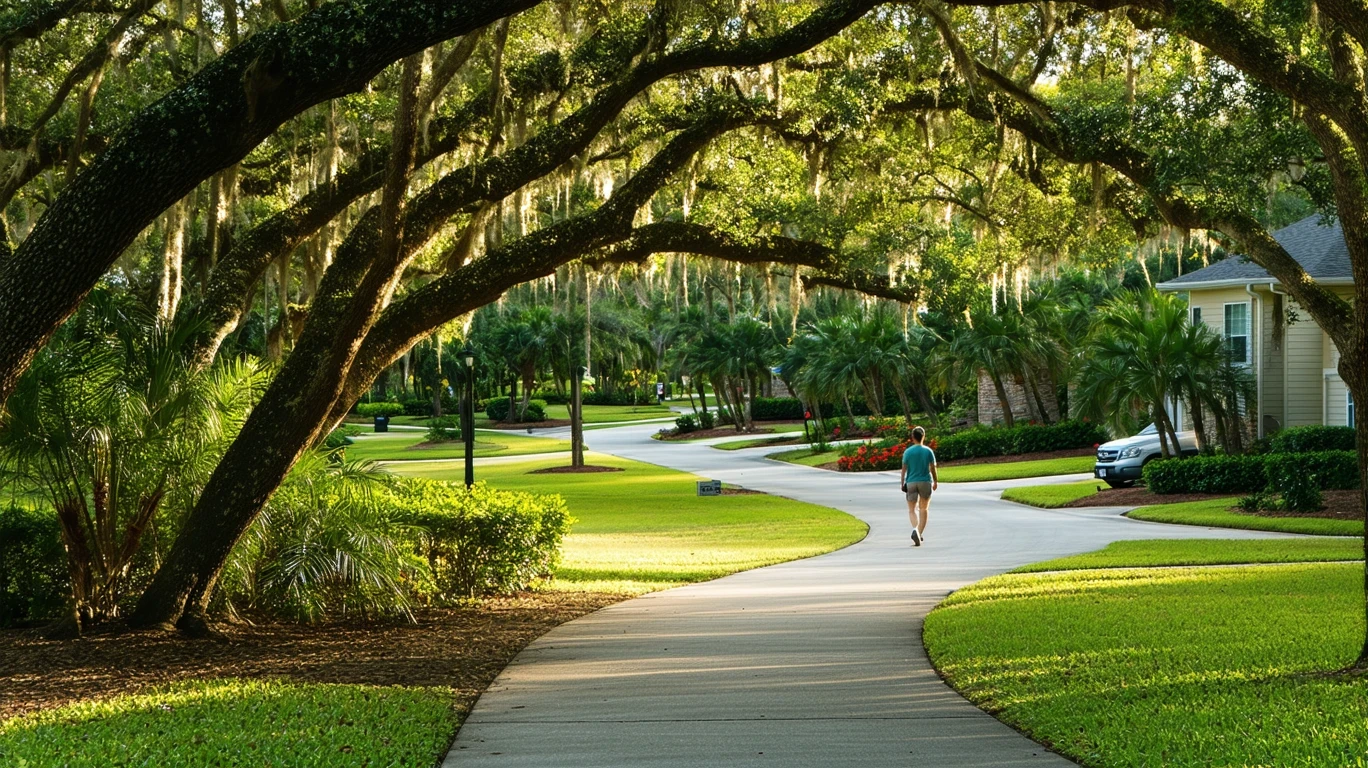
Davie’s housing market reflects its role as a college city with family-oriented infrastructure. The presence of Nova Southeastern University creates steady rental demand, but the city’s strong school and playground density—both meeting medium thresholds across the area—also attracts families looking for stability and outdoor access. Park density exceeds high thresholds, and water features are present throughout, which distinguishes Davie from purely commuter-oriented suburbs.
The mixed building character—average building levels fall in the medium band—means you’ll find both low-rise single-family neighborhoods and small apartment clusters. Residential and commercial land use are mixed, creating corridors where errands are walkable and quieter blocks where cars dominate. That variability matters because it determines whether your housing choice locks you into car dependency or gives you occasional relief from it.
Median household income in Davie is $84,346 per year, and the regional price parity index sits at 103—slightly above the national baseline. The unemployment rate is 3.2%, reflecting stable local employment. These conditions support a housing market where ownership is common but not automatic, and where rental pressure exists without reaching the extremes seen in Miami or Fort Lauderdale proper.
What newcomers often misunderstand is that Davie’s suburban texture doesn’t mean low costs—it means different costs. You’re not paying for density or transit access; you’re paying for space, green infrastructure, and proximity to family-oriented amenities. If those aren’t priorities, the market may feel overpriced relative to convenience.
Renting in Davie
At $1,805 per month median gross rent, Davie sits in the middle range for South Florida suburbs. That figure includes rent but may or may not include utilities, parking, or other fees depending on the property. In a city where grocery density exceeds high thresholds but food establishment density sits in the medium band, renters benefit from strong access to essentials along commercial corridors—but those corridors are typically car-dependent.
Bus service is present throughout Davie, but rail transit is not. That means renters without cars face meaningful friction running errands, commuting, or accessing healthcare beyond routine local clinics. The city’s walkable pockets—areas where the pedestrian-to-road ratio exceeds high thresholds—exist but don’t cover the entire city. Most rental properties sit in car-oriented zones where sidewalks are present but destinations are spread out.
Rental availability in Davie tends to cluster near the university and along major corridors. Families renting here often do so temporarily while saving for ownership, because the city’s strong school and playground infrastructure makes it more appealing as a long-term base than as a short-term landing spot. Renters who prioritize walkability or transit access may find their options limited to specific apartment complexes near mixed-use corridors, where rents often run higher than the median.
The extended cooling season in South Florida means renters face year-round air conditioning exposure. Electricity rates in Davie are 15.70¢/kWh, and most rental units bill tenants separately for utilities. That creates ongoing variability in monthly housing costs, especially in older buildings with less efficient HVAC systems. Renters should expect summer utility bills to add noticeable pressure on top of base rent.
Owning a Home in Davie
At $405,100 median home value, ownership in Davie requires a substantial down payment and stable income, but it’s accessible to middle- and upper-middle-class households, particularly dual-income families. Ownership here is less about locking in a monthly payment and more about controlling long-term exposure to Florida-specific risks: humidity-driven maintenance, storm preparation, insurance volatility, and landscape upkeep in a climate where vegetation grows year-round.
Davie’s housing stock includes single-family homes on larger lots, townhomes, and low-rise condos. The mixed building character means ownership options vary widely in structure and governance. Some neighborhoods have homeowners’ associations that bundle services like landscaping or community amenities; others leave all maintenance to individual owners. The presence or absence of an HOA changes both predictability and control, but specific prevalence data isn’t available.
Property taxes in Florida are governed by state law, but exact rates and assessment practices vary by jurisdiction. Owners in Davie should verify local millage rates and exemptions directly, as these determine the ongoing cost of ownership beyond the purchase price. What’s consistent across Florida is that property tax exposure is less volatile than insurance exposure, which has become a dominant concern for homeowners statewide.
Ownership in Davie also means taking on the cost of maintaining outdoor space in a subtropical climate. Irrigation, pest control, and humidity-related repairs (roof wear, mold prevention, HVAC strain) are routine, not exceptional. Homes with pools or extensive landscaping face higher ongoing costs. The integrated green space and water features that make Davie appealing also mean that outdoor maintenance is a year-round responsibility, not a seasonal one.
Apartment vs House in Davie — Cost Behavior Comparison
| Expense Category | Apartment | House |
|---|---|---|
| Cooling costs | Lower square footage and shared walls reduce load; older buildings may lack efficient systems | Higher square footage and standalone structure increase load; extended cooling season dominates annual utility exposure |
| Outdoor maintenance | Typically covered by landlord or HOA; tenant exposure limited to patio or balcony | Owner responsibility; subtropical climate requires year-round irrigation, pest control, and landscape management |
| Storm preparation | Minimal tenant responsibility; building management handles shutters, drainage, and structural prep | Full owner responsibility; includes shutter installation, generator backup, and post-storm repairs |
| Parking | May be included in rent or charged separately; availability varies by property and proximity to university | Typically included with property; driveway or garage standard in single-family homes |
| Access to green space | Depends on location; some complexes near parks, but private outdoor space limited | Private yards common; proximity to Davie’s integrated park network adds appeal for families |
Why these categories? The table reflects cost behaviors that differ meaningfully in Davie due to climate (extended cooling season, storm exposure), housing stock (mixed building character, suburban lot sizes), and infrastructure (integrated parks, car-oriented layout). Categories like base rent vs mortgage, insurance, or property taxes were excluded because they don’t vary by housing type in ways specific to Davie—they’re determined by market conditions, property value, and individual financial structure.
Utilities & Upkeep Differences
In Davie, the extended cooling season means air conditioning runs nearly year-round, not just in summer. Electricity rates at 15.70¢/kWh are consistent across housing types, but usage differs sharply. Apartments with shared walls and smaller square footage face lower cooling loads, though older buildings with single-pane windows or outdated HVAC systems can still see noticeable bills. Houses, especially those with vaulted ceilings, large windows, or poor insulation, face dominant cooling exposure that shapes monthly costs from April through October—and often beyond.
Natural gas is available in Davie at $32.82/MCF, but its use is limited. Most homes rely on electric water heaters and electric or heat pump systems rather than gas furnaces. That reduces fuel diversity but increases electricity dependency, which matters when cooling loads are already high.
Humidity drives maintenance differences between apartments and houses. In apartments, landlords or HOAs typically handle mold prevention, roof repairs, and exterior upkeep. In houses, owners manage these directly. Roof longevity is shorter in Florida than in drier climates, and HVAC systems work harder, wearing out faster. Houses with tile roofs, impact-resistant windows, or newer HVAC systems face lower ongoing costs, but those features are reflected in purchase price or rent.
Landscape maintenance is another dividing line. Apartment renters rarely manage irrigation or pest control; house owners do. In a climate where grass grows year-round and insects are persistent, that’s not a minor difference. Owners should expect regular spending on lawn care, pest control, and irrigation repairs, especially if the property includes mature trees or decorative landscaping.
Rent vs Buy: Long-Term Exposure in Davie
Renting in Davie offers flexibility and limits exposure to Florida-specific ownership risks—storm damage, insurance volatility, and humidity-driven maintenance. Renters avoid the upfront cost of a down payment and the long-term responsibility of managing a property in a subtropical climate. But renting also means ongoing exposure to rent increases, which tend to track regional demand rather than individual household stability. In a college town with steady enrollment and family appeal, rental demand remains consistent, which supports upward pressure over time.
Owning in Davie trades that flexibility for control and predictability—but only over certain costs. A fixed-rate mortgage locks in the base housing payment, but property taxes, insurance, maintenance, and utilities all remain variable. Insurance exposure has become particularly unpredictable in Florida, where carriers have exited the market or raised premiums sharply in response to storm risk. Owners also take on the cost of preparing for hurricanes, including shutters, generators, and post-storm repairs that insurance may not fully cover.
The decision between renting and buying in Davie depends on how much value you place on stability versus liquidity, and how much risk you’re willing to manage. Families who plan to stay long-term and prioritize access to Davie’s strong school infrastructure, integrated parks, and family-oriented amenities often find ownership worth the exposure. Households with shorter timelines, less savings, or lower tolerance for maintenance and storm prep may find renting a better fit, even at $1,805/month median rent.
What’s consistent across both options is that day-to-day costs—transportation, utilities, groceries—don’t change with tenure. Davie’s car-oriented layout and corridor-clustered errands mean you’ll likely need a car whether you rent or own. Cooling costs remain high in both cases, though houses face larger exposure. The choice between renting and owning shifts financial structure, not lifestyle cost.
FAQs About Housing Costs in Davie
Is $1,805/month rent typical for Davie, FL?
$1,805 per month is the median gross rent, meaning half of rental units cost more and half cost less. Rent varies by location, unit size, and proximity to the university or commercial corridors. Apartments near walkable areas or with newer construction often exceed the median.
What does a $405,100 home look like in Davie?
At the median home value of $405,100, buyers typically find single-family homes with three bedrooms, modest yards, and access to Davie’s park network and school infrastructure. Homes at this price point may be older and require updates, or newer with smaller lots. Location and condition vary widely within this range.
Do renters or owners pay more for cooling in Davie?
Owners of single-family homes typically face higher cooling costs due to larger square footage and standalone structure. Renters in apartments benefit from shared walls and smaller spaces, though older buildings with inefficient systems can still see noticeable bills. Both groups face year-round exposure due to Davie’s extended cooling season.
How does Davie’s housing market compare to nearby cities?
Davie sits between the density and cost of Fort Lauderdale and the sprawl of western suburbs like Weston or Pembroke Pines. It offers more green space and family infrastructure than urban cores, but less transit access and walkability than denser areas. Home values and rents reflect that middle position.
Is buying in Davie worth it if I’m not sure I’ll stay long-term?
Ownership in Davie makes the most sense for households planning to stay at least several years, because upfront costs (down payment, closing costs) and ongoing exposure (insurance, maintenance, storm prep) take time to justify. Renters with shorter timelines or uncertain plans face less risk and retain more flexibility, even at median rent levels.
Making Housing Choices in Davie
Housing costs in Davie reflect the city’s role as a suburban college town with strong family infrastructure, integrated green space, and a car-oriented layout punctuated by walkable pockets. Median rent at $1,805/month and median home values at $405,100 position Davie as accessible to middle- and upper-middle-class households, but neither option eliminates exposure to Florida-specific risks—extended cooling seasons, humidity-driven maintenance, and storm preparation.
Renters gain flexibility and avoid ownership risks, but face ongoing rent pressure and limited relief from car dependency. Owners gain control and stability, but take on long-term exposure to insurance volatility, property upkeep, and climate-related costs that don’t exist in drier or cooler regions. The choice depends on how long you plan to stay, how much savings you have, and how much risk you’re willing to manage.
What doesn’t change is the underlying cost structure. Davie’s corridor-clustered grocery access, bus-only transit, and routine local healthcare mean most households depend on cars, face year-round cooling costs, and manage logistics across a spread-out suburban grid. Those realities shape the cost of living here regardless of whether you rent or own.
For more on how housing fits into overall monthly expenses, see A Month of Expenses in Davie: What It Feels Like. If you’re planning a move and evaluating logistics, compare moving company costs and options to understand what relocation itself will cost.
How this article was built: In addition to public economic data, this article incorporates location-based experiential signals derived from anonymized geographic patterns—such as access density, walkability, and land-use mix—to reflect how day-to-day living actually feels in Davie, FL.