
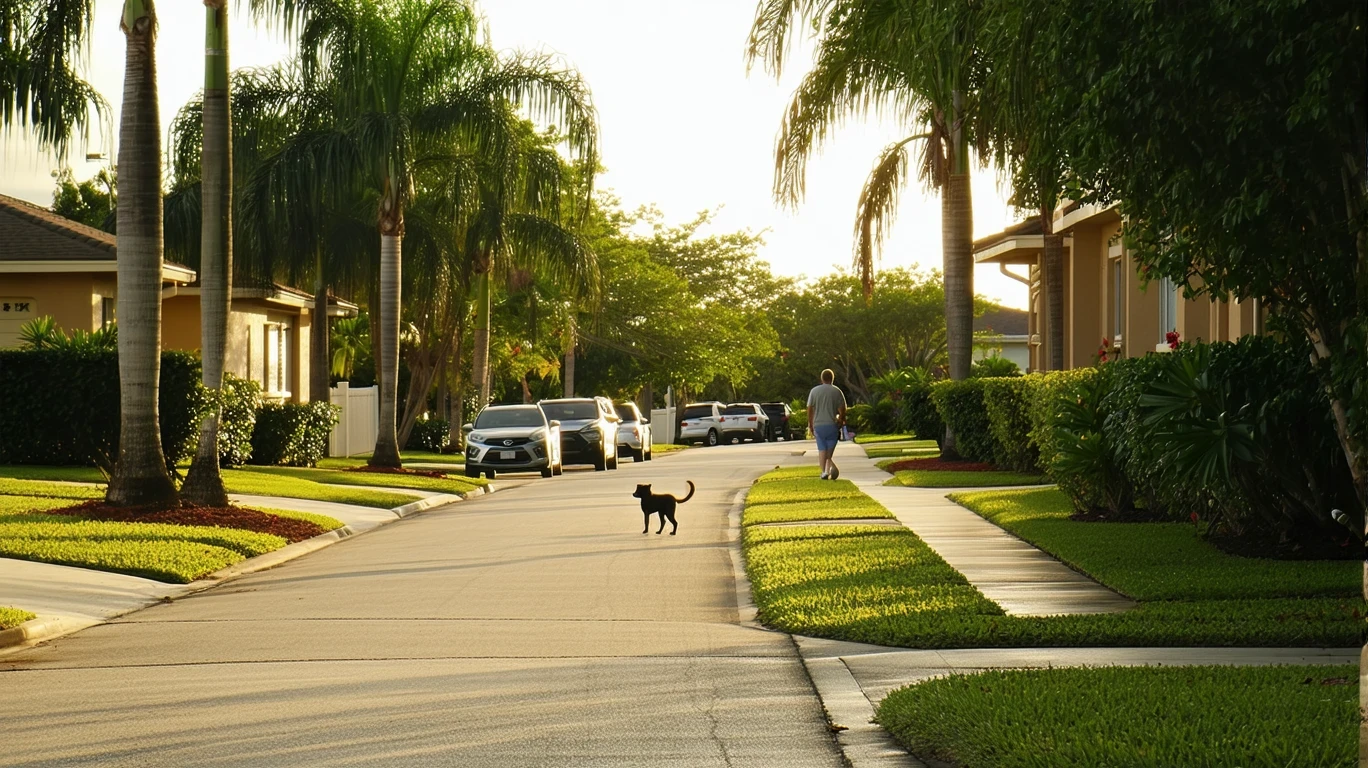
The Housing Market in Hialeah Today
Hialeah’s housing market operates under tension between its position in the Miami metro and the income realities of its residents. With a median home value of $324,300 and median household income of $49,531 per year, the gap between ownership costs and earning power shapes nearly every housing decision here. This isn’t a bedroom community with easy commuter access to higher-paying jobs elsewhere—it’s a dense, established city where most residents work locally or face the Miami metro’s notorious commute patterns.
What surprises newcomers is how much where money goes depends on where you live within Hialeah itself. The city’s urban form includes both low-rise single-family neighborhoods and more vertical apartment corridors, often within blocks of each other. Rail transit access exists but doesn’t blanket the city, and grocery and service availability clusters along specific corridors rather than spreading evenly. That means two households paying similar base housing costs can experience very different day-to-day expenses depending on whether they need a car for every errand or can walk to a bus stop.
The market also reflects South Florida’s broader exposure to insurance volatility, hurricane preparedness costs, and year-round cooling demands. Buyers here aren’t just purchasing shelter—they’re taking on a maintenance and utility profile that doesn’t ease seasonally the way it does in temperate climates.
Renting in Hialeah
Median gross rent in Hialeah sits at $1,458 per month, a figure that includes rent plus tenant-paid utilities in most cases. For households earning near the city’s median income, that represents significant monthly pressure, but it comes with a level of cost predictability that ownership often doesn’t provide here.
Rental housing in Hialeah spans single-family homes, duplexes, and apartment buildings, with the apartment stock concentrated in areas where the city’s building profile rises above the low-rise norm. Renters near rail stations or along commercial corridors gain access to transit and walkable errands, reducing the need to budget for a second vehicle or daily driving costs. Those in quieter residential blocks may face lower base rent but higher transportation and time costs, especially if work or school sits across the metro.
Lease renewals in South Florida markets tend to reflect landlord costs that shift year to year—insurance, taxes, and maintenance all move with climate events and regional market conditions. Renters here should expect rent to behave less like a fixed expense and more like a cost that adjusts to external pressures, even if the lease itself offers short-term stability.
Owning a Home in Hialeah
At $324,300, Hialeah’s median home value positions ownership as a long-term commitment that requires both upfront resources and ongoing cost management. Property taxes, homeowners insurance, and hurricane-related coverage combine to create a recurring expense layer that doesn’t appear on the purchase price but defines the affordability experience once you close.
Homeownership here also means taking on maintenance exposure shaped by heat, humidity, and storm season. Roofs, HVAC systems, and exterior surfaces degrade faster in tropical climates than in temperate zones. Older housing stock—common in Hialeah—often requires more frequent intervention, and deferred maintenance compounds quickly when systems fail during peak cooling months.
Some neighborhoods operate under homeowners associations, which add monthly or annual fees in exchange for shared amenities or exterior upkeep. Even outside formal HOAs, many single-family areas maintain strong aesthetic norms, and code enforcement can make exterior neglect costly in ways that renters never encounter.
What ownership provides in Hialeah is control and protection from rent increases, but it trades that predictability for exposure to costs that shift with climate events, insurance markets, and regional economic conditions. Buyers who succeed here typically enter with reserves and a realistic view of how much margin they’ll need when systems fail or policies reprice.
Apartment vs House in Hialeah — Cost Behavior Comparison
| Expense Category | Apartment | House |
|---|---|---|
| Cooling Costs | Lower total usage due to smaller square footage and shared walls; often included in rent or separately metered | Year-round exposure with no seasonal relief; larger spaces and standalone structure increase load; owner bears full system replacement cost |
| Storm Prep & Recovery | Landlord or association handles exterior protection, debris removal, and structural repairs | Owner responsible for shutters, generator access, roof integrity, and yard cleanup; costs spike in active hurricane seasons |
| Insurance | Renters insurance covers personal property only; low annual cost | Homeowners and windstorm policies required; costs vary significantly by elevation, age, and proximity to flood zones |
| Exterior Maintenance | No responsibility for roof, siding, landscaping, or structural repairs | Tropical climate accelerates wear on roofs, paint, and outdoor surfaces; humidity promotes mold and pest pressure |
| Governance & Fees | May include HOA or building fees bundled into rent; tenant not directly exposed to special assessments | HOA fees common in planned communities; special assessments possible for shared infrastructure or storm damage |
| Transportation Interaction | Apartments near rail or commercial corridors reduce need for second vehicle; parking may be limited or assigned | Single-family areas typically require car ownership for errands and commuting; driveway parking standard |
Why these categories: The table reflects distinctions that behave differently in Hialeah due to tropical climate, hurricane exposure, mixed urban form, and the interaction between housing type and transportation access. Categories like basic utilities or trash service were omitted because they don’t vary meaningfully by housing type in this market. The differences shown are structural, not preferential—they explain how costs are triggered and who controls them, not which option costs less overall.
Utilities & Upkeep Differences
Electricity dominates the utility picture in Hialeah regardless of housing type, but the intensity and control differ sharply. At 15.78¢/kWh, the rate itself sits slightly above national averages, but the real cost driver is duration—cooling runs year-round, and summer months bring sustained heat that keeps systems under load for weeks at a time. Apartments benefit from smaller conditioned space and shared-wall insulation, which reduces total consumption even if tenants lack control over system efficiency. Houses, especially older single-family stock, expose owners to both higher usage and the full cost of system failure when aging HVAC units give out mid-summer.
Natural gas, priced at $25.39/MCF, plays almost no role in most Hialeah households. Heating demand is rare, and most cooking and water heating runs on electric. That simplifies the utility structure but removes the seasonal cost relief that northern climates experience when cooling season ends.
Upkeep in Hialeah is shaped by heat, humidity, and storm exposure. Exterior paint fades and peels faster. Roof shingles degrade under constant sun and occasional hurricane-force wind. Mold and mildew pressure is constant, particularly in older homes with limited ventilation. Renters are insulated from these costs entirely—landlords or property managers handle it as part of maintaining the asset. Homeowners, by contrast, face a maintenance cadence that doesn’t pause and costs that can’t be deferred without compounding risk.
How this article was built: In addition to public economic data, this article incorporates location-based experiential signals derived from anonymized geographic patterns—such as access density, walkability, and land-use mix—to reflect how day-to-day living actually feels in Hialeah, FL.
Rent vs Buy: Long-Term Exposure in Hialeah
The rent-versus-buy decision in Hialeah isn’t primarily about building equity or tax benefits—it’s about which cost structure aligns with your tolerance for volatility and your ability to absorb sudden expenses.
Renting offers short-term cost predictability within the lease term, but exposes tenants to rent increases at renewal that reflect broader market and insurance trends. Renters avoid property tax shifts, special assessments, and the cost of replacing major systems, but they also lack control over housing stability and cannot modify the property to improve efficiency or comfort.
Owning locks in the acquisition cost and provides control, but it transfers all structural risk to the buyer. Property taxes adjust with assessed value and millage rates. Insurance premiums move with hurricane activity and carrier availability. Roofs, HVAC systems, and water heaters fail on schedules that don’t align with household cash flow. In Hialeah’s climate, these aren’t rare events—they’re predictable categories of exposure that owners must budget for continuously.
What makes the decision harder here is that neither path eliminates cost uncertainty. Renters face lease renewal risk in a market where landlords reprice to cover their own volatility. Owners face systems and coverage that reprice regardless of whether the household’s income grows. The question isn’t which option is cheaper—it’s which risks you’d rather manage and whether you have the reserves to handle the costs that come with ownership in a hurricane-exposed, high-humidity market.
FAQs About Housing Costs in Hialeah
How does Hialeah’s median home value compare to what households here can afford?
At $324,300, the median home value significantly exceeds what standard affordability guidelines would suggest for a household earning $49,531 per year. This gap means many buyers either stretch their budgets, rely on multi-generational income, or remain renters longer than they might in markets where income and home values align more closely.
Does renting or owning make more sense in Hialeah’s climate?
Climate doesn’t favor one option—it changes the cost profile of both. Renters avoid hurricane prep and HVAC replacement costs, but they can’t control efficiency upgrades or lock in housing costs long-term. Owners gain control and stability but take on maintenance and insurance exposure that intensifies in South Florida’s tropical environment.
How much does location within Hialeah affect housing costs?
Location drives more than base rent or purchase price—it determines transportation needs, errand accessibility, and time costs. Households near rail stations or commercial corridors can reduce car dependency, which lowers fuel, insurance, and maintenance expenses. Those in quieter residential areas may pay less for housing but more for mobility, especially if work or services require crossing the metro.
What makes homeownership in Hialeah more volatile than in other markets?
Hurricane exposure, year-round cooling demand, and Florida’s insurance market all contribute. Costs that remain stable in temperate or inland markets—roofing, exterior maintenance, windstorm coverage—shift frequently here. Owners must budget not just for predictable expenses but for the possibility that systems, policies, or tax assessments will reprice with little warning.
Are apartments in Hialeah a good long-term housing option?
Apartments work well for households that value lower maintenance exposure, proximity to transit, and flexibility. Hialeah’s more vertical building stock concentrates near commercial and transit corridors, which reduces car dependency and increases walkable access to errands. For households that don’t need yard space or single-family privacy, apartments often provide a better match between cost and lifestyle than stretching to buy a house.
Making Housing Choices in Hialeah
Housing decisions in Hialeah require looking past the purchase price or monthly rent and understanding the full cost structure that follows. Ownership here isn’t just about qualifying for a mortgage—it’s about sustaining the ongoing expenses that come with tropical climate exposure, insurance volatility, and systems that wear faster than they do in temperate zones. Renting trades equity for insulation from those risks, but it doesn’t eliminate cost uncertainty—it just shifts the source from systems and taxes to lease renewals and landlord repricing.
Where you live within the city matters as much as whether you rent or own. Proximity to rail transit, walkable errands, and commercial corridors reduces the transportation and time costs that can quietly dominate a budget. Households that prioritize access over space often find apartments near these corridors offer better overall cost control than single-family homes in car-dependent blocks.
The housing market here rewards households that enter with clarity about their risk tolerance, reserves to handle volatility, and realistic expectations about how costs behave over time. Whether you rent or buy, the goal is to match your housing choice to the cost structure you’re prepared to manage—not the one you hope will stay stable.