
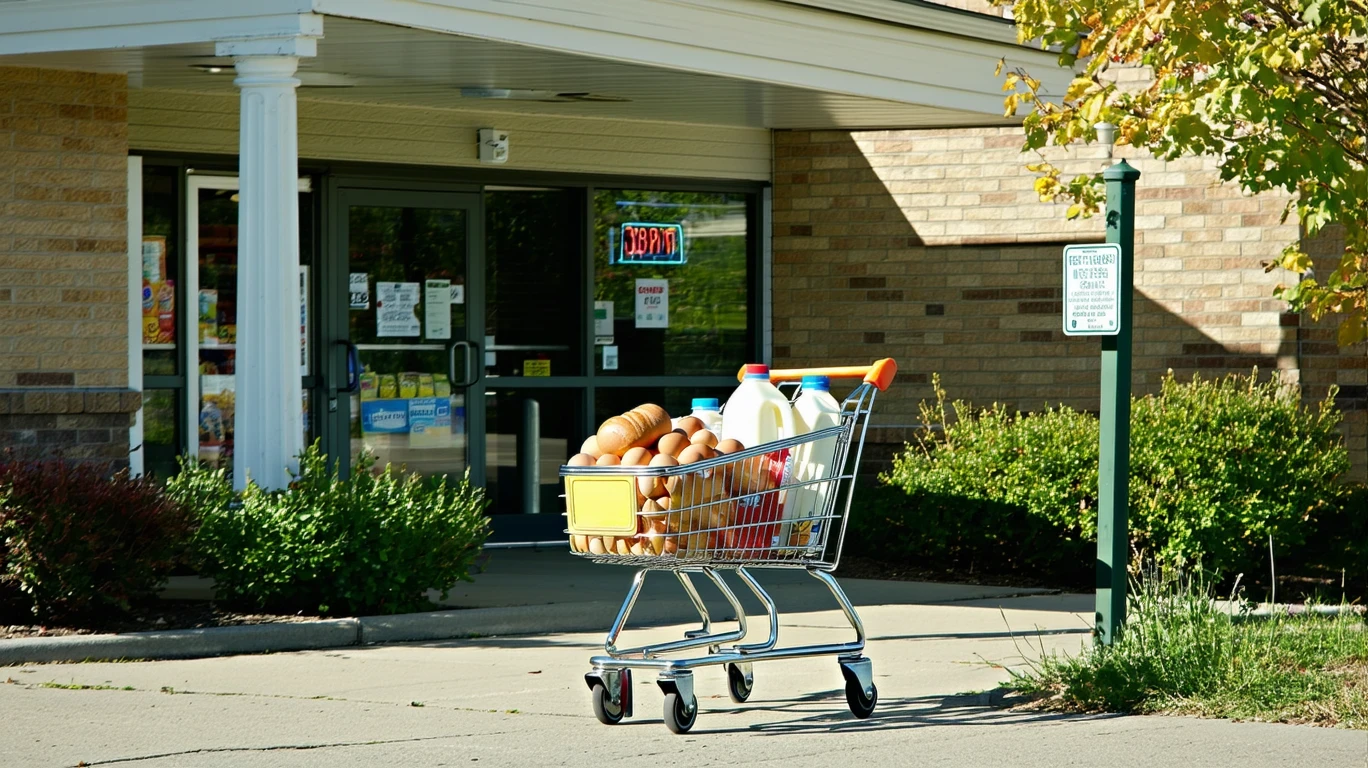
How Grocery Costs Feel in Blaine
Planning meals for the week in Blaine means navigating a food cost landscape that sits just below the national baseline but still demands attention depending on household size and income. With a regional price parity index of 98—slightly under the national average—grocery prices here don’t carry the premium seen in coastal metros, but they’re not bargain-bin territory either. For a single person buying staples and building meals around sales, the pressure is manageable but noticeable. For families with multiple mouths to feed, especially those juggling school lunches, snacks, and dinner prep for four or five people, grocery spending becomes one of the most visible and recurring cost categories in the household budget.
What makes grocery costs feel tighter or looser in Blaine isn’t just the price on the shelf—it’s how those prices interact with income and household composition. With median household income at $100,659 per year, many families here have room to absorb food costs without constant stress, but that doesn’t mean grocery spending is invisible. Singles and younger households earning below the median often find that food takes up a larger share of their budget than they’d like, especially when convenience and time constraints push them toward prepared foods or mid-tier stores. Families, meanwhile, feel the volume effect: even modest per-item prices add up quickly when you’re buying in bulk or restocking staples every week.
The structure of grocery access in Blaine also shapes how people experience food costs. Food and grocery establishments here tend to cluster along commercial corridors rather than being evenly distributed across neighborhoods. That pattern—evident in the city’s infrastructure—means that running errands often involves a deliberate trip rather than a quick stop on the way home. For households that plan carefully and consolidate shopping into one or two weekly trips, this isn’t a major friction point. But for those who shop more frequently, need last-minute items, or lack flexibility in their schedule, the corridor-clustered layout can add time and fuel costs to the grocery equation, making the total cost of feeding a household feel higher than the sticker prices alone would suggest.
Grocery Price Signals (Illustrative)
These prices illustrate how staple items tend to compare locally—not a full shopping list. They’re derived estimates based on national baseline data adjusted by regional price parity, and they reflect typical pricing patterns rather than store-specific or week-specific snapshots. Use them as anchors for understanding relative cost positioning in Blaine, not as guarantees of what you’ll see at checkout.
| Item | Typical Price |
|---|---|
| Bread (per pound) | $1.75 |
| Milk (half-gallon) | $3.92 |
| Eggs (dozen) | $2.80 |
| Chicken (per pound) | $2.00 |
| Ground beef (per pound) | $6.41 |
| Cheese (per pound) | $4.63 |
| Rice (per pound) | $1.04 |
Derived estimate based on national baseline adjusted by regional price parity; not an observed local price.
What stands out here is the range of sensitivity across categories. Staples like rice, bread, and chicken sit at price points that allow for volume buying and meal stretching without major budget strain. Ground beef and cheese, on the other hand, represent higher-cost proteins and ingredients where brand choice, sales timing, and store tier make a meaningful difference. Eggs and milk occupy a middle zone—affordable in absolute terms but subject to seasonal and supply-driven volatility that can surprise households who don’t track prices closely. For families building weekly meal plans around these items, the difference between shopping strategically and shopping reactively can add up to noticeable pressure over the course of a month.
Store Choice and Price Sensitivity
Grocery price pressure in Blaine varies significantly by store tier, and understanding that variation is more useful than focusing on a single “average” experience. At the discount tier—warehouse clubs, no-frills grocers, and value chains—prices on staples, bulk items, and private-label goods run meaningfully lower than mid-tier or premium options. Households willing to buy in larger quantities, plan around what’s available rather than what’s on a specific list, and tolerate less variety or ambiance can reduce their per-item costs substantially. For families with storage space, reliable transportation, and the time to consolidate trips, discount stores offer the most direct path to lowering grocery spending without sacrificing volume or nutrition.
Mid-tier stores—regional chains and national supermarkets with loyalty programs, moderate selection, and consistent stock—represent the default shopping experience for many Blaine households. Prices here sit above discount levels but below premium, and the tradeoff is convenience, familiarity, and a balance between variety and value. These stores tend to cluster along the commercial corridors that define grocery access in Blaine, making them the most accessible option for households that prioritize proximity and predictability over absolute lowest cost. For moderate-income families, mid-tier stores become the baseline against which other options are measured: discount stores feel like effort and planning, premium stores feel like indulgence, and mid-tier stores feel like the path of least resistance.
Premium stores—specialty grocers, organic-focused chains, and upscale markets—cater to households where food quality, sourcing, and variety outweigh price sensitivity. Prices here can run 20 to 40 percent higher than mid-tier equivalents, and the gap widens further on organic, prepared, or specialty items. For high-income households in Blaine, premium stores represent convenience and preference rather than financial strain. But for moderate-income families, even occasional premium shopping can create noticeable budget pressure, especially when it becomes habitual rather than intentional. The key insight is that store tier isn’t just about price—it’s about how much friction, planning, and tradeoff tolerance a household is willing to accept in exchange for lower costs.
What Drives Grocery Pressure Here
Income is the most powerful mediator of grocery cost pressure in Blaine. At the median household income of $100,659 per year, food spending—even at mid-tier stores—rarely forces difficult tradeoffs or month-end anxiety. Households earning above the median often treat grocery costs as a background expense, focusing more on convenience and quality than on price optimization. But for households earning below the median—singles, younger families, or those with one income—grocery spending becomes a category that demands active management. The same per-item prices that feel invisible to a high-income household can feel like a meaningful constraint to a household earning $50,000 or $60,000, especially when combined with rent, childcare, and transportation costs.
Household size amplifies grocery pressure in ways that income alone doesn’t capture. A single person or couple can absorb price increases, shop flexibly, and adjust meal plans without major disruption. A family of four or five, on the other hand, faces relentless volume pressure: every price increase gets multiplied across dozens of items every week, and there’s less room to substitute or skip purchases without affecting meal quality or household satisfaction. Families also face less flexibility in timing—school schedules, work hours, and activity logistics often compress shopping into narrow windows, reducing the ability to chase sales or visit multiple stores. The result is that grocery costs feel more rigid and less controllable for larger households, even when income is solid.
The corridor-clustered layout of food and grocery establishments in Blaine introduces a subtle but real friction into grocery shopping. Because stores concentrate along commercial corridors rather than being evenly distributed, most households need to make a deliberate trip rather than stopping on the way home from work or school. For households with reliable transportation, flexible schedules, and the ability to plan weekly shopping in advance, this layout works fine. But for those who shop more frequently, lack a car, or need to make last-minute runs for forgotten items, the clustered pattern adds time, fuel, and inconvenience to the cost of feeding a household. It’s not a dealbreaker, but it’s a structural feature that makes grocery shopping feel less spontaneous and more like a planned errand—and that affects how people think about store choice, bulk buying, and meal planning.
Practical Ways People Manage Grocery Costs
The most effective lever for controlling grocery costs in Blaine is store tier choice combined with volume planning. Households that shift even a portion of their shopping to discount or warehouse stores—especially for staples like rice, pasta, canned goods, dairy, and frozen proteins—can reduce their per-item costs without sacrificing nutrition or variety. The tradeoff is upfront planning: buying in bulk requires storage space, transportation capacity, and the discipline to use what you buy before it spoils. But for families with those resources, the payoff is meaningful and recurring. Even splitting shopping between a discount store for staples and a mid-tier store for fresh produce and specialty items can lower overall food spending while preserving convenience and flexibility.
Meal planning and list discipline are behavioral strategies that reduce waste and impulse spending without requiring access to cheaper stores. Households that plan meals for the week, build shopping lists around what they already have, and resist the temptation to buy items that aren’t on the list tend to spend less and throw away less. This approach works especially well in Blaine’s corridor-clustered grocery environment, where trips are less frequent and more deliberate. The key is treating grocery shopping as a planned event rather than a reactive errand—buying what you need for the week rather than what looks appealing in the moment. For families juggling tight schedules, this kind of planning also reduces the likelihood of expensive last-minute takeout or convenience purchases when dinner plans fall apart.
Seasonal awareness and sales timing offer additional control for households willing to track prices and adjust purchasing around what’s cheapest. Proteins, produce, and dairy all experience predictable price swings based on supply cycles, holidays, and regional availability. Households that buy chicken when it’s on sale and freeze it, stock up on canned goods during promotional periods, and shift meal plans toward what’s in season can smooth out cost volatility and avoid paying peak prices. This strategy doesn’t require extreme couponing or obsessive deal-hunting—just a baseline awareness of what’s expensive this week and what’s not, and the flexibility to adjust meals accordingly. For moderate-income families in Blaine, this kind of tactical shopping can make the difference between grocery costs feeling predictable and feeling like a source of recurring stress.
Groceries vs Eating Out (Directional)
The tradeoff between cooking at home and eating out in Blaine isn’t just about price—it’s about time, energy, and household logistics. Cooking at home almost always costs less per meal than restaurant dining or takeout, but the gap varies depending on what you cook, where you shop, and how much food waste you generate. A home-cooked dinner built around chicken, rice, and vegetables might cost $3 to $5 per person when ingredients are bought strategically; the same meal at a casual restaurant runs $12 to $18 per person before tip. For families, that difference compounds quickly, making home cooking the default choice for budget-conscious households.
But eating out isn’t purely a cost decision—it’s also a time and convenience decision. For dual-income households, families with long commutes, or anyone juggling multiple schedules, the time required to plan, shop, cook, and clean up can feel like a cost of its own. In those cases, occasional takeout or restaurant meals become a relief valve rather than a luxury, and the financial tradeoff feels worth it. The key is recognizing when eating out is a deliberate choice and when it’s a symptom of poor planning or exhausted routines. Households that cook most nights and treat dining out as an intentional exception tend to feel more in control of their food spending than those who drift into frequent takeout because they didn’t plan ahead.
FAQs About Grocery Costs in Blaine (2026)
Is it cheaper to shop in bulk in Blaine? For households with storage space and transportation, bulk buying at warehouse clubs or discount stores lowers per-item costs on staples like rice, pasta, canned goods, and frozen proteins. The tradeoff is upfront planning and the discipline to use what you buy before it spoils.
Which stores in Blaine are best for low prices? Discount-tier stores—warehouse clubs and value chains—offer the lowest per-item prices, especially on private-label and bulk goods. Mid-tier supermarkets balance convenience and cost, while premium stores cater to households prioritizing quality and variety over price.
How much more do organic items cost in Blaine? Organic and specialty items typically run 20 to 40 percent higher than conventional equivalents, with the gap widening at premium stores. For households on tight budgets, selectively choosing organic for high-priority items—rather than across the board—helps manage costs without abandoning quality preferences.
How do grocery costs for households in Blaine tend to compare to nearby cities? Blaine’s regional price parity sits slightly below the national baseline, meaning grocery prices here run modestly lower than in higher-cost metros but aren’t dramatically cheaper than other Twin Cities suburbs. Store tier choice and shopping habits matter more than location alone.
How do households in Blaine think about grocery spending when cooking at home? Most households treat grocery spending as a recurring, manageable expense that responds to planning and store choice. Families focus on volume control and waste reduction, while singles and couples prioritize flexibility and convenience. Income level determines whether grocery costs feel like background noise or a category requiring active management.
How Groceries Fit Into the Cost of Living in Blaine
Grocery costs in Blaine occupy a middle tier in the household budget hierarchy—less dominant than housing or utilities, but more visible and controllable than insurance or taxes. For most households, food spending represents a recurring expense that responds directly to behavior: store choice, meal planning, and waste management all offer meaningful levers for reducing costs without sacrificing nutrition or satisfaction. That makes groceries one of the few major cost categories where households feel a sense of agency and control, even when other expenses—like rent or property taxes—feel fixed and immovable.
But grocery costs don’t exist in isolation. They interact with transportation costs (driving to clustered stores), time constraints (which drive convenience purchases), and income levels (which determine how much planning effort feels worth it). For families trying to understand your monthly budget in Blaine: where it breaks, groceries are best understood as part of a larger system of household logistics and financial tradeoffs. The goal isn’t to minimize food spending at all costs—it’s to find the balance between cost, convenience, and quality that fits your household’s income, schedule, and priorities.
For households moving to Blaine or trying to get a handle on where their money goes, the most useful starting point is tracking actual grocery spending for a month or two and comparing it to income and other fixed costs. That baseline reveals whether food costs are absorbing a reasonable share of the budget or crowding out other priorities. From there, the levers are clear: shift some volume to discount stores, plan meals around sales and staples, reduce waste, and treat eating out as an intentional choice rather than a default. Grocery costs in Blaine are manageable for most households, but they reward planning and discipline—and they punish reactive, convenience-driven shopping more than many people expect.
How this article was built: In addition to public economic data, this article incorporates location-based experiential signals derived from anonymized geographic patterns—such as access density, walkability, and land-use mix—to reflect how day-to-day living actually feels in Blaine, MN.