
| Expense Category | Apartment | House |
|---|---|---|
| Base Housing Cost | $1,356 median rent (includes structure maintenance) | Mortgage on $260,400 median value (plus property taxes, insurance) |
| Cooling Exposure | Shared walls reduce load; landlord may control system efficiency | Full envelope exposure; owner controls efficiency investment and thermostat strategy |
| Exterior Maintenance | Landlord responsibility | Owner handles roof, siding, yard, driveway—suburban lots increase scope |
| Commute Friction | More likely located near corridor-clustered errands; may reduce daily driving | Typically farther from commercial corridors; increases fuel and time cost for households making frequent trips |
| Governance & Fees | Lease terms fixed for term; no HOA exposure | Property tax adjustments and potential HOA dues (prevalence varies by neighborhood) |
Why these categories? Clayton’s housing cost differences are shaped by its role as a commuter suburb with mixed infrastructure. Apartments cluster near commercial corridors, reducing errand-related driving. Houses, often on larger suburban lots, increase maintenance scope and daily travel distance. Cooling dominates utility exposure due to North Carolina’s extended warm season, and the difference in building envelope size matters. Categories like water and trash were excluded because they don’t vary meaningfully by housing type in this market.
The Housing Market in Clayton Today
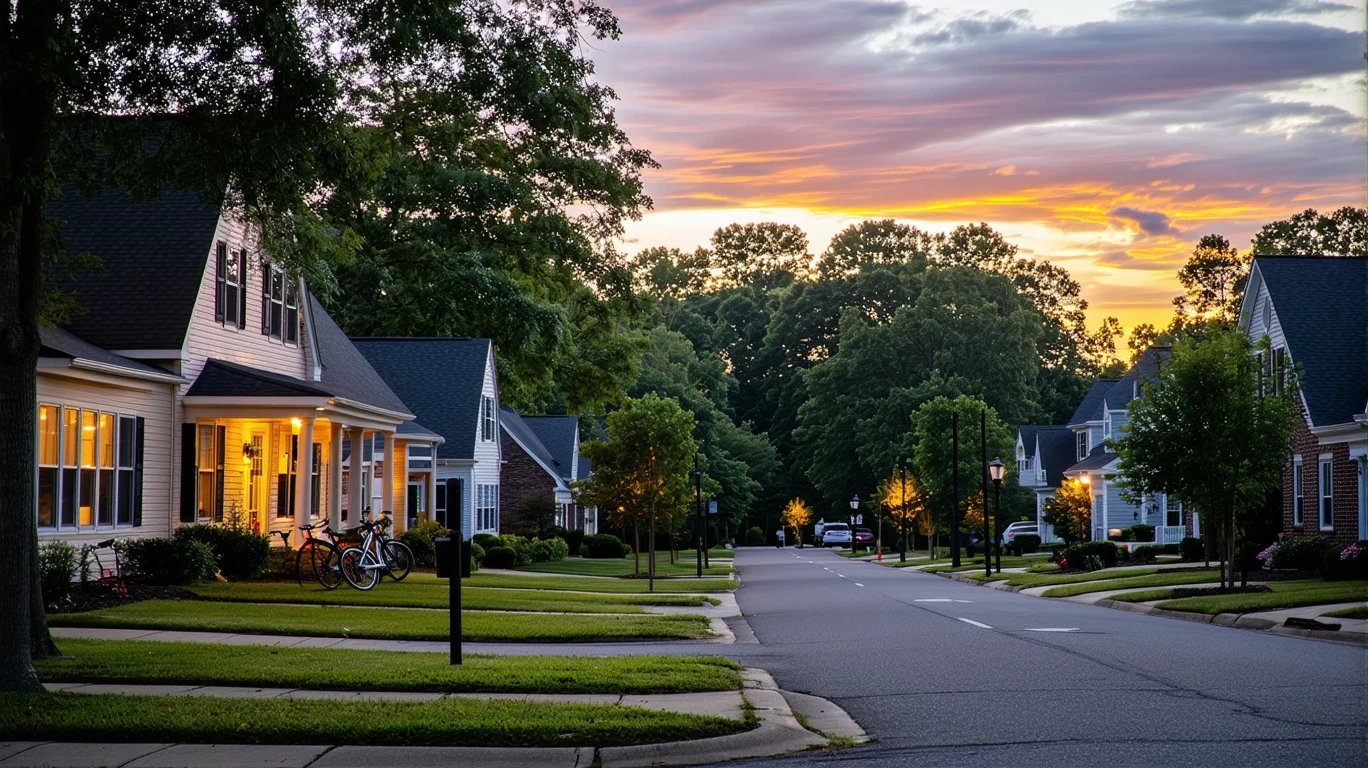
Clayton sits at the edge of the Raleigh metro area, functioning primarily as a commuter suburb for households seeking more affordable ownership than the urban core offers. The median home value of $260,400 reflects this positioning—lower than Raleigh proper, but rising as the town grows. What newcomers often misunderstand is that Clayton’s housing market isn’t uniform. The town has pockets of walkable, mixed-use development alongside traditional suburban subdivisions, and the daily cost experience differs sharply depending on which type of neighborhood you choose.
The rental market, with a median gross rent of $1,356 per month, serves a smaller share of the population than ownership does. Rentals tend to concentrate near commercial corridors, where access to grocery stores and services reduces the need for constant driving. Ownership, by contrast, often means a single-family home on a larger lot farther from daily destinations, which changes both the maintenance burden and the transportation cost profile. The town’s infrastructure is in transition—bike lanes and pedestrian paths exist in some areas, but public transit remains minimal, and most errands still require a car unless you’re in one of the denser pockets.
Renting in Clayton
Renting in Clayton offers flexibility and lower upfront cost, but the rental stock is limited compared to ownership inventory. Most rental options are apartments or townhomes located along the town’s commercial corridors, where food and grocery access is more concentrated. This placement reduces daily driving for renters who work locally or remotely, but it also means less choice in neighborhood character. If you’re commuting to Raleigh or Research Triangle Park, rental locations may not align well with your route, adding time and fuel cost despite the lower base rent.
At $1,356 per month, median rent in Clayton is below what you’d pay in Raleigh’s urban core, but it’s not cheap relative to the town’s median household income of $71,698 per year. Renters avoid property tax exposure and exterior maintenance costs, but they also lack control over efficiency upgrades, thermostat access, and lease renewal terms. In a growing suburb, lease renewals can shift quickly as demand increases, and renters have no mechanism to lock in long-term cost predictability the way ownership does.
For car-free households, renting in Clayton is difficult. Despite the presence of bike infrastructure in some areas, the town’s errands and services are corridor-clustered rather than broadly accessible, and public transit options are extremely limited. If you don’t own a car, you’ll need to choose your rental location carefully, prioritizing proximity to a grocery store and employer, and even then, you’ll face friction that car-owning renters don’t experience.
Owning a Home in Clayton
Ownership in Clayton is the dominant housing model, and the median home value of $260,400 reflects the town’s appeal to households priced out of closer-in Raleigh neighborhoods. Buyers typically get more square footage and land than they would in the urban core, but they also take on the full cost structure of suburban homeownership: property taxes, insurance, exterior maintenance, and the transportation expenses that come with living farther from daily destinations.
Property taxes in North Carolina are assessed locally, and while the specific rate isn’t provided here, owners should expect annual adjustments based on assessed value changes. Unlike rent, which resets at lease renewal, property taxes shift gradually but persistently, and owners have no ability to negotiate or exit without selling. Insurance costs are shaped by the home’s age, construction type, and proximity to water features, and they too adjust over time. Maintenance is the wildcard—roofs, HVAC systems, driveways, and landscaping all require periodic investment, and suburban lots increase the scope of exterior upkeep compared to attached housing.
Ownership also means control. You decide when to replace an inefficient air conditioner, whether to invest in insulation, and how aggressively to cool your home during Clayton’s long, hot summers. These decisions directly affect your utility bills, and over time, they compound. Renters live with the efficiency level their landlord provides; owners build equity in their comfort infrastructure, but they also absorb the cost of deferred decisions.
For families, ownership in Clayton comes with a logistics consideration that’s easy to overlook. School density in the town is below typical suburban thresholds, meaning the distance between home and school may be greater than expected, and walkability to schools is limited. This increases the daily driving burden for parents and makes car dependency even more pronounced than it would be in a denser suburb.
Utilities & Upkeep Differences
Utility exposure in Clayton is dominated by cooling. The town experiences hot, humid summers with extended periods of heat that push air conditioning systems hard. At 14.64¢ per kWh, electricity rates are moderate, but the intensity and duration of cooling season means that total usage—and therefore total cost—can climb quickly. Houses, with larger square footage and full envelope exposure, face higher cooling costs than apartments, where shared walls and smaller footprints reduce the load. Owners control thermostat settings and can invest in efficiency upgrades, but they also absorb the full cost of running the system. Renters may face less absolute cost, but they have no control over the efficiency of the equipment or the insulation quality of the building.
Heating costs are lower in Clayton due to mild winters, but natural gas service at $20.48 per MCF is available for homes that use it. Most heating exposure comes during short cold snaps rather than extended freezing periods, so the seasonal cost swing is less severe than in northern climates. Still, houses with older HVAC systems or poor insulation will see noticeable spikes during winter months, while apartments benefit from ambient heat transfer between units.
Maintenance costs are where ownership diverges sharply from renting. Suburban homes in Clayton often sit on larger lots, which means more landscaping, longer driveways, and greater exterior surface area to maintain. Roofs, siding, and gutters all degrade faster in humid climates, and the cost of replacing or repairing these systems falls entirely on the owner. Apartments push all of this responsibility to the landlord, which simplifies budgeting but also removes any control over timing or quality of repairs.
Rent vs Buy: Long-Term Exposure in Clayton
The choice between renting and buying in Clayton is not primarily about monthly payment size—it’s about control, predictability, and exposure to different types of cost volatility. Renters face lease renewal risk, where rent can adjust annually based on market conditions. In a growing suburb like Clayton, that risk is real, and renters have no mechanism to lock in cost stability beyond the lease term. Owners, by contrast, face property tax adjustments, insurance increases, and maintenance events that are less predictable in timing but more controllable in response. You can defer a roof replacement; you can’t defer a rent increase.
Over time, ownership in Clayton builds equity, but it also concentrates risk. If the local economy weakens or if Raleigh’s job market shifts, home values and tax assessments will reflect that change, and owners absorb the impact. Renters can leave at lease end without transaction costs. Owners pay to enter and exit the market, and those costs are significant.
For households planning to stay in Clayton long-term, ownership offers cost predictability that renting does not. Mortgage principal and interest are fixed (for fixed-rate loans), and while taxes and insurance will drift upward, the base housing cost is stable. Renters, especially those in high-demand corridor locations, face the possibility of being priced out over time as the town grows and rental inventory tightens.
The transportation dimension also matters. Owners in Clayton are more likely to live farther from commercial corridors, which increases daily driving and fuel costs. Renters in corridor-clustered apartment complexes drive less for errands, which reduces transportation expenses and time cost. Over years, that difference compounds, and it’s not captured in any housing payment comparison.
FAQs About Housing Costs in Clayton
Is it cheaper to rent or buy in Clayton, NC?
Monthly cost comparisons depend on down payment size, loan terms, and property taxes, none of which are uniform. Renting at $1,356 per month avoids maintenance and tax exposure but offers no equity or cost stability beyond the lease term. Buying at $260,400 median value requires upfront capital and ongoing upkeep, but it locks in base housing cost and builds equity. The answer depends on how long you plan to stay and whether you value control over predictability.
What drives housing costs up in Clayton over time?
For renters, lease renewals reflect market demand, which is rising as Clayton grows. For owners, property tax assessments adjust with home values, insurance costs shift with claims experience and climate exposure, and maintenance needs accumulate as homes age. Cooling costs are also significant due to Clayton’s long, hot summers, and they affect both renters and owners, though owners have more control over efficiency improvements.
How does living in Clayton affect transportation costs?
Most of Clayton’s housing stock requires a car for daily errands. Rentals near commercial corridors reduce driving frequency, but ownership typically means living farther from grocery stores and services, which increases fuel and time costs. The town has bike infrastructure in some areas, but public transit is minimal, so car ownership is effectively mandatory unless you’re in one of the walkable pockets and work locally.
Are there hidden costs to owning a home in Clayton?
Suburban homeownership in Clayton includes exterior maintenance (roofs, siding, driveways, landscaping), which is more extensive on larger lots. HVAC replacement is a significant periodic cost, especially given cooling-season intensity. Some neighborhoods have HOA fees, though prevalence varies. Property insurance adjusts over time, and water or sewer service may be billed separately depending on the neighborhood. None of these costs appear in a mortgage payment, but all are part of the ownership structure.
Does Clayton’s housing market favor families or singles?
Clayton’s ownership market is built for families and dual-income households with cars, but the town’s limited school density and car-dependent errands increase logistics burden for parents. Singles and car-free households face more friction, especially renters, because the town’s infrastructure assumes vehicle access. Walkable pockets exist, but they’re the exception, not the norm.
Making Housing Choices in Clayton
Housing costs in Clayton are shaped by the town’s role as a commuter suburb with mixed infrastructure and a growing population. Ownership dominates, and the median home value of $260,400 reflects the trade-off households make: more space and lower cost than Raleigh, but greater car dependency and maintenance exposure. Renting offers flexibility and lower upfront cost, but rental inventory is limited, and lease renewals carry risk in a tightening market.
The daily cost experience depends heavily on where you live within Clayton. Corridor-clustered rentals reduce driving and errand friction. Suburban ownership increases lot size, maintenance scope, and transportation costs. Walkable pockets exist, but they’re not the default, and public transit is not a viable alternative to car ownership for most households.
For households planning to stay long-term and willing to manage maintenance and transportation costs, ownership in Clayton builds equity and locks in base housing cost. For those prioritizing flexibility, lower upfront cost, or proximity to commercial corridors, renting makes sense, but it comes with less control and less predictability over time. The choice depends on how you value control versus liquidity, and how much daily driving you’re willing to absorb.
For more context on what a budget has to handle in Clayton, including how housing interacts with transportation and utilities, see our breakdown of monthly expenses. If you’re comparing Clayton’s overall cost structure to other metros, our guide to where your money goes in Clayton explains how housing pressure shapes the rest of your spending. And if you’re planning a move and weighing logistics, our comparison of pods vs trucks covers the cost and timing tradeoffs for different move types.
How this article was built: In addition to public economic data, this article incorporates location-based experiential signals derived from anonymized geographic patterns—such as access density, walkability, and land-use mix—to reflect how day-to-day living actually feels in Clayton, NC.