
Marcus leaves his house on the north edge of Leander at 6:45 a.m., coffee in hand, and drives eight minutes to the rail station. He parks, boards the train, and settles in for the ride south into Austin’s downtown core, where his office sits three blocks from the station. The train handles the commute; his car handles everything else. That split defines transportation in Leander: rail access exists, but daily life still runs on four wheels.
Understanding transportation options in Leander means recognizing that this city operates as a commuter suburb with selective transit access. Rail service connects residents to Austin’s employment centers, but the infrastructure that shapes everyday errands, school runs, and weekend logistics remains car-dependent. Newcomers often assume that rail presence means walkable urbanism or that proximity to Austin implies dense transit coverage. Neither is true. Leander’s layout, density, and commercial distribution create a mobility reality where most households rely on personal vehicles for the majority of trips, even if they use transit for work.
This article explains how people actually get around Leander, what public transit covers and what it doesn’t, and which household types benefit from rail access versus those who absorb full car dependence. It does not calculate commute costs or transit fares—it explains access, coverage, and the practical tradeoffs that shape daily movement in this city.
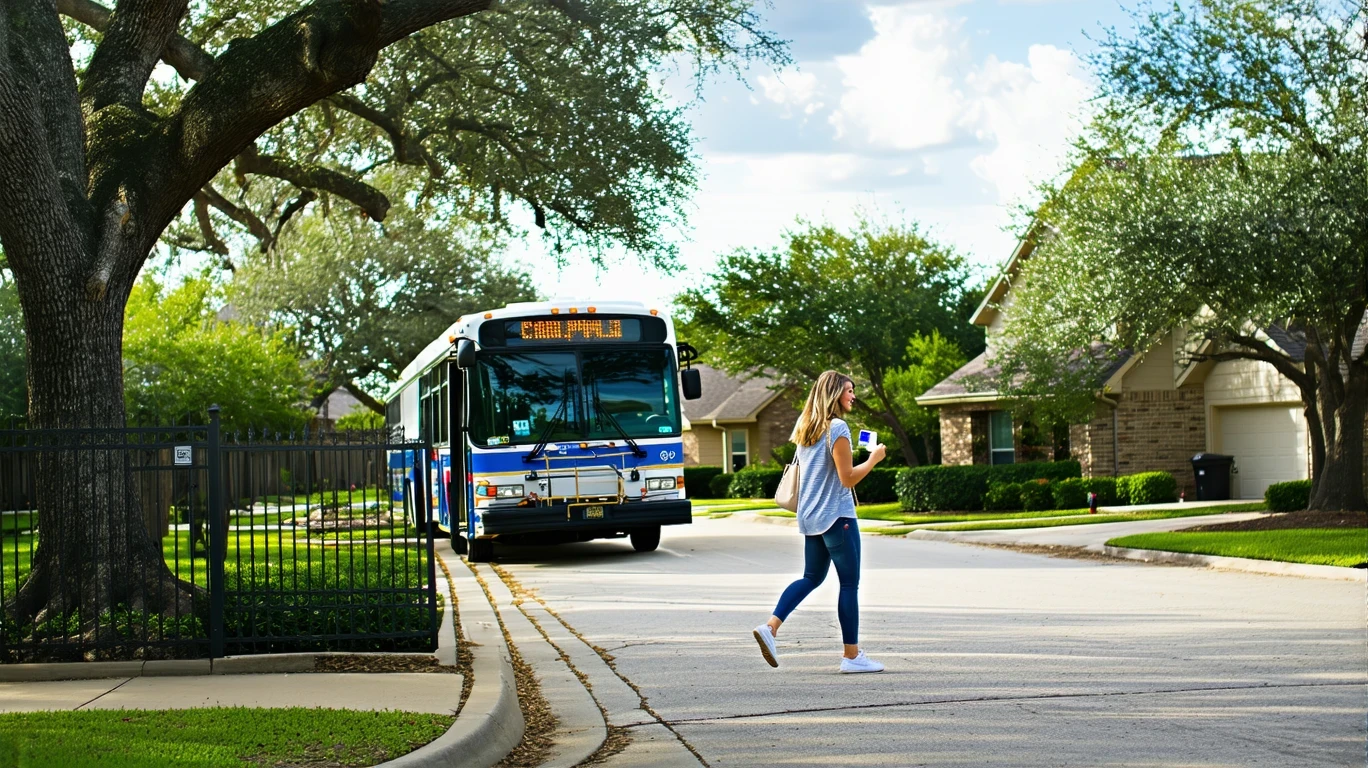
How People Get Around Leander
Leander’s transportation pattern reflects its role as a suburban node in the Austin metro. The city developed outward during periods of rapid regional growth, prioritizing single-family residential zones with commercial corridors rather than mixed-use density. That growth pattern produced a place where pedestrian infrastructure exists in pockets—particularly where the pedestrian-to-road ratio exceeds typical suburban thresholds—but where car ownership remains the default assumption for most households.
Rail service provides a structured commute option for workers traveling to Austin’s core, but it does not replace the need for a vehicle. Grocery density falls below functional thresholds, and food establishments cluster along corridors rather than distributing evenly across neighborhoods. Cycling infrastructure appears in some areas, though coverage remains limited and uneven. The result is a mobility system that supports rail commuters during peak hours but defaults to driving for nearly everything else: errands, medical appointments, school pickups, and social trips.
What newcomers often misunderstand is that rail access does not eliminate car dependence—it narrows it. A household might reduce vehicle miles traveled by commuting via rail, but they will still drive to the grocery store, the clinic, and the park. Leander’s structure rewards households that can split their mobility between rail and car, not those hoping to avoid car ownership entirely.
Public Transit Availability in Leander
Public transit in Leander centers around commuter rail service that connects the city to downtown Austin. The presence of rail infrastructure distinguishes Leander from fully car-dependent suburbs, offering a fixed-route, scheduled option for workers whose destinations align with the rail corridor. This service functions best for single-destination commuters traveling during traditional work hours, particularly those employed in Austin’s central business district or near rail-adjacent stops.
Where transit falls short is in coverage, frequency outside peak periods, and last-mile connectivity. Rail serves a linear corridor, not a grid, meaning that residents living outside walkable distance from the station must drive to access it. Bus service exists but operates with limited routes and schedules that do not support the spontaneous, multi-stop trips that define daily household logistics. Late-hour service, weekend frequency, and coverage in residential subdivisions remain constrained.
The practical implication is that transit works well for a specific use case—commuting to Austin’s core—but does not function as a comprehensive mobility system. Households relying solely on public transit for all trips face significant friction. Those who combine rail commuting with car ownership gain flexibility and cost control, but they do not escape vehicle dependence.
Driving & Car Dependence Reality
Driving is not optional for most Leander households. The city’s commercial geography, residential density, and infrastructure design assume car access. Grocery stores, medical clinics, schools, and retail clusters sit along arterial roads with large parking lots, not on pedestrian-friendly main streets. Even in areas where sidewalks and bike lanes exist, distances between destinations and the lack of continuous pedestrian networks make walking or cycling impractical for routine errands.
Parking is abundant and typically free, which reduces one friction point common in denser cities but reinforces car-oriented behavior. Subdivision design prioritizes garage access and cul-de-sac layouts, which enhance residential quiet but increase travel distances and limit route options. For families with children, multiple jobs, or complex schedules, day-to-day costs tied to driving become unavoidable.
The tradeoff is predictability and control. A personal vehicle allows households to manage irregular schedules, handle emergencies, and access dispersed services without waiting for transit or coordinating rides. That flexibility comes with exposure to fuel prices, maintenance, insurance, and depreciation, but it also removes the time cost and logistical complexity that transit dependence would impose in a low-density environment.
Commuting Patterns & Daily Mobility
Commuting in Leander typically follows one of two patterns: rail-based trips to Austin or car-based trips to distributed employment sites across the metro. Workers employed in Austin’s downtown core, the Capitol complex, or the University of Texas area benefit most from rail service, as their destinations align with the transit corridor. These commuters often drive to the station, park, and ride, treating the rail line as a way to avoid highway congestion and parking costs in the urban core.
Workers employed in North Austin, Round Rock, Cedar Park, or other suburban job centers generally drive the entire commute. Rail does not serve these destinations, and bus connections are sparse or nonexistent. For households with two working adults employed in different locations, the likelihood of both benefiting from transit is low. One may use rail while the other drives, or both drive separate routes.
Daily mobility extends beyond work trips. School runs, medical appointments, grocery shopping, and recreational activities all require transportation, and most of these trips happen outside transit service areas or schedules. Households with children face compounded complexity, as school locations, extracurricular activities, and daycare pickups rarely align with transit routes. The result is a mobility pattern where even rail-commuting households rely heavily on cars for non-work travel.
Who Transit Works For — and Who It Doesn’t
Transit works best for single adults or couples without children who work in Austin’s core and live near the rail station. These households can structure their lives around a predictable commute schedule, minimize vehicle use during the workweek, and potentially reduce transportation costs by limiting car dependency to evenings and weekends.
Transit works less well for families with school-age children, multi-stop commuters, or households with irregular schedules. Parents managing school drop-offs, after-school pickups, and weekend activities face logistical challenges that transit cannot solve. Workers employed outside the rail corridor or those with job sites that change daily—contractors, sales professionals, service workers—gain little benefit from fixed-route transit.
Renters living in neighborhoods closer to the station may find transit more practical than homeowners in outlying subdivisions, but even proximity does not eliminate the need for a car. Grocery access, medical care, and errands still require driving. The distinction is not between car-free and car-dependent households—it is between households that can reduce vehicle miles traveled through selective transit use and those who cannot.
Transportation Tradeoffs in Leander
The central tradeoff in Leander’s transportation landscape is predictability versus flexibility. Rail commuting offers predictable travel times, insulation from highway congestion, and lower exposure to fuel price volatility during work trips. It also imposes schedule constraints, limits spontaneous detours, and requires coordination around fixed departure times.
Driving offers flexibility, control, and the ability to handle multi-stop trips, irregular hours, and emergencies. It also exposes households to fuel costs, maintenance schedules, and the time burden of navigating traffic during peak periods. For many households, the optimal strategy is not choosing one mode over the other but combining them strategically: rail for predictable work commutes, car for everything else.
Another tradeoff involves housing location. Living closer to the rail station increases transit viability but may raise housing costs or limit neighborhood options. Living farther out reduces housing pressure but increases driving dependence and commute complexity. Households must weigh proximity to transit against school quality, lot size, neighborhood character, and home price—all of which vary across Leander’s geography.
How this article was built: In addition to public economic data, this article incorporates location-based experiential signals derived from anonymized geographic patterns—such as access density, walkability, and land-use mix—to reflect how day-to-day living actually feels in Leander, TX.
FAQs About Transportation in Leander (2026)
Is public transit usable for daily commuting in Leander?
Public transit is usable for commuters whose jobs are located in downtown Austin or along the rail corridor. The rail line provides a structured, predictable option for peak-hour travel to the urban core. For workers employed in suburban job centers, North Austin, or areas outside the rail corridor, transit is not a practical option. Daily commuting in Leander works best when households can combine rail for work trips with car access for errands and non-work travel.
Do most people in Leander rely on a car?
Yes. Most Leander households rely on a car for the majority of their trips. Even residents who use rail for commuting typically own a vehicle for errands, medical appointments, school runs, and weekend activities. The city’s layout, grocery access, and commercial distribution assume car ownership. Transit reduces vehicle miles traveled for some households but does not eliminate the need for a car.
Which areas of Leander are easiest to live in without a car?
No area of Leander functions well without a car. Neighborhoods closer to the rail station reduce the need for driving during work commutes, but grocery stores, clinics, and schools remain dispersed and require vehicle access. Households attempting to live car-free face significant logistical friction and limited access to essential services. Leander’s infrastructure is designed around car ownership, and even transit-adjacent neighborhoods do not support car-free living.
How does commuting in Leander compare to nearby cities?
Leander offers rail access to Austin’s core, which distinguishes it from fully car-dependent suburbs like Georgetown or Liberty Hill. However, it lacks the transit density and walkability of Austin’s central neighborhoods. Compared to Round Rock or Cedar Park, Leander provides a similar car-oriented experience with the added option of rail commuting for Austin-bound workers. The key difference is whether a household’s employment and daily destinations align with the rail corridor—if they do, Leander offers a mobility advantage; if they don’t, the experience is comparable to other suburban nodes in the metro.
Does Leander’s rail service run frequently enough for flexible schedules?
Rail service in Leander is designed for traditional commute schedules, with higher frequency during morning and evening peak hours. Off-peak, weekend, and late-night service is limited. Workers with flexible or irregular schedules may find that train times do not align with their needs, reducing the practical value of transit. The service works best for employees with fixed start and end times who can structure their day around the train schedule.
How Transportation Fits Into the Cost of Living in Leander
Transportation is not just a budget line—it is a structural factor that shapes where households can live, how they manage time, and what tradeoffs they accept. In Leander, getting around determines housing choice, job accessibility, and daily logistics complexity. Households that can use rail for commuting gain predictability and reduce exposure to fuel price swings, but they still absorb the costs of car ownership for errands and non-work travel.
Families with children, multi-earner households, or workers employed outside the rail corridor face higher transportation exposure because they cannot substitute transit for driving. The result is that transportation costs in Leander are less about mode choice and more about how well a household’s employment, housing, and daily destinations align with the available infrastructure.
Understanding how transportation works in Leander helps households make better decisions about where to live, whether to prioritize proximity to the rail station, and how to structure commutes and errands. It also clarifies which cost pressures are controllable—fuel efficiency, vehicle choice, commute timing—and which are fixed by geography and infrastructure. Leander offers a transportation option that many suburbs lack, but it does not eliminate the need to plan around car dependence.