
It’s 7:45 a.m., and you’re standing under the shade of a live oak at a MetroRail stop in East Austin, watching the red line pull in. You board, settle into a seat, and twenty minutes later you’re stepping off downtown, coffee in hand, ready for work. No traffic. No parking hunt. Just a smooth, predictable ride. For some people in Austin, this is daily life. For others—especially those living beyond the core corridors—it’s a fantasy that doesn’t match their reality.
Understanding transportation options in Austin means recognizing that this city operates on two tracks. In walkable pockets near downtown, the University of Texas, and along established transit corridors, public transportation is a genuine option. But Austin’s sprawl is real, and for most households—especially those in the suburbs or juggling multi-stop routines—driving remains the default. The question isn’t whether Austin has transit. It’s whether transit works for your life.
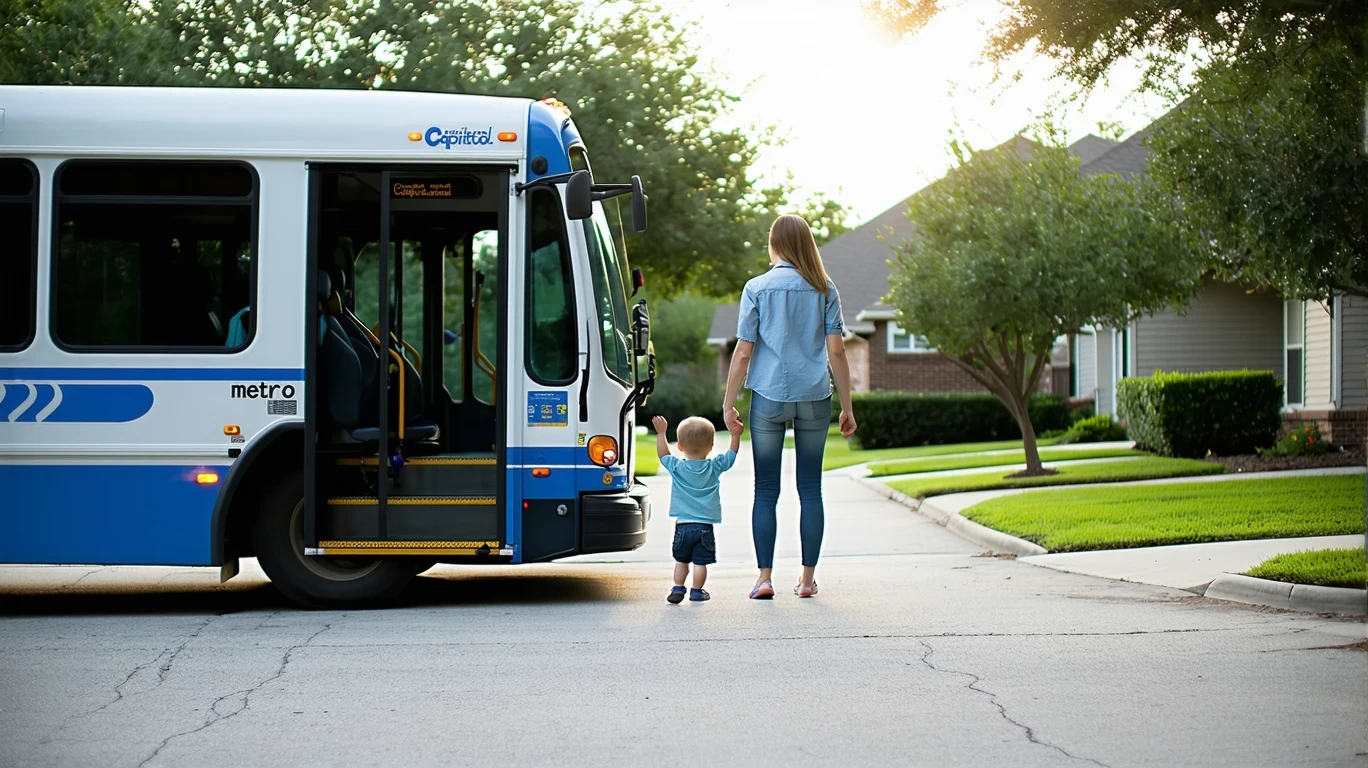
How People Get Around Austin
Austin’s mobility landscape reflects its development pattern: a dense, increasingly vertical core surrounded by lower-density neighborhoods that stretch in every direction. The city has invested in rail, expanded bus service, and built out cycling infrastructure, but geography and growth have kept cars at the center of daily life for most residents.
What newcomers often misunderstand is that Austin isn’t uniformly car-dependent. If you live and work along the rail line or within a few miles of downtown, you can structure a life around transit, biking, and walking. Pedestrian infrastructure is substantial in these areas, and the ratio of sidewalks to roads exceeds thresholds that support real walkability. But step outside those pockets, and the picture changes fast. Errands that would take ten minutes by car can require an hour of transfers and waiting. Jobs in office parks north or south of the core are functionally unreachable by transit.
The city’s cycling infrastructure is notable, with bike-to-road ratios that support commuting and errands in parts of town. But again, this benefit concentrates in core areas. Riders in outer neighborhoods face gaps, traffic exposure, and routes that don’t connect to key destinations.
In short: Austin offers real alternatives to driving, but only if your home, work, and daily destinations align with where those alternatives actually exist.
Public Transit Availability in Austin
Public transit in Austin often centers around systems such as Capital Metro, which operates bus routes and the MetroRail red line. The rail line runs north-south, connecting downtown to neighborhoods like East Austin, Hyde Park, and suburbs farther out. For people who live and work along this corridor, rail service provides a practical, predictable commute option.
Bus service is more extensive, covering a wider geographic area, but effectiveness varies sharply by location. In dense neighborhoods with high food and grocery establishment density—where errands are broadly accessible—buses can support a car-free or car-light lifestyle. But in lower-density areas, routes thin out, frequencies drop, and coverage gaps make transit a supplement rather than a primary option.
Transit works best for single-destination commuters traveling during peak hours along established corridors. It falls short for households with complex trip patterns: dropping kids at school, stopping for groceries, picking up a prescription, and getting to work. Those routines require the flexibility and speed that only driving provides in most of Austin.
Late-night and weekend service is limited compared to larger metro areas, which affects service workers, students, and anyone whose schedule doesn’t align with traditional commute windows. If your life operates outside 9-to-5 hours or beyond core neighborhoods, transit becomes a backup plan, not a primary tool.
Driving & Car Dependence Reality
For most Austin households, driving isn’t a preference—it’s a structural necessity. The city’s development pattern, with jobs dispersed across office parks, retail centers, and industrial zones, makes car ownership the path of least resistance. Commute times average 25 minutes, and 19.9% of workers face long commutes, often because they’re traveling across town or out to suburbs where transit doesn’t reach.
Parking availability varies. Downtown and near the University of Texas, parking is constrained and often comes with a cost. But in most residential neighborhoods and suburban areas, parking is abundant and free. This asymmetry reinforces driving: it’s easy to park at home, but harder to park at your destination, which paradoxically makes owning a car feel even more necessary.
Sprawl also means that errands require driving. Even in neighborhoods with decent grocery and food access, the distances between home, work, school, and other daily stops are too great to walk or bike comfortably. Families with kids face this acutely: school drop-offs, after-school activities, and weekend logistics all assume car access.
Gas prices in Austin sit at $2.41 per gallon, which is relatively moderate but still a recurring cost that scales with how much you drive. The real expense isn’t the fuel itself—it’s the cumulative burden of car ownership: insurance, maintenance, registration, and the opportunity cost of capital tied up in a vehicle.
For households trying to avoid car dependency, the tradeoff is housing cost. Living close enough to work and transit to go car-free typically means paying more for rent or a mortgage. The neighborhoods where transit actually works—downtown, East Austin, areas near the university—command premium prices. You’re choosing between transportation flexibility and housing affordability, and for many households, the math tips toward driving and living farther out.
Commuting Patterns & Daily Mobility
Austin’s commute reality depends heavily on where you live and where you work. Single-job commuters traveling along the rail line or major bus corridors can build routines around transit. But multi-stop commuters—parents shuttling kids, workers with side gigs, anyone managing errands alongside work—find transit impractical.
Only 4.8% of workers in Austin work from home, which means the vast majority are commuting regularly. For those in core neighborhoods with strong pedestrian infrastructure and high park density, the commute might include a bike ride or a walk to a transit stop. For those in outer suburbs, it’s a drive, often on highways that funnel traffic into and out of the city center.
The city’s layout creates predictable bottlenecks. North-south routes along I-35 and MoPac are heavily trafficked, and east-west connections are less developed. This means commuters often face a choice: live close and pay more, or live farther out and absorb the time cost of driving.
Proximity to work isn’t just about time—it’s about predictability. Transit commuters know their schedule. Drivers face variability: traffic, accidents, construction. That unpredictability adds stress and forces buffers into daily routines, which eats into personal time.
Who Transit Works For — and Who It Doesn’t
Transit in Austin works well for a specific slice of households: young professionals, students, and service workers who live in core neighborhoods and work along rail lines or in dense employment centers. If your home is within walking distance of a MetroRail stop and your job is downtown or near the university, transit is a legitimate option. You’ll save on parking, avoid traffic, and enjoy predictable commute times.
Renters in walkable pockets—areas with substantial pedestrian infrastructure and broadly accessible errands—can often structure a car-free or car-light life. The city’s cycling infrastructure supports this in parts of town, and the presence of parks, schools, and playgrounds in medium-density bands makes daily life manageable without a vehicle.
Transit doesn’t work as well for families, especially those with kids. School locations, activity schedules, and grocery runs create multi-stop routines that transit can’t accommodate efficiently. Even in neighborhoods with strong family infrastructure—where both schools and playgrounds meet density thresholds—the distances and timing don’t align with bus or rail schedules.
Homeowners in outer suburbs face the starkest car dependence. These areas lack the pedestrian-to-road ratios and transit coverage that make alternatives viable. Jobs in dispersed office parks, retail centers, and industrial zones are functionally unreachable without driving. For these households, transit is irrelevant to daily life.
Service workers with non-traditional hours face a different challenge. Late-night and weekend transit service is limited, which means even if you live along a bus route, you might not have a ride home after a closing shift. This forces car ownership or reliance on ride-hailing, both of which add cost.
Transportation Tradeoffs in Austin
Choosing between transit and driving in Austin isn’t about which is “better”—it’s about which tradeoffs you’re willing to accept.
Transit offers predictability. You know when the train arrives, how long the trip takes, and what it costs. You’re insulated from traffic variability and parking friction. But you sacrifice flexibility. Your route is fixed, your schedule is constrained, and multi-stop trips become complicated.
Driving offers control. You leave when you want, stop where you need, and adjust on the fly. But you absorb exposure to traffic, parking costs, and the ongoing expense of vehicle ownership. You also trade time for convenience—sitting in traffic is dead time, and it compounds over weeks and months.
For households in core neighborhoods, the tradeoff often tips toward transit or a mix of biking, walking, and occasional driving. The infrastructure supports it, and the cost savings—no parking fees, lower insurance, deferred vehicle purchase—add up. But these households are also paying more for housing. The rent or mortgage premium in walkable, transit-accessible neighborhoods offsets some of the transportation savings.
For households in outer suburbs, the tradeoff tips toward driving by default. Transit isn’t a real option, and the monthly expenses tied to car ownership become unavoidable. The benefit is lower housing costs and more space, but the cost is time, fuel, and the friction of managing a vehicle.
Families face the sharpest tradeoffs. Even in neighborhoods with strong family infrastructure and integrated green space, the logistics of school, activities, and errands require a car. Transit might work for one parent’s commute, but it won’t work for the household’s full mobility needs.
FAQs About Transportation in Austin (2026)
Is public transit usable for daily commuting in Austin?
Yes, but only if you live and work along core corridors. The MetroRail red line and major bus routes serve downtown, the University of Texas area, and parts of East Austin effectively. Outside those zones, transit becomes impractical for daily commuting. Most workers still rely on cars.
Do most people in Austin rely on a car?
Yes. The city’s sprawl, dispersed job centers, and limited transit coverage make car ownership the default for most households. Only those in dense, walkable neighborhoods near transit lines can realistically go car-free.
Which areas of Austin are easiest to live in without a car?
Downtown, areas near the University of Texas, and neighborhoods along the MetroRail line in East Austin offer the best car-free viability. These areas have high pedestrian infrastructure, strong errands accessibility, and direct transit connections to major employment centers.
How does commuting in Austin compare to nearby cities?
Austin’s average commute time is 25 minutes, which is moderate but reflects the city’s sprawl. Compared to denser metros with more extensive transit, Austin leans more car-dependent. Compared to smaller Texas cities, Austin offers more transit options but still requires driving for most households.
Can you bike to work in Austin?
In parts of the city, yes. Austin has notable cycling infrastructure, especially in core neighborhoods where bike-to-road ratios support commuting. But outside those areas, gaps in routes, traffic exposure, and distance make biking impractical for most workers.
How Transportation Fits Into the Cost of Living in Austin
Transportation in Austin isn’t just about getting around—it’s a structural factor that shapes where you live, how much you spend, and how much time you control. The choice between transit and driving ripples through housing decisions, daily routines, and long-term financial planning.
Households that prioritize transit access pay more for housing but save on vehicle costs and gain predictability. Households that prioritize space and affordability accept car dependence and the time cost that comes with it. Neither path is wrong, but both require clear-eyed recognition of what you’re trading.
Austin’s mobility landscape rewards alignment. If your life fits the corridors where transit works—if you’re a single commuter, a renter in a walkable pocket, someone whose job and home line up along the rail—you can build a lower-cost, lower-friction routine. If your life doesn’t fit that pattern—if you’re a family in the suburbs, a worker in a dispersed office park, someone with complex daily logistics—you’ll need a car, and that reality should inform every other decision you make about living here.
The city is investing in transit, expanding bike infrastructure, and densifying core neighborhoods. But for now, Austin remains a place where most people drive most of the time. Understanding that upfront—and planning accordingly—gives you the clarity to make housing, job, and lifestyle choices that actually work.
How this article was built: In addition to public economic data, this article incorporates location-based experiential signals derived from anonymized geographic patterns—such as access density, walkability, and land-use mix—to reflect how day-to-day living actually feels in Austin, TX.