
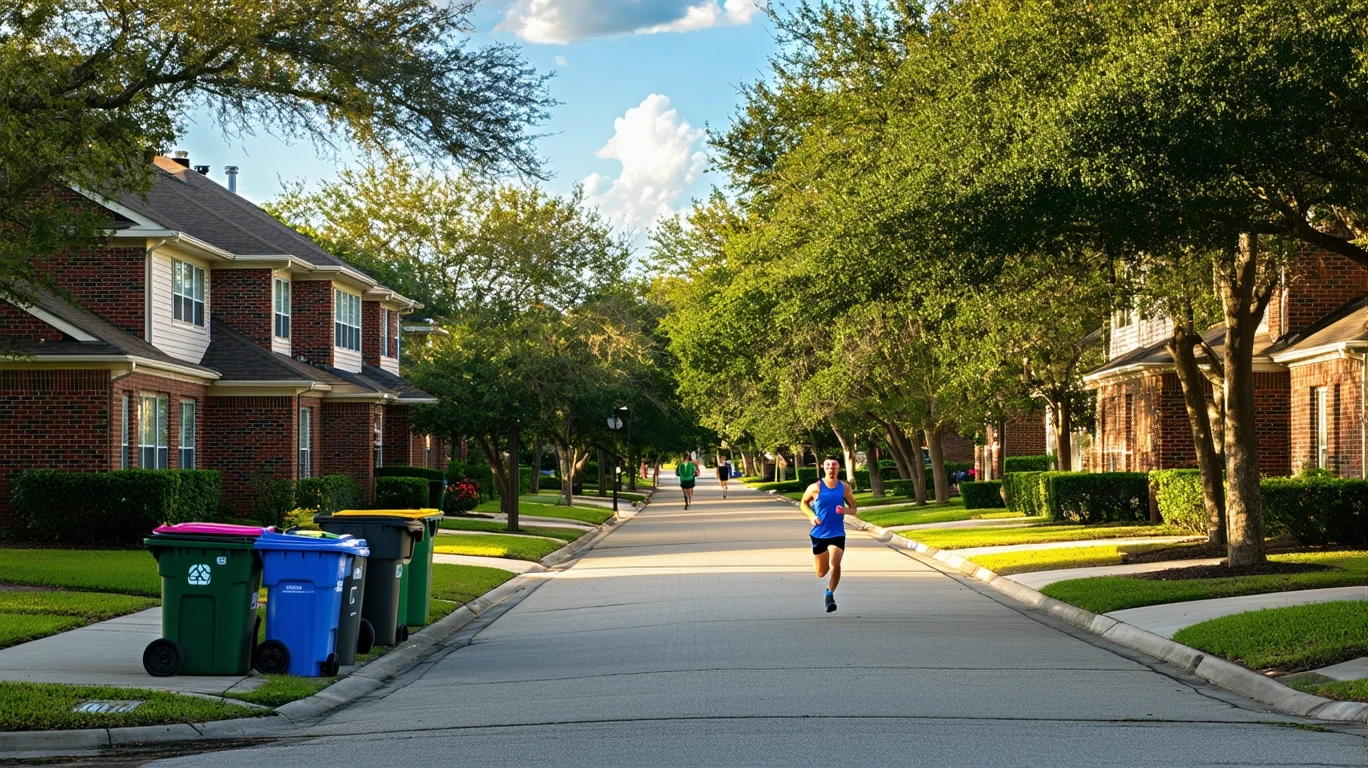
Picture this: You’re standing in a Houston apartment, rent statement in hand—$1,235 for the month. Your friend in Pearland just texted theirs: $1,622. You both hit the grocery store on Saturday. You paid $4.84 for a pound of cheese in Houston; they paid $4.73 in Pearland. Your gas receipt shows $2.55 per gallon; theirs reads $2.41. On paper, these look like simple swaps—a little more here, a little less there. But the reality of living in Houston versus Pearland in 2026 isn’t about line-by-line math. It’s about where cost pressure concentrates, how predictably it arrives, and which households feel it most.
Houston and Pearland sit in the same metro, share the same humidity and summer heat, and draw from overlapping job markets. But they organize daily life differently. Houston offers walkable pockets, rail transit, and broadly accessible errands—structure that reduces car dependence and creates flexibility in how you move and spend. Pearland, a commuter-oriented suburb, centers life around single-family homes and driving, with higher housing entry costs but also higher household incomes. The decision between them isn’t about which city costs less overall. It’s about which cost structure fits the household you’re running and the tradeoffs you’re willing to make.
This article explains how housing, utilities, groceries, transportation, and daily logistics behave differently in Houston and Pearland—not to declare a winner, but to show where each city’s cost pressure shows up, how predictable it is, and which households are more exposed. If you’re deciding between these two cities, the question isn’t “Which is cheaper?” It’s “Which costs can I control, and which ones will control me?”
Housing Costs
Housing is where Houston and Pearland diverge most clearly, not in monthly obligation alone but in the type of housing stock available and the entry barrier required. Houston’s median home value sits at $235,000, with median rent at $1,235 per month. Pearland’s median home value is $311,100, with median rent at $1,622 per month. These aren’t small differences, but they also don’t tell you what kind of housing you’re getting or what ongoing costs follow.
Houston’s housing market includes a mix of older single-family homes, townhomes, and apartment complexes, many built decades ago and located in neighborhoods with varying walkability and transit access. The lower entry cost reflects both the age of the housing stock and the density of options—more apartments, more older homes, more variation in size and condition. Renters in Houston often find one-bedroom and two-bedroom units in neighborhoods close to job centers, grocery stores, and transit stops, which reduces the need for a second car or long commutes. Buyers face lower down payments and smaller mortgage obligations, but they may also inherit older HVAC systems, less efficient insulation, and higher ongoing maintenance needs. The tradeoff is access and flexibility in exchange for older infrastructure.
Pearland’s housing market skews toward newer single-family homes in master-planned communities, many built in the last 20 years with modern construction standards, energy-efficient windows, and updated HVAC systems. The higher home values and rents reflect not just square footage but also the expectation of lower immediate maintenance, HOA-managed amenities, and proximity to highly rated schools. Renters in Pearland typically pay more for single-family home rentals or newer apartment complexes designed for families, often with two-car garages and larger floor plans. Buyers face higher down payments and larger monthly mortgage obligations, but they also benefit from predictable utility performance and less deferred maintenance risk. The tradeoff is higher entry cost and ongoing obligation in exchange for newer, more efficient housing and family-oriented infrastructure.
| Housing Type | Houston | Pearland |
|---|---|---|
| Median Home Value | $235,000 | $311,100 |
| Median Gross Rent | $1,235/month | $1,622/month |
| Typical Housing Form | Mixed: older single-family, townhomes, apartments | Newer single-family homes, master-planned communities |
| Entry Barrier | Lower down payment, lower monthly obligation | Higher down payment, higher monthly obligation |
For renters, Houston offers lower monthly obligations and more flexibility in neighborhood choice, especially for single adults or couples who prioritize proximity to work, errands, and transit over square footage. Pearland’s rental market caters more to families seeking space, newer construction, and access to schools, but the higher rent reflects that specialization. For first-time buyers, Houston’s lower home values reduce the cash needed upfront and the size of the mortgage, making homeownership accessible earlier—but at the cost of potentially higher utility bills and maintenance surprises in older homes. Pearland’s higher home values require more savings and larger monthly payments, but buyers gain predictability in energy costs and fewer immediate repair needs.
Housing takeaway: Households prioritizing lower entry costs, neighborhood walkability, and flexibility in housing type will find Houston’s structure easier to navigate. Households prioritizing newer construction, family space, and predictable utility performance will find Pearland’s higher housing costs justified by what they deliver. The difference isn’t about affordability in the abstract—it’s about whether you’re paying for access and flexibility or paying for space and predictability.
Utilities and Energy Costs
Utility costs in Houston and Pearland are shaped by the same climate—long, hot summers with high air conditioning demand and mild winters with occasional heating needs—but the age and efficiency of the housing stock changes how that exposure translates into monthly bills. Houston’s electricity rate is 16.04¢/kWh, while Pearland’s is 16.11¢/kWh—a negligible difference that won’t drive decision-making. Natural gas pricing shows more separation: Houston’s rate is $25.56/MCF, compared to Pearland’s $30.71/MCF. But the real difference in utility exposure comes from housing age, insulation quality, and square footage, not the rate itself.
Houston’s older housing stock—particularly single-family homes and apartments built before modern energy codes—tends to experience higher cooling costs in summer due to less efficient insulation, single-pane windows, and aging HVAC systems. A 1,200-square-foot apartment in an older Houston complex may run the air conditioner harder and longer than a similarly sized unit in Pearland, even at nearly identical electricity rates. Heating costs in winter are lower overall due to the mild climate, but older homes with poor insulation or drafty windows still see spikes during cold snaps. Renters in older Houston buildings have little control over these inefficiencies and must absorb the volatility. Homeowners can invest in upgrades—new windows, attic insulation, programmable thermostats—but those improvements require upfront capital and time.
Pearland’s newer housing stock, built largely in the 2000s and 2010s, benefits from modern insulation standards, double-pane windows, and more efficient HVAC systems. A 2,000-square-foot single-family home in Pearland may use less electricity per square foot than a smaller, older home in Houston, simply because the building envelope is tighter and the equipment is newer. Natural gas costs are higher in Pearland, but the mild climate means heating demand is low and concentrated in a few winter months. The result is more predictable utility bills with less seasonal volatility. Families in Pearland can budget more confidently because the housing itself reduces exposure to extreme usage swings.
Household size and housing type amplify these differences. Single adults or couples in small Houston apartments face lower baseline utility costs due to smaller square footage, even in older buildings. Families in larger Houston homes—especially older single-family houses—face higher cooling costs and more volatility. In Pearland, larger homes mean higher baseline usage, but the efficiency of newer construction keeps costs more predictable. Renters in both cities have limited control over building performance, but Pearland renters benefit more from landlords who’ve invested in newer, efficient properties.
Utility takeaway: Households in older Houston housing face higher cooling exposure and more seasonal volatility, with less control unless they own and can invest in upgrades. Households in newer Pearland housing experience more predictable utility costs due to better insulation and efficient systems, even in larger homes. The difference is less about the rate you pay and more about how much energy your home demands and how predictably it does so.
Groceries and Daily Expenses
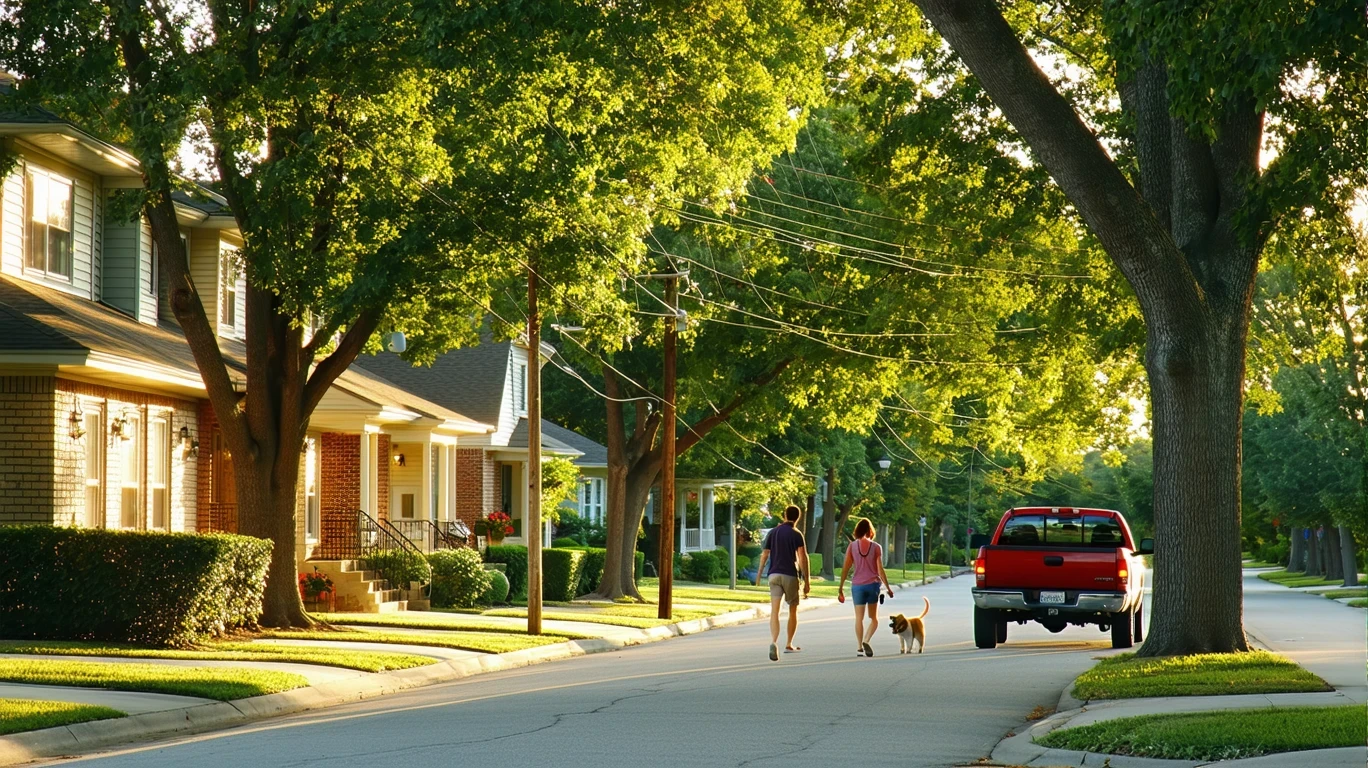
Grocery costs in Houston and Pearland reflect nearly identical regional pricing, with both cities drawing from the same supply chains and retail networks. Derived estimates for staples like bread ($1.84/lb in Houston, $1.83/lb in Pearland), chicken ($2.04/lb in Houston, $2.02/lb in Pearland), and eggs ($2.58/dozen in Houston, $2.71/dozen in Pearland) show minimal variation. But how grocery spending feels in daily life depends less on per-item pricing and more on access patterns, shopping habits, and the friction involved in running errands.
Houston’s broadly accessible food and grocery infrastructure—driven by high food establishment density and high grocery density—means households can shop frequently, compare prices easily, and rely on walkable or transit-accessible stores in many neighborhoods. Single adults and couples in Houston can stop at a neighborhood grocery store on the way home from work, pick up a few items, and avoid the need for large weekly shopping trips. Families with kids benefit from competitive pricing across multiple chains and discount grocers within short driving distances. The structure reduces the need to stockpile or plan far in advance, which lowers the risk of food waste and allows households to respond to sales or preferences more flexibly.
Pearland’s grocery access is concentrated along major corridors and within master-planned communities, often requiring a car trip even for routine purchases. Households in Pearland tend to consolidate errands into fewer, larger shopping trips, which increases the importance of planning and list discipline. Families with kids—who make up a larger share of Pearland’s population—face higher cart totals simply due to volume, but the per-item pricing remains similar to Houston. The difference is in the logistics: fewer spontaneous trips, more reliance on bulk purchasing, and less ability to take advantage of small, frequent deals.
Dining out and convenience spending follow similar patterns. Houston’s density of restaurants, coffee shops, and takeout options creates more opportunities for spontaneous spending, which can add up quickly for households without strict budgets. Pearland’s more suburban layout reduces the temptation for frequent takeout or coffee runs, but it also means fewer low-cost options when convenience is needed. Single adults in Houston may spend more on dining out simply because it’s easier and more visible. Families in Pearland may spend less on convenience food because the infrastructure doesn’t encourage it, but they also lose flexibility when time is tight.
Grocery takeaway: Households prioritizing flexibility, frequent small trips, and access to competitive pricing will find Houston’s grocery infrastructure easier to navigate. Households comfortable with planned, consolidated shopping trips and less reliance on convenience spending will find Pearland’s structure manageable. The difference isn’t price—it’s how much friction you encounter getting food into your home and how much discipline you need to avoid convenience creep.
Taxes and Fees
Texas has no state income tax, so both Houston and Pearland rely heavily on property taxes and sales taxes to fund local services, schools, and infrastructure. The structure of these taxes—and the fees that accompany them—affects homeowners and renters differently, and the predictability of those costs varies by housing type and length of residence.
Property taxes in both cities are assessed as a percentage of home value, which means Pearland homeowners face higher absolute tax bills due to higher median home values ($311,100 in Pearland versus $235,000 in Houston). But the tax rate itself and the frequency of reassessment matter more than the home value alone. Homeowners in both cities should expect annual property tax bills that reflect not just the purchase price but also market appreciation and local taxing authority decisions. Long-term residents in Houston may see slower tax growth if their neighborhoods appreciate less quickly. Long-term residents in Pearland, particularly in newer master-planned communities, may see faster tax growth as the area builds out and property values rise.
Renters in both cities don’t pay property taxes directly, but landlords pass those costs through in rent, especially in markets where demand is strong. Renters in Pearland’s newer communities may see rent increases that reflect rising property taxes on newly built homes. Renters in older Houston neighborhoods may see slower rent growth if property taxes remain more stable. The key difference is predictability: renters have no control over tax policy or reassessment cycles, so they absorb the volatility indirectly.
HOA fees are more common in Pearland, where master-planned communities often bundle services like landscaping, trash collection, and amenity maintenance into monthly or annual fees. These fees add to the cost of homeownership but also reduce variability—you know what you’re paying and what’s covered. Houston’s housing stock includes fewer HOA-governed neighborhoods, which means lower or no HOA fees for many homeowners, but also more responsibility for individual maintenance and service contracts. The tradeoff is control versus predictability.
Sales taxes apply equally to both cities at the state and local level, so they don’t create meaningful cost differences. But the cumulative effect of property taxes, HOA fees, and service fees (trash, water, sewer) adds up differently depending on housing type. Homeowners in Pearland face higher total fees but more bundled services. Homeowners in Houston face lower fees but more individual responsibility for upkeep and service contracts.
Taxes and fees takeaway: Homeowners in Pearland face higher property tax exposure due to higher home values, plus more frequent HOA fees, but gain predictability and bundled services. Homeowners in Houston face lower property tax bills and fewer HOA fees, but more variability in service costs and maintenance responsibility. Renters in both cities absorb these costs indirectly through rent, with less control over how they change over time.
Transportation & Commute Reality
Transportation costs in Houston and Pearland are shaped by infrastructure, commute patterns, and the degree to which daily life requires a car. Gas prices show a small difference—$2.55/gallon in Houston versus $2.41/gallon in Pearland—but that gap matters less than how much you drive, why you’re driving, and whether alternatives exist.
Houston’s transportation structure offers more flexibility than most Texas cities. Rail transit is present, bus service is available, and the pedestrian-to-road ratio exceeds high thresholds in parts of the city, creating walkable pockets where households can reduce car dependence. The average commute in Houston is 27 minutes, but that figure includes a mix of short urban commutes, longer suburban drives, and transit users. Single adults or couples living in walkable Houston neighborhoods near job centers, grocery stores, and transit stops can reduce driving frequency, lower fuel costs, and avoid the need for a second car. Families with kids in Houston face more complexity—school drop-offs, extracurriculars, and weekend errands still require a car—but the presence of transit and bike infrastructure creates some flexibility for non-school trips.
Pearland’s transportation structure is car-dependent by design. Commute data for Pearland is not available in the feed, but the city’s suburban layout, lack of rail transit, and lower density mean most households rely on personal vehicles for all trips—work, errands, school, and recreation. Families in Pearland typically operate two cars, and the cost structure reflects that: fuel, insurance, maintenance, and registration for multiple vehicles. The lower gas price in Pearland ($2.41/gallon) offsets some of that exposure, but the total miles driven per household are higher due to longer commutes and less consolidated errand infrastructure.
The difference in transportation costs isn’t just fuel—it’s time, vehicle count, and the ability to substitute transit or walking for driving. Houston households in walkable neighborhoods can reduce vehicle ownership costs and gain time by shortening commutes or using transit. Pearland households gain predictability and comfort (no transit delays, no weather exposure) but lose flexibility and pay more for vehicle ownership and operation.
Cost Structure Comparison
Housing dominates the cost experience in both cities, but the nature of that pressure differs. Houston’s lower home values and rents reduce the entry barrier and ongoing monthly obligation, making it easier for single adults, couples, and first-time buyers to secure housing without stretching their budgets. But that lower cost comes with tradeoffs: older housing stock, higher utility volatility, and more maintenance risk. Pearland’s higher home values and rents create a steeper entry barrier and larger monthly obligation, but households gain newer construction, more predictable utility performance, and less immediate maintenance exposure. Families with kids and dual-income households are more likely to absorb Pearland’s higher housing costs because they value space, school access, and predictability over flexibility.
Utilities introduce more volatility in Houston due to older housing stock and less efficient building envelopes. Households in older Houston homes face higher cooling costs in summer and less predictable bills overall, with limited control unless they own and can invest in upgrades. Pearland’s newer housing stock reduces utility volatility and creates more predictable monthly costs, even in larger homes. Families in Pearland benefit most from this predictability because larger households face higher baseline usage, and efficiency gains compound over time.
Daily living costs—groceries, dining, convenience spending—are nearly identical in per-item pricing, but the infrastructure around errands differs. Houston’s broadly accessible grocery and food establishment density reduces friction and allows households to shop frequently, compare prices, and avoid large stockpiling trips. Pearland’s more corridor-based grocery access requires more planning and larger trips, which benefits disciplined households but reduces flexibility. Single adults and couples in Houston may spend more on convenience simply because it’s easier; families in Pearland may spend less because the structure discourages spontaneous spending.
Transportation patterns matter more in Pearland, where car dependence is near-universal and most households operate two vehicles. Houston’s walkable pockets, rail transit, and bike infrastructure create opportunities to reduce vehicle ownership costs and driving frequency, especially for single adults and couples in urban neighborhoods. Families with kids in both cities still rely heavily on cars, but Houston’s transit options provide some flexibility for non-school trips.
The better choice depends on which costs dominate your household. Households sensitive to housing entry barriers and ongoing obligations may prefer Houston’s lower costs and greater flexibility in housing type and neighborhood choice. Households sensitive to utility volatility, maintenance risk, and commute logistics may prefer Pearland’s newer housing, predictable costs, and family-oriented infrastructure. For single adults and couples, the difference is less about price and more about whether you value walkability and transit access over space and newness. For families with kids, the difference is whether you prioritize lower monthly obligations and urban flexibility or higher costs with suburban predictability and school access.
How the Same Income Feels in Houston vs Pearland
Single Adult
In Houston, housing and transportation become negotiable. A single adult can choose a smaller apartment in a walkable neighborhood, reduce car dependence, and keep monthly obligations low. Flexibility exists in how much space you rent, how often you drive, and how much you spend on convenience. In Pearland, housing costs rise and car ownership becomes non-negotiable. The same income buys more space but less flexibility, and the cost structure assumes you’re driving everywhere. Time costs increase even if cash costs feel manageable.
Dual-Income Couple
In Houston, a dual-income couple can prioritize location over size, live in a walkable neighborhood near work, and reduce transportation costs by sharing one car or using transit. Dining and convenience spending become the primary discretionary pressure, and discipline matters more than access. In Pearland, the same couple faces higher rent or mortgage costs but gains space and predictability. Two cars become standard, and commute logistics dominate daily planning. Flexibility disappears in exchange for newer housing and lower utility volatility.
Family with Kids
In Houston, families face tradeoffs between housing age, school access, and transportation flexibility. Lower housing costs create room for childcare or savings, but older homes mean higher utility bills and maintenance surprises. School quality varies by neighborhood, and families must weigh proximity to good schools against housing affordability. In Pearland, families pay more upfront for housing but gain access to highly rated schools, newer homes with predictable utility costs, and family-oriented infrastructure. The cost structure is front-loaded, and ongoing obligations are higher, but the predictability reduces planning friction and maintenance risk.
Decision Matrix: Which City Fits Which Household?
| Decision factor | If you’re sensitive to this… | Houston tends to fit when… | Pearland tends to fit when… |
|---|---|---|---|
| Housing entry + space needs | You need lower upfront costs or flexibility in housing type and location | You prioritize lower entry barriers, walkable neighborhoods, and access over square footage | You prioritize newer construction, family space, and predictable utility performance over lower monthly costs |
| Transportation dependence + commute friction | You want to reduce car ownership costs or avoid long commutes | You can live near work or transit, value walkability, and want the option to reduce driving frequency | You accept car dependence, prefer suburban commute predictability, and are comfortable operating two vehicles |
| Utility variability + home size exposure | You want predictable monthly bills and lower seasonal volatility | You can tolerate older housing stock and higher cooling costs in exchange for lower rent or mortgage | You value energy-efficient construction and predictable utility costs even in larger homes |
| Grocery strategy + convenience spending creep | You want frequent, flexible shopping options and access to competitive pricing | You value walkable grocery access, frequent small trips, and the ability to respond to sales easily | You prefer planned, consolidated shopping trips and are disciplined enough to avoid convenience spending |
| Fees + friction costs (HOA, services, upkeep) | You want to minimize ongoing fees or prefer control over service contracts | You prefer lower or no HOA fees and are comfortable managing individual service contracts and maintenance | You value bundled services, predictable fees, and less individual responsibility for upkeep |
| Time budget (schedule flexibility, errands, logistics) | You want to reduce time spent on errands and commute logistics | You can live in a walkable neighborhood, consolidate errands easily, and reduce driving time | You accept longer commutes and car-dependent errands in exchange for space and family infrastructure |
Lifestyle Fit
Houston and Pearland offer distinct lifestyle experiences shaped by density, infrastructure, and the way daily life is organized. Houston’s walkable pockets, rail transit, and integrated park access create opportunities for households to reduce car dependence and engage with urban amenities—museums, restaurants, live music, and professional sports. Neighborhoods near downtown, the Museum District, and the Medical Center offer shorter commutes, more dining variety, and access to cultural institutions. Families in Houston can find strong school options in certain neighborhoods, but school quality varies, and proximity to good schools often comes with higher housing costs or older housing stock. The city’s more vertical building profile and mixed land use create a denser, more urban feel in parts of the city, which appeals to households prioritizing walkability and access over space.
Pearland’s lifestyle centers on family-oriented suburban living, with master-planned communities, highly rated schools, and recreational amenities like parks, pools, and sports leagues. The city’s newer housing stock and lower-density layout create a quieter, more predictable environment, with less traffic congestion and more space between neighbors. Families with kids benefit from strong school districts, safe neighborhoods, and easy access to youth activities. But the tradeoff is less cultural variety, fewer dining options, and near-universal car dependence. Pearland residents often drive to Houston for entertainment, dining, and cultural events, which adds time and fuel costs but allows them to live in a quieter, more family-focused environment.
Lifestyle factors indirectly affect costs in both cities. Houston’s walkability and transit access can lower transportation costs for households willing to live in denser neighborhoods and reduce car ownership. Pearland’s newer housing stock lowers utility costs and reduces maintenance risk, but the suburban layout increases transportation costs and requires more planning for errands. Households prioritizing cultural access, dining variety, and walkability will find Houston’s lifestyle more aligned with those values. Households prioritizing space, school quality, and family infrastructure will find Pearland’s lifestyle more supportive of those goals.
Houston’s current temperature: 67°F (feels like 65°F). Pearland’s current temperature: 51°F (feels like 48°F). Both cities experience the same regional climate—hot, humid summers with extended cooling seasons and mild winters with occasional cold snaps.
Frequently Asked Questions
Is Houston or Pearland more affordable for renters in 2026?
Houston offers lower median rent ($1,235/month versus $1,622/month in Pearland) and more flexibility in housing type and neighborhood choice, making it easier for single adults and couples to keep monthly obligations low. Pearland’s higher rent reflects newer construction, larger floor plans, and family-oriented amenities, which appeal to households prioritizing space and predictability over lower costs. Renters sensitive to monthly obligations will find Houston’s structure easier to navigate, while renters prioritizing newer housing and family infrastructure will find Pearland’s higher costs justified by what they deliver.
How do utility costs compare between Houston and Pearland in 2026?
Electricity rates are nearly identical (16.04¢/kWh in Houston, 16.11¢/kWh in Pearland), but utility exposure differs due to housing age and efficiency. Houston’s older housing stock tends to experience higher cooling costs and more seasonal volatility, especially in single-family homes built before modern energy codes. Pearland’s newer housing stock benefits from better insulation and efficient HVAC systems, creating more predictable utility bills even in larger homes. Households in older Houston housing face higher exposure unless they own and can invest in efficiency upgrades. Households in newer Pearland housing experience lower volatility and more predictable monthly costs.
Which city requires more car dependence, Houston or Pearland?
Pearland’s suburban layout and lack of rail transit make car ownership near-universal, with most households operating two vehicles for work, errands, and school. Houston offers more flexibility, with rail transit, bus service, and walkable neighborhoods that allow some households—particularly single adults and couples living near job centers—to reduce car dependence and lower transportation costs. Families with kids in both cities still rely heavily on cars, but Houston’s transit and bike infrastructure provide some flexibility for non-school trips. Households prioritizing lower vehicle ownership costs and shorter commutes will find Houston’s structure more supportive.
Do groceries cost more in Houston or Pearland in 2026?
Per-item grocery pricing is nearly identical between Houston and Pearland, with both cities drawing from the same regional supply chains. The difference is in access and logistics. Houston’s broadly accessible grocery infrastructure allows households to shop frequently, compare prices easily, and avoid large stockpiling trips. Pearland’s more corridor-based grocery access requires more planning and larger trips, which benefits disciplined households but reduces flexibility. Households prioritizing frequent, flexible shopping will find Houston easier to navigate. Households comfortable with planned, consolidated trips will find Pearland manageable.
Is it easier to buy a home in Houston or Pearland in 2026?
Houston’s lower median home value ($235,000 versus $311,100 in Pearland) reduces the down payment required and the size of the monthly mortgage, making homeownership accessible earlier for first-time buyers. But buyers in Houston may inherit older housing stock with higher utility costs and more maintenance risk. Pearland’s higher home values require more upfront savings and larger monthly payments, but buyers gain newer construction, predictable utility performance, and less immediate maintenance exposure.