
Houston’s housing market surprises newcomers in two directions: the entry price is lower than many expect, but the ongoing costs—especially property taxes and homeowners association fees—are higher and less predictable than renters anticipate. Without a state income tax, Texas funds local services through property taxes, which means homeowners pay directly for schools, infrastructure, and emergency services. Meanwhile, many neighborhoods are governed by HOAs that bundle amenities, enforce standards, and add another layer of monthly obligation. For renters, monthly spending in Houston includes rent that embeds some of these costs indirectly, but the structure is simpler and the exit is faster.
This article explains how housing costs behave in Houston—what drives rent, what ownership actually includes, and how the tradeoffs between renting and buying play out over time in a metro where walkable pockets, rail transit, and broadly accessible errands coexist with car-oriented sprawl.
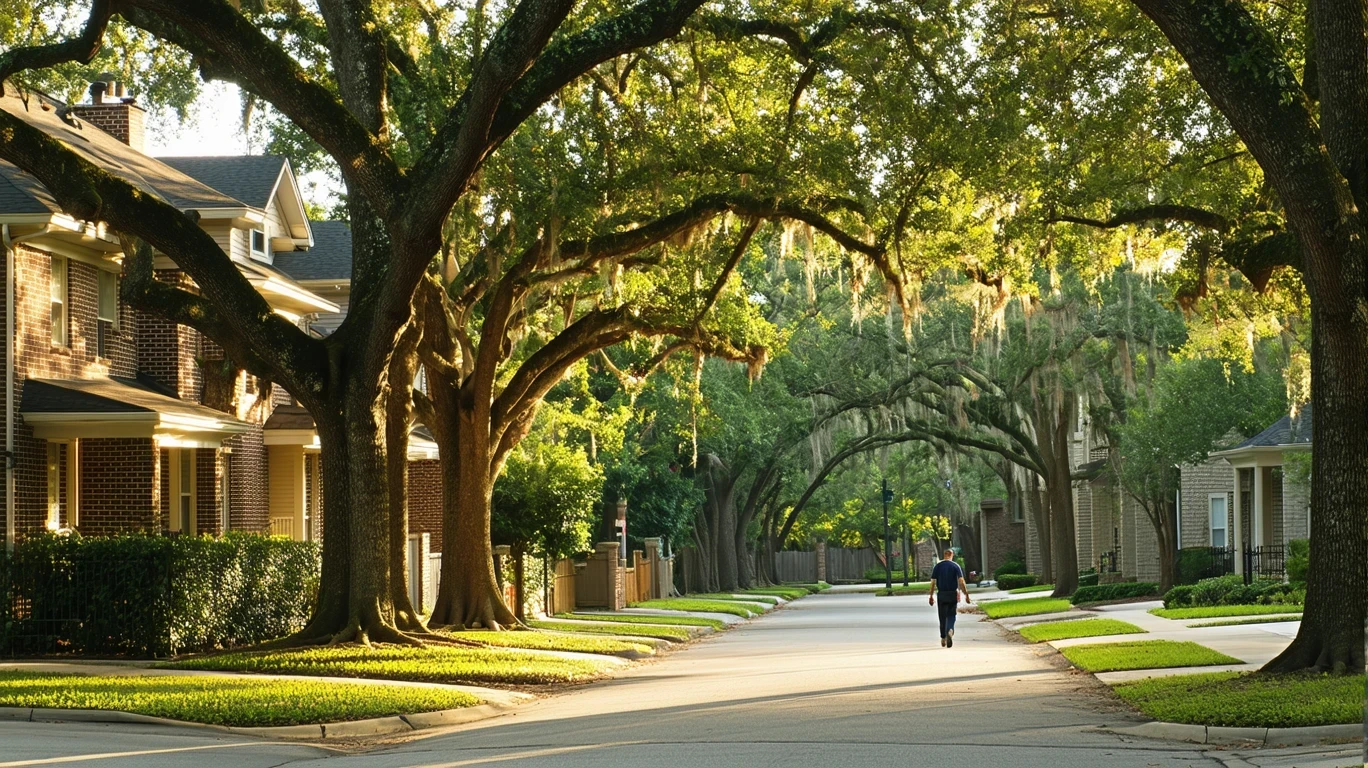
The Housing Market in Houston Today
Houston’s housing market is shaped by three forces that don’t always move together: job growth tied to energy and healthcare, a development pattern that has historically favored outward expansion over density, and a tax structure that shifts the cost of government services onto property owners. The result is a metro where the median home value sits at $235,000—well below coastal metros—but where the cost of staying in that home rises each year through taxes, insurance, and maintenance driven by heat, humidity, and storm exposure.
What surprises people moving from other regions is how much of Houston’s cost of living is back-loaded. The purchase price feels accessible, but property taxes are high by national standards, and they’re not capped by acquisition value the way they are in some states. Assessed values rise with the market, and so do the bills. Add mandatory HOA fees in many suburban neighborhoods, and the gap between “what you can buy” and “what you can afford to keep” becomes a central question for first-time buyers.
Houston is also not a single housing market. Walkable pockets with substantial pedestrian infrastructure, rail access, and mixed-use development exist alongside car-dependent subdivisions where errands require planning and driving. The city’s pedestrian-to-road ratio exceeds high thresholds in parts of the metro, and food and grocery density is broadly accessible, meaning neighborhood choice directly affects not just commute time but daily logistics, transportation costs, and how much of your week is spent in a car.
Renting in Houston
The median gross rent in Houston is $1,235 per month, a figure that reflects the wide range of neighborhoods, housing types, and proximity to job centers across the metro. Renters in Houston face a market where supply has generally kept pace with demand, but where location determines far more than rent alone—it shapes commute length, access to transit, and whether daily errands require a car or can be handled on foot.
Rental pressure in Houston is less about scarcity and more about distribution. Apartments near the Medical Center, Downtown, or inside the Loop offer shorter commutes and access to rail transit, but command higher rents. Moving outward reduces rent but increases transportation costs and time, especially in areas where bus service is limited and pedestrian infrastructure is sparse. The tradeoff isn’t just financial—it’s logistical. Renters who prioritize walkability and transit access will find it in pockets, but most of the metro requires a car for grocery runs, errands, and commuting.
Rent renewals in Houston can be volatile, especially in neighborhoods experiencing job growth or infrastructure investment. Unlike ownership, where property tax increases are predictable and maintenance costs are controllable, renters face renewal terms set by landlords responding to market conditions. The upside is flexibility: renters can relocate without selling, avoid property tax exposure, and leave maintenance and insurance complexity to someone else.
Owning a Home in Houston
Ownership in Houston means taking on costs that renters never see directly. The median home value of $235,000 is the starting point, but the ongoing expenses—property taxes, homeowners insurance, HOA fees, and maintenance driven by heat and humidity—define the real cost of staying put.
Property taxes in Texas are high because they fund what income taxes cover in other states. Homeowners pay for schools, roads, emergency services, and local infrastructure through annual assessments tied to property value. When home values rise, so do tax bills, and there’s no acquisition-date cap to limit increases. This makes ownership in Houston more volatile than in states with tax limitations, and it means buyers need to plan for rising costs even if they lock in a fixed mortgage rate.
HOAs are common in Houston’s suburban neighborhoods, especially in newer developments. They maintain common areas, enforce deed restrictions, and sometimes provide amenities like pools or parks. Fees vary widely—from under $100 to several hundred dollars per month—and they’re mandatory. For buyers comparing a $1,200 rent to a $1,200 mortgage payment, the HOA fee is the hidden line item that changes the math.
Maintenance in Houston is driven by climate. Air conditioning isn’t optional—it’s a survival cost that runs from April through October. HVAC systems work harder here than in temperate climates, and they wear out faster. Humidity accelerates rot, mold, and pest pressure. Roofs take a beating from sun exposure and occasional severe weather. These aren’t surprises, but they’re not always priced into buyer expectations, especially for people moving from regions where homes require less environmental defense.
Apartment vs House in Houston — Cost Behavior Comparison
The table below isolates cost categories where apartments and houses behave differently in Houston, based on local climate, governance, and infrastructure. Rows are included only where the distinction is meaningful and locally justified. Generic or nationally uniform categories are omitted.
| Expense Category | Apartment | House |
|---|---|---|
| Cooling costs | Shared walls reduce exposure; central systems managed by landlord | Full envelope exposure; homeowner responsible for HVAC efficiency and replacement |
| Property tax | Embedded in rent; landlord absorbs volatility | Paid directly; rises with assessed value and tax rate changes |
| HOA fees | Rare or included in rent | Common in suburban neighborhoods; mandatory and separate from mortgage |
| Maintenance responsibility | Landlord handles HVAC, roof, exterior, pest control | Homeowner pays for all repairs, replacements, and preventive work |
| Insurance complexity | Renter’s insurance covers contents only | Homeowner’s insurance includes structure, liability, and often flood or windstorm riders |
Why these rows: Cooling costs differ because Houston’s long, hot summers create sustained HVAC load, and houses bear full envelope exposure. Property taxes and HOA fees are structural differences tied to Texas’s tax system and common governance patterns. Maintenance and insurance reflect the shift in responsibility and climate-driven risk that defines ownership here. Categories like internet, water, or trash were excluded because they vary by lease terms and provider, not by housing type.
Utilities & Upkeep Differences
Utility exposure in Houston is dominated by air conditioning. The cooling season runs from late spring through early fall, and in a typical summer, indoor comfort depends on systems running daily. Apartments benefit from shared walls and centrally managed equipment, which reduces individual exposure. Houses, especially older or poorly insulated ones, face higher bills and more frequent HVAC repairs. Electricity rates in Houston are 16.04¢/kWh, and while that’s not extreme, the volume of usage during peak months makes cooling a primary budget line.
Natural gas, priced at $25.56 per thousand cubic feet, plays a smaller role. Heating demand is light and short-lived, concentrated in a few winter months when temperatures occasionally dip. The cost asymmetry is notable: cooling dominates spending, heating barely registers.
Maintenance differences between apartments and houses are driven by responsibility, not just cost. Apartment residents call the landlord when the AC fails or the roof leaks. Homeowners pay for the service call, the repair, and eventually the replacement. In Houston’s climate, HVAC systems, roofs, and exterior paint face accelerated wear. Humidity creates mold risk, pest pressure, and wood rot. These aren’t catastrophic expenses, but they’re recurring, and they’re not optional.
Rent vs Buy: Long-Term Exposure in Houston
The rent-versus-buy decision in Houston isn’t primarily about building equity or tax benefits—it’s about which cost structure fits your tolerance for volatility, responsibility, and long-term commitment.
Renters face unpredictable rent renewals, but they avoid property tax increases, maintenance surprises, and insurance complexity. When the AC breaks or the roof leaks, it’s the landlord’s problem. When the neighborhood changes or a job opportunity appears across town, renters can leave without selling. The cost of renting is higher than a mortgage payment in many cases, but the cost is also the ceiling—renters don’t pay for new water heaters, foundation repairs, or property tax appeals.
Homeowners gain control and predictability in some areas, but they also absorb risks that renters never touch. Property taxes rise with assessed values, and in a no-income-tax state, those increases are how local governments fund services. Maintenance costs are driven by climate and age, and they’re not optional. Insurance premiums reflect flood risk, windstorm exposure, and claims history. Homeowners can improve efficiency, lock in housing costs through fixed mortgages, and avoid rent renewal shocks—but they pay for that control with responsibility and reduced flexibility.
The long-term tradeoff in Houston comes down to whether you value exit speed or cost control. Renters keep options open and avoid the back-end costs of ownership. Owners accept those costs in exchange for stability and the ability to modify, improve, and stay put without landlord approval. Neither path is cheaper—both shift where the money goes and when the bills arrive.
FAQs About Housing Costs in Houston
Why are property taxes in Houston higher than in other states?
Texas has no state income tax, so local governments fund schools, infrastructure, and services through property taxes. Homeowners in Houston pay directly for what income taxes cover elsewhere, and because assessed values aren’t capped at purchase price, tax bills rise as home values increase.
Do all Houston neighborhoods have HOA fees?
No, but they’re common in suburban subdivisions and newer developments. Older neighborhoods inside the Loop and some unincorporated areas often lack HOAs. Fees vary widely depending on amenities, governance, and maintenance responsibilities, and they’re mandatory where they exist.
Is renting cheaper than owning in Houston?
Not necessarily. Rent can exceed a mortgage payment, but renters avoid property taxes, maintenance costs, insurance complexity, and HOA fees. Ownership shifts costs from rent to taxes, upkeep, and responsibility. The question isn’t which is cheaper—it’s which cost structure fits your situation and timeline.
How much does air conditioning cost homeowners in Houston?
Cooling dominates utility spending from late spring through early fall. Electricity rates are 16.04¢/kWh, and usage depends on home size, insulation, and system efficiency. Older homes and poorly insulated houses face notably higher bills. HVAC replacement and repair costs add to the long-term expense of ownership in Houston’s climate.
Does Houston’s walkability affect housing costs?
Indirectly, yes. Walkable pockets with pedestrian infrastructure, rail access, and broadly accessible errands reduce transportation costs and time spent driving. Homes and apartments in these areas often command higher prices or rents, but they lower the need for second cars, long commutes, and fuel expenses. Location choice in Houston affects not just housing costs but overall living costs and daily logistics.
Making Housing Choices in Houston
Housing costs in Houston are shaped by a tax structure that shifts public services onto property owners, a climate that accelerates maintenance cycles, and a development pattern that creates pockets of walkability within a largely car-dependent metro. The entry price is lower than many large metros, but the ongoing costs—taxes, HOA fees, cooling, and upkeep—require planning and realistic expectations.
Renters gain flexibility and avoid the back-end costs of ownership, but they face renewal volatility and limited control. Homeowners lock in some costs and gain the ability to improve efficiency and stability, but they absorb property tax increases, maintenance responsibility, and insurance complexity. Neither path is universally cheaper—both redistribute costs across time and control.
For households prioritizing walkability, transit access, and errand convenience, Houston offers infrastructure in concentrated areas, but most of the metro requires a car. For those weighing rent against ownership, the decision hinges on how long you plan to stay, your tolerance for maintenance and tax volatility, and whether you value exit speed or cost predictability. Houston’s housing market rewards those who understand not just what homes cost to buy, but what they cost to keep.
How this article was built: In addition to public economic data, this article incorporates location-based experiential signals derived from anonymized geographic patterns—such as access density, walkability, and land-use mix—to reflect how day-to-day living actually feels in Houston, TX.