
“I take the bus when I can, but honestly, most of my week still happens in the car. The routes are there, but they don’t always line up with where I need to be or when I need to be there.”
That’s the reality for many people navigating transportation options in Eastvale — a city where mobility is shaped by suburban layout, selective walkability, and a transit system that plays a supporting role rather than a starring one. Understanding how people actually get around here means looking past the availability of bus stops and focusing on how daily routines, commute patterns, and neighborhood design interact in practice.
Eastvale sits in the Inland Empire, a region where car ownership has long been the default. But the city’s internal structure tells a more nuanced story. Some neighborhoods feature pedestrian infrastructure dense enough to support local errands on foot, while others remain tightly bound to the car for nearly every trip. Public transit exists, but its role is narrow — useful for specific routes and riders, less so for the flexibility most households expect from their daily transportation.
This article explains what works, what doesn’t, and who benefits from each mode of getting around in Eastvale.
How People Get Around Eastvale
Most residents rely on a personal vehicle for the majority of their trips. The city’s layout — residential subdivisions interspersed with commercial corridors — creates a structure where driving offers the most predictable access to work, school, shopping, and services. Parking is generally available, roads are wide, and the freeway network connects Eastvale to employment centers across the Inland Empire and into Orange County.
But Eastvale isn’t uniformly car-dependent. Certain pockets of the city show pedestrian infrastructure that exceeds typical suburban norms. Sidewalks, crosswalks, and pedestrian pathways appear at densities high enough to make walking a practical choice for nearby errands — picking up groceries, reaching a park, or accessing local services. These walkable zones don’t eliminate the need for a car, but they reduce the frequency of short, low-value trips that add up over time.
Newcomers often assume Eastvale operates like older Inland Empire suburbs, where every destination requires ignition. In practice, the city’s newer development patterns have embedded more pedestrian-friendly design in select areas, creating a hybrid mobility environment. The challenge is that walkability remains localized. A household in one neighborhood may walk to a grocery store or coffee shop regularly, while a household two miles away finds nothing reachable on foot.
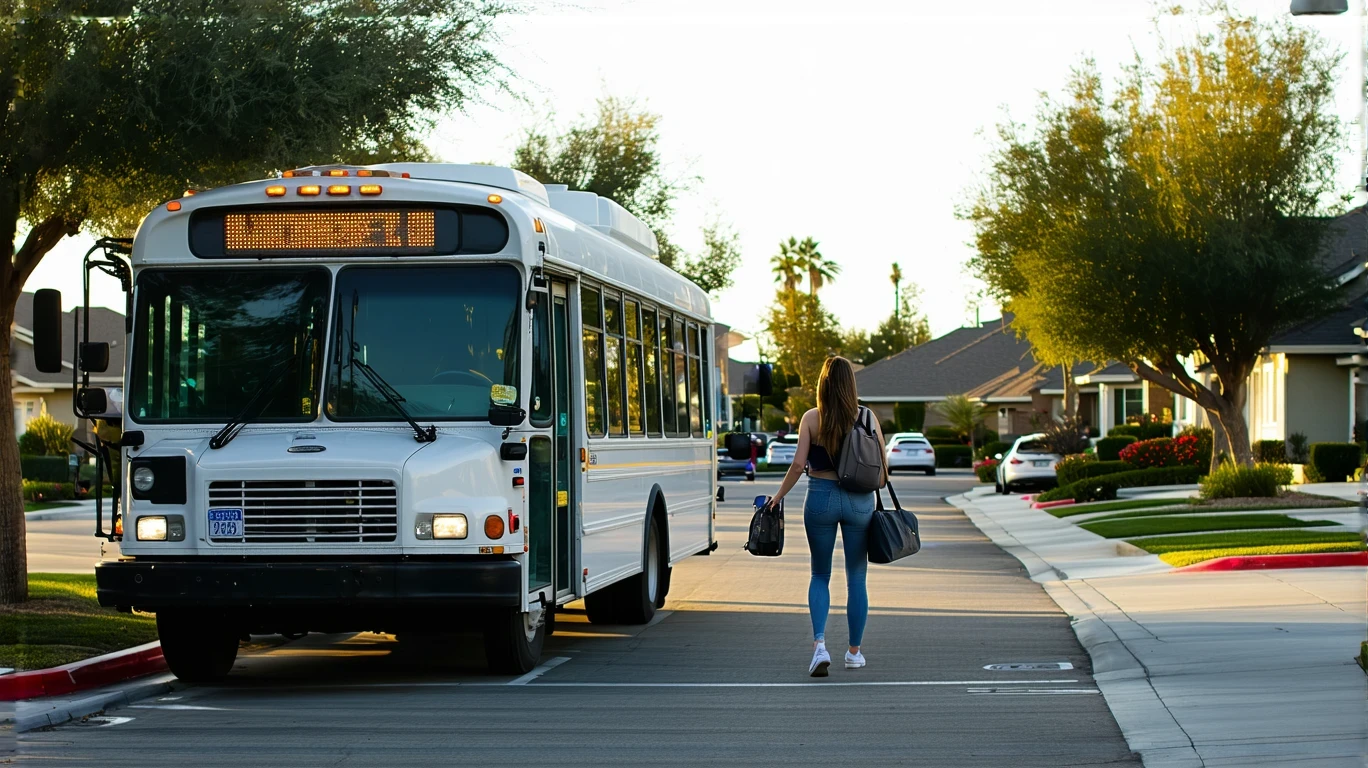
Public transit serves as a supplemental option, not a primary one. Bus service is present, offering connections within Eastvale and to nearby cities, but the network doesn’t provide the coverage or frequency that would allow most residents to forgo car ownership. For households with one vehicle and multiple drivers, transit can fill gaps — getting one person to work while another uses the car. For those without a vehicle, transit availability becomes a constraint, limiting job access and daily flexibility.
Public Transit Availability in Eastvale
Public transit in Eastvale centers around bus service, typically operated by regional systems such as Riverside Transit Agency (RTA). Routes connect residential areas to commercial corridors, schools, and neighboring cities, but coverage is selective. Not every neighborhood has a nearby stop, and service frequency varies by route and time of day.
Transit tends to work best along major corridors where residential density and commercial activity create consistent ridership. In these areas, bus stops are spaced regularly, and routes align with common destinations — shopping centers, medical offices, and transfer points to other regional lines. For riders whose daily routines fit these corridors, transit can provide a viable alternative to driving, especially for trips that don’t require tight scheduling.
Where transit falls short is in reaching lower-density subdivisions, providing late-night or weekend service, and offering the kind of route flexibility that matches the multi-stop, non-linear trips many households make. A commute from home to a single workplace may work on transit. A trip that involves dropping off children, stopping for groceries, and picking up a prescription typically does not.
Eastvale lacks rail service, which limits the speed and capacity of the transit network. Bus-only systems face inherent tradeoffs: they share road space with cars, experience the same traffic delays, and require longer travel times for equivalent distances. For commuters heading to job centers in Ontario, Riverside, or Orange County, transit becomes less competitive as distance increases and transfer requirements multiply.
The result is a transit system that serves specific use cases well — budget-conscious commuters with linear routes, students, and households supplementing car access — but doesn’t provide the comprehensive coverage that would allow most residents to rely on it as their primary mode.
Driving & Car Dependence Reality
Driving remains the dominant mode of transportation in Eastvale because the city’s geography and infrastructure are built around it. Residential neighborhoods spread across a relatively large area, commercial development clusters along arterial roads, and employment centers lie outside city limits. Without a car, accessing work, school, and services becomes a logistical puzzle that most households choose not to solve.
Parking is rarely a constraint. Homes typically include garages and driveways, shopping centers provide ample surface lots, and street parking is available in most areas. This abundance reduces one of the friction points that makes car ownership burdensome in denser cities, but it also reinforces the expectation that every household will own at least one vehicle — and often two or more.
The cost of driving in Eastvale includes fuel, insurance, maintenance, and registration, but the city’s structure makes these expenses difficult to avoid. Gas prices in the area run higher than the national average, reflecting California’s fuel taxes and market conditions. At $4.61 per gallon, filling a tank costs more than in many other states, and households with long commutes or multiple drivers feel that pressure regularly.
Car dependence also shapes housing decisions. Proximity to freeways becomes a key factor for buyers and renters, as does access to commercial corridors that reduce the need for long drives to reach daily services. Households willing to absorb longer commutes can access more affordable housing, while those prioritizing shorter drives pay a premium for location.
The tradeoff is predictability. A car offers control over timing, routing, and trip chaining in ways that transit cannot match. For families managing school schedules, work shifts, and extracurricular activities, that control often outweighs the financial cost of ownership.
Commuting Patterns & Daily Mobility
Commuting in Eastvale typically involves driving to employment centers outside the city. Many residents work in Ontario, Riverside, Corona, or Orange County, making freeway access a daily necessity. The structure of these commutes — single-destination, predictable timing, and reliance on major highways — fits the region’s car-oriented infrastructure well.
For households where both adults work, commuting often requires two vehicles. Carpooling is less common due to mismatched schedules and workplace locations. Public transit can serve one commuter in a two-worker household, but only if their route aligns with available bus service and their employer’s location sits near a transit stop.
Daily mobility extends beyond commuting. School runs, grocery trips, medical appointments, and social activities all require transportation, and most households default to driving for these as well. The city’s layout — with schools, parks, and services distributed across neighborhoods rather than concentrated in a walkable core — makes trip chaining by car the most efficient option.
Some residents benefit from walkable pockets within Eastvale, where pedestrian infrastructure supports short trips on foot. These areas reduce the need to drive for every errand, but they don’t eliminate car dependence. Even in the most walkable neighborhoods, longer trips — to work, to regional shopping centers, or to visit family in nearby cities — still require a vehicle.
The result is a mobility pattern where driving dominates, but the intensity of that dependence varies by household. Those living near commercial corridors and working locally may drive less frequently. Those commuting long distances or managing complex schedules drive more, and the cost and time burden of that mobility becomes a central factor in their daily routine.
Who Transit Works For — and Who It Doesn’t
Public transit in Eastvale serves a narrow but meaningful segment of the population. It works best for individuals with linear commutes to destinations along bus routes, flexible schedules that accommodate longer travel times, and a willingness to trade convenience for cost savings. Students, budget-conscious workers, and households using transit to supplement car access make up the core ridership.
Transit becomes less viable for families with children, especially those managing school drop-offs, after-school activities, and multi-stop errands. The lack of route density and service frequency makes these trips impractical without a car. Similarly, workers with non-traditional hours — early mornings, late evenings, or weekend shifts — often find that bus service doesn’t align with their schedules.
Renters living near transit corridors have better access than those in peripheral subdivisions, but even proximity to a bus stop doesn’t guarantee usability. If a rider’s workplace requires a transfer, adds significant travel time, or sits far from a stop on the destination end, the practical benefit diminishes quickly.
Homeowners in Eastvale are more likely to own multiple vehicles, reducing their reliance on transit for daily trips. For these households, transit may serve as a backup option — useful during vehicle repairs or for occasional trips — but it rarely functions as a primary mode.
The clearest fit for transit is the single commuter with a predictable route, no mid-day mobility needs, and a workplace located near a bus line. For everyone else, transit availability matters less than the structure of their daily routine and the flexibility required to manage it.
Transportation Tradeoffs in Eastvale
Choosing between transit and driving in Eastvale means weighing predictability against cost, and control against flexibility. Driving offers the ability to leave when needed, take direct routes, and chain multiple stops into a single trip. It also requires paying for fuel, insurance, maintenance, and parking — though parking costs in Eastvale remain minimal compared to urban centers.
Transit reduces direct transportation costs but introduces time penalties and scheduling constraints. A trip that takes 15 minutes by car may take 45 minutes by bus, and that gap widens with transfers or indirect routing. For households where time is the limiting resource — parents managing school schedules, workers with tight shift windows — the cost savings from transit often don’t justify the added complexity.
Walkability in Eastvale’s denser pockets offers a third option for local trips, reducing reliance on both driving and transit for nearby errands. But walkability doesn’t replace the need for a car; it supplements it. Households in walkable neighborhoods still drive for work, regional shopping, and longer trips, but they drive less frequently for low-value errands.
The tradeoff ultimately comes down to household structure and priorities. Single adults with flexible schedules and linear commutes can make transit work. Families with children, multiple workers, or complex daily routines default to driving because the alternatives don’t provide the control and predictability they need. Walkable neighborhoods reduce driving frequency but don’t eliminate car dependence.
Eastvale’s transportation landscape rewards car ownership and penalizes those without it. Transit exists, but it functions as a supplement rather than a substitute, and walkability remains localized rather than citywide.
FAQs About Transportation in Eastvale (2026)
Is public transit usable for daily commuting in Eastvale?
Public transit works for specific commutes — those that align with bus routes, tolerate longer travel times, and don’t require mid-day mobility. For most residents, especially those commuting to job centers outside Eastvale or managing family schedules, transit doesn’t provide the coverage or frequency needed to replace a car.
Do most people in Eastvale rely on a car?
Yes. The city’s layout, employment patterns, and limited transit coverage make car ownership the default for most households. Even in neighborhoods with walkable infrastructure, longer trips and regional commutes still require driving.
Which areas of Eastvale are easiest to live in without a car?
Neighborhoods near commercial corridors with bus service and higher pedestrian infrastructure density offer the best chance of reducing car dependence. But even in these areas, most residents still own a vehicle for work commutes and trips outside the city.
How does commuting in Eastvale compare to nearby cities?
Eastvale shares the Inland Empire’s car-oriented commute culture. Residents face similar driving patterns as those in Corona, Norco, or Jurupa Valley, with most commutes heading to regional employment centers. Transit options are comparable to other suburban cities in the area — present but limited.
Does Eastvale have bike infrastructure for commuting?
Bike infrastructure exists in some pockets, with bike-to-road ratios in the medium range. This supports recreational cycling and short local trips in certain neighborhoods, but the city’s layout and distances to major employment centers make bike commuting impractical for most residents.
How Transportation Fits Into the Cost of Living in Eastvale
Transportation in Eastvale functions as a structural cost — one that shapes housing decisions, daily routines, and household budgets in ways that extend beyond the price of gas or a bus pass. The city’s car-dependent layout means that most households need at least one vehicle, and many need two. That requirement introduces fixed costs — insurance, registration, maintenance — that persist regardless of how much driving actually happens.
For households evaluating whether Eastvale fits their budget, transportation deserves attention not just as a line item, but as a factor that influences where they live, how they commute, and how much time they spend managing logistics. Proximity to freeways, access to walkable corridors, and alignment with bus routes all affect the intensity of car dependence and the associated costs.
Readers looking for a fuller picture of how transportation costs interact with housing, utilities, and other expenses should consult the Monthly Spending in Eastvale: The Real Pressure Points article, which breaks down where money goes and how different household types experience cost pressure.
Eastvale’s transportation landscape rewards those who can afford flexibility — multiple vehicles, proximity to work, or schedules that allow for longer commutes. For those without that flexibility, the city’s limited transit and localized walkability create friction that affects not just cost, but quality of life. Understanding that tradeoff early helps newcomers make decisions that align with their actual mobility needs, not just their assumptions about suburban living.
How this article was built: In addition to public economic data, this article incorporates location-based experiential signals derived from anonymized geographic patterns—such as access density, walkability, and land-use mix—to reflect how day-to-day living actually feels in Eastvale, CA.