
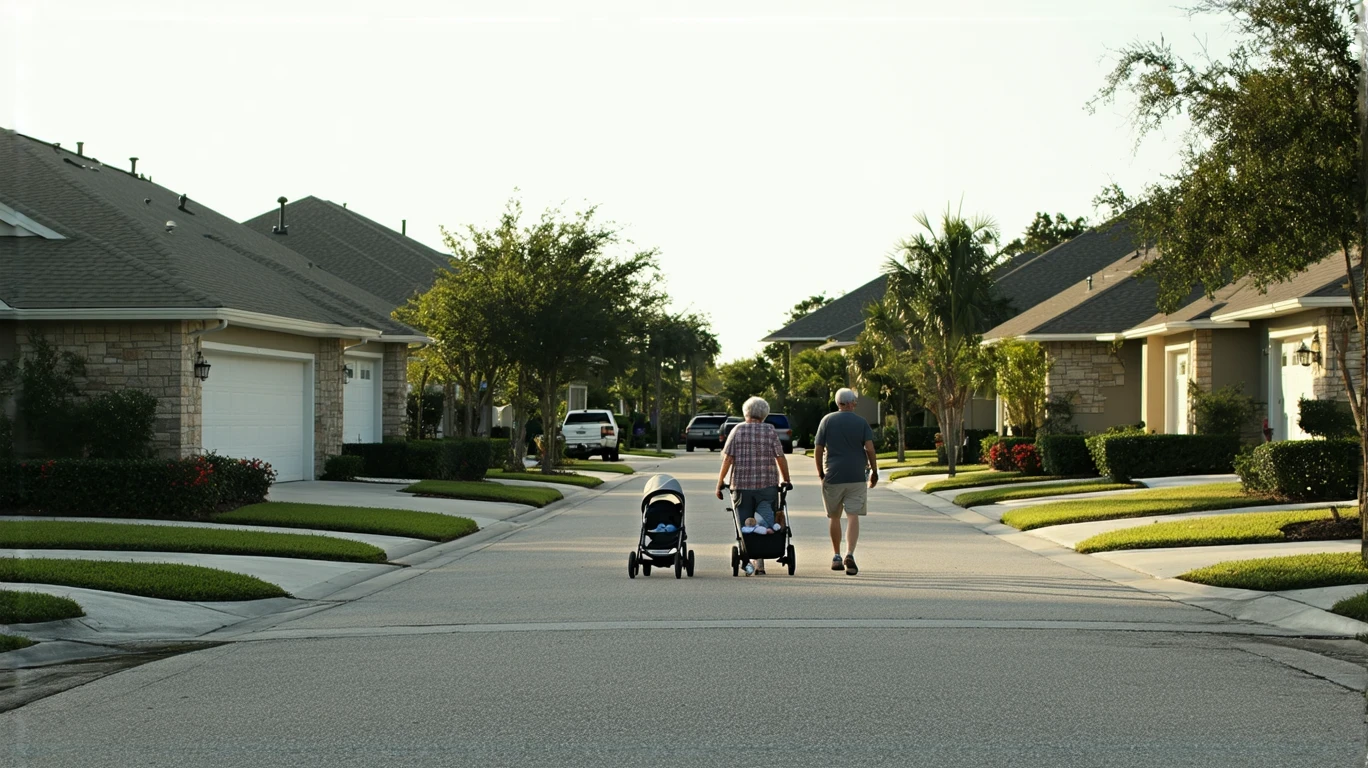
Is Land O Lakes the kind of place you grow roots—or just pass through? That depends less on what the city offers and more on what you’re hoping to escape or find. Tucked into the northern Tampa metro, Land O Lakes has grown quickly from rural crossroads into a sprawling suburban landscape filled with planned communities, chain retail, and families chasing space and affordability. But growth brings tension: between convenience and character, between quiet and isolation, between the promise of suburban ease and the reality of car dependency. The vibe here isn’t unhappy—it’s transitional. People who wanted room to breathe and a mortgage they could manage tend to feel satisfied. People who wanted texture, spontaneity, or a sense of place tend to feel restless.
What keeps coming up emotionally is the gap between expectation and infrastructure. Land O Lakes looks like it should have everything—new homes, decent roads, green spaces—but daily life reveals friction. Grocery runs require planning because options are spread thin and clustered along busy corridors. Getting around means driving, always, because bus service exists but remains limited and rail transit is absent entirely. For families, the appeal of newer neighborhoods comes with a tradeoff: school density is low, and finding the right fit often means navigating waitlists or longer drives. The city feels like it’s still catching up to its own growth, and that creates a particular emotional texture—hopeful but impatient, comfortable but not quite complete.
What the Conversation Sounds Like Online
Social media discussion around Land O Lakes tends to circle a few recurring themes: traffic and growth, the search for community identity, and the tension between suburban convenience and suburban sameness. On local Facebook groups and regional subreddit threads, residents describe a place that’s still figuring out what it wants to be. Tone varies—some posts celebrate the quiet, the affordability, the family-friendly feel. Others express frustration with congestion on major roads, limited dining variety, and the sense that “everything requires a drive.”
One common refrain: “It’s a great place to raise kids if you’re okay with driving everywhere and planning ahead.” Another: “We moved here for the space and the price, but I miss being able to walk to anything.” And from long-time locals: “It’s changed so fast—it doesn’t feel like the same town anymore, but I’m not sure what it’s becoming.”
The emotional undercurrent is less about dissatisfaction and more about adjustment. People aren’t angry; they’re recalibrating expectations. The city works well for households who prioritize yard space, newer construction, and lower costs over walkability and spontaneous social options. It works less well for people who assumed suburban growth would bring urban-style convenience.
How Local Coverage Frames the City
Local news and community coverage tend to frame Land O Lakes through the lens of growth management and infrastructure catch-up. Headlines and story angles reflect a place in transition, where new development arrives faster than the amenities and systems needed to support it. The tone is rarely celebratory or critical—it’s observational, focused on the mechanics of change rather than judgment about direction.
Typical topic buckets include:
- “New Neighborhoods Bring Families—and Traffic Questions”
- “Residents Debate What ‘Community Character’ Should Mean”
- “Local Schools Face Capacity Pressure as Population Grows”
- “Retail Expansion Continues Along Major Corridors”
- “Parks and Green Space: Keeping Pace with Development”
The framing reflects a city that’s neither struggling nor thriving in a dramatic way—it’s managing. That creates a particular emotional tone: practical, forward-looking, but also a little uncertain. Residents reading this coverage tend to feel validated in their mixed feelings. Growth is real, but so is the lag between what’s built and what’s needed to make daily life feel seamless.
What Review Platforms Reveal About Expectations
Public reviews on platforms like Google, Yelp, and neighborhood apps reveal a pattern: Land O Lakes tends to delight people who wanted suburban predictability and disappoint people who wanted texture or variety. Positive reviews emphasize safety, space, and family-friendliness. Negative or lukewarm reviews focus on repetition—chain restaurants, limited nightlife, and the sense that “everything looks the same.”
Praise often sounds like this: “Quiet streets, good schools nearby, and we finally have a yard.” Or: “Perfect for families who want a slower pace without being too far from Tampa.” Complaints tend to be more specific: “You have to drive 15 minutes for anything interesting,” or “It’s all big box stores and the same five chain restaurants.”
Neighborhood variation exists but is often described in broad strokes—newer planned communities with HOAs and amenities versus older pockets with larger lots and fewer rules. The former appeals to families seeking move-in-ready convenience; the latter attracts buyers prioritizing space and autonomy over community pools and landscaping standards. Both groups tend to agree on one thing: if you don’t have a reliable car, daily life becomes significantly harder. The physical layout of the city—low-density, car-oriented, with commercial corridors separated from residential areas—means that errands, healthcare, and social activities all require intentional trips rather than spontaneous stops.
How Land O Lakes Compares to Nearby Cities
| Dimension | Land O Lakes | Wesley Chapel | Lutz |
|---|---|---|---|
| Overall Vibe | Transitional suburban growth, family-oriented but infrastructure catching up | Polished planned communities, newer amenities, slightly more upscale feel | Established suburban mix, more mature trees and older homes, quieter tone |
| Walkability & Errands | Car-dependent, sparse grocery density requires planning | Also car-dependent but denser retail clusters near major intersections | Similar car dependency, slightly more neighborhood-scale retail pockets |
| Community Identity | Still forming, rapid growth creates mixed identity | Stronger planned community identity, more cohesive branding | More settled identity, long-time residents anchor tone |
| Family Appeal | High appeal for space and affordability, but school density concerns | High appeal with newer schools and family amenities more accessible | Steady appeal, established schools but fewer new builds |
The comparison reveals that Land O Lakes occupies a middle position—less polished than Wesley Chapel, less settled than Lutz. If you prioritize newer construction and don’t mind a city still finding its rhythm, Land O Lakes offers good value and space. If you want a more cohesive community feel with denser amenities, Wesley Chapel may feel more complete. If you prefer established neighborhoods with mature landscaping and a quieter, less transient vibe, Lutz might be a better emotional fit. None of these cities offer walkable urban convenience, but they differ in how far along they are in translating suburban growth into daily ease.
What Locals Are Saying
“We moved here from Tampa for the space and the schools. It’s been great for the kids—they have a yard, we’re in a safe neighborhood. But I do miss being able to walk to a coffee shop or grab dinner without getting in the car.” — Parent of two, moved in 2021
“I work remotely, so the lack of walkability doesn’t bother me much. What I appreciate is the quiet and the lower cost compared to closer-in suburbs. It’s not exciting, but it’s exactly what I needed after years in a cramped apartment.” — Remote worker, renting since 2022
“It’s fine if you’re okay with chain everything. I just wish there were more local spots—places with personality. It all feels a little generic.” — Young professional, considering a move
“Traffic on 41 and Land O Lakes Boulevard can be rough during rush hour, and it’s only getting worse as more people move in. I love my neighborhood, but getting anywhere takes longer than it should.” — Long-time resident
“We looked at Wesley Chapel but couldn’t afford what we wanted. Land O Lakes gave us more house for the money, and honestly, the drive to work is about the same. No regrets.” — First-time homebuyer
“I’m retired and wanted something quiet and affordable. Land O Lakes checks both boxes. I don’t need nightlife, and I’m used to driving. It works for me.” — Retiree, moved in 2020
“The parks are nice, and there’s water access nearby, which we use a lot. But finding a good pediatrician or specialist means driving to Wesley Chapel or Tampa. It’s not a dealbreaker, just something to know going in.” — Parent, planning to stay long-term
Does Land O Lakes Feel Like a Good Fit?
Land O Lakes doesn’t ask you to love it—it asks you to decide whether its tradeoffs align with your priorities. This is a city that works well for households who value space, affordability, and a family-oriented suburban structure over walkability, spontaneity, or dense local amenities. It works for people who are comfortable with car dependency and who don’t mind planning errands around longer drives. It works for remote workers, retirees seeking quiet, and families willing to navigate school options in exchange for larger homes and lower costs.
It tends to frustrate people who assumed suburban growth would bring urban-style convenience—those who want to walk to the grocery store, grab dinner on a whim, or access a wide range of services without intentional trips. The city’s infrastructure is catching up, but it’s not there yet. Daily life requires a car, always, and that creates friction for households without reliable transportation or those who simply prefer a more walkable rhythm. The low school density and absence of a nearby hospital also add logistical complexity for families and anyone managing ongoing healthcare needs.
The emotional profile of Land O Lakes is neither celebratory nor dissatisfied—it’s pragmatic. People here tend to focus on what they gained (space, cost, quiet) rather than what they gave up (walkability, variety, spontaneity). If that tradeoff feels like a win, you’ll likely feel at home. If it feels like settling, you’ll likely feel restless. The city isn’t finished becoming what it will be, and that means living here requires a tolerance for transition—construction, traffic, and the slow build of community identity. For some, that’s part of the appeal. For others, it’s a reason to keep looking.
If you’re weighing whether Land O Lakes fits your life, consider exploring your monthly budget in Land O Lakes to understand where money goes day-to-day, or dive into quality of life factors and lifestyle needs to see how amenities and infrastructure align with your expectations. And if you’re still deciding between renting and buying, the real tradeoffs in Land O Lakes housing can help clarify what makes sense for your situation.
How this article was built: In addition to public economic data, this article incorporates location-based experiential signals derived from anonymized geographic patterns—such as access density, walkability, and land-use mix—to reflect how day-to-day living actually feels in Land O Lakes, FL.
The perspectives shown reflect commonly expressed local sentiment and recurring themes in public discussion, rather than individual accounts.