
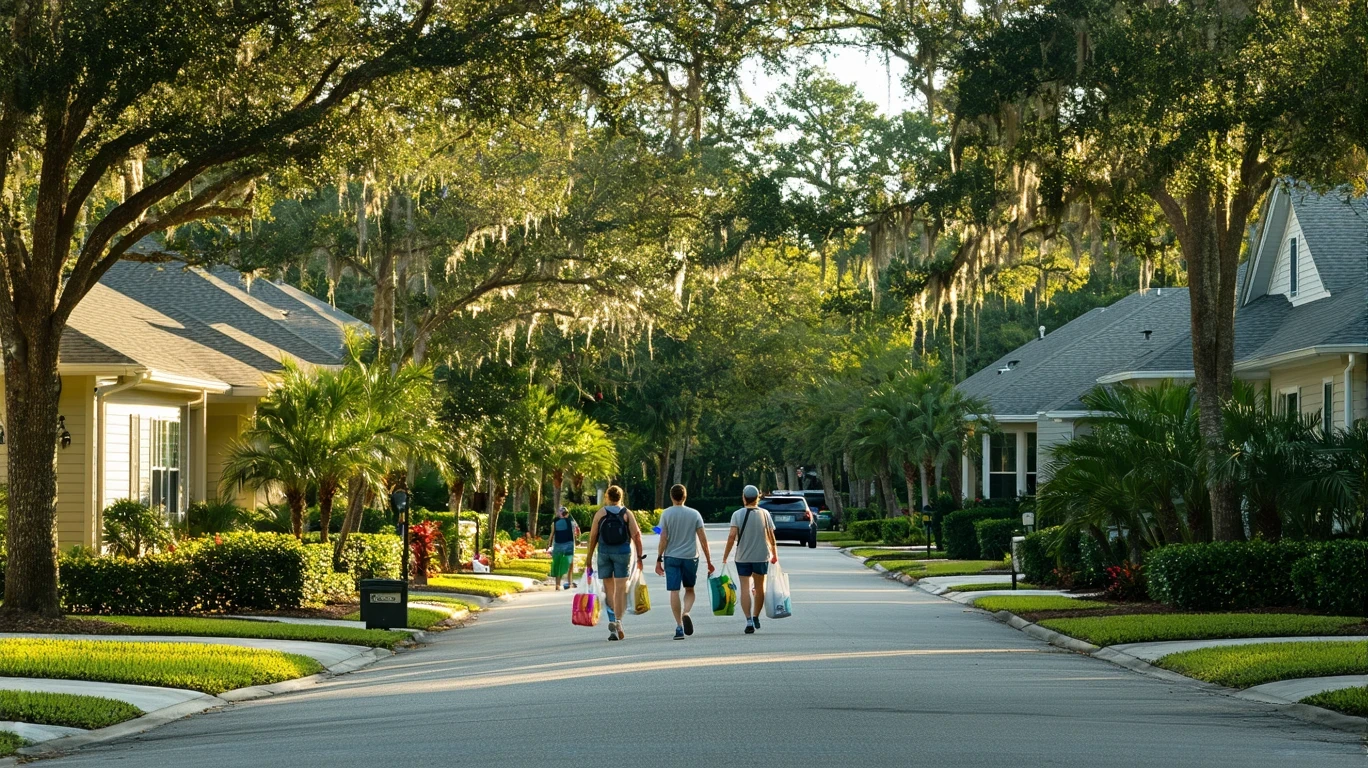
How Grocery Costs Feel in Land O Lakes
Grocery prices in Land O Lakes sit slightly above the national baseline, reflecting the broader cost structure of the Tampa metro area. With a regional price parity index of 103, everyday staples—bread, eggs, chicken, milk—tend to run a few percentage points higher than the national average, though the difference is modest enough that most households notice it more through cumulative weekly spending than through sticker shock on individual items. For singles and couples, grocery costs are manageable but require attention to store choice and shopping habits. For families, especially those with children, the volume effect amplifies price sensitivity: even small per-item differences add up quickly when buying in quantity, making discount-tier access and planning essential tools for keeping food costs predictable.
Who feels grocery pressure most in Land O Lakes depends less on the price of any single item and more on household size, income flexibility, and shopping logistics. Singles often spend less in absolute terms but feel the impact of price variation more acutely—there’s less room to buy in bulk or absorb waste. Couples and small households occupy a middle ground, where store choice and meal planning can meaningfully shift weekly spending without requiring extreme couponing or long drives. Families, particularly those with multiple children or single-income structures, face the highest sensitivity: grocery spending becomes a significant line item, and the difference between discount and premium store tiers can represent hundreds of dollars annually. In Land O Lakes, where grocery density sits below typical thresholds and most errands require a car, the logistics of shopping—how far you drive, how often, and whether you can easily compare prices across stores—become part of the cost equation itself.
The structure of Land O Lakes shapes how people shop for groceries in ways that aren’t immediately visible in price tags. The area’s low-rise, mixed-use character and sparse grocery accessibility mean that most households rely on strip-center retail reached by car rather than walkable neighborhood markets. With a pedestrian-to-road ratio in the medium band and bus service present but limited, grocery shopping here is a planned errand rather than a spontaneous stop on the way home. That car dependency introduces friction: you’re more likely to consolidate trips, which can encourage bulk buying and discount-tier shopping but also reduces the flexibility to price-shop across multiple stores in a single outing. For households without reliable transportation or those managing tight schedules, that friction translates into fewer store options and less ability to chase sales or compare prices—effectively raising the real cost of groceries even when shelf prices stay constant.
Grocery Price Signals (Illustrative)
These prices illustrate how staple items tend to compare locally—not a full shopping list or a week’s worth of meals, but anchor points that help explain relative cost positioning in Land O Lakes. Derived from national baselines adjusted for regional price parity, they reflect typical pricing patterns rather than store-specific or week-specific snapshots.
| Item | Price |
|---|---|
| Bread | $1.90/lb |
| Cheese | $4.99/lb |
| Chicken | $2.10/lb |
| Eggs | $2.65/dozen |
| Ground Beef | $6.95/lb |
| Milk | $4.22/half-gallon |
| Rice | $1.09/lb |
Derived estimate based on national baseline adjusted by regional price parity; not an observed local price.
These figures suggest that protein—chicken and ground beef—and dairy products like cheese and milk carry the most noticeable price weight in Land O Lakes. Ground beef at nearly $7 per pound and cheese just under $5 per pound mean that households building meals around these staples will feel cost pressure more directly than those relying on rice, beans, or bread. Eggs and chicken offer relative value, particularly for families cooking in volume, but even these “affordable” proteins add up quickly when feeding multiple people daily. The key takeaway isn’t that any single item is prohibitively expensive—it’s that the cumulative effect of modest upward pressure across the basket makes store choice and meal planning more consequential than they might be in lower-cost regions.
Store Choice & Price Sensitivity
Grocery price pressure in Land O Lakes varies significantly by store tier, and understanding that variation is more useful than fixating on a single “average” price. Discount-tier stores—no-frills chains focused on private-label goods, limited selection, and high turnover—offer the lowest shelf prices and the most predictable savings for households willing to trade convenience and brand variety for cost control. These stores are where families and budget-conscious singles can most effectively reduce weekly spending, particularly on staples like rice, pasta, canned goods, and frozen vegetables. Mid-tier stores—regional and national supermarkets with broader selection, frequent sales, and loyalty programs—occupy the middle ground, offering a balance between price and convenience. They’re where most households shop most of the time, and where strategic use of sales, coupons, and store brands can narrow the gap with discount tiers without requiring a separate trip. Premium-tier stores—specialty grocers, organic-focused chains, and upscale markets—charge noticeably more for the same staples, though they offer differentiated value through prepared foods, specialty ingredients, and perceived quality. For households prioritizing convenience, dietary preferences, or time savings, premium stores may be worth the markup, but they’re rarely the most cost-effective choice for routine grocery shopping.
In Land O Lakes, where grocery density is below typical thresholds and most shopping requires a car, store tier choice is shaped by access as much as preference. If the nearest discount-tier store is ten minutes farther than the mid-tier supermarket, the time and fuel cost of that extra trip can erode some of the savings, particularly for households making frequent small trips rather than consolidated weekly runs. Conversely, households with the flexibility to plan larger, less frequent shopping trips can more easily take advantage of discount-tier pricing without the logistics becoming burdensome. The sparse grocery accessibility here also means that price-shopping across multiple stores in a single outing is less practical than in denser areas—you’re more likely to commit to one primary store and supplement selectively, which makes the initial choice of store tier more consequential. For families, that often means prioritizing discount or mid-tier access and planning meals around what’s on sale. For singles and couples, mid-tier stores with strong loyalty programs or rotating promotions can offer a reasonable compromise between cost and convenience.
What Drives Grocery Pressure Here
Grocery pressure in Land O Lakes is shaped by the interaction of regional pricing, household size, and the logistics of access. The regional price parity index of 103 means that the baseline cost of food is modestly elevated compared to the national average, but that upward pressure is relatively uniform—it’s not driven by extreme local scarcity or supply chain bottlenecks, but rather by the broader cost structure of the Tampa metro area. For households with income flexibility, that baseline difference is noticeable but not prohibitive. For households operating on tight budgets—particularly single-income families, retirees on fixed incomes, or service-industry workers—the cumulative effect of that 3% premium compounds with volume, turning grocery shopping into a significant monthly expense that requires active management.
Household size is the single largest amplifier of grocery cost sensitivity. A single person might spend $250–$350 per month on groceries depending on diet and store choice; a couple might spend $500–$650; a family of four can easily approach or exceed $1,000, particularly if dietary needs include fresh produce, protein variety, or specialty items. In Land O Lakes, where grocery density is sparse and car dependency is the norm, larger households face not only higher absolute spending but also greater logistical complexity: more frequent trips, more planning, and more exposure to the friction of limited nearby store options. That friction doesn’t show up in shelf prices, but it affects the real cost of feeding a family—time spent driving, fuel consumed, and the reduced ability to respond flexibly to sales or price changes.
Seasonal variability in grocery prices is less extreme in Florida than in regions with harsher winters, but it still matters. Produce prices fluctuate with growing seasons and supply chain conditions, and protein prices—particularly beef and poultry—can swing with feed costs, fuel prices, and demand cycles. Households that shop flexibly, building meals around what’s in season or on sale rather than fixed weekly menus, can smooth out some of that volatility. Those with less flexibility—due to dietary restrictions, picky eaters, or time constraints—are more exposed to price swings and less able to substitute lower-cost alternatives when specific items spike.
Practical Ways People Manage Grocery Costs
Managing grocery costs in Land O Lakes is less about extreme couponing or deprivation and more about building habits that reduce waste, leverage store pricing patterns, and align shopping behavior with household needs. Meal planning is the single most effective tool: knowing what you’ll cook for the week allows you to buy only what you need, avoid impulse purchases, and take advantage of sales on items you were already planning to use. It also reduces the likelihood of food waste, which is effectively throwing money away—every unused ingredient or expired item represents spending that didn’t translate into meals. For families, meal planning also helps manage the volume challenge: buying in bulk when staples are on sale and building multiple meals around the same core ingredients (a whole chicken becomes roast chicken, soup, and sandwiches) stretches the budget further without requiring elaborate cooking skills.
Store loyalty programs and rotating sales are underutilized by many households but can meaningfully reduce weekly spending without requiring extra trips or extreme effort. Most mid-tier supermarkets offer digital coupons, personalized discounts, and fuel rewards tied to grocery purchases; taking five minutes to load offers before shopping can shave 10–15% off a typical cart. Shopping the sales cycle—knowing that certain items (canned goods, pasta, frozen vegetables) go on deep discount every few weeks—allows you to stock up when prices are low and avoid paying full price. For households with storage space, buying sale items in quantity and rotating through them over time smooths out price volatility and reduces the per-unit cost of staples.
Store brand and private-label products offer another straightforward path to savings. In most categories—canned goods, dairy, frozen vegetables, pasta, rice—the quality difference between name brands and store brands is minimal, but the price difference can be 20–40%. For households willing to experiment and identify which store-brand items meet their standards, switching even half of a typical cart to private-label products can reduce weekly spending noticeably without sacrificing meal quality. The key is to focus on staples and commodities where branding matters least, rather than trying to substitute every item indiscriminately.
Groceries vs Eating Out (Directional)
The tradeoff between cooking at home and eating out is fundamentally about time, convenience, and cost control, and in Land O Lakes the balance tilts more heavily toward home cooking for households managing tight budgets. Eating out—even at casual or fast-casual restaurants—typically costs two to three times as much per meal as cooking the same dish at home, and that multiplier increases with household size. A family of four spending $50–$70 on a single restaurant meal could prepare two or three home-cooked dinners for the same amount, making frequent dining out a significant budget pressure for all but the highest-income households.
That said, the real tradeoff isn’t purely financial—it’s about time, energy, and mental load. Cooking at home requires planning, shopping, prep work, and cleanup, all of which take time and effort that not every household has in equal measure. For dual-income couples, single parents, or households managing irregular schedules, the convenience of eating out or ordering takeout can be worth the premium, particularly on busy weeknights. The key is recognizing that dining out is a discretionary expense that should be budgeted intentionally rather than treated as a default when cooking feels inconvenient. Households that reserve restaurant meals for specific occasions or limit takeout to once or twice a week can enjoy the convenience without letting it dominate the food budget.
In Land O Lakes, where car dependency shapes most errands, the logistics of eating out also matter. If dining out requires a separate trip rather than being a natural stop on the way home, the time and fuel cost add to the total expense. Conversely, households that cook at home benefit from the ability to consolidate grocery shopping with other errands, reducing the incremental cost of keeping the kitchen stocked. The decision isn’t binary—most households mix home cooking and dining out in proportions that reflect their income, time constraints, and priorities—but understanding the cost differential helps clarify where flexibility exists and where budget pressure is most acute.
FAQs About Grocery Costs in Land O Lakes (2026)
Is it cheaper to shop in bulk in Land O Lakes? Buying in bulk can reduce per-unit costs on staples like rice, pasta, canned goods, and frozen items, particularly at discount-tier stores or warehouse clubs. The savings are most meaningful for larger households with storage space and the ability to use items before they expire; singles and couples may find that bulk buying leads to waste unless they focus on non-perishables or items they use frequently.
Which stores in Land O Lakes are best for low prices? Discount-tier stores focused on private-label goods and high turnover typically offer the lowest shelf prices, followed by mid-tier supermarkets with strong sales cycles and loyalty programs. The best choice depends on proximity, household size, and willingness to trade selection and convenience for cost control; many households find that a primary discount or mid-tier store supplemented by occasional trips to specialty stores offers the best balance.
How much more do organic items cost in Land O Lakes? Organic products generally carry a premium over conventional equivalents, with the markup varying by category—produce and dairy tend to show the largest differences, while pantry staples like grains and canned goods may have smaller gaps. For households prioritizing organic options, focusing on high-impact categories (items consumed frequently or in large quantities) and mixing organic and conventional purchases can help manage the cost without abandoning dietary preferences entirely.
How do grocery costs for two adults in Land O Lakes tend to compare to nearby cities? Grocery costs in Land O Lakes reflect the broader Tampa metro pricing environment, sitting modestly above the national baseline due to regional cost structure. Nearby cities within the metro area will show similar pricing patterns, though specific store availability and local competition can create variation; households considering relocation within the region should focus more on store access and tier availability than on city-to-city price differences, which tend to be small.
How do households in Land O Lakes think about grocery spending when cooking at home? Most households treat grocery spending as a controllable expense that responds to planning, store choice, and shopping habits. Families and budget-conscious households prioritize discount-tier access, meal planning, and buying in quantity when staples are on sale; singles and couples often focus on mid-tier stores with loyalty programs and flexible meal planning that reduces waste. The goal is to keep food costs predictable and aligned with household income without requiring extreme effort or sacrifice.
Does shopping at different times of day or week affect grocery prices in Land O Lakes? Shelf prices don’t typically vary by time of day, but shopping during off-peak hours (mid-morning or early afternoon on weekdays) can improve the shopping experience by reducing crowds and improving product availability, particularly for sale items or fresh produce. Some stores mark down perishables nearing expiration in the evening, offering opportunistic savings for households with flexible meal plans.
How does Florida’s climate affect grocery costs in Land O Lakes? Florida’s long growing season and proximity to domestic and international produce sources generally moderate produce costs compared to regions dependent on long-distance shipping year-round. However, extreme weather events—hurricanes, freezes—can temporarily disrupt supply chains and spike prices on specific items, making it useful to stock up on non-perishables when prices are stable and to remain flexible with fresh produce choices during volatility.
How Groceries Fit Into the Cost of Living in Land O Lakes
Grocery costs in Land O Lakes are a meaningful but manageable component of the broader cost-of-living picture, sitting below housing and utilities in terms of absolute dollars but above most discretionary spending categories in terms of frequency and necessity. For most households, groceries represent the third or fourth largest monthly expense, and unlike housing or insurance, it’s a category where behavior and planning can create meaningful short-term savings. That flexibility makes grocery spending a natural place to look for budget relief when other costs—rent, utilities, transportation—feel fixed or rising, but it also means that grocery pressure compounds with other cost burdens rather than existing in isolation.
The interaction between grocery costs and housing is particularly important in Land O Lakes. Households stretching to afford rent or a mortgage in a low-rise, car-dependent area may find that the combination of elevated housing costs and sparse grocery accessibility creates a double friction: less income left over for food, and more logistical complexity in accessing affordable store options. Conversely, households with housing stability and reliable transportation can more easily leverage discount-tier stores, plan consolidated shopping trips, and manage grocery spending as a controllable line item. The key insight is that grocery costs don’t exist in a vacuum—they’re shaped by where you live, how you get around, and how much income flexibility you have after covering fixed expenses.
For a complete picture of how grocery spending fits into monthly budgets alongside housing, utilities, transportation, and other essentials, see Your Monthly Budget in Land O Lakes: Where It Breaks. That article provides the household-level totals and tradeoff analysis that this piece intentionally defers, helping you understand not just what groceries cost, but how food spending interacts with every other financial decision you’ll make in Land O Lakes. The goal here has been to explain why groceries feel the way they do, who feels pressure most, and how shopping behavior and store choice shape the experience—context that makes the numbers in a full budget breakdown more actionable and less abstract. Grocery costs in Land O Lakes are modest but require attention; with planning, flexibility, and awareness of store tiers and access patterns, most households can keep food spending predictable and aligned with their income without sacrificing quality or variety.
How this article was built: In addition to public economic data, this article incorporates location-based experiential signals derived from anonymized geographic patterns—such as access density, walkability, and land-use mix—to reflect how day-to-day living actually feels in Land O Lakes, FL.