
“I thought I could make the bus work when I first moved here. Took me about two weeks to realize I was spending more time waiting than moving.” That’s how one Lutz commuter described the gap between expectation and reality when it comes to getting around this Tampa suburb.
Understanding transportation options in Lutz means recognizing that this is a place built around the car. The street grid, the distance between daily destinations, and the way neighborhoods spread across the landscape all point to the same conclusion: most people here drive, most of the time. Public transit exists, but it plays a supporting role rather than a central one, and that distinction shapes daily life in ways that aren’t always obvious until you’re living it.
Lutz sits in a region where low-rise development stretches across a wide area, and pedestrian infrastructure remains thin relative to the road network. That’s not an accident or an oversight — it’s the structural reality of how the community developed. For newcomers weighing their options, the question isn’t whether transit is available in theory, but whether it works in practice for the life you’re planning to live here.
How People Get Around Lutz
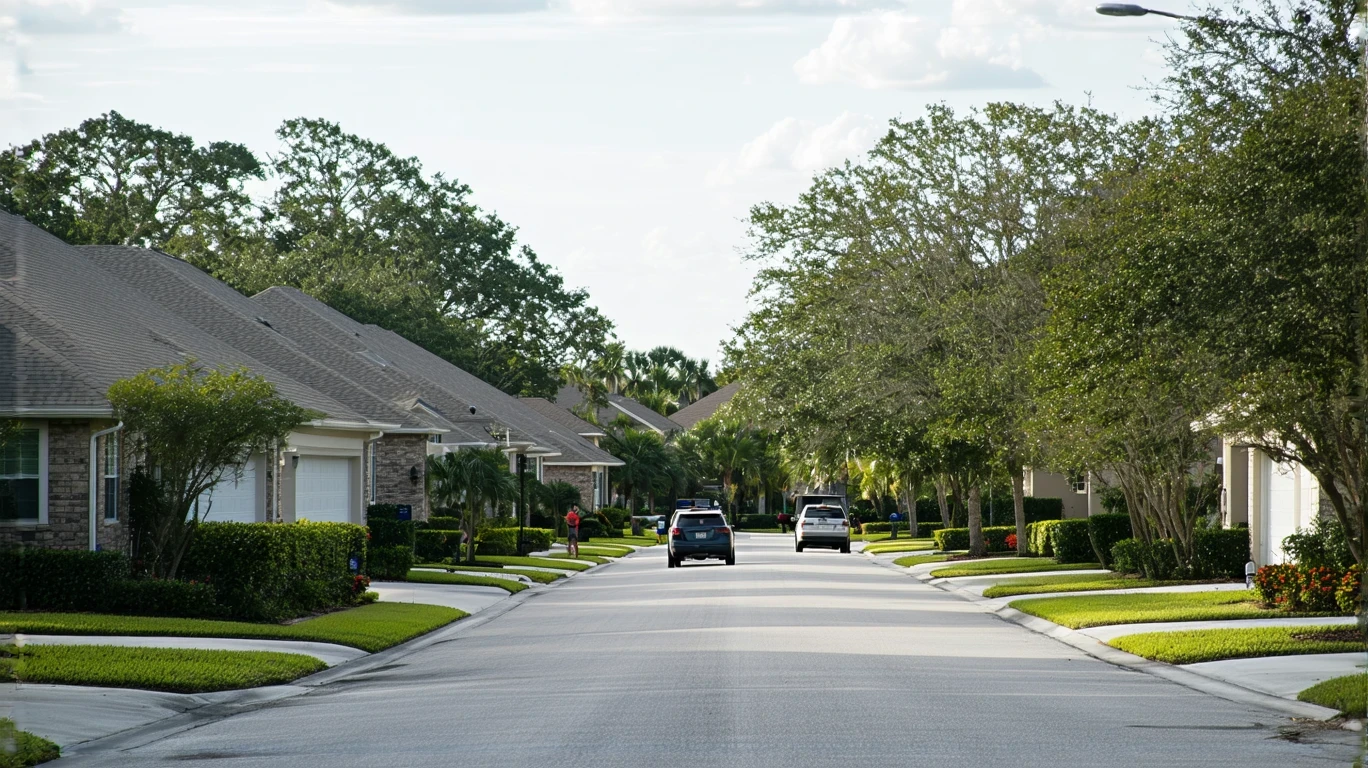
The dominant pattern in Lutz is straightforward: people drive. That’s true for work commutes, grocery runs, school drop-offs, and weekend errands. The infrastructure reflects this — roads are wide, parking is abundant, and the distance between home and daily destinations typically exceeds what most people are willing to walk, especially in Florida’s heat and humidity.
Bus service does exist, which means transit isn’t entirely absent. But the coverage is limited, and the routes serve specific corridors rather than blanketing the area. For someone living near a bus line and working along that same route, it’s possible to make transit part of the routine. For everyone else, the car is the default, and that default is reinforced every time you need to pick up a prescription, meet a friend, or get to an appointment that’s three miles away with no sidewalk in between.
What newcomers often misunderstand is that Lutz isn’t a place where you can easily “try out” a car-free lifestyle and see how it goes. The layout doesn’t support that experiment. Errands are spread out, food and grocery options are sparse relative to the area’s footprint, and even short trips require planning around heat, distance, and the absence of pedestrian-friendly infrastructure. If you’re moving here without a car, you’re not choosing simplicity — you’re choosing friction.
Public Transit Availability in Lutz
Public transit in Lutz often centers around systems such as Hillsborough Area Regional Transit (HART), which provides bus service connecting parts of the Tampa metro area. The presence of bus stops means that transit infrastructure exists, but the practical question is where it goes and how well it aligns with your daily routine.
Transit tends to work best when your home and your primary destination both sit along an established route, and when your schedule allows for the flexibility that fixed-route service requires. If you’re commuting into Tampa’s core for work, and you live near a stop, the bus can be a viable option. If your job is in a suburban office park, or if you need to make multiple stops in a day, transit quickly becomes impractical.
Where transit falls short in Lutz is coverage. The area is large, development is dispersed, and many neighborhoods sit outside the reach of regular service. Late hours, weekend frequency, and connections between non-central destinations are all gaps that car ownership fills by default. That’s not a critique of the transit system itself — it’s a reflection of the geographic and demographic realities that shape service planning in a low-density, sprawling suburb.
Driving & Car Dependence Reality
Driving in Lutz isn’t just common — it’s structurally necessary for most households. The layout of the community, the distance between home and work, and the way daily errands are distributed all assume car access. Parking is rarely a problem, which removes one of the friction points that makes driving stressful in denser cities. But that ease comes with a tradeoff: you’re absorbing the cost, maintenance, and time that car ownership requires, and there’s no practical way to opt out.
For families, car dependence often means multiple vehicles. One adult’s commute doesn’t prevent another from running errands, getting kids to school, or handling an unexpected appointment. That redundancy provides flexibility, but it also doubles the exposure to fuel prices, insurance, registration, and upkeep. At $2.90 per gallon, gas prices in Lutz are moderate but not negligible, and the miles add up quickly when every destination requires a drive.
Sprawl isn’t just a planning term here — it’s a daily experience. The distance between home and the grocery store, between work and daycare, between your neighborhood and the places you actually spend time, all translate into time behind the wheel. That’s time you’re not walking, not on a train, and not multitasking. It’s a cost that doesn’t show up on a spreadsheet, but it shapes how your day unfolds and how much energy you have left at the end of it.
Commuting Patterns & Daily Mobility
Commuting in Lutz typically means driving to Tampa or another nearby employment center, though remote work has shifted the pattern for some households. The structure of the commute matters more than the distance in many cases — if your route is straightforward and traffic is predictable, a 30-minute drive feels manageable. If you’re navigating congestion, construction, or multi-stop days, that same distance becomes a source of daily stress.
People who benefit most from Lutz’s location are those whose work is either remote or situated along a direct route with minimal bottlenecks. Flexibility in start times also helps, since peak-hour congestion can add significant unpredictability. For households where both adults work outside the home, coordinating schedules and vehicle access becomes part of the daily logistics, especially if school or childcare drop-offs are involved.
Single-job commutes are simpler to manage than multi-stop routines. If your day involves picking up kids, stopping for groceries, and making it to an evening obligation, the car provides the control and flexibility that transit can’t match. That’s not about preference — it’s about the way daily life is structured in a place where destinations are dispersed and public transit coverage is limited.
Who Transit Works For — and Who It Doesn’t
Transit in Lutz works for a narrow slice of households: those who live near a bus line, work along that same corridor, and have schedules that align with fixed-route service. If you’re a single commuter heading into Tampa’s core for a 9-to-5 job, and you’re comfortable with the time and exposure that bus travel requires, it’s possible to make it work.
For families, transit becomes far less practical. Coordinating multiple schedules, managing school drop-offs, running errands, and handling the unpredictability of daily life all require the flexibility that only a car provides. Renters in neighborhoods closer to bus routes have slightly better access than those in more peripheral areas, but even then, the coverage gaps mean that most errands still require driving.
Retirees and older adults face a different calculus. If driving becomes difficult or undesirable, the lack of robust transit options creates real isolation risk. Ride-hailing services can fill some of the gap, but they’re not a substitute for the independence and routine that reliable public transit provides. In Lutz, aging in place without a car is difficult, and that’s a reality worth confronting before it becomes urgent.
Transportation Tradeoffs in Lutz
The tradeoff between transit and driving in Lutz isn’t really a choice for most people — it’s a structural given. Driving offers control, flexibility, and the ability to manage a dispersed set of daily obligations. Transit offers lower exposure to fuel prices and vehicle costs, but only if your life fits within the narrow corridors where service is available and practical.
Predictability favors the car. You know when you’ll leave, when you’ll arrive, and what route you’ll take. You’re not waiting for a bus that may be delayed, and you’re not limited to destinations along a fixed line. That predictability has value, especially for households managing tight schedules or multiple dependents.
The cost tradeoff is harder to quantify without running the numbers, but the exposure is clear: car ownership means you’re absorbing fuel, insurance, maintenance, and depreciation. Transit means you’re absorbing time, schedule constraints, and the friction of limited coverage. For most households in Lutz, the calculus tips toward driving, not because transit is inherently inferior, but because the infrastructure and layout make it impractical for the majority of daily routines.
FAQs About Transportation in Lutz (2026)
Is public transit usable for daily commuting in Lutz?
It depends entirely on where you live and where you work. If both are along an established bus route, transit can be part of your routine. For most residents, though, the limited coverage and fixed schedules make driving the more practical option.
Do most people in Lutz rely on a car?
Yes. The layout, density, and infrastructure all assume car access. Public transit exists, but it plays a supplemental role rather than serving as the primary mobility option for most households.
Which areas of Lutz are easiest to live in without a car?
Areas near bus corridors offer the best chance of reducing car dependence, but even there, most daily errands will still require driving or significant time investment. True car-free living in Lutz is difficult for nearly all household types.
How does commuting in Lutz compare to nearby cities?
Lutz sits in a suburban context where car dependence is the norm. Compared to Tampa’s core, transit options are more limited. Compared to other suburbs in the metro area, the pattern is similar: driving dominates, and transit serves specific corridors rather than providing broad coverage.
Does Lutz have bike infrastructure?
Some pockets of bike infrastructure exist, but it’s not widespread or connected enough to serve as a primary transportation option. Biking may work for recreational purposes or very short trips, but it’s not a substitute for a car in most daily routines.
How Transportation Fits Into the Cost of Living in Lutz
Transportation in Lutz isn’t just a line item — it’s a structural factor that shapes where you can live, how you spend your time, and what kind of flexibility you have in daily life. A Month of Expenses in Lutz: What It Feels Like explores how mobility costs interact with housing, utilities, and other budget pressures, but the broader point is that car dependence creates exposure that extends beyond fuel and insurance.
Choosing housing closer to work reduces commute time and fuel consumption, but it may also mean higher rent or fewer housing options. Choosing affordability farther out means longer drives and more time behind the wheel. That tradeoff plays out differently depending on whether you’re a single commuter, a family managing multiple schedules, or a retiree trying to maintain independence without driving.
The reality is that most people in Lutz drive because the alternative isn’t practical, not because they’ve run the numbers and decided driving is cheaper. The infrastructure, the layout, and the distances involved all point in the same direction. If you’re moving here, plan for car ownership. If you’re trying to reduce transportation costs, focus on housing location, commute efficiency, and vehicle choice — but understand that eliminating the car entirely isn’t a realistic option for the vast majority of households.
How this article was built: In addition to public economic data, this article incorporates location-based experiential signals derived from anonymized geographic patterns—such as access density, walkability, and land-use mix—to reflect how day-to-day living actually feels in Lutz, FL.
—