
“I love the space and the quiet, but you definitely need to plan your day around driving—nothing’s really walkable here.”
That tension—between suburban comfort and logistical friction—captures much of what people feel about living in Lutz. This unincorporated community north of Tampa offers the appeal of lower-density living, larger lots, and a slower pace, but it asks residents to accept a car-dependent rhythm and the planning burden that comes with it. For families and remote workers seeking affordability and elbow room near a major metro, Lutz tends to feel like a smart tradeoff. For those who crave spontaneous errands, walkable neighborhoods, or a vibrant dining scene, it often feels limiting.
What Defines the Lutz Vibe
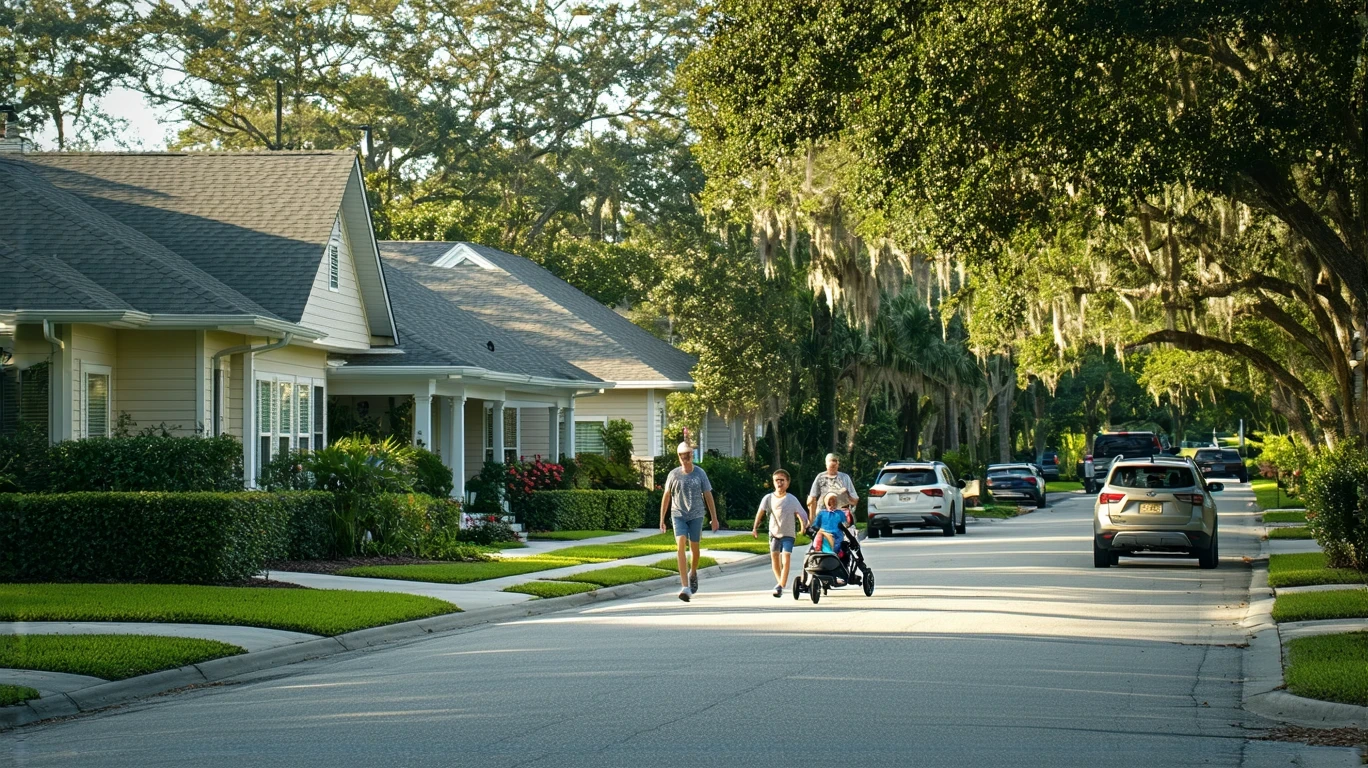
Lutz sits in that suburban middle ground: not quite rural, not quite urban, and still figuring out its identity as growth reshapes the landscape. The community attracts people who want proximity to Tampa’s job market and amenities without the density, traffic, or cost of living closer in. What you get is space—both physical and emotional. Homes tend to have yards, streets are quieter, and the pace feels less hurried than in the city core.
But that spaciousness comes with a structural tradeoff. Lutz is built around the car. Pedestrian infrastructure is minimal, and the street network prioritizes driving over walking or biking. Food and grocery options are present but spread out, and running a quick errand almost always means getting in the car, navigating a parking lot, and building your day around multiple stops. For households that value control over their schedule and don’t mind the logistics, this feels manageable. For those who want to walk to a coffee shop or grab dinner on a whim, it feels like friction.
The community’s emotional tone reflects this duality. People who feel at home here tend to describe Lutz as peaceful, family-friendly, and practical. People who feel restless describe it as isolated, car-dependent, and lacking in texture. Both are true, depending on what you’re optimizing for.
How People Talk About Lutz Online
Public discussion about Lutz—on neighborhood Facebook groups, local Reddit threads, and community forums—tends to circle around a few recurring themes: the tension between growth and preservation, the logistics of daily life, and the question of what kind of place Lutz is becoming.
You’ll see pride in the community’s relative affordability compared to South Tampa or downtown, and appreciation for the fact that you can still find single-family homes with yards at prices that don’t require dual six-figure incomes. There’s also a strong undercurrent of protectiveness—longtime residents expressing concern that new development will erase the quiet, low-key character that drew them here in the first place.
At the same time, there’s frustration about the lack of walkable infrastructure and the feeling that everything requires a car. One commonly expressed sentiment: “It’s great if you’re a homebody, but if you want to do anything, you’re driving 20 minutes minimum.” Another: “I wish we had more local spots—places you could just walk to and hang out without it being a whole production.”
The tone isn’t angry, but it’s not entirely satisfied either. It’s the voice of people who chose Lutz for specific reasons—space, cost, proximity—and are now negotiating the tradeoffs that come with that choice.
What Local Coverage Tends to Emphasize
Local news and community coverage in and around Lutz often frame the area through the lens of change and growth. Headlines and story angles tend to focus on:
- “New Retail and Dining Options Arrive as Lutz Expands”
- “Residents Weigh Suburban Quiet Against Calls for More Walkable Amenities”
- “Community Debates What Growth Should Look Like”
- “Healthcare Access Strong, but Families Note Gaps in School and Playground Density”
- “Commuters Find Value in Lutz’s Proximity to Tampa Job Market”
The framing is rarely celebratory or critical—it’s observational, reflecting a community in transition. The underlying question in much of the coverage is: What kind of place is Lutz becoming, and who gets to decide? That ambiguity shows up in how people talk about the area, too. There’s no single narrative, just a collection of perspectives shaped by what people need from where they live.
Review-Based Public Perception
On platforms like Google Reviews, Yelp, and Nextdoor-style forums, Lutz earns a mix of praise and measured critique. The praise tends to come from families, retirees, and remote workers who value the slower pace, the access to healthcare (a hospital is present, along with pharmacies), and the ability to find housing that fits their budget. One recurring theme: “It’s a great place to raise kids if you don’t mind driving everywhere.”
The critique is rarely harsh, but it’s consistent. People mention the lack of walkable dining and entertainment options, the need to drive for nearly every errand, and the sense that Lutz doesn’t have a clear “center” or gathering place. Newer planned areas tend to get slightly higher marks for amenities and upkeep, while older pockets are described as quieter but more disconnected.
Expectation matching plays a big role in how people experience Lutz. Those who moved here expecting suburban comfort and affordable space tend to feel satisfied. Those who expected more spontaneity, variety, or urban texture tend to feel disappointed. The place itself hasn’t changed—the fit just depends on what you were hoping for.
How Lutz Compares to Nearby Communities
| Dimension | Lutz | Tampa | Wesley Chapel |
|---|---|---|---|
| Overall Vibe | Suburban, car-dependent, family-oriented | Urban, walkable pockets, diverse nightlife | Planned, newer, family-focused with more retail |
| Walkability | Minimal; errands require driving | Varies by neighborhood; downtown walkable | Limited; similar car dependency |
| Dining & Entertainment | Sparse; chain-heavy, limited variety | Abundant; independent restaurants, nightlife | Growing; newer retail centers, family dining |
| Pace of Life | Slower, quieter, less dense | Faster, more activity, higher density | Moderate; newer infrastructure, planned feel |
| Commute Tradeoff | Drive to Tampa for work/culture | Live where you work/play | Drive to Tampa, but newer roads |
The comparison isn’t about declaring a winner—it’s about understanding what you’re trading. If you want urban texture, walkability, and spontaneous access to dining and culture, Tampa offers that at a higher cost and density. If you want newer infrastructure, planned amenities, and a slightly more polished suburban feel, Wesley Chapel might be a better match. Lutz sits in between: less expensive and less dense than Tampa, but also less developed and less walkable than Wesley Chapel. It works best for people who prioritize space and cost over convenience and variety.
What Locals Are Saying
Young family, moved from Tampa: “We got so much more house for our money here, and the kids have a yard. But yeah, we’re in the car constantly. School runs, groceries, everything. It’s just part of the deal.”
Remote worker, renting: “Lutz is perfect for me right now. I work from home, so I’m not commuting, and the rent is way more reasonable than anything closer to downtown. I do miss being able to walk to a coffee shop, though.”
Retiree, longtime resident: “It used to feel more like a small town. Now there’s more traffic, more development. I’m glad there’s a hospital nearby, but I hope we don’t lose the quiet that made this place special.”
Young professional, considering a move: “I looked at Lutz because the prices are good, but I realized I’d be driving to Tampa for work, for friends, for anything fun. That got old fast just thinking about it.”
Parent of school-age kids: “We love the space and the safety, but I was surprised how spread out the schools and playgrounds are. It’s not like there’s a park on every corner.”
Commuter, works in Tampa: “The drive isn’t terrible, and I save enough on [housing costs](/lutz-fl/housing-costs/) that it’s worth it. But if I didn’t have to commute, I’d probably pick somewhere with more going on locally.”
Newcomer from out of state: “Lutz feels like a lot of Florida suburbs—quiet, spread out, not much to do unless you drive. It’s fine, but it’s not exciting.”
Does Lutz Feel Like a Good Fit?
Lutz doesn’t try to be everything. It offers suburban space, relative affordability, and proximity to Tampa’s job market and amenities. It has a hospital, bus service, and a low-rise, low-density layout that appeals to families, retirees, and remote workers who want room to breathe. But it also asks residents to accept a car-dependent rhythm, sparse walkable amenities, and the logistical planning that comes with spread-out infrastructure.
This tends to work for households that prioritize cost control, yard space, and a slower pace—and who don’t mind building their day around driving. It tends to frustrate those who want spontaneous errands, walkable neighborhoods, or a vibrant local dining and nightlife scene. The place itself is stable and functional. The question is whether its tradeoffs align with how you want to live day to day.
If you’re weighing Lutz against other options, consider exploring [what drives monthly expenses](/lutz-fl/monthly-budget/) and [what lifestyle factors matter most](/lutz-fl/lifestyle-requirements/) to see whether the financial and logistical tradeoffs make sense for your household.
How this article was built: In addition to public economic data, this article incorporates location-based experiential signals derived from anonymized geographic patterns—such as access density, walkability, and land-use mix—to reflect how day-to-day living actually feels in Lutz, FL.
The perspectives shown reflect commonly expressed local sentiment and recurring themes in public discussion, rather than individual accounts.