
“I keep my car because I have to,” says Maria, who’s been commuting from her Clearwater apartment to a job in Tampa for three years. “The bus works if you’re going somewhere specific at the right time. But if your schedule changes, or you need to make two stops, you’re stuck.”
That tension—between the transit that exists and the flexibility most people need—defines how residents actually move through Clearwater in 2026. This article explains what transportation options are available, who benefits from public transit, and how car dependence shapes daily life and decision-making for households across the city.
How People Get Around Clearwater
Clearwater operates primarily as a car-dependent city, but with notable pockets where walking, cycling, and bus transit play meaningful roles. The city’s layout—a mix of denser corridors and lower-density residential neighborhoods spreading inland from the Gulf—creates uneven mobility options. Some areas support daily errands on foot or by bike; others require a vehicle for nearly every trip.
Pedestrian infrastructure is stronger than many assume, particularly in parts of the city where the ratio of sidewalks and crossings to road mileage exceeds typical suburban thresholds. These walkable pockets tend to cluster near mixed-use corridors where grocery stores, pharmacies, and services sit within a manageable distance. But walkability here is localized, not citywide. Step outside these zones, and car dependency returns quickly.
Cycling infrastructure exists but remains limited to specific areas. Residents who bike regularly tend to live along routes with dedicated lanes or lower-traffic streets. For most households, bikes serve recreational purposes rather than transportation.
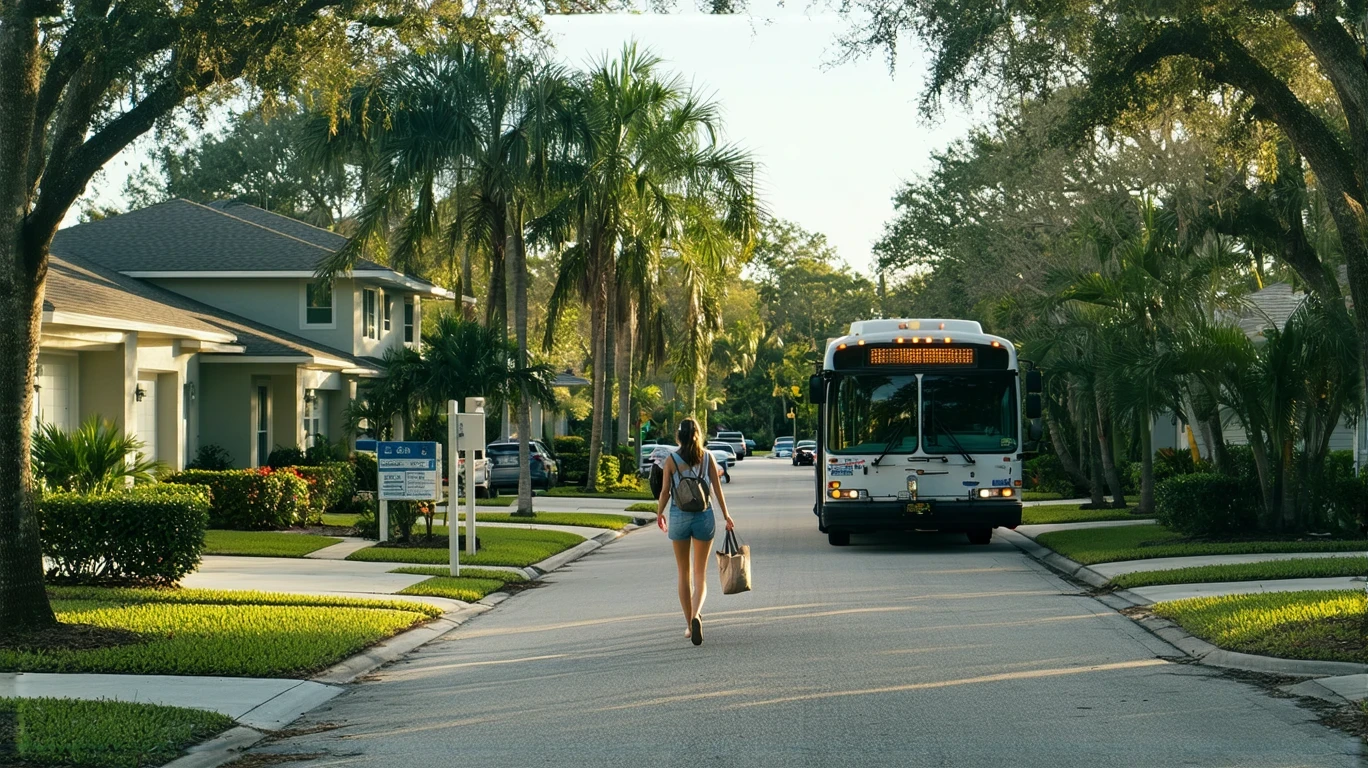
Public transit is present in the form of bus service, but it functions as a supplemental system rather than a backbone. Coverage focuses on key routes connecting residential areas to commercial corridors and regional destinations. For riders whose origins, destinations, and schedules align with those routes, the bus works. For everyone else, it’s a backup option at best.
What newcomers often misunderstand is that Clearwater’s transportation reality isn’t binary. It’s not “walkable vs car-dependent” across the board—it’s layered. Where you live, where you work, and how predictable your schedule is determine whether you can reduce car reliance or whether you’ll drive for everything.
Public Transit Availability in Clearwater
Public transit in Clearwater centers around bus service provided by the Pinellas Suncoast Transit Authority (PSTA), which operates routes throughout Pinellas County. The system connects Clearwater to neighboring cities including St. Petersburg, Largo, and Tampa, and serves local corridors within the city itself.
Transit works best for residents living along established routes with access to frequent stops. Corridors with higher commercial density—where errands, employment, and services cluster—tend to see more consistent service. Riders who commute to fixed locations at regular times, particularly along north-south or east-west spines, can build routines around the bus.
Where transit falls short is in coverage breadth and schedule flexibility. Suburban neighborhoods, particularly those farther from the city’s core, see limited or no service. Late-night and weekend frequencies drop, making the system less practical for shift workers or households with variable schedules. Multi-stop errands—picking up groceries, stopping at a pharmacy, and dropping off dry cleaning—become logistically difficult without a car.
There is no rail service in Clearwater. All public transit relies on buses, which means travel times are subject to traffic conditions and route structure. For trips that require transfers or involve destinations outside the main corridors, transit becomes time-intensive.
The system is not designed to replace car ownership for most residents. It functions as an option for specific trips and specific riders, not as a comprehensive mobility solution.
Driving & Car Dependence Reality
For the majority of Clearwater residents, driving is not optional—it’s structural. The city’s geography, development pattern, and job market all reinforce car dependency. Employment centers are dispersed. Retail and services, while accessible in some corridors, are spread across a region that requires a vehicle to navigate efficiently.
Parking is generally abundant and free or low-cost in most areas, which removes one of the friction points that might otherwise encourage transit use. Commute flexibility—the ability to leave at different times, make unplanned stops, or adjust routes—favors driving heavily. For families managing school drop-offs, daycare pickups, and activity schedules, a car isn’t just convenient; it’s the only realistic option.
Sprawl plays a role. Clearwater’s residential areas extend across a wide footprint, and many neighborhoods were built with the assumption that every household would own at least one vehicle. Sidewalks may exist, but distances between home, work, and errands often exceed what’s practical on foot.
Car dependence also means exposure to maintenance, insurance, and fuel costs, even if those expenses aren’t always top of mind when choosing where to live. Households that assume they can reduce transportation costs by relying on transit often find that Clearwater’s system doesn’t support that tradeoff unless they live in very specific areas.
Commuting Patterns & Daily Mobility
Commuting in Clearwater varies widely depending on where residents work. Some commute within the city to local employers in healthcare, hospitality, or retail. Others travel to Tampa, St. Petersburg, or other parts of Pinellas County, where job concentrations are higher.
Single-destination commutes—home to work and back—are the most common pattern and the easiest to structure, whether by car or bus. Multi-stop commutes, which involve dropping off children, running errands, or managing caregiving responsibilities, almost always require a vehicle. Flexibility becomes the deciding factor: households with unpredictable hours or responsibilities that shift day-to-day find transit impractical.
Proximity matters more than mode. Residents who live near their workplace, regardless of whether they drive or take the bus, experience less friction and more control over their time. Those who face longer commutes absorb that cost in time, fuel, and mental load, and transit rarely offsets it unless the route is direct and frequent.
Remote work has changed the equation for some households, reducing commute frequency and making location decisions less tied to transportation access. But for those who must be on-site daily, where money goes and how time is spent remain tightly linked to how they get there.
Who Transit Works For — and Who It Doesn’t
Public transit in Clearwater works for a specific subset of residents: those who live along bus routes, work at destinations served by those routes, and maintain schedules that align with service hours. This often includes renters in denser corridors, students, and some retirees who no longer commute daily but need occasional access to services and appointments.
It works less well—or not at all—for families with children, shift workers, and residents in suburban neighborhoods. Families face logistical complexity that transit can’t accommodate: multiple stops, time-sensitive pickups, and the need to carry groceries or gear. Shift workers, particularly those with early-morning or late-night hours, find that service outside peak times is sparse or nonexistent.
Homeowners in lower-density areas are almost universally car-dependent. The distance between home and transit stops, combined with infrequent service, makes the bus a non-starter for daily life. Even in walkable pockets, most households still own a car for trips that fall outside the pedestrian range.
Retirees represent a middle case. Those in areas with strong pedestrian infrastructure and nearby grocery access may drive less frequently, but they rarely eliminate car ownership entirely. Medical appointments, social visits, and errands beyond the immediate neighborhood still require a vehicle.
The dividing line isn’t income or preference—it’s geography and schedule predictability. Transit works when your life fits the system. When it doesn’t, you drive.
Transportation Tradeoffs in Clearwater
Choosing between transit and driving in Clearwater isn’t a question of cost savings—it’s a question of control, predictability, and time. Driving offers flexibility: you leave when you want, stop where you need to, and adjust on the fly. Transit offers lower direct expense but requires schedule alignment, route availability, and tolerance for longer travel times.
For households that can make transit work, the tradeoff is favorable when commutes are predictable and destinations are well-served. But the system’s limited coverage means that even transit-friendly residents often need a car for some trips, which reduces the financial benefit of going car-free.
Driving, meanwhile, provides independence but comes with fixed costs—insurance, registration, maintenance—that persist whether you drive daily or occasionally. Fuel expenses fluctuate with usage and market conditions, but the baseline cost of car ownership is unavoidable.
Proximity reduces the stakes of this tradeoff. Residents who live close to work, services, and social connections face less pressure to optimize transportation mode. Those farther out absorb more friction regardless of whether they drive or attempt to use transit.
The real tradeoff in Clearwater isn’t between two equal options—it’s between the flexibility of driving and the narrow practicality of transit. Most households choose driving because the alternative doesn’t support the life they’re trying to live.
FAQs About Transportation in Clearwater (2026)
Is public transit usable for daily commuting in Clearwater?
It depends entirely on where you live and work. If both your home and workplace are along established bus routes with frequent service, and your schedule is consistent, transit can work. For most residents, particularly those in suburban areas or with variable hours, driving remains far more practical.
Do most people in Clearwater rely on a car?
Yes. The vast majority of Clearwater residents depend on a personal vehicle for daily transportation. Public transit serves a supplemental role, and even in areas with better walkability or bus access, car ownership is the norm.
Which areas of Clearwater are easiest to live in without a car?
Areas with higher pedestrian infrastructure density and proximity to bus routes—typically closer to commercial corridors and mixed-use zones—offer the most realistic car-free or car-light options. Even in these areas, most residents still own a vehicle for trips that fall outside walking or transit range.
How does commuting in Clearwater compare to nearby cities?
Clearwater shares similar car-dependent patterns with much of Pinellas County. St. Petersburg has denser corridors and slightly more transit-friendly neighborhoods, while Tampa offers broader employment access but longer average commutes. Across the region, driving dominates, and transit works only for specific routes and riders.
Can you bike for transportation in Clearwater?
Cycling infrastructure exists in pockets, and some residents use bikes for local errands or recreation. But the city’s layout, traffic patterns, and distances make biking impractical as a primary transportation mode for most households. It’s an option in specific areas, not a citywide solution.
How Transportation Fits Into the Cost of Living in Clearwater
Transportation isn’t just a line item—it’s a structural factor that shapes where people live, how they spend their time, and what tradeoffs they face daily. In Clearwater, the reality of car dependence means that most households must budget for vehicle ownership, even if they’d prefer not to. That includes insurance, maintenance, and fuel, all of which persist regardless of how much or how little you drive.
For renters weighing neighborhoods, proximity to work and services reduces both time and transportation exposure. Living farther out may lower rent, but it often increases driving frequency and the friction of getting around. Homeowners face the same calculus, with the added complexity of long-term location lock-in.
Transit availability, while present, doesn’t fundamentally change the equation for most households. It works as a supplement, not a replacement, and only for those whose lives align with the system’s structure. The result is that transportation in Clearwater functions less as a choice and more as a given: you’ll almost certainly need a car, and your costs will reflect that.
Understanding how mobility works here—what’s realistic, what’s not, and who benefits from the limited alternatives—helps newcomers and long-time residents alike make decisions that fit their actual lives, not the transportation system they wish existed.
How this article was built: In addition to public economic data, this article incorporates location-based experiential signals derived from anonymized geographic patterns—such as access density, walkability, and land-use mix—to reflect how day-to-day living actually feels in Clearwater, FL.
—