
Households relying on public transit in car-dependent communities can save thousands annually compared to multi-car ownership — but only if transit actually reaches where they need to go. In Apopka, that’s the central question: not whether buses exist, but whether the system connects your home, your job, and your daily errands without adding hours to your week.
Apopka sits northwest of Orlando, shaped by decades of suburban growth that prioritized single-family neighborhoods, wide arterials, and commercial corridors built around parking lots. That layout determines how people move through the city every day — and for most residents, the answer is behind the wheel.
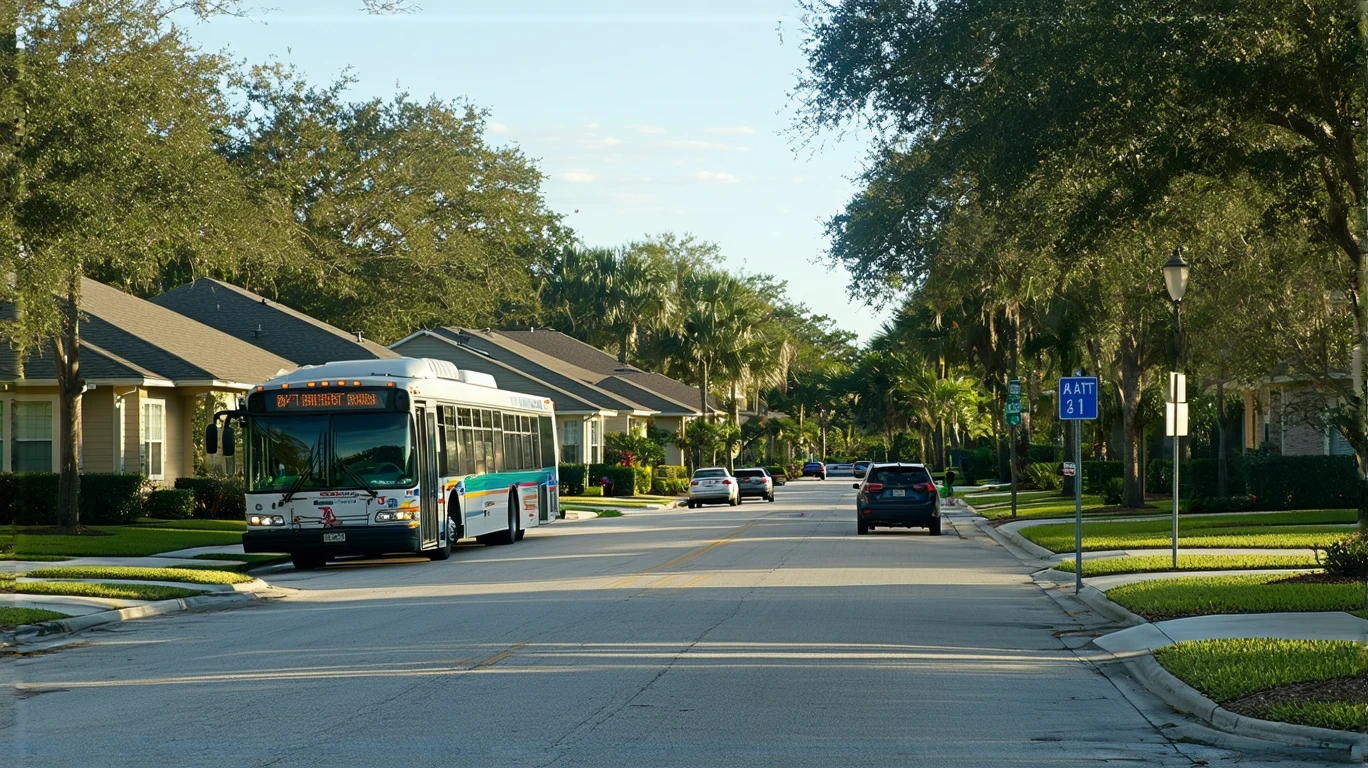
How People Get Around Apopka
Transportation options in Apopka reflect its role as a commuter suburb with a car-first infrastructure. The street grid, land-use patterns, and distance between residential areas and employment centers all reinforce driving as the default mode. Sidewalks exist in some neighborhoods but rarely connect to commercial districts or transit stops in a continuous, walkable network. Bike lanes are sparse, and the summer heat and afternoon storms make year-round cycling impractical for most households.
Newcomers often assume that proximity to Orlando means access to the region’s transit network. In practice, Apopka’s distance from the urban core and its low-density layout mean that transit plays a limited role in daily mobility. Most residents structure their lives around at least one personal vehicle, and many households operate two or more cars to manage work commutes, school drop-offs, grocery runs, and errands that can’t be chained together on foot or by bus.
The city’s development pattern — shopping plazas set back from the road, residential subdivisions without through-streets, and employment scattered across multiple corridors — makes point-to-point car trips faster and more predictable than any alternative. That’s not a reflection of preference; it’s a structural reality shaped by zoning, infrastructure investment, and decades of growth that assumed universal car ownership.
Public Transit Availability in Apopka
Public transit in Apopka often centers around systems such as LYNX, the regional bus service covering parts of the Orlando metro area. Coverage exists along certain corridors, particularly routes connecting Apopka to employment centers in Orlando and surrounding communities. However, service is limited in frequency, geographic reach, and evening or weekend availability.
Transit tends to work best for riders living near major arterials with direct routes to stable job locations. It falls short in neighborhoods set back from main roads, areas requiring transfers, and trips that don’t align with peak commuting hours. Late shifts, weekend errands, and multi-stop trips — picking up a child, stopping for groceries, running to the pharmacy — become logistically difficult without a car.
The gaps aren’t just about coverage. They’re about predictability and control. A missed connection can mean an hour’s delay. A route that doesn’t run past 7 p.m. limits work flexibility. A system designed around downtown Orlando doesn’t necessarily serve the retail, healthcare, or service jobs scattered across Apopka’s commercial strips.
For households able to structure their lives around fixed routes and schedules, transit can reduce transportation costs significantly. But that requires aligning housing, employment, and daily logistics in ways that many families — especially those with children, irregular hours, or multiple earners — find difficult to sustain.
Driving & Car Dependence Reality
Driving isn’t optional for most Apopka residents; it’s the baseline assumption embedded in how the city functions. Jobs, schools, medical offices, and grocery stores are spread across a geography that doesn’t support walking or waiting for a bus. Parking is abundant and free in most places, reinforcing the convenience of car travel.
Car dependence shapes household costs in ways that go beyond fuel. It means insurance, registration, maintenance, and the need to replace vehicles on a predictable cycle. For families, it often means operating multiple cars to avoid bottlenecks — one adult can’t drop off kids and make it to work on time if the household shares a single vehicle and jobs are in opposite directions.
The tradeoff is flexibility. A car allows you to live farther from work if housing is more affordable. It lets you change jobs without changing neighborhoods. It gives you control over timing, routing, and the ability to handle emergencies or last-minute errands without depending on a system that may not run when you need it.
But that flexibility comes with exposure. Gas prices fluctuate. Repairs arrive without warning. A breakdown can derail a week’s logistics. And the assumption that everyone drives means that households without reliable transportation face isolation, not just inconvenience.
Commuting Patterns & Daily Mobility
Commuting in Apopka typically means driving to Orlando or nearby employment hubs, though some residents work locally in retail, healthcare, or service industries. The commute structure varies widely: some households have one earner with a fixed office location, while others juggle multiple jobs, shift work, or roles that require travel throughout the day.
For single-destination commuters, the drive can be predictable and manageable, especially outside peak congestion windows. For households with complex logistics — school schedules, daycare pickups, errands that must happen during lunch breaks — the lack of transit alternatives means every trip requires a car, and every delay cascades.
Proximity to work becomes a major factor in housing decisions. Living closer to Orlando reduces drive time but often increases rent. Staying in Apopka keeps housing costs lower but adds miles and time to the daily routine. There’s no universal right answer; the tradeoff depends on income, schedule flexibility, and whether saving an hour a day is worth paying more in rent.
Daily mobility also includes non-work trips: getting kids to school, running to the pharmacy, meeting friends, attending appointments. In a transit-rich environment, some of those trips could happen on foot or by bus. In Apopka, they almost always require a car, which means transportation isn’t just a commute cost — it’s woven into every part of household logistics.
Who Transit Works For — and Who It Doesn’t
Public transit in Apopka works best for individuals with stable schedules, jobs along direct bus routes, and the ability to structure their lives around fixed departure times. That might include single adults working in Orlando’s core, students commuting to community college, or service workers whose shifts align with bus availability.
It works less well for families with children, especially those managing school drop-offs, after-school activities, and daycare schedules that don’t align with bus routes. It’s difficult for shift workers whose hours extend past evening service. And it’s nearly impossible for households that need to make multiple stops in a single trip — grocery store, pharmacy, bank — across locations that aren’t on the same line.
Renters in neighborhoods near major corridors have better access than those in subdivisions set back from main roads. Homeowners, who tend to live in areas developed with the assumption of car ownership, rarely have transit as a practical option. And older adults or residents with mobility challenges face additional barriers if stops aren’t accessible, shelters aren’t maintained, or service doesn’t reach medical facilities.
The question isn’t whether someone could use transit in theory. It’s whether doing so allows them to get to work on time, pick up their kids, buy groceries, and manage the rest of life without spending hours waiting or walking in Florida heat. For most Apopka households, the answer is no.
Transportation Tradeoffs in Apopka
Choosing between transit and driving in Apopka isn’t about comparing fares to fuel costs. It’s about comparing control and flexibility against predictability and reduced exposure to car ownership costs.
Transit offers lower direct costs for households that can make it work. It removes the need to maintain a vehicle, pay for insurance, or absorb surprise repair bills. It can reduce financial volatility, especially for households living close to the margin where a transmission failure could mean missed rent.
But driving offers something transit can’t: the ability to live where housing is affordable, work where jobs are available, and manage a household’s complex daily demands without depending on a system that may not serve your neighborhood, your schedule, or your needs.
The tradeoff also includes time. A 20-minute drive might become a 90-minute bus trip with a transfer. That’s not just inconvenience — it’s hours per week that could be spent working, caring for family, or resting. For shift workers, parents, or anyone managing multiple responsibilities, that time cost can outweigh the financial savings.
In Apopka, the infrastructure makes driving the path of least resistance. That doesn’t mean it’s cheap or without risk. It means the alternative requires sacrifices — in where you live, where you work, and how you structure daily life — that many households can’t sustain.
FAQs About Transportation in Apopka (2026)
Is public transit usable for daily commuting in Apopka?
Public transit can support daily commuting for individuals with jobs along direct bus routes and schedules that align with service hours. For most households — especially those with children, irregular hours, or jobs outside main corridors — transit doesn’t provide the coverage, frequency, or flexibility needed to replace a car.
Do most people in Apopka rely on a car?
Yes. Apopka’s layout, density, and infrastructure are built around car ownership. Most residents depend on personal vehicles for commuting, errands, and daily logistics. Multi-car households are common, particularly among families managing school, work, and activity schedules across multiple locations.
Which areas of Apopka are easiest to live in without a car?
Neighborhoods near major arterials with direct bus service to Orlando offer the most realistic car-free or car-light options. Even in those areas, daily life without a vehicle requires careful planning, limited errands, and acceptance of longer travel times. Most of Apopka’s residential areas are not designed for car-free living.
How does commuting in Apopka compare to nearby cities?
Commuting in Apopka typically involves driving to Orlando or other nearby employment centers, with travel times and congestion depending on route and timing. Compared to denser parts of the metro area, Apopka offers less transit coverage but also less traffic congestion within the city itself. The tradeoff is distance: living in Apopka often means longer commutes in exchange for lower housing costs.
Can you get by with one car in Apopka?
Single-car households can function in Apopka if work schedules align, errands can be batched, and daily logistics don’t require simultaneous trips in different directions. For families with multiple earners, school-age children, or jobs with conflicting hours, operating one car often creates bottlenecks that are difficult to manage without backup transportation.
How Transportation Fits Into the Cost of Living in Apopka
Transportation isn’t just a line item in your monthly budget in Apopka — it’s a structural factor that shapes where you can live, where you can work, and how much control you have over daily logistics. In a city built around car ownership, mobility costs are embedded in nearly every decision: housing location, job choice, household size, and even social participation.
The absence of robust transit doesn’t make Apopka unlivable. It makes transportation a fixed cost that most households can’t avoid, reduce, or substitute. That reality shifts the financial calculus: instead of choosing between driving and transit, most residents are choosing between one car and two, between proximity and affordability, between time and money.
Understanding how people actually get around Apopka — and what that costs in time, flexibility, and exposure — helps clarify what “affordable” really means. A lower rent in a neighborhood without transit access may cost more in the long run if it requires a second car, longer commutes, or daily logistics that consume hours and energy.
Transportation shapes the cost of living not just through what you spend, but through what you give up to make the system work. In Apopka, that system assumes you drive. The question is whether your household can absorb that assumption — or whether it quietly determines everything else.
—